People ask me how engines work all the time. Almost nobody asks how brakes work — until something feels wrong. That’s backwards: your brakes are the most important safety system on your car, and understanding them takes five minutes.
I’ve replaced thousands of brake pads, rotors, calipers, and master cylinders over ten years in the shop. Here’s exactly what happens between your foot hitting the pedal and your car stopping, in plain English.
Table of Contents
- The One-Sentence Version
- The Pedal: Where It All Starts
- The Brake Booster: Your Foot’s Assistant
- The Master Cylinder: Pressure Factory
- Brake Lines: Hydraulic Highways
- Disc Brakes: Calipers, Pads, and Rotors
- Drum Brakes: The Older Design
- Brake Fluid: The Unsung Hero
- ABS: The Computer That Pumps for You
- What Worn Brakes Feel Like
- Basic Brake Maintenance
- Frequently Asked Questions
The One-Sentence Version
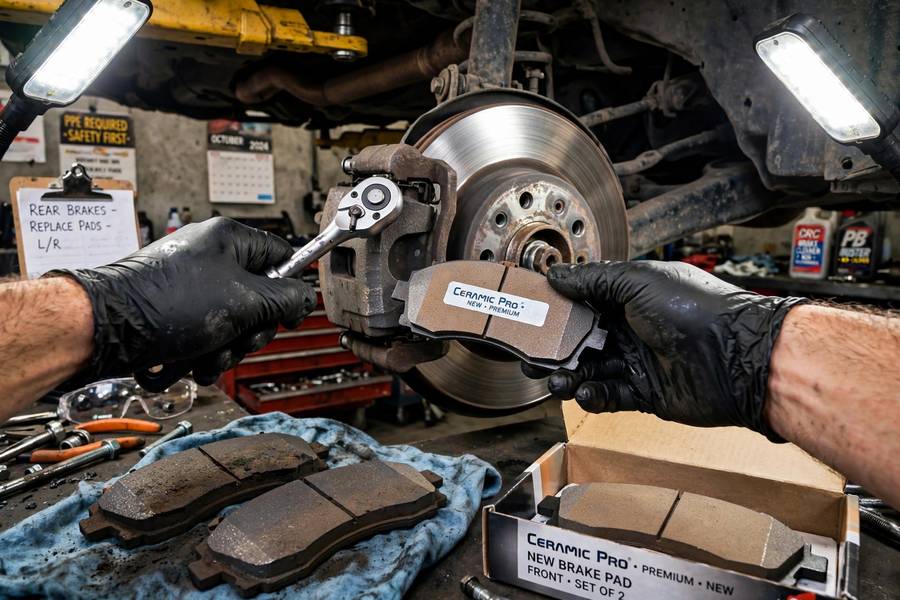
Your foot pushes a pedal, which multiplies your force, which pressurizes brake fluid, which squeezes brake pads against spinning rotors — and the friction between pad and rotor converts your car’s motion into heat, slowing you down.
That’s it. Brakes are friction machines. Everything else is detail. But the details are what make modern brakes so much better than the ones from thirty years ago, so let’s walk through them.
The Pedal: Where It All Starts
The brake pedal is a lever, and levers multiply force. The pedal ratio in most cars is about 4:1 to 6:1, meaning 50 pounds of foot pressure becomes 250–300 pounds of force at the other end. That’s why braking doesn’t feel like a leg workout.
Push the pedal and you’ll feel some free travel first — a small dead zone before resistance builds. That’s normal. If that dead zone suddenly gets much bigger, though, that’s a warning sign.
The Brake Booster: Your Foot’s Assistant
Between the pedal and the master cylinder sits the brake booster — usually a big black disc-shaped canister on the firewall. It uses engine vacuum (or an electric pump on EVs and some modern cars) to multiply your pedal force again, typically 2–4 times over.
This is why your brake pedal feels rock-hard when the engine is off: no vacuum, no boost. The booster is also why a vacuum leak can make your pedal feel weirdly hard while the engine idles rough — same vacuum, two symptoms.
The Master Cylinder: Pressure Factory
The master cylinder converts the booster’s push into hydraulic pressure. Inside is a piston in a fluid-filled bore. Push the piston, and it pressurizes the brake fluid — typically to 800–1,200 PSI during normal braking, and over 2,000 PSI in a panic stop.
Here’s the clever safety part: the master cylinder has two separate circuits, usually split diagonally. If one circuit fails completely, the other still brakes two wheels. You won’t stop well, but you’ll stop.
The fluid reservoir sits on top of the master cylinder — that translucent container under your hood with “MIN” and “MAX” lines. Low fluid means either your pads are worn (normal) or you have a leak (not normal — get it checked immediately).
Brake Lines: Hydraulic Highways
Brake fluid travels from the master cylinder to each wheel through steel lines and short flexible rubber hoses. The system works because liquids don’t compress — push fluid in at one end, and the same force arrives instantly at the other.
This is also the system’s Achilles’ heel. If air gets into the lines — from a leak, or from boiling old fluid — air does compress. The pedal goes spongy because your foot is now squeezing air bubbles instead of moving fluid. That’s why “bleeding the brakes” (flushing air out of the lines) instantly restores a firm pedal.
Those flexible rubber hoses at each wheel deserve respect. They flex every time the suspension moves, they live next to hot brakes, and they degrade with age. I replace cracked, swollen brake hoses on older cars constantly. A burst brake hose means sudden loss of that wheel’s braking — inspect them whenever the car is on a lift.
Disc Brakes: Calipers, Pads, and Rotors
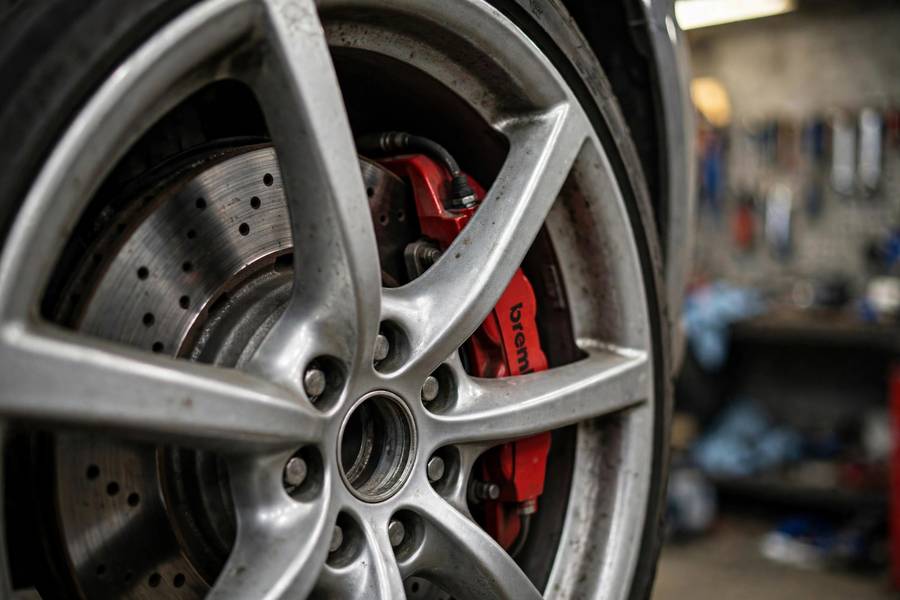
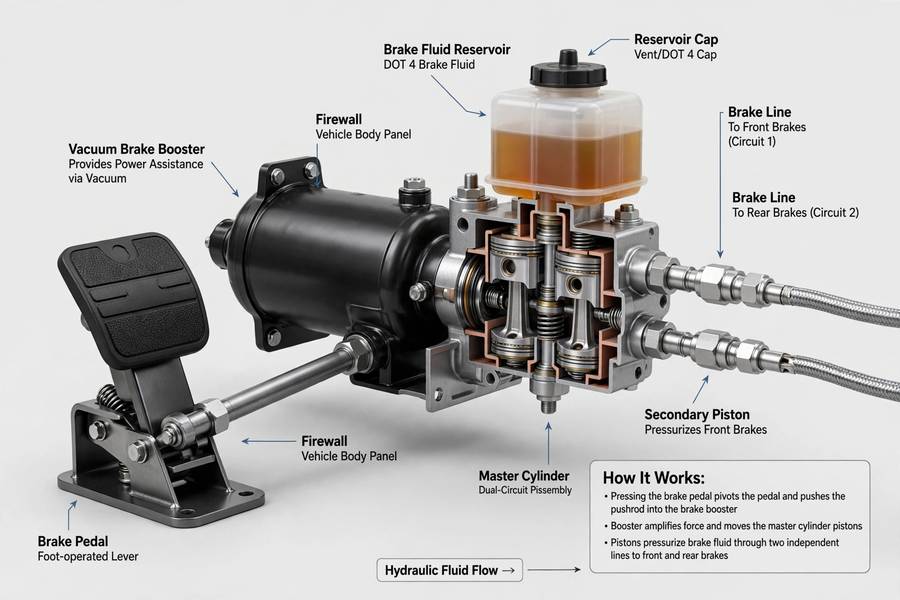
Most modern cars have disc brakes on at least the front wheels, usually all four. Here’s the anatomy:
- The rotor (or disc) is a heavy metal disc bolted to the wheel hub. It spins with the wheel. It’s also a heat sink — stopping a 3,500-pound car from 70 mph generates enormous heat, and the rotor absorbs and dissipates it. Vented rotors (with cooling vanes between two friction surfaces) handle heat far better, which is why they’re standard up front where most braking happens.
- The caliper is the clamp that straddles the rotor. Inside it are one or more pistons. Hydraulic pressure pushes these pistons out.
- The brake pads sit between the pistons and the rotor. When the pistons extend, they squeeze the pads against both sides of the spinning rotor. Friction does the rest.
Pad material matters. Organic pads are quiet and cheap but wear fast. Semi-metallic pads bite harder but dust more. Ceramic pads are the sweet spot for most drivers — quiet, low dust, long life. On a street car, I recommend ceramic every time.
Here’s what most people don’t realize: roughly 70% of braking happens at the front wheels. When you brake, weight transfers forward, pressing the front tires into the pavement. That’s why front brakes are always bigger than rears, and why front pads wear out first.
Drum Brakes: The Older Design
Some budget cars and trucks still use drum brakes on the rear wheels. Instead of a disc, a drum rotates with the wheel while curved brake shoes press outward against its inside surface.
Drums are cheaper and fine for the rear wheels’ smaller share of braking, and the parking brake integrates neatly. But they trap heat inside, so they fade faster under hard use. The industry has been moving to four-wheel discs for decades, and drums are on their way out.
Brake Fluid: The Unsung Hero
Brake fluid is hygroscopic — it absorbs moisture from the air over time, right through the rubber hoses and reservoir seals. Water in brake fluid lowers its boiling point. Under hard braking, that water can boil into steam, and steam compresses. Remember the air-bubble problem? Same thing, except now it’s your fluid itself betraying you. Pedal goes to the floor on a mountain descent. Not fun.
This is why brake fluid should be flushed every 2–3 years regardless of mileage. It’s a $80–$150 service that prevents the scariest brake failure mode there is. Fresh fluid is cheap insurance.
The numbers on the cap — DOT 3, DOT 4, DOT 5.1 — are boiling-point ratings. Higher is better, and you can generally go up a grade but never down.
ABS: The Computer That Pumps for You
Anti-lock Braking System. Wheel speed sensors watch each wheel dozens of times per second. If a wheel is about to lock up and skid during hard braking, the ABS module rapidly pulses that wheel’s brake pressure — many times per second, far faster than any human could pump the pedal.
Why does this matter? A locked, skidding tire has less grip than a rolling tire at the edge of lockup. ABS keeps each tire at maximum grip, which means shorter stops and — critically — you can still steer while braking hard. Before ABS, a panic stop in the rain often meant sliding straight ahead with the wheels locked, steering wheel useless.
If you’ve never felt ABS activate, it feels like a rapid grinding or buzzing through the pedal. It’s alarming the first time. Don’t lift off. That vibration means it’s working. Keep your foot planted and steer where you want to go. Modern adaptive cruise control systems use these same brakes and sensors to slow the car for you.
What Worn Brakes Feel Like
Your brakes talk to you. Learn the language:
- Squealing when braking: Usually the wear indicators — small metal tabs on the pads designed to screech when pads get thin. It’s the car asking for new pads politely.
- Grinding: The impolite version. Pads are gone, metal backing plate is eating your rotor. Every mile now costs you extra.
- Pulsation in the pedal: The rotor surface is uneven (often called “warped,” though it’s usually uneven pad deposits). Resurfacing or replacement fixes it.
- Car pulls to one side: A sticking caliper or collapsed brake hose on one side. Needs attention soon.
- Spongy pedal: Air in the lines or waterlogged fluid. Bleed or flush.
- Pedal slowly sinks to the floor: Master cylinder internal seals failing. This one is urgent — get it towed, don’t drive it.
Basic Brake Maintenance
Brakes aren’t complicated to maintain — and they’re not the only system that can strand you. (A dead battery will do it just as fast; here’s how to jump start a car.)
- Pads: Expect 30,000–70,000 miles depending on driving style. City drivers wear them fastest.
- Rotors: Often last through two sets of pads. Replace (don’t resurface) if they’re below minimum thickness — it’s stamped on the rotor.
- Fluid: Flush every 2–3 years. Non-negotiable in my book.
- Hoses and lines: Inspect yearly, especially on cars over 8 years old.
- Parking brake: Use it regularly. Cables seize from disuse, and on drum-brake cars it keeps the rear brakes adjusted.
A typical front brake job (pads and rotors) runs $300–$600 per axle at an independent shop — more at a dealer, less if you DIY. It’s one of the most straightforward repairs on any car, which is why brake work is also where shady shops upsell hardest. Get a second opinion if someone tells you everything needs replacing.
Frequently Asked Questions
Your foot presses a pedal that multiplies your force, pressurizing brake fluid. That pressure travels through brake lines to each wheel, where it squeezes brake pads against spinning rotors. The friction converts the car’s motion into heat, slowing the car down.
Hydraulic pressure pushes caliper pistons that clamp brake pads against both sides of a spinning metal rotor. The friction between pad and rotor resists the rotor’s rotation, converting kinetic energy into heat. The rotor acts as a heat sink, absorbing and dissipating that heat into the air.
Disc brakes squeeze pads against an exposed spinning rotor, which cools well and resists fade — they’re standard on front wheels. Drum brakes press curved shoes outward inside an enclosed drum; they’re cheaper but trap heat and fade faster. Most modern cars use discs on all four wheels.
ABS uses wheel speed sensors to detect when a wheel is about to lock up during hard braking. The system then rapidly pulses brake pressure to that wheel — many times per second — keeping the tire at maximum grip. This shortens stopping distances and lets you steer during emergency braking.
A spongy pedal almost always means air in the brake lines or moisture-contaminated brake fluid — both compress, unlike clean fluid. The fix is bleeding the brakes to remove air, or a full fluid flush if the fluid is old. Both are inexpensive services that restore a firm pedal immediately.
Every 2–3 years regardless of mileage. Brake fluid absorbs moisture from the air over time, which lowers its boiling point and can cause brake fade or failure under hard braking. A flush typically costs $80–$150 and is some of the cheapest safety insurance you can buy.