Basic Golf Rules for Beginners: What You Must Know Before Your First Round


I’ll be honest: my first round of golf was a rules disaster. I improved my lie (didn’t know I couldn’t), took roughly nine mulligans (didn’t know those weren’t real), and spent twenty minutes looking for a ball I was allowed five minutes to find. Nobody fined me — my playing partners just laughed — but I spent the whole round vaguely aware I was doing it wrong. Golf’s rules feel intimidating because there are so many, but beginners only need about ten percent of them.
This guide covers the basic golf rules for beginners: the core principles, teeing off, playing it as it lies, the penalties you’ll actually encounter, green etiquette, and scoring — everything you need for a legitimate, enjoyable first round. For the culture side, pair it with our guide to golf etiquette for beginners.
The Spirit of the Game: Play It as It Lies
Golf’s entire rulebook rests on two principles: play the ball as it lies (hit it from where it stopped, without improving its position) and play the course as you find it (don’t move or bend things to make your shot easier). Almost every specific rule is just these principles applied to a situation. Internalize them and you’ll intuit correct rulings most of the time — and when you don’t know a rule, playing it as it lies is almost always the right default.

Before Your First Tee: What to Know
- Count your clubs: the limit is 14. Beginners won’t have that many; just know the rule exists.
- Mark your ball: put a distinctive mark on it with a Sharpie. When two identical balls land near each other, you’ll be glad you did.
- Know the tees: different colored markers indicate different tee boxes (back tees for advanced players, forward tees for beginners). Play the forward tees — there’s no honor in struggling from the tips. Most beginners should start from the shortest tees available.
- Check local rules: the scorecard lists course-specific rules (out of bounds areas, environmentally sensitive zones). Read it on the first tee.
- Bring enough balls: beginners lose balls. Bring a dozen; nobody judges, everyone remembers being there.
Teeing Off: Starting Each Hole
Tee your ball between the tee markers (not in front of them — that’s a penalty; up to two club-lengths behind is fine). The player with the lowest score on the previous hole tees off first (‘the honor’); on the first tee, it’s whoever’s ready or decided by lot. If you mishit your tee shot and it barely dribbles forward, that’s your shot — play it as it lies (no, you can’t re-tee it, whatever your friends told you about mulligans).
One more: if your ball falls off the tee before you swing, there’s no penalty — just re-tee it. The stroke only counts once you’ve made a swing at the ball with intent to hit it. Whiffs count as strokes, by the way — yes, really, and yes, everyone has done it.
Playing the Ball as It Lies
After the tee shot, the rule is absolute: play the ball as it lies. Bad lie in the rough? Play it. Behind a tree? Play it (or take a penalty for relief — see below). You may not: move the ball to a better spot, press down the grass behind it, break branches to clear your swing, or nudge it with your club at address. Touching the ball at all (except when the rules allow, like marking on the green) is generally a penalty.
There are merciful exceptions: loose impediments (twigs, leaves, stones — natural loose objects) may be removed, as long as the ball doesn’t move. Movable obstructions (rakes, bottles, other artificial objects) may be moved. And casual water, ground under repair, and cart paths give you free relief — drop within one club-length of the nearest point of relief, no penalty. When in doubt, ask your playing partners; golfers love explaining rules mid-round.
The Penalties You’ll Actually Meet
Forget the obscure ones. Beginners meet these four constantly:
- Out of bounds (white stakes): stroke AND distance — add one penalty stroke and replay from where you hit the original shot. Brutal, and the reason smart beginners aim away from OB.
- Lost ball: after 3 minutes of searching, it’s lost — same penalty as OB: stroke and distance. (The old 5-minute rule is gone; it’s 3 now.)
- Water hazard (yellow/red stakes): one penalty stroke, then drop behind the hazard (yellow) or laterally (red) within two club-lengths. Red stakes are kinder — learn the difference.
- Unplayable lie: anywhere except a penalty area, you can declare your ball unplayable — one penalty stroke, then drop within two club-lengths, go back on the line, or replay the shot. This is your escape hatch from bushes; use it without shame.
Key concept: most penalties are one stroke (added to your score for the hole) or stroke and distance (penalty stroke plus replaying the shot). When you’re unsure, the safe play is always the penalty drop — a guaranteed bogey beats a heroic triple.

On the Green: Putting Rules
The green has its own customs:
- Mark, lift, clean, replace: you may mark your ball’s position with a coin or marker, lift it, clean it, and replace it on the exact spot. Replace it wrong (even slightly forward) and it’s a penalty — be careful.
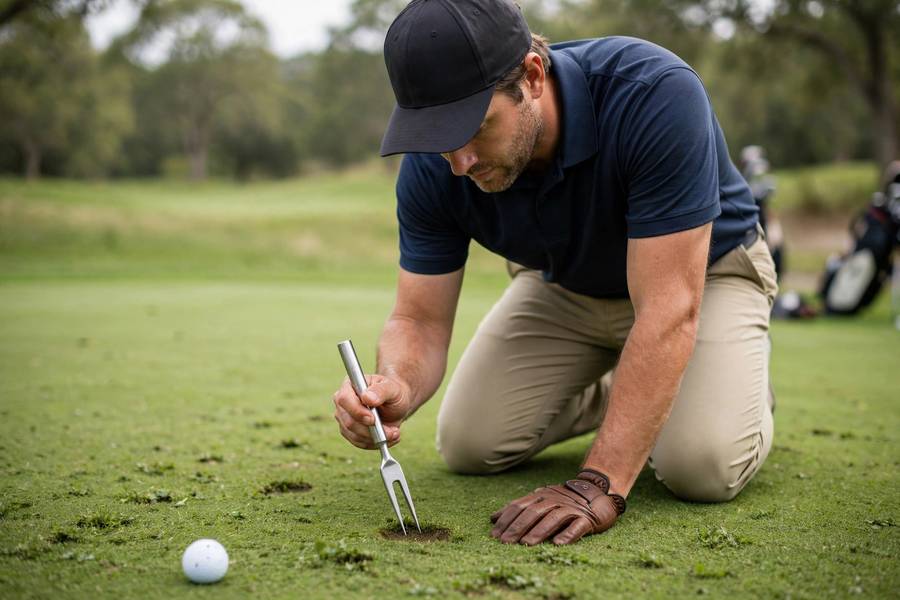
- Repair ball marks and divots: fix your pitch marks (and others’ — good karma) and replace divots. This is etiquette with the force of expectation.
- Don’t step in putting lines: avoid walking on the line between someone’s ball and the hole. It’s the oldest courtesy in golf.
- Tend or remove the flagstick: the rules now allow putting with the flagstick in (your choice). If it’s leaning or you want it out, have someone tend it.
- Order of play: farthest from the hole putts first. And ‘ready golf’ (whoever’s ready goes) is fine in casual play — just don’t putt while someone’s in your line.
The green is also where beginners bleed strokes unnecessarily — three-putts are scorecard poison. Two-putt everything as your goal; lag the first putt close, tap in the second. Aggressive first putts lead to long comebackers and the dreaded four-putt.
Etiquette: The Unwritten Rules That Matter
Golf etiquette isn’t snobbery — it’s the operating system that lets strangers share a course peacefully:
- Silence and stillness: don’t talk, move, or stand in someone’s peripheral vision during their swing.
- Play ready golf: hit when ready and safe, not in strict honor order (casual play). Slow play is the cardinal sin.
- Rake bunkers, fix marks: leave the course better than you found it. Rake your bunker footprints, replace divots, fix pitch marks.
- Shout ‘FORE’: if your ball might hit someone, yell it immediately and loudly. Safety first, pride never.
- Let faster groups through: if the group behind is waiting on every shot, wave them through at the next tee. It costs two minutes and buys goodwill.
- Phones: silent, and calls away from other players. Nobody wants swing thoughts interrupted by a ringtone.
Our full golf etiquette guide goes deeper — but master this list and you’ll be welcome in any casual group. And if you want to understand the language everyone’s speaking out there, our golf terms for beginners decodes the jargon.
Scoring Basics for Your First Round
Each hole has a par (the expected strokes: usually 3, 4, or 5). Your score per hole is strokes taken; common results have names worth knowing:
- Birdie: one under par. Par: even. Bogey: one over. Double bogey: two over.
- Pick up at double par: beginners’ best friend — if you’ve taken twice the par strokes on a hole, pick up your ball and move on. It keeps pace and sanity. (Agree this with your group first.)
- Stableford (optional): many beginners play this points format instead of stroke play — points per hole based on score relative to par, so blow-up holes don’t ruin the card. Ask the pro shop; it’s beginner-friendly.
For your first rounds, the only score that matters is whether you had fun and kept pace. Serious scoring comes later. If tournaments intrigue you down the line, our guide to how golf tournaments work explains formats from club championships to the majors.
Pace of Play: Keep It Moving
The target: a fourball should take around 4 hours for 18 holes (less for 9). Beginners’ pace tips:
- Limit ball searches to 3 minutes (it’s the rule anyway), then drop and move on.
- Play ready golf — don’t wait for honors on every tee.
- Take one practice swing max (or none). Your second practice swing never helped anyone.
- Plan your shot while others play — club selected, yardage known, before it’s your turn.
- Keep up with the group ahead, not ahead of the group behind. That’s the real pace standard.
Nobody expects beginners to play well. Everybody expects beginners to play at a reasonable pace. Get the pace right and you’ll be invited back everywhere. For the fitness that keeps your swing smooth through 18 holes, the general conditioning in our strength training for runners guide helps more than most golfers expect — golf is a walking sport first.
Play the ball as it lies, play the course as you find it. Tee off between the markers, don’t improve your lie, count every stroke (including whiffs and penalties), repair the course as you go, and keep pace. Those principles cover most of what beginners need.
Play the ball as it lies — hit it from where it stopped without improving its position, lie, or line of play. It’s the foundation the entire rulebook is built on, and the default answer whenever you’re unsure.
Out of bounds (or a lost ball) costs stroke and distance: add one penalty stroke and replay from where you hit the original shot. It’s the harshest common penalty, which is why smart play avoids the white stakes entirely.
In casual play, yes — the common convention is to pick up once you’ve reached double par on a hole (or a maximum agreed with your group). It keeps pace and is universally accepted among casual golfers; just agree it with your group first.
Play from the forward tees, bring plenty of balls, mark your ball, know the 3-minute lost-ball rule, shout ‘fore’ for safety, repair divots and pitch marks, keep pace with the group ahead, and pick up at double par. Etiquette matters as much as rules.
Yes — if you swing at the ball with the intent to hit it and miss, it counts as a stroke. Everyone does it; just count it honestly and move on. (A practice swing with no intent to strike the ball doesn’t count.)