Transmission fluid is the most ignored fluid in most cars. People check their oil (sometimes), top off their coolant (when the light comes on), and never once think about the transmission — until it starts slipping and the quote has four digits.
Ten years around cars taught me this: catching transmission trouble early is the difference between a $150 fluid service and a $3,500 rebuild. And the early warning system is a two-minute check you can do in your driveway. Here’s how to check transmission fluid properly — what to look for, what it means, and what to do about it.
Contents
- Does Your Car Even Have a Dipstick?
- What You’ll Need
- Step-by-Step: Checking the Fluid
- Reading the Fluid: Color, Smell, and Texture
- What Low Fluid Means
- Sealed Transmissions: What to Do
- When to Change It (Not Just Check It)
Does Your Car Even Have a Dipstick?
First things first — and this surprises a lot of people: many modern cars have no transmission dipstick at all. Manufacturers started sealing transmissions in the 2000s (BMW, many VWs, and others), with the fluid checkable only from underneath via a fill plug.
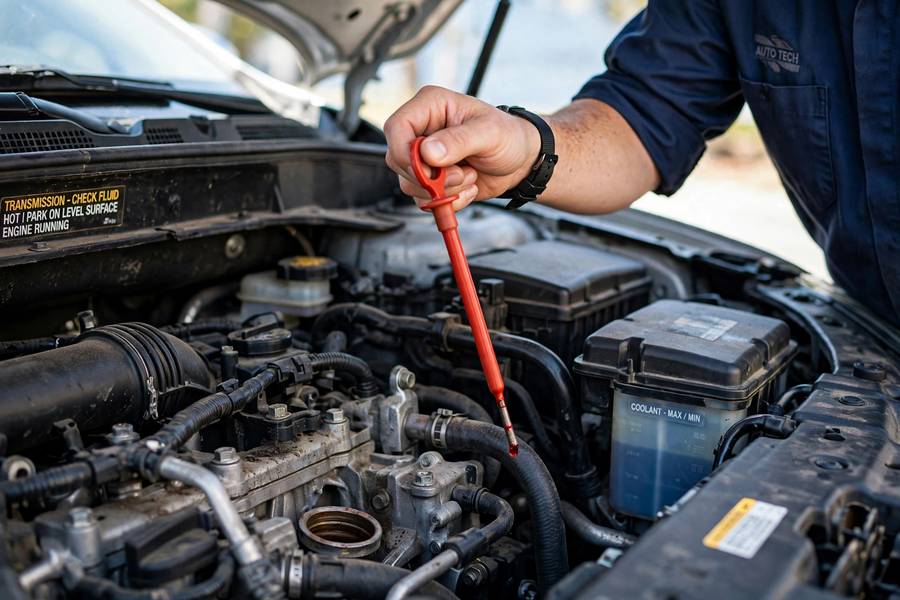
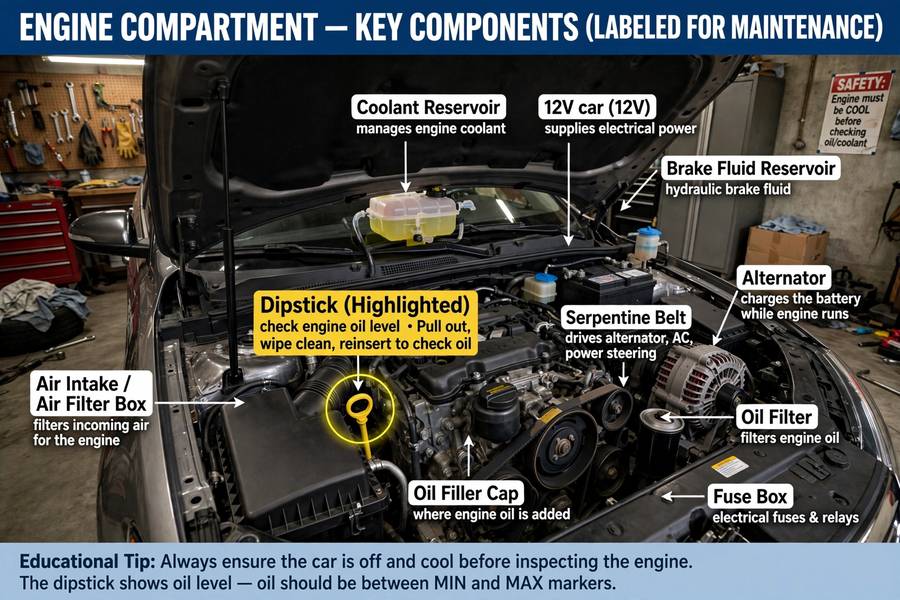
How to tell: pop the hood and look for a dipstick handle — transmission dipsticks are usually red or yellow, located toward the back of the engine bay. Your owner’s manual will confirm. If there’s no dipstick, skip to the sealed transmission section below — this becomes a shop job.
Rough rule: most American and Japanese cars through the mid-2010s have dipsticks. Most German cars and many newer models don’t. When in doubt, the manual knows.
What You’ll Need
- A clean white rag or paper towels (white so you can see the fluid color)
- Funnel (long, narrow — transmission dipstick tubes are skinny)
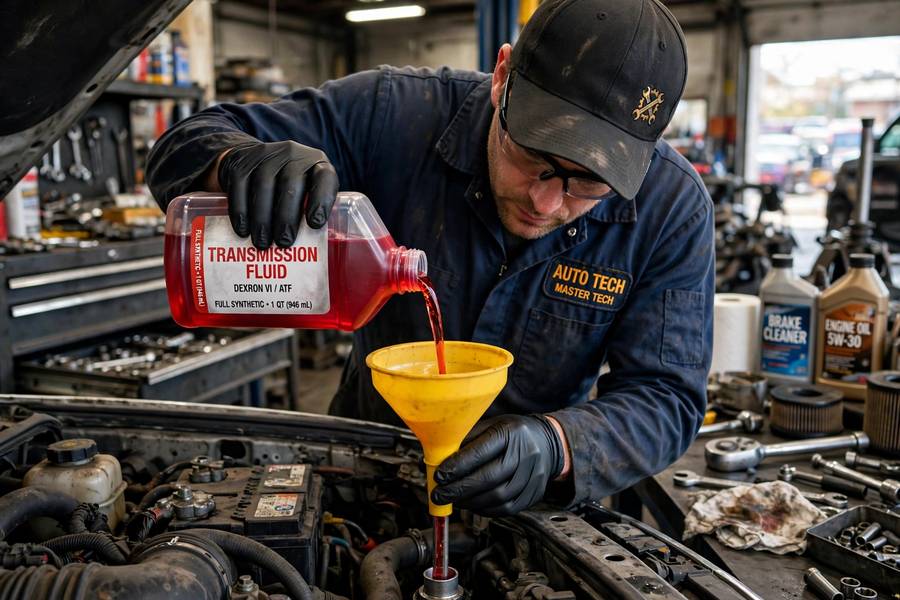
- The correct fluid for top-off (check your manual — ATF type matters enormously)
- Gloves (transmission fluid is nasty stuff on skin)
- 5 minutes and a level parking spot
Step-by-Step: Checking the Fluid
1. Warm it up. Transmission fluid expands when hot, and the dipstick is calibrated for operating temperature. Drive for 10–15 minutes — not just idle in the driveway, actually drive it so the fluid circulates through all the gears.
2. Park on level ground, engine running, in Park. This is different from checking oil (engine off). The transmission pump needs to be running for an accurate reading — except on Honda/Acura, which specify engine OFF. Check your owner’s manual. Parking brake on.
3. Pull the dipstick, wipe it clean, reinsert fully, pull again. Same technique as oil — the first pull is always smeared and misleading. The second pull is the truth.
4. Read the level. The dipstick has HOT and COLD marks (sometimes just one range). You’re reading the HOT side after driving. Level should be between the marks — ideally near the top.
5. Inspect the fluid on the white rag. This is the important part — see below.
6. Smell it. Yes, really. Your nose is a diagnostic tool here.
Reading the Fluid: Color, Smell, and Texture
Wipe the dipstick on the white rag and look carefully. Transmission fluid tells a story:
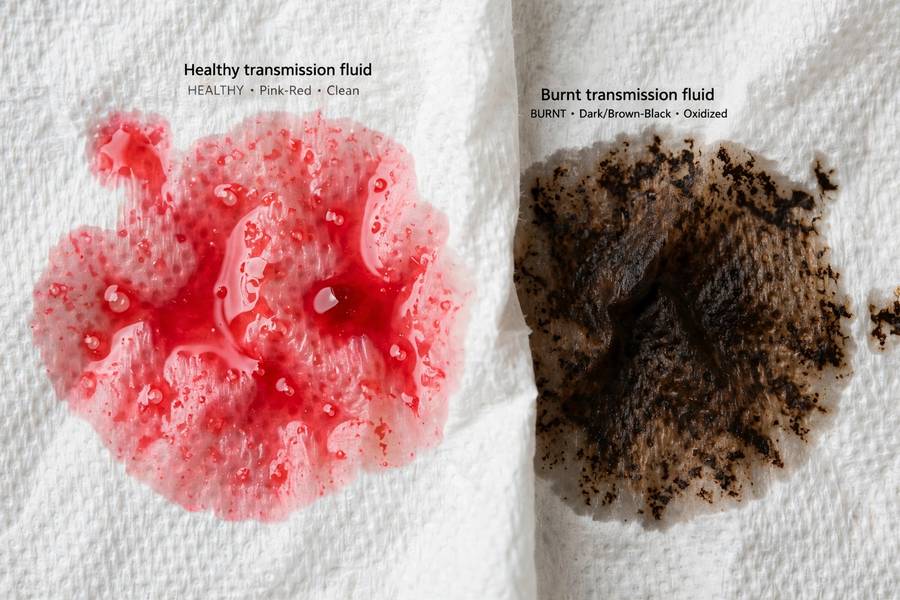
Healthy: translucent pinkish-red, slightly sweet smell. This is what fresh ATF looks like. If yours looks like this and the level’s right, you’re in good shape. Close the hood.
Aging: darker red to light brown, still translucent. Normal for fluid with 30,000+ miles on it. Not an emergency, but it’s telling you a fluid change is due soon. Don’t ignore it for another year.
Worried: dark brown, opaque, slightly burnt smell. The fluid is cooked — it’s lost its protective properties and the transmission is running hotter than it should. Schedule a fluid change promptly. This is the “check engine” equivalent of a warning light.
Trouble: black, burnt toast smell, possibly with metal particles. The fluid has failed and the transmission is eating itself. Metal flakes (look for glitter in the fluid on the rag) mean internal wear is already happening. Get to a transmission shop — not a quick-lube — immediately. Be prepared for bad news, but sometimes catching it here still saves the unit.
Milky pink (like strawberry milk): coolant is mixing with transmission fluid, usually through a failed radiator cooler. This is urgent — coolant destroys transmissions fast. Do not drive it any farther than the shop.
What Low Fluid Means
Here’s something critical: transmissions don’t “use” fluid like engines use oil. The system is sealed. If the level is low, fluid went somewhere — there’s a leak.
Common leak points I’ve seen in the shop:
– Pan gasket (the most common — a $30 part, an hour of labor)
– Cooler lines (rubber sections crack with age)
– Axle seals (look for fluid near the wheels)
– Torque converter seal (the expensive one — transmission has to come out)
Top it off to the correct level with the right fluid, then find the leak. Topping off without fixing the leak is like refilling a bucket with a hole — you’ll be back under the hood in a month, and running low in between is what kills transmissions.
Never overfill. Too much fluid causes foaming, overheating, and erratic shifting. Add a little, recheck, repeat. Patience beats a turkey baster full of regret.
Sealed Transmissions: What to Do
No dipstick? You’re not completely helpless:
- Watch for symptoms: delayed engagement (pause before Drive catches), slipping (RPM flares without acceleration), harsh or erratic shifts, whining noises, dashboard warnings.
- Check for leaks underneath: reddish spots where you park are the giveaway.
- The actual check requires lifting the car, removing the fill plug, and checking level with the engine running at a specific temperature — genuinely a shop procedure. Expect to pay for 30 minutes of labor.
I know “sealed for life” sounds like you never need to think about it. In my experience, “lifetime” means “lifetime of the warranty,” not lifetime of the car. Sealed transmissions still benefit from fluid service at 60,000–100,000 miles — it just has to be done by someone with a lift.
When to Change It (Not Just Check It)
Checking is monitoring; changing is maintenance. My shop-floor guidance:
- Conventional automatics: every 30,000–60,000 miles, depending on use. Towing, city driving, and heat shorten the interval.
- CVTs: every 30,000–60,000 miles, non-negotiable. CVT fluid is the lifeblood of the belt system.
- “Lifetime fill” claims: service at 60,000–100,000 miles anyway. I’ve opened “lifetime” transmissions at 120,000 miles — the fluid looked like used motor oil.
Flush vs. drain-and-fill: for well-maintained transmissions, either is fine. For neglected, high-mileage units that have never been serviced — do a drain-and-fill (replaces ~40% of fluid), drive 1,000 miles, repeat. A full flush on a neglected transmission can dislodge debris that was structurally load-bearing, for lack of a better term. Gentle is better than thorough when you’re late.
Two minutes with a dipstick, twice a year. That’s the whole habit. The transmission is the second most expensive component in your car — treat it like it matters, because the repair bill certainly will.
Transmission Fluid Types: Why the Right One Matters
A quick but critical addendum, because using the wrong fluid is one of the most common DIY mistakes I see. Transmission fluid is not generic — and the differences matter enormously.
ATF varieties: Dexron (GM), Mercon (Ford), ATF+4 (Chrysler), Toyota WS, Honda DW-1, Nissan Matic — each formulated with specific friction modifiers for that manufacturer’s clutch materials. Using Dexron in a transmission spec’d for ATF+4 causes harsh shifting and accelerated wear; the friction characteristics are genuinely different, not marketing.
CVT fluid is not ATF. This deserves emphasis because the bottles look similar and the mistake is catastrophic. CVT fluid has completely different friction properties designed for belt-to-pulley grip. Putting ATF in a CVT (or vice versa) will destroy it. If your car has a CVT, the fluid must say CVT on the bottle and match your manufacturer’s spec.
The safe rule: buy the fluid your owner’s manual specifies, by specification number, not by brand claims of “compatible with.” Aftermarket “multi-vehicle” fluids exist and reputable ones work — but when a $30 bottle choice protects a $4,000 transmission, I buy the exact spec and sleep well. This is one place where brand loyalty to your manufacturer’s specification is pure rationality.
Transmission checks are part of knowing your car rather than guessing about it. Same goes for how to jump start a car (a dead battery waits for no one), how to clean car headlights for safe night driving, and what cruise control is — most drivers have it and barely use it.
Frequently Asked Questions
Warm up the car by driving 10–15 minutes, park on level ground with the engine running in Park, pull the transmission dipstick, wipe it, reinsert, pull again, and read the HOT marks. Check the fluid’s color (healthy = translucent pink-red) and smell on a white rag.
Healthy transmission fluid is translucent pinkish-red with a slightly sweet smell. Dark brown means it’s overdue for a change; black with a burnt smell indicates serious trouble; milky pink means coolant contamination — get to a shop immediately.
Engine ON, in Park, on level ground. Unlike engine oil, transmission fluid must be checked with the pump running for an accurate reading. The car should be at operating temperature from actual driving.
Many modern cars have sealed transmissions with no dipstick. Checking requires lifting the car and removing a fill plug — a shop procedure. Watch for symptoms instead: slipping, delayed engagement, harsh shifts, or reddish leaks underneath.
Yes — low fluid causes slipping, overheating, and accelerated wear that can destroy a transmission. Since transmissions don’t consume fluid, a low level always means a leak that needs finding and fixing, not just topping off.