Summer Bucket List for Families: Ideas Every Age Will Love


Ask a kid in September what they did all summer and you’ll get one of two answers: a blank stare, or an excited flood of specific stories. The difference between those two answers is rarely money or exotic travel. It’s whether someone — usually a parent — made a loose plan. I don’t have kids of my own, but I’ve spent enough summers as the fun aunt to know the secret: kids don’t need a perfect summer. They need a summer with a few anchor experiences and a lot of unstructured outdoor time.
This list is built for real families: multiple ages, limited budgets, working parents, and the eternal “I’m boooored” that arrives by week two. It’s organized by effort level (because parents have different energy on different days), covers toddlers to grandparents, and includes the rainy-day and too-hot-day plans that save a summer. Pick 25, stick them on the fridge, and let the kids cross them off — ownership makes them care. Or start from these summer bucket list ideas and adapt for ages.
Anchor Experiences (Plan These First)
Every family summer needs three to five anchor experiences — the bigger things you plan ahead and the kids anticipate. A camping trip (even one night in the backyard counts for little ones), a day at a water park or beach, a visit to somewhere new within driving distance, and one “big event” like a fair, festival, or outdoor concert. Put them on the calendar in June. Anticipation is half the fun for kids.
The anchors don’t have to be expensive. Our family’s legendary anchor was “cousin camp” — all the cousins at grandma’s for three days of chaos, costing basically nothing. Another friend’s family does an annual “tourist day” in their own city, hitting the attractions locals never visit. Kids remember the feeling of a special day, not the price tag. A $20 day planned with excitement beats a $200 day done out of obligation.
Let each kid pick one anchor. Giving them ownership — even a five-year-old choosing between the zoo and the children’s museum — turns the event from “something we’re dragging you to” into “your day.” They’ll talk about their pick for weeks beforehand, which extends the joy well beyond the day itself.
Free Everyday Fun
The bulk of a family summer is ordinary days, and ordinary days need a bench of free ideas. The park rotation: visit a different playground every week and rate them — kids take rating very seriously, and you’ll discover the great parks you never knew existed. For age-specific picks, see this summer bucket list for kids. Nature scavenger hunts (find something smooth, something yellow, something that makes noise) turn any walk into an adventure — or start how to start a garden with kids for a project that lasts all season for under-tens.
Sidewalk chalk is endlessly renewable entertainment: giant hopscotch, trace each other’s shadows, draw a whole town and drive toy cars through it. Bubble stations (a $3 bottle of solution and homemade wands from pipe cleaners), sprinkler runs, and “car wash” days where kids wash bikes and scooters with buckets and sponges fill hot afternoons happily.
Library summer programs are the most underused free resource in family life: reading challenges with prizes, free craft workshops, story times, and sometimes museum pass lending. Sign up in June. And don’t forget the simplest one: unstructured time outside. Kids with a yard, a park, or even a sidewalk and some basic supplies (balls, chalk, water) will invent their own fun if you resist the urge to schedule every minute. Boredom is where creativity lives — protect some of it.
The boredom jar
Fill a jar with slips of paper, each with one free activity: “build a fort,” “have a dance party,” “draw a comic,” “bake something,” “write a letter to grandma.” When someone says “I’m bored,” they draw a slip — no arguing, no swaps. It ends the negotiation instantly and kids genuinely enjoy the randomness. Refill it together when it runs low.
Water Days (the Whole Point of Summer)
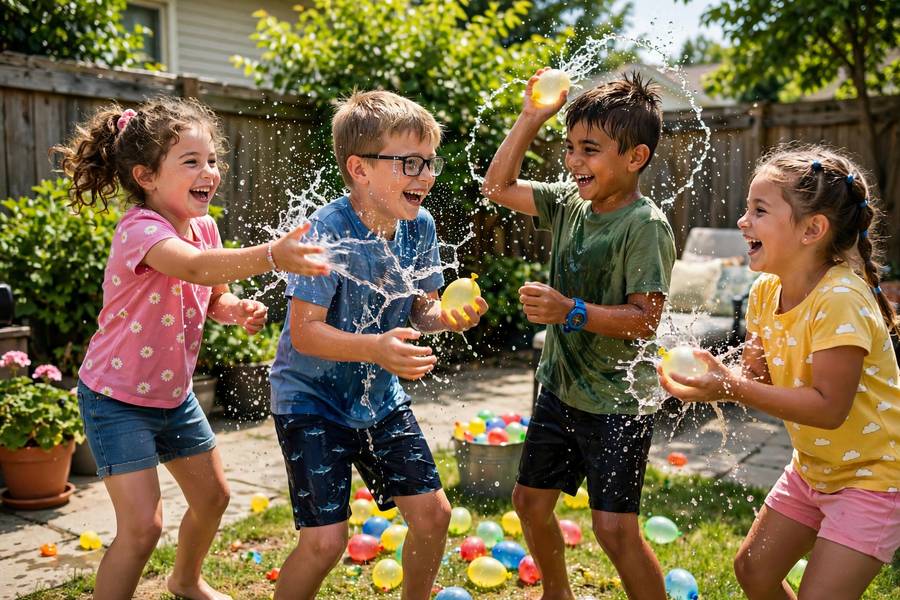
For kids, summer basically is water. Beyond pools and beaches: splash pads (free, everywhere, go early), creek wading and rock-skipping, water balloon fights (fill 100 balloons for $3 — the filling is half the entertainment), and slip-n-slides (the $20 classic, worth every penny). A “car wash” fundraiser-style afternoon where kids wash the actual car with hoses combines helpful with fun.
Make one water day special: the annual “yes to water” day where every water activity is approved — sprinklers, hoses, water guns, the kiddie pool, ice cubes down shirts. Set the boundaries (stay in the yard, no hosing the neighbors), then say yes to everything else. Kids talk about “yes day” for years. Adults are invited to participate; dignity is suspended.
Water safety note, because it matters: designate a water watcher — one undistracted adult whose only job is watching the water, rotating every 20-30 minutes. Drowning is fast and silent, and it happens in backyard pools and at crowded beaches alike. The bucket list is supposed to be fun; the watcher system is what keeps it that way.
Rainy Days and Too-Hot Days
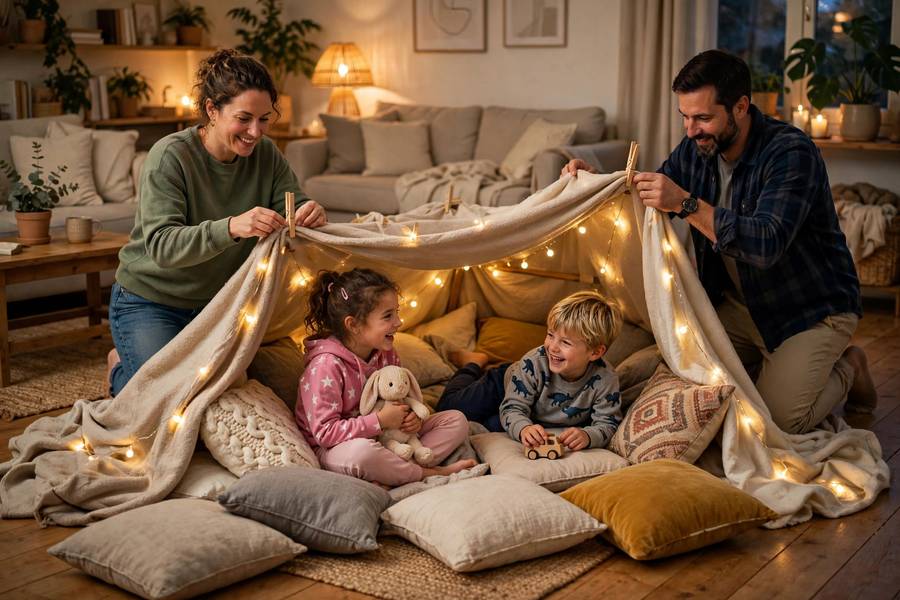
Every family needs an indoor bench for weather days. Fort-building is the king: every blanket and cushion in the house, flashlights, books and snacks inside. Indoor camping (sleeping bags in the living room, s’mores made in the microwave or over a candle-supervised stove) turns a stormy night into an event.
Baking projects fill rainy afternoons deliciously: decorate-your-own cookies or cupcakes, homemade pizza with everyone making their own, or a “chopped” style challenge with mystery ingredients from the pantry. Craft projects with actual purpose — paint flower pots then plant them, make greeting cards for upcoming birthdays, build birdhouses from kits — beat aimless coloring.
Too-hot days (over 95°F) call for strategic cooling: morning park trip, midday library or mall or museum (many have free days — check), afternoon quiet time with movies and popsicles, evening sprinkler session when the sun drops. Don’t fight the heat; schedule around it. The Spanish had it right with siestas.
Evening Magic (When Days Cool Down)
Summer evenings are family prime time — cooler, calmer, and lit beautifully. The after-dinner walk or bike ride is the simplest great tradition: same loop, every evening, no agenda. Kids decompress, parents decompress, everyone sleeps better. Ours was 20 minutes around the block; it was the most peaceful part of every day.
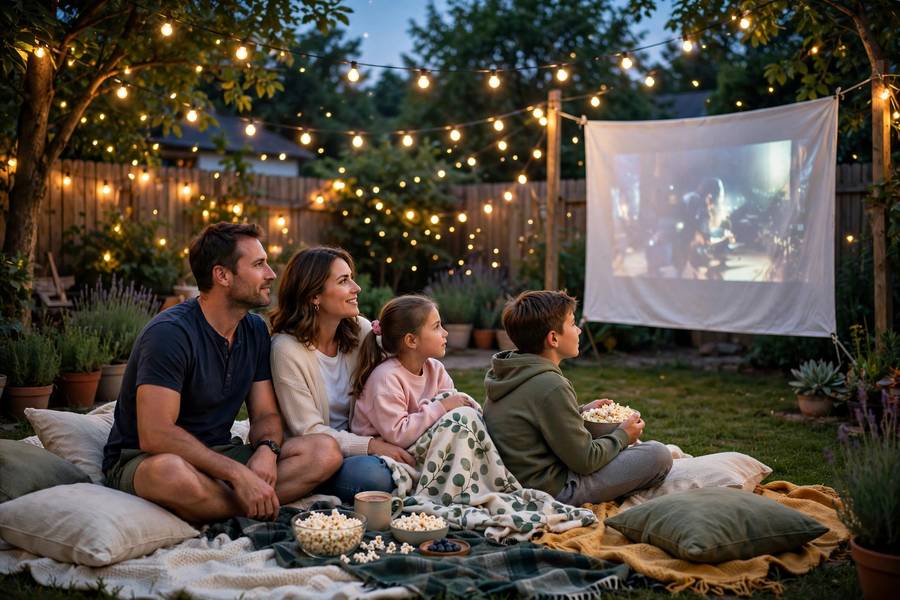
Backyard movie nights with a sheet and a borrowed projector are pure magic for kids — watching a film under actual stars feels like an event even if it’s a movie they’ve seen ten times. Firefly hunting (where they exist), stargazing with a free app, and catching-and-releasing fireflies in jars (with air holes, released after) are the kind of small wonders kids remember forever.
Let bedtime slide a little in summer. I’m serious — the strict school-year schedule can relax by 30-60 minutes. Long summer evenings are for catching up with cousins on video calls, reading one more chapter on the porch, or just sitting outside together as the light fades. Childhood summers are short; the memories are long. Protect the evenings.
Traditions Worth Starting
The families with the best summers aren’t doing more — they’re repeating more. Pick two or three traditions and commit: Friday night pizza-and-movie, Sunday morning pancakes, the annual first-day-of-summer ice cream trip, a yearly photo in the same spot (watch the kids grow in the series). Traditions give kids a sense of time passing well, which is a genuine gift.
The summer journal works for families too: a shared notebook where everyone writes or draws one thing from the day. Little kids dictate, big kids write, teens might actually participate if there’s no pressure. By September you have a family document of the season. We did this one year and the entries — “saw a frog,” “dad burned the burgers (again),” “best day ever (pool)” — are family lore now.
End-of-summer ritual: on the last weekend before school, do a “summer awards” dinner where everyone gives out silly awards (best splash, funniest moment, best fort, most improved swimmer). Review the crossed-off bucket list, look at photos, and let everyone pick one thing to repeat next year. It closes the season with gratitude instead of back-to-school dread. Then keep the good times rolling with fun fall activities for families.
Sanity Tips for Parents
A quick word for the adults, because family summers run on parental energy. Lower the bar on housekeeping — summer houses are sandy and chaotic, and that’s fine. Trade childcare with another family for occasional kid-free afternoons; even two hours of quiet recharges you enormously. Say yes to help and no to guilt: the perfect summer is a myth, the good-enough summer is real.
Build in your own bucket list items. Parents who have nothing on the list except kid logistics burn out by July. Put three things on there just for you — the book, the long bike ride, the dinner with friends — and protect them like any other plan. Your kids benefit from seeing you enjoy your own life; it’s modeling, not selfishness.
And when it’s all too much — the fighting, the mess, the heat, the seventeenth popsicle request before noon — remember: they’re going to remember the sprinkler and the fort and the yes-to-water day. They’re not going to remember that the laundry piled up. You’re doing better than you think. Now go cross something off the list.
Include 3-5 anchor experiences (camping, a beach day, a festival, a new place to visit), a bench of free everyday ideas (park rotation, scavenger hunts, sidewalk chalk, library programs), water days, indoor plans for bad weather, and 2-3 repeatable traditions. Let each kid pick at least one item for ownership.
Rotate free activities: different playgrounds weekly, nature scavenger hunts, sprinkler and bubble play, library summer programs, fort-building, and baking projects. A ‘boredom jar’ filled with free activity slips ends the ‘I’m bored’ negotiation instantly. Protect unstructured outdoor time — boredom fuels creativity.
Splash pads, sandbox play, bubble chasing, sidewalk chalk, short nature walks with a scavenger hunt (find something red, something smooth), library story times, and water tables. Keep outings short (toddlers tap out fast), go early to beat heat and crowds, and always pack snacks — toddler mood is 90% snack timing.
Give teens real input and some autonomy: let them plan one outing, invite a friend along on family activities, and include teen-friendly items (concerts, adventure activities, food tours, photography challenges). Don’t force participation in little-kid activities — parallel options (they bring a friend) keep everyone happy.
Fort-building with all the blankets, indoor camping with sleeping bags in the living room, baking or decorating projects, craft kits with a purpose (paint pots, build birdhouses), puzzles, and movie marathons with homemade tickets and popcorn. Keep a rainy-day box ready so bad weather becomes an event, not a crisis.