8 Best Shoulder Exercises With Resistance Bands (Full Workout)

Resistance bands are the most underrated shoulder tool in existence. I know lifters who own thousands of dollars of equipment and still keep bands in their gym bag, because bands do something free weights cannot: the resistance increases as the band stretches, which means the exercise gets hardest exactly where your delt is strongest. That tension curve is not a gimmick. It is biomechanically ideal for delt training, and it is why band lateral raises burn like nothing else.
Bands are also cheap, portable, joint-friendly, and nearly indestructible. I have programmed band-only shoulder blocks for traveling clients, injured lifters working around limitations, and beginners who were not ready for dumbbells. Every one of them built real shoulder strength. Here are the best shoulder exercises with resistance bands, how to set them up right, and a complete band shoulder workout.
In this guide:
- Why Bands Work So Well for Shoulders
- Band Setup: Anchoring Without Drama
- The 8 Best Band Shoulder Exercises
- The Complete Band Shoulder Workout
- How to Progress With Bands
- Frequently Asked Questions
Why Bands Work So Well for Shoulders
Three reasons bands punch above their weight for delt training. First, the ascending resistance curve: a band is easiest at the start of the rep and hardest at the end. For lateral raises, that means peak tension at the top, right where the side delt is fully shortened and working hardest. Dumbbells do the opposite: heaviest at the bottom, nearly slack at the top. The band’s curve matches the muscle’s strength curve, which is about as good as resistance gets.
Second, constant tension. A dumbbell lateral raise unloads the delt at the top of the rep. A band never unloads. The muscle works through the entire range, every rep, which is why 20 band lateral raises feel like 40 with dumbbells.
Third, joint-friendliness. The resistance is lightest in the stretched position, where joints are most vulnerable, and heaviest in the contracted position, where joints are most stable. For lifters with cranky shoulders, this makes bands the safest way to train delts hard. I have rehabbed more shoulders with bands than with any other tool.
The honest limitation: bands top out. A thick band might give you 50 to 80 pounds of peak tension, which is plenty for lateral raises and rear-delt work but limiting for heavy overhead pressing. Bands are a complete solution for delt hypertrophy and a partial solution for maximal pressing strength. Know what they are for and they will never disappoint you.
Band Setup: Anchoring Without Drama
Half of band training is setup. Get this right and everything works; get it wrong and the band snaps back at you mid-set, which is educational exactly once.
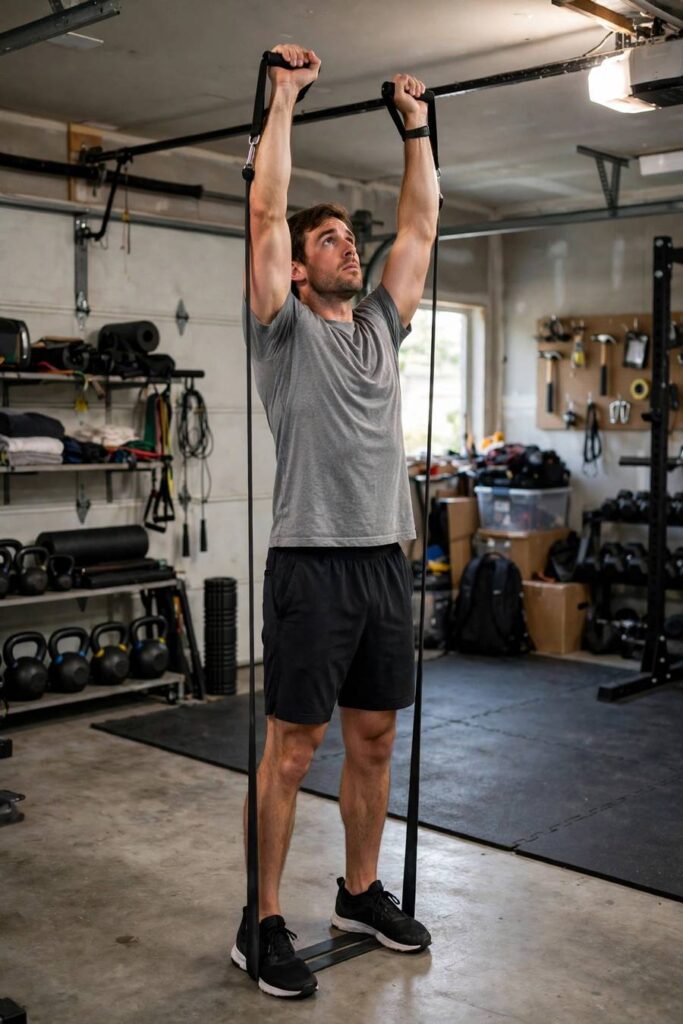
- Under the feet: Stand on the band for lateral raises, presses, front raises, and upright rows. Wider stance equals more tension. This is the default setup for most exercises.
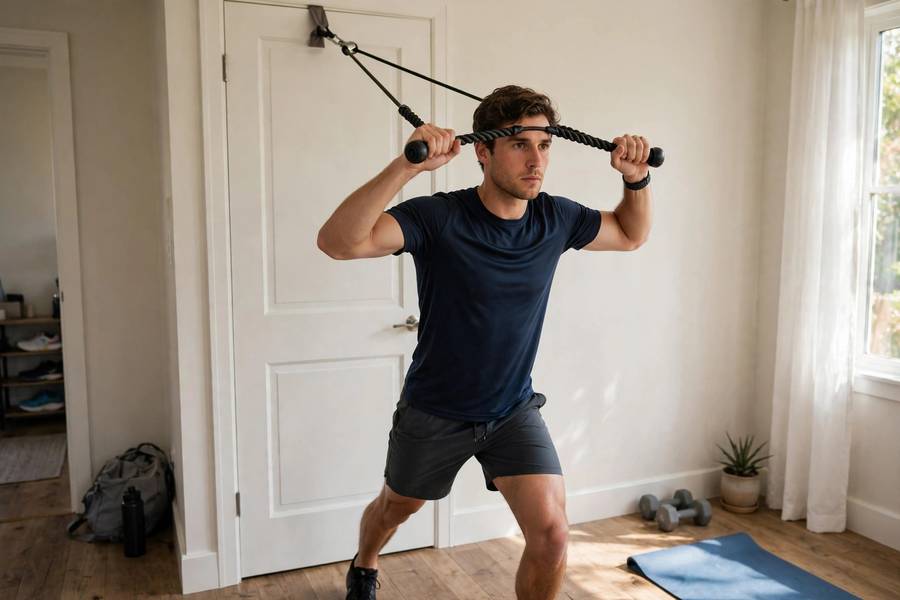
- Door anchor: A fabric door anchor (a few dollars) lets you set the band at any height for face pulls, chest-height presses, and pull-aparts. Close the door fully, test it with a hard pull before your face goes near it.
- Around a post: A squat rack upright, a sturdy pole, or a heavy piece of furniture works for face pulls and rows. Wrap the band, not your optimism: test the anchor before loading.
- Doubled up: Loop the band around your back for push-up-resistance or around your hands to shorten it and increase tension without buying thicker bands.
Safety note: inspect bands for nicks, tears, and thinning before each session, especially near the handles. A band that snaps under tension is a whip. Replace worn bands; they cost less than lunch. And never anchor a band to something that can move: doors that open, light furniture, and helpful friends who promise to hold it still.
If you are building a home training space around bands, our best home gym setup guide covers the full equipment picture, and the bodyweight exercises collection pairs perfectly with band work for complete home sessions.
The 8 Best Band Shoulder Exercises
1. Band Lateral Raise
Stand on the band, hold the ends at your sides, and raise out to shoulder height. This is the single best band shoulder exercise, because the ascending resistance hits the side delt hardest at the top. Step wider for more tension. Do 4 sets of 15 to 25 with a one-second pause at the top. The burn is disproportionate to how light the band feels at the bottom. That is the point.
2. Band Overhead Press
Stand on the band with feet shoulder-width, handles at shoulder height, press overhead. The band overloads the lockout, which is where the delts work hardest. Four sets of 10 to 15. Keep the core braced; the band will try to pull you forward or backward depending on your stance, and fighting that is part of the exercise.

3. Band Front Raise
Stand on the band and raise straight forward to shoulder height, one or both arms. Same rules as the dumbbell version: stop at shoulder height, no swinging, controlled lowering. The band’s increasing tension makes the top of the rep genuinely challenging even with a light band. Three sets of 15 to 20.
4. Band Face Pull
Anchor at face height, pull to your forehead with external rotation. Rear delts, external rotators, upper back: all in one movement. This is the most important band exercise for shoulder health and posture. Three to four sets of 15 to 20. If you do one band exercise for the rest of your life, make it this one. I am serious.
5. Band Pull-Apart
Hold the band at shoulder height with straight arms and pull apart until it touches your chest. Rear delts and mid-traps. Do 3 sets of 20 to 25 as a warm-up, finisher, or scattered through the day. I have clients keep a band at their desk and do 100 pull-aparts daily. Posture transforms within weeks.
6. Band Rear-Delt Fly
Anchor the band at chest height in front of you, face the anchor, and perform a wide fly motion with straight arms. This is the band version of the reverse fly, with constant tension through the whole rep. Step further from the anchor for more resistance. Three sets of 15 to 20. Keep the shoulders down and the movement wide.
7. Band External Rotation
Anchor the band at elbow height to your side, tuck your elbow against your ribs, and rotate your forearm outward. This targets the rotator cuff, the small muscles that stabilize the shoulder joint. It is not glamorous and it will never be your favorite exercise, but it is the reason your shoulders stay healthy enough to train hard. Two to three sets of 15 to 20 per arm, light band, slow and controlled.
8. Band Upright Row
Stand on the band and pull the handles up along your body to chest height, elbows leading. Wide grip, moderate tension, stop at chest height. The band’s smooth resistance makes this friendlier than the barbell version for most shoulders. Three sets of 12 to 15. Drop it if you feel pinching in the front of the shoulder; lateral raises cover the same ground.
The Complete Band Shoulder Workout
One band (or a set of two to three tensions), 35 minutes, twice a week:
- Band overhead press: 4 x 10-15 (rest 90 sec)
- Band lateral raise: 4 x 15-25 (rest 60 sec)
- Band face pull: 3 x 15-20 (rest 60 sec)
- Band front raise: 3 x 15-20 (rest 60 sec)
- Band rear-delt fly: 3 x 15-20 (rest 60 sec)
- Band pull-apart: 2 x 25 (rest 45 sec)
- Band external rotation: 2 x 15-20 per arm (rest 45 sec)
That is 21 sets hitting every delt head plus the rotator cuff. It looks like a lot of sets, but band sets are quick and the rests are short. The whole thing flows.
For programming context, compare with the full best shoulder exercises list, and if core stability is a weak link in your overhead work, the how to build core strength guide will fix the foundation that pressing sits on.
How to Progress With Bands
“Bands are light” is only true if you never progress them. Here are the levers:
- Thicker bands. The obvious one. Own at least two or three tensions and move up when you hit the top of the rep ranges.
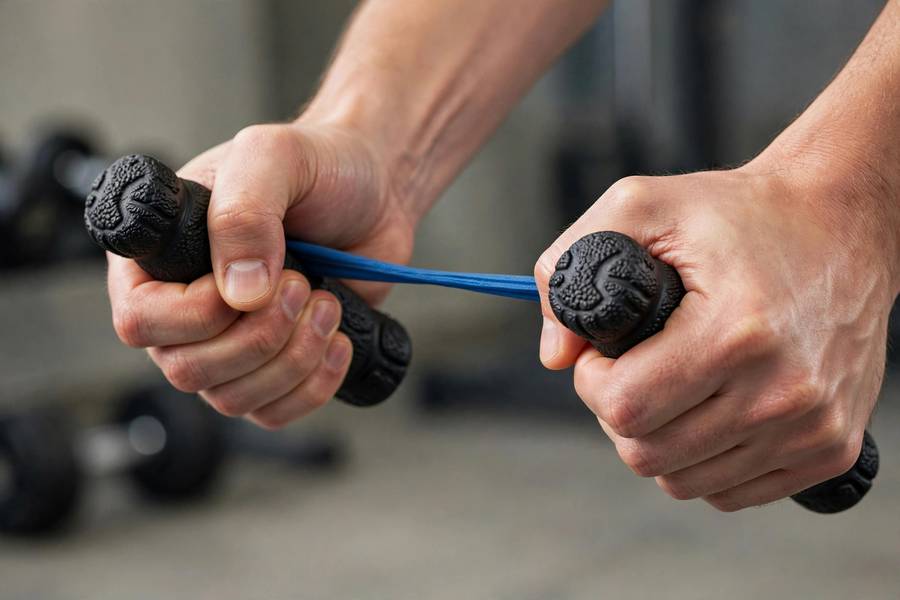
- More tension on the same band. Stand wider, choke up on the band, double it over, or step further from the anchor. A single band has a wide tension range if you manipulate the setup.
- More reps. Take lateral raises from 15 to 25 reps before changing bands. High-rep band work builds serious delt endurance and size.
- Slower tempo. A 3-second lowering phase on band lateral raises is brutal. Tempo is free progressive overload.
- Shorter rests. Cut rest periods by 15 seconds every couple of weeks to increase density.
- Pre-exhaustion. Do lateral raises before overhead press so the delts are the limiter. Advanced, effective, humbling.
Track your setups like you track weights: “red band, wide stance, 4×20 lateral raise” is a data point you can beat next week. “Some band stuff” is not. The notebook rule applies to bands exactly as it does to barbells.
Yes. Bands provide ascending resistance that peaks where the delt is strongest, plus constant tension through the full range. With progressive overload (thicker bands, more reps, slower tempo), bands build real delt size, especially in the side and rear heads. They are a complete hypertrophy tool for shoulders.
Dumbbells allow heavier absolute loads for pressing strength; bands offer a better resistance curve for delt isolation and are gentler on joints. For hypertrophy and shoulder health, bands are excellent. For maximal overhead strength, dumbbells have the edge. Most lifters benefit from using both.
A set of loop or tube bands with light, medium, and heavy tensions. Light bands suit lateral raises and external rotations; medium bands cover presses and rows; heavy bands work for upright rows and high-tension pressing. A door anchor is a cheap, worthwhile add-on for face pulls.
Two to three times per week. Bands are joint-friendly, so slightly higher frequency works, but the muscles still need 48 hours between hard sessions. Two full sessions plus light daily pull-aparts is an effective template.
Yes, eventually. Inspect bands for nicks, tears, and thinning before each session, and replace them at the first sign of damage. Stored out of sunlight and not overstretched, quality bands last one to two years of regular use. They are inexpensive to replace.