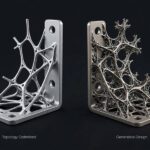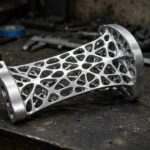
Every manufacturing process is a set of rules about what shapes are allowed. Milling says: the shape must be reachable by a spinning cutter. Casting says: the shape must release from a mold. And for a century, those rules quietly shaped everything engineers were allowed to imagine. Then 3D printing arrived and deleted most of the rules — if you can model it, you can print it, more or less. Generative design, which had been producing forms that conventional manufacturing couldn’t build, suddenly had a dance partner. This is the story of that partnership, and it’s the reason so many generative designs look the way they do. Start with what generative design is if the concept is new.
Table of Contents
- The Manufacturing Constraint That Shaped Everything
- What 3D Printing Unlocks
- Complexity Is Free (Almost)
- The New Design Rules: Designing for Additive
- Lattices: The Killer Application
- Consolidation: Printing Assemblies as Single Parts
- Materials: From Plastic to Titanium
- Where the Partnership Still Struggles
- Frequently Asked Questions
The Manufacturing Constraint That Shaped Everything
To understand why this pairing matters, you have to feel the weight of the old constraints. A milled part must be accessible to the tool — no undercuts, no internal voids, no features smaller than the cutter. A cast part needs draft angles and uniform wall thickness. A sheet metal part is, well, sheet metal. Every one of these constraints pruned the tree of possible designs before the engineer even started, and generations of engineers internalized them as “how parts look.”
Generative algorithms don’t know these rules unless you teach them. Left unconstrained, they produce forms with internal channels, undercuts, variable-density lattices, and topology that no mill could reach and no mold could release. For years, this was generative design’s dirty secret: the beautiful optimized forms were unmanufacturable. The studies were intellectually satisfying and practically useless. Then additive manufacturing matured, and the secret became the selling point.
What 3D Printing Unlocks
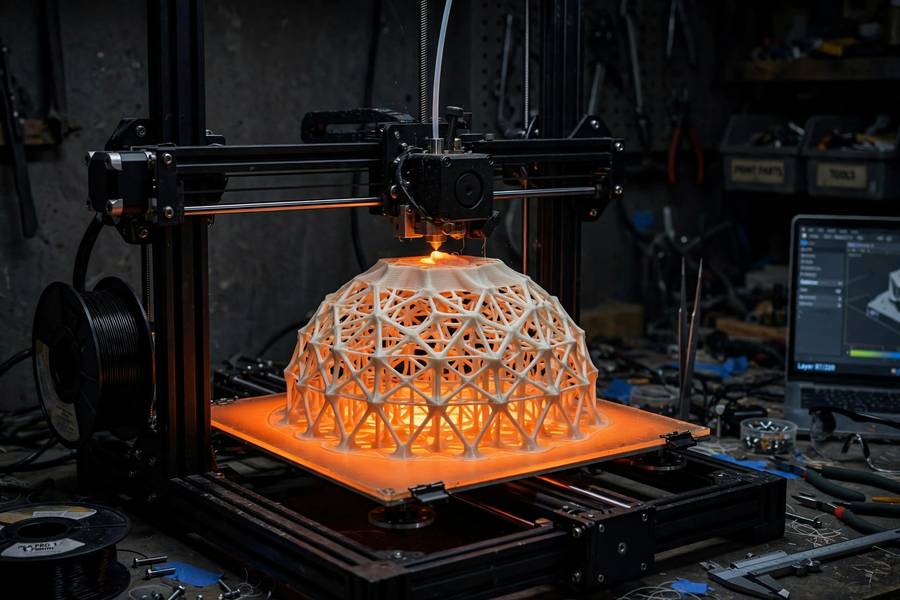
3D printing — additive manufacturing, properly — builds parts layer by layer, which inverts the constraint logic. Internal voids? Fine, as long as you can remove the support material or design self-supporting geometry. Undercuts? Irrelevant. Complex internal channels? Not just possible but easy. Variable wall thickness following stress contours? The printer doesn’t care.
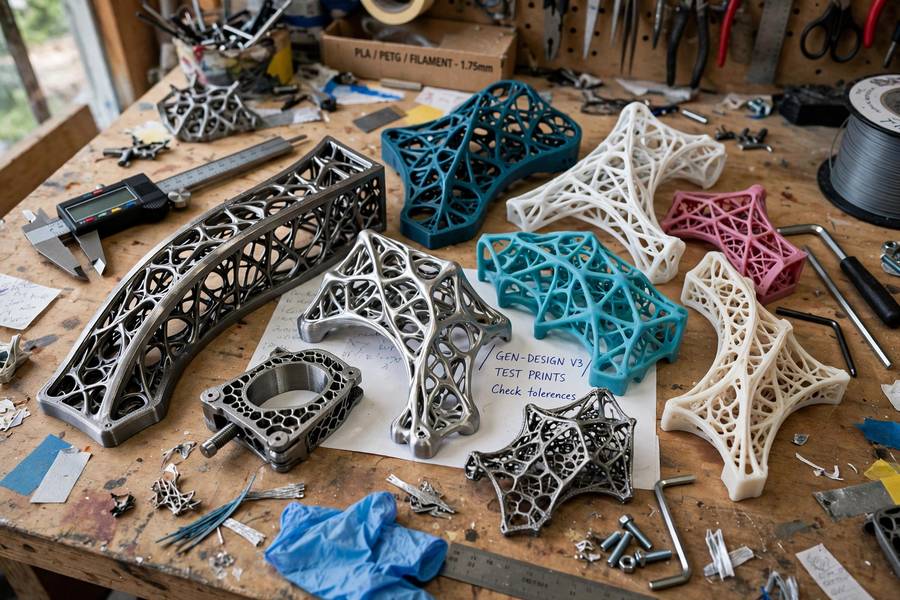
This is why the generative design renaissance and the additive manufacturing renaissance happened simultaneously. Each solved the other’s core problem: generative design needed a way to build its forms, and 3D printing needed a reason to exist beyond prototyping — a class of designs that only it could produce. The lattice structures, the organic brackets, the consolidated assemblies: these are the native art of the pairing, forms that are simultaneously optimal and printable and nothing else.
The numbers tell the story. A generative bracket printed in titanium can be 40 percent lighter than its machined equivalent. A consolidated assembly printed as one piece eliminates dozens of fasteners. These aren’t marginal gains; they’re the kind of step changes that justify new manufacturing infrastructure.
Complexity Is Free (Almost)
The phrase the industry uses is “complexity is free,” and like all slogans it’s 90 percent true. In milling, complexity costs: every feature is tool time, every setup is money. In 3D printing, a complex lattice and a solid block of the same volume take roughly the same time to print — the cost driver is material volume and build time, not geometric complexity. This flips a century of design economics on its head.
The “almost” matters. Complexity isn’t free in design time (someone has to model it, though generative methods automate this), in file size (lattice models can be enormous), in post-processing (support removal from complex internals is genuinely hard), or in inspection (how do you verify the inside of a part you can’t see?). The slogan is about manufacturing cost, and there it’s largely true. Everywhere else, complexity still bills by the hour.
But the manufacturing economics are the point. When complexity stops costing extra, the optimal design — however intricate — becomes the economical design. That’s the fundamental shift: for the first time in manufacturing history, the best-performing form and the cheapest form can be the same form.
The New Design Rules: Designing for Additive
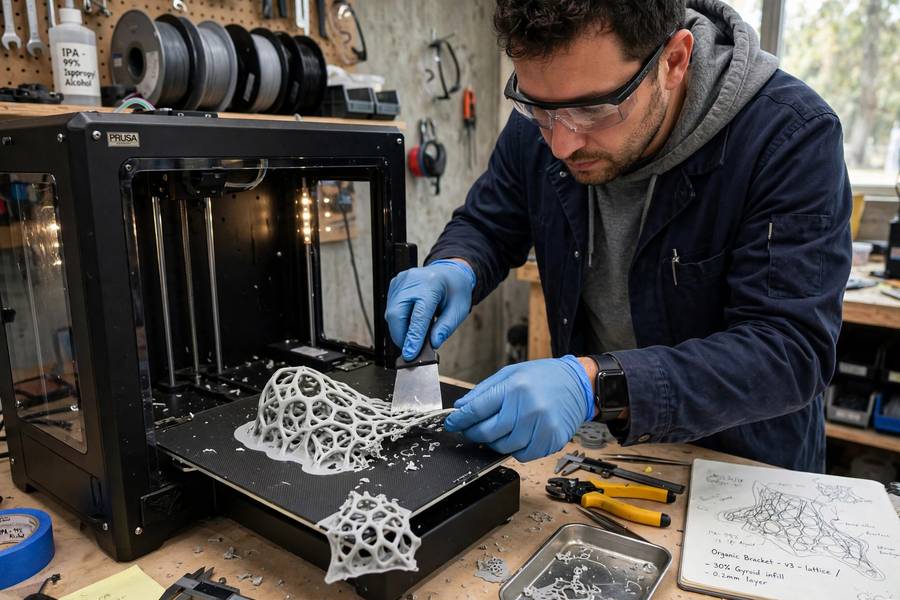
3D printing deletes old rules and writes new ones, and generative studies need to know them. The new rules: overhangs beyond about 45 degrees need support structures (which must then be removed); large flat surfaces warp; residual stresses from the printing process can distort the part; surface finish is rougher than machined; and material properties are anisotropic — different in different directions, because the part was built layer by layer.
Good generative-for-additive workflows encode these as constraints: the study penalizes unsupported overhangs, respects minimum feature sizes for the specific printer and material, and accounts for anisotropy in the structural analysis. The studies that ignore these produce beautiful forms that fail in the printer or in service. The studies that include them produce forms that look slightly less alien — the algorithm has learned the new rules — but actually work.
This is the maturing of the field in miniature: from “look what the algorithm dreamed up” to “here’s a printable, validated part.” The can AI make art question is fun, but the engineering question — can it make a part that survives the build plate — is the one that matters.
Lattices: The Killer Application
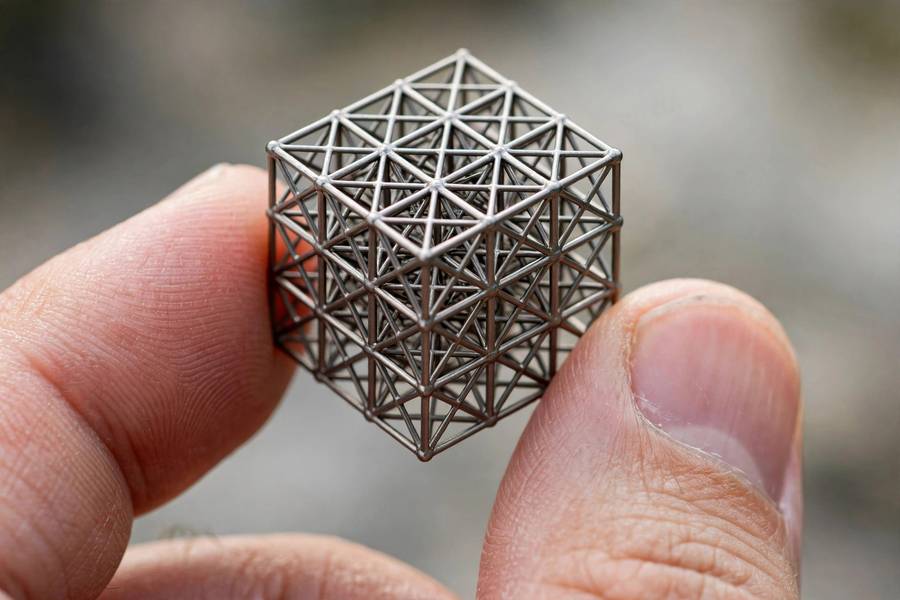
If there’s one geometry that defines the generative-plus-additive era, it’s the lattice: a repeating or graded cellular structure that fills volume with minimal material. Lattices are the perfect showcase because they’re simultaneously impossible to manufacture conventionally, trivial to print, and structurally brilliant — high stiffness per unit mass, excellent energy absorption, tunable properties by varying the cell geometry.
The generative angle: the best lattices aren’t uniform. A generative study can grade the lattice density to match the stress field — dense where loads are high, open where they’re low — producing a structure that’s optimal in a way no human would design by hand. The result looks like bone, because bone is a graded lattice optimized by evolution for the same objectives. Nature got there first; we’re just catching up with better printers.
Applications are everywhere the weight matters: aerospace brackets, titanium implants (where the lattice also encourages bone ingrowth — a genuinely beautiful convergence of engineering and biology), sporting goods, and increasingly automotive. The lattice is the geometry that proves the partnership isn’t hype: it does things no other combination of design method and manufacturing process can do.
Consolidation: Printing Assemblies as Single Parts
The second killer application is part consolidation: replacing assemblies of many parts with single printed components. A hydraulic manifold that was twenty parts — block, fittings, seals, fasteners — becomes one printed piece with internal channels optimized for flow. An aerospace ducting assembly becomes a single organic form.
The economics are compelling beyond the part itself: fewer suppliers, no assembly labor, no fasteners to loosen, no seals to leak, lighter weight, better performance from the optimized internal geometry. The printed manifold doesn’t just replace the assembly; it outperforms it, because the internal channels can follow flow-optimized paths that drilled passages never could.
The constraint is scale and speed. Printing is slow compared to stamping or molding, and large parts need large (expensive) printers. Consolidation makes economic sense where the assembly is complex, the volumes are moderate, and the performance gains are valuable — aerospace, motorsport, prosthetics, high-end industrial. For commodity high-volume parts, conventional manufacturing still wins on cost. The partnership dominates the complex middle, not the simple extremes.
Materials: From Plastic to Titanium
The material palette has expanded dramatically: engineering polymers, then metals (titanium, aluminum, Inconel, stainless steel), then ceramics and composites. Each material unlocks new applications — titanium for aerospace, biocompatible alloys for implants, high-temperature alloys for engine components.
But materials bring their own constraints into the generative study. Printed titanium has different fatigue behavior than wrought titanium. Porosity — microscopic voids from the printing process — affects strength and must be accounted for. Post-processing (heat treatment, HIP — hot isostatic pressing) changes properties and adds cost. The mature workflows include material-specific constraints and validated property data; the immature ones treat “titanium” as a single entry in a dropdown menu.
This is where the field’s credibility gets built or lost. A generative study is only as good as its material data, and printed materials are still less characterized than conventional ones. The gap is closing — every year brings better data — but anyone running a structural generative study on printed metal without validated material properties is building on sand.
Where the Partnership Still Struggles
Honest accounting. The pairing struggles with: build volume (large parts need huge printers); speed (printing is slow — fine for complex low-volume parts, hopeless for commodity volumes); surface finish and tolerances (printed parts often need machining on critical surfaces, which reintroduces conventional constraints); inspection (verifying internal geometry non-destructively is hard and expensive); and cost (the printers, the powder, the post-processing, and the expertise all cost real money).
The trajectory favors the partnership — printers get bigger, faster, and cheaper; materials get better characterized; design tools get smarter about the constraints. But the honest version is that generative-plus-additive dominates a specific territory: complex, high-value, low-to-medium-volume parts where performance justifies cost. It is not replacing stamping lines or injection molding, and it won’t. It’s the best tool for the parts that were previously impossible, not for the parts that were previously cheap.
Frequently Asked Questions
Generative algorithms produce complex organic forms that conventional manufacturing (milling, casting) cannot build. 3D printing builds layer by layer, so it can produce almost any geometry, making it the natural manufacturing method for generative designs.
A lattice is a cellular structure filling volume with minimal material. Lattices offer high stiffness per unit mass and excellent energy absorption, and generative methods can grade lattice density to match stress fields. They are impossible to manufacture conventionally but easy to 3D print.
Part consolidation replaces an assembly of many parts with a single 3D-printed component. It eliminates fasteners, seals, and assembly labor while allowing optimized internal geometry, improving performance and simplifying the supply chain.
Common materials include engineering polymers, titanium, aluminum, Inconel, stainless steel, ceramics, and composites. Each has specific constraints around strength, fatigue, and surface finish that generative studies must account for.
Limits include build volume, slow print speeds unsuitable for high volumes, rougher surface finishes, difficulty inspecting internal geometry, and higher costs than conventional manufacturing. The pairing excels for complex, high-value, low-to-medium-volume parts.
Keep reading: