Every winter ends the same way: not with a single dramatic moment, but with an accumulation of changes that eventually becomes undeniable. Nobody rang a bell in 2012 and announced the AI winter over. Instead, three forces — data, compute, and a methodological revolution — converged over two decades, quietly dissolving every cause that had frozen the field. By the time the world noticed, the thaw was complete.
What ended the AI winter is really the story of how the field’s deepest problems got solved — not by the approaches that froze, but by abandoning them. The symbolic AI of the first winter and the expert systems of the second shared a flaw: they tried to hand-install intelligence. The thaw came from systems that learned it. For the winter itself, see what AI winter is; for the full timeline, the history of artificial intelligence.
Table of Contents
- Turning Point One: The Data Deluge
- Turning Point Two: The Compute Explosion
- Turning Point Three: Deep Learning Works
- The 2012 Moment: AlexNet
- Why Learning Beat Hand-Coding
- The Benchmark Culture
- Industry Money Returns
- The Label Gets Rehabilitated
- Is the Thaw Permanent
- Frequently Asked Questions
Turning Point One: The Data Deluge
The first great thawing force was data — oceans of it, arriving via the internet. The pre-winter approaches were starved of examples: expert systems learned from interviews with a handful of experts; early machine learning trained on datasets you could fit on a floppy disk. Learning-based AI needs examples the way engines need fuel, and for decades there wasn’t enough fuel.
The internet changed everything. By the 2000s, the web contained billions of images, documents, and interactions — labeled implicitly by human behavior (clicks, tags, links, captions). ImageNet (2009) provided 14 million labeled images, an unprecedented training resource. Text corpora grew to billions of words. Speech datasets reached thousands of hours. Each domain’s data explosion unlocked learning-based approaches that had been theoretically sound but practically starved.
This is the most underappreciated cause of the thaw, because data is boring and algorithms are exciting. But ask any practitioner what made modern AI possible and data is always in the top two. The models didn’t just get smarter — they got fed. A neural network with 1980s data and 2020s architecture would still be mediocre; a 1980s architecture with 2020s data would be surprisingly capable. Data was the binding constraint, and the internet removed it.
Turning Point Two: The Compute Explosion
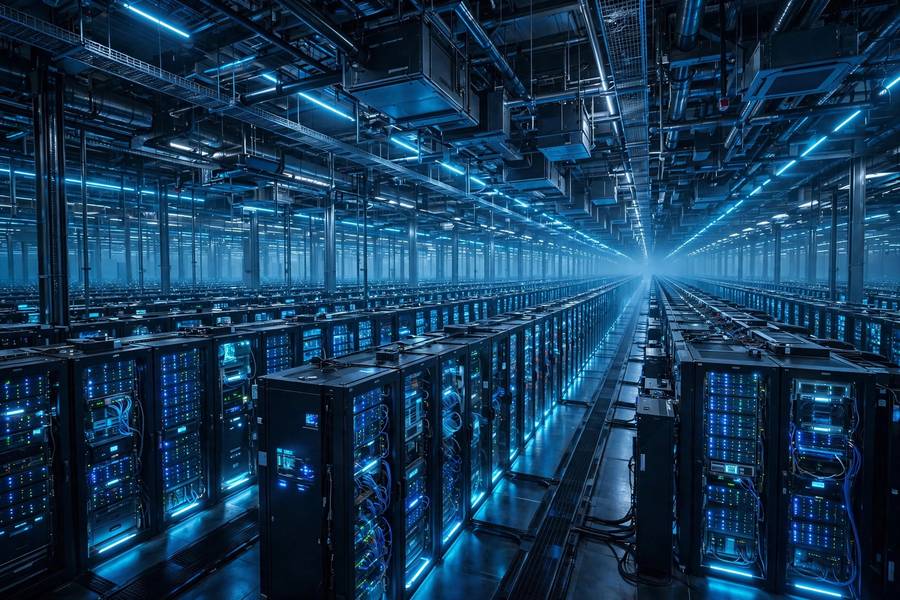
Data without compute is a library without readers. The second thawing force was the exponential growth in computing power — specifically, the repurposing of GPUs (graphics processing units) for AI training. GPUs, designed for rendering video game graphics, turned out to be spectacularly good at the parallel matrix math neural networks need. A training run that took months on CPUs took days on GPUs.
The numbers are staggering: compute used in landmark AI training runs grew by orders of magnitude per decade, far outpacing Moore’s Law, driven by GPU clusters and later specialized AI chips (TPUs and others). What was computationally impossible in 1995 became routine in 2005 and trivial in 2015. Ideas that researchers had shelved as “theoretically nice but intractable” — deep networks with many layers — suddenly became trainable.
This compute explosion had a democratizing second-order effect: cloud computing let anyone rent massive compute by the hour. You no longer needed a supercomputer budget to train serious models — just a credit card. The barrier to entry for AI research collapsed, flooding the field with new researchers, startups, and ideas. The winter’s concentration (a few labs, a few patrons) gave way to a Cambrian explosion of participants.
Turning Point Three: Deep Learning Works
Data and compute were necessary but not sufficient — the field also needed the methodological breakthrough: deep learning actually working. Neural networks had existed since the 1950s and had been through their own hype-and-disappointment cycles. The winter-era consensus held that deep networks couldn’t be trained effectively (vanishing gradients, local minima, overfitting).
The 2006-2012 period dismantled that consensus piece by piece: better initialization methods, ReLU activations, dropout regularization, improved optimization, and the crucial realization that big data plus big compute made deep networks trainable and generalizable. Then the empirical results started landing — each one a hammer blow to the winter’s pessimism.
The breakthroughs came in sequence: speech recognition (deep networks beating traditional methods around 2009-2011), computer vision (AlexNet 2012), machine translation (2014-2016), game playing (AlphaGo 2016), and eventually language (transformers 2017, GPT series 2018+). Each success expanded the thaw; each expanded thaw attracted more researchers, more data, more compute — a virtuous cycle, the exact inverse of the winter’s death spiral. For how this training works mechanically, see how AI models are trained.
The 2012 Moment: AlexNet
If the thaw needs a symbolic date, it’s September 2012: AlexNet, a deep convolutional neural network, won the ImageNet image recognition competition by a margin so large it shocked the field — roughly 10 percentage points better than the runner-up, an eternity in benchmark terms. Built by Alex Krizhevsky, Ilya Sutskever, and Geoffrey Hinton using GPUs, it proved decisively that deep learning scaled where traditional computer vision didn’t.
AlexNet’s significance wasn’t just the win — it was the method’s generality. The same deep learning approach soon conquered speech, translation, and games. Researchers who’d spent careers on hand-engineered features watched learned features outperform them across domains simultaneously. The paradigm shift was total and fast: within a few years, “deep learning” went from a fringe interest to the default approach across AI.
Hinton’s role adds poignancy: he’d kept neural network research alive through the winter decades, enduring ridicule and funding droughts. AlexNet was vindication decades in the making — the stubborn survivor proved right. The thaw’s human story is full of such figures: the believers who wouldn’t leave, positioned perfectly when the conditions changed. Winters select for stubbornness; springs reward it.

Why Learning Beat Hand-Coding
Step back and the thaw’s intellectual core is simple: learning from data beat hand-coding knowledge. The winter-era approaches — symbolic logic, expert system rules, hand-engineered features — all tried to install intelligence manually. They hit the same wall: the world is too complex, too messy, too full of exceptions for manual encoding. The knowledge bottleneck wasn’t a temporary obstacle; it was a fundamental limit of the paradigm.
Learning-based approaches sidestepped the bottleneck entirely. Instead of telling the machine the rules, show it millions of examples and let it discover the patterns. This works because the patterns are really there in the data — the world is structured, just too richly structured for humans to formalize by hand. Deep networks turned out to be excellent pattern-discoverers, given enough data and compute.
This is the deepest answer to “what ended the AI winter”: the field stopped trying to program intelligence and started trying to grow it. Every previous thaw attempt had refined the old paradigm; the real thaw required abandoning it. The lesson generalizes uncomfortably: sometimes the way out of a freeze isn’t better execution of the current approach but a different approach entirely — which is worth remembering when evaluating today’s dominant paradigms.
The Benchmark Culture
An underrated thawing force was cultural: the machine learning community’s benchmark-driven evaluation culture, forged during the winter’s lean years. Shared datasets, public competitions, and rigorous measurement replaced grand claims. You couldn’t hype your way past a leaderboard — the numbers were public, the test sets were held out, and progress was undeniable when it happened.
This culture did two things. First, it made real progress visible and undeniable — when deep learning started winning benchmarks across domains, skeptics couldn’t dismiss it as hype because the measurements were transparent. Second, it disciplined the field’s claims — researchers learned to under-promise and over-deliver, the exact inverse of the winter-causing behavior.
The benchmark culture also accelerated progress directly: competitions focused collective effort, shared datasets eliminated data-collection duplication, and the rapid iteration of “try it on the benchmark” compressed research cycles. It’s no coincidence that the thaw’s biggest moments (AlexNet, AlphaGo, GPT) were all benchmark or competition victories. The winter taught the field to measure; measurement ended the winter.
Industry Money Returns
Capital follows results, and the thaw’s results pulled in unprecedented investment. Google’s acquisition of DeepMind (2014), the deep learning talent wars, massive corporate AI labs, venture funding for AI startups — industry money dwarfed anything the field had seen, including the 1980s boom. By the late 2010s, AI was the most funded technology sector in history.
This industrialization changed the field’s character: from academic and patron-funded to product-driven and massively resourced. The scale enabled things academia couldn’t — training runs costing millions, datasets of unprecedented size, engineering teams of hundreds. It also concentrated power: frontier AI became something only well-funded organizations could do, a new kind of concentration risk.
But for ending the winter, industry money was decisive. It funded the researchers, built the infrastructure, and — crucially — created the applications (search, ads, recommendations, assistants) that made AI visibly useful to billions. The winter ended not when researchers believed again, but when the world couldn’t ignore the results. Usefulness is the ultimate thawing agent.
The Label Gets Rehabilitated
The final thaw marker was linguistic: “AI” became a good word again. Companies bragged about AI; job titles proliferated; the press returned with (excessive) enthusiasm. The toxic label of the 1990s became the magic word of the 2010s-2020s — so thoroughly rehabilitated that it got slapped on everything, repeating the dilution pattern that preceded past winters.
This rehabilitation matters because labels coordinate expectations and funding. When “AI” is prestigious, students enter the field, investors fund it, and institutions support it — the virtuous cycle. When it’s toxic, the reverse. The label’s journey from poison (1990s) to prestige (2020s) tracks the thaw precisely, lagging the technical reality by years in both directions.
The rehabilitation’s excess is itself a warning: the current label inflation (“AI-powered” everything) mirrors the pre-winter dilution. Labels are lagging indicators of reality but leading indicators of hype. Watch the label’s health as a barometer — not for the technology’s sake, but for the funding climate’s.
Is the Thaw Permanent
The honest answer: probably, but not certainly, and not in the way people assume. The thaw’s foundations — data abundance, massive compute, learning-based methods, genuine utility, diversified funding — are structurally sounder than anything that preceded them. A return to hand-coded symbolic AI’s failure modes is unlikely; the paradigm that thawed the field actually works.
But “winter” could take new forms. A funding winter driven by the gap between AI investment and revenue is conceivable — the economics, not the technology, freezing. A regulatory winter, if AI rules become prohibitive. A trust winter, if high-profile failures or misuses trigger backlash. The next freeze, if it comes, probably won’t look like the last ones — it’ll rhyme in dynamics (hype, disappointment, withdrawal) but differ in specifics.
The best insurance is the winter’s own lessons: honest measurement, modest claims, genuine utility, diversified bets. The field that internalized these survived and thrived. The thaw isn’t permanent because winters are impossible — it’s durable to the extent the field remembers what caused the cold. Memory is the insulation. That’s why histories like this one matter: they’re not nostalgia, they’re infrastructure.

Frequently Asked Questions
Three converging forces: the data deluge (the internet provided massive training datasets), the compute explosion (GPUs made training deep networks feasible), and the deep learning breakthrough (neural networks proved they could learn effectively at scale). Together they dissolved every cause that had frozen the field.
AlexNet (2012) was a deep neural network that won the ImageNet competition by a shocking ~10 percentage point margin using GPUs. It proved deep learning scaled dramatically better than traditional computer vision, triggering the paradigm shift that ended the winter and launched the modern AI era.
Expert systems tried to hand-code human knowledge as rules, hitting the knowledge acquisition bottleneck — too slow, too expensive, too brittle. Deep learning discovers patterns automatically from massive data, sidestepping the bottleneck entirely. Learning beat hand-coding because the world is too complex to formalize manually.
There’s no single date, but 2012 (AlexNet) is the symbolic turning point most historians cite, with the thaw building through the 2000s (data, GPUs, methodological advances) and full rehabilitation in the 2010s as industry investment and public enthusiasm returned.
A repeat of the old winters is unlikely — today’s foundations (data, compute, learning methods, real utility) are structurally sound. But new-form freezes are conceivable: funding winters from investment-revenue gaps, regulatory winters, or trust winters from high-profile failures. The insurance is the winter’s own lessons: honest measurement and modest claims.
Keep reading: