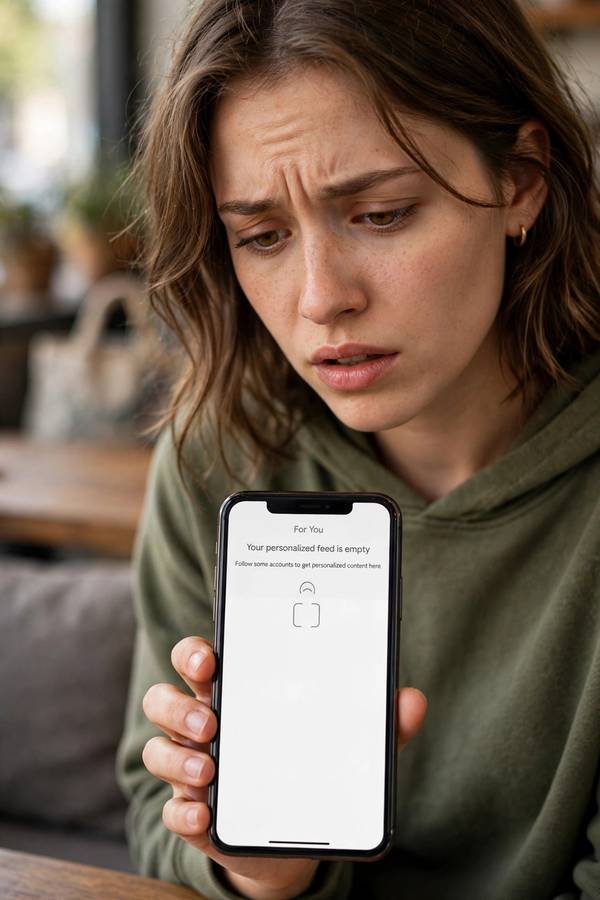
Every recommendation system has a paradox at its heart: it needs data to make good recommendations, but it needs to make recommendations to get data. A brand-new user opens Netflix and the system knows nothing. A brilliant song uploads to Spotify and nobody has heard it. The algorithm stares at a blank slate, and the blank slate stares back.
This is the cold start problem, and it’s one of the most practically important challenges in all of machine learning — not because it’s mathematically deep, but because every system faces it constantly. New users arrive every second. New items appear every minute. Solving cold start is the difference between a recommender that works from day one and one that serves generic mush until it learns. Here’s how the problem works and the genuinely clever ways systems solve it. Background: how recommendation algorithms work.
Table of Contents
- The Paradox, Stated Plainly
- Three Flavors of Cold Start
- Why It’s Harder Than It Looks
- Solution 1: Just Ask (Onboarding)
- Solution 2: Popularity as a Starting Point
- Solution 3: Content Features Don’t Need History
- Solution 4: Exploration Boosts
- Solution 5: Transfer Learning and Side Information
- How the Big Platforms Handle It
- Why Cold Start Never Fully Goes Away
- Frequently Asked Questions

The Paradox, Stated Plainly
Collaborative filtering — the engine behind most recommendations — works by finding patterns in behavior: users who liked X also liked Y. But patterns require data, and data requires history. A new user has no history. A new item has no interactions. The pattern-matching machinery has nothing to match.
It’s like a librarian who’s brilliant at recommending books based on your reading history, meeting a stranger who’s never read anything. All the librarian’s skill is useless without the input. The skill isn’t the problem — the missing input is.
This isn’t an edge case. Consider the scale: Spotify gets tens of thousands of new tracks daily. TikTok gets millions of new videos daily. Every one of them starts at zero interactions. And every day, millions of new users sign up across platforms, each a blank profile. Cold start isn’t a startup problem that goes away with scale — it’s a permanent operating condition. The systems that win are the ones that warm up fastest.
Three Flavors of Cold Start
The problem splits three ways, each with different solutions:
New user, existing items. You just signed up; the catalog is well-understood. The system knows everything about the items but nothing about you. This is the classic “new Netflix subscriber” case.
New item, existing users. A new song, video, or product enters a system full of known users. The system knows the users but nothing about how they’ll react to this item. The “unknown creator uploads a video” case.
New user, new item (the double cold start). Neither side has data — rare in pure form, but it happens at platform launches. The hardest case: the system is guessing on both sides.
Why It’s Harder Than It Looks
The naive fix — “just show popular stuff until we learn” — works, but badly, and the reasons reveal the problem’s depth:
Generic isn’t personal. Showing everyone the same top-10 list is safe but uninspiring. The whole value proposition of personalization is “for you” — a generic cold-start experience teaches new users that the system doesn’t know them, which is true but shouldn’t be advertised.
First impressions compound. The cold-start period is when users decide whether to stay. Bad early recommendations cause churn — and churned users never generate the data that would have fixed the recommendations. It’s a death spiral: no data → bad recommendations → user leaves → no data.
Learning takes time you don’t have. Collaborative filtering needs substantial interaction history to find reliable patterns. But users expect good recommendations in minutes, not weeks. The gap between “enough data for the math to work” and “user patience” is where all the clever solutions live.
Solution 1: Just Ask (Onboarding)
The simplest solution: ask the user directly. Spotify’s “pick your favorite artists,” Netflix’s “choose shows you like,” news apps’ “select your topics.”
This works better than its simplicity suggests. A handful of explicit choices gives the system seed data — enough to place the user in a rough taste neighborhood, enough to avoid the generic top-10. Five artist picks can bootstrap a music profile surprisingly well because taste is correlated: liking three specific indie bands places you precisely.
The design challenge is friction — every onboarding question is a hurdle, and each hurdle loses users. The art is asking the minimum that gives maximum signal. Smart systems treat onboarding answers as priors: strong at first, decaying as behavioral data accumulates.
Solution 2: Popularity as a Starting Point
When in doubt, show what’s popular. It’s the universal fallback, and it’s less dumb than it sounds.
Popularity is a reasonable prior: the most-watched shows, the bestselling products, the trending videos — these are popular for reasons, and a new user will likely find something acceptable among them. It’s the “staff picks” shelf: not personalized, but curated by collective wisdom.
The sophistication is in which popularity: global top-10 is the crudest version. Better systems use demographic popularity (popular among users like you demographically), geographic popularity (trending in your country — licensing and culture make this genuinely informative), and contextual popularity (popular right now, not all-time).
The limitation is the obvious one: popularity is the opposite of personalization. It works as a bridge — keeping the new user engaged while behavioral data accumulates — not as a destination. Systems that lean on it too long feel generic, because they are.

Solution 3: Content Features Don’t Need History
Here’s the elegant solution for new items: analyze the item itself, not its interaction history.
A new song has no plays, but it has audio features — tempo, energy, key. A new video has no views, but it has visual content, transcripts, tags. A new product has no purchases, but it has descriptions, categories, images. Content-based analysis works on day zero, no behavioral data required.
This is why hybrid systems dominate: the content-based side handles new items gracefully while the collaborative side warms up. Spotify’s audio fingerprinting means a track uploaded this morning can be recommended this afternoon — matched to listeners by sonic similarity before a single human has streamed it.
For new users, content features help differently: once the user interacts with even a few items, the system can build a content-based profile immediately (“you liked these three action movies → here are more action movies”) while the collaborative profile is still gathering data. A handful of interactions is enough for content-based; collaborative needs much more.
Solution 4: Exploration Boosts
New items need interaction data, and the only way to get it is to show them to people. Exploration boosts deliberately promote new or uncertain items to gather that data.
TikTok’s staged distribution is the purest example: every new video gets tested on a small audience batch, and performance determines whether it reaches a larger batch. The system is explicitly buying information — spending some users’ attention (showing them untested content) to learn what works.
The mathematics behind this — multi-armed bandit algorithms, Thompson sampling, upper confidence bounds — is about optimally trading exploration (learning) against exploitation (serving the best-known content). Show only proven hits and you never discover anything new; show only new things and the experience suffers. The optimal policy mixes both, weighted by uncertainty.
For users, exploration boosts are why you sometimes see random-seeming content — a video with 12 views, a song nobody’s heard. You’re part of the test audience. It’s a small tax on your feed that funds the system’s learning, and it benefits you later when the tested winners reach your feed with confidence.
Solution 5: Transfer Learning and Side Information
Sometimes the system knows you from elsewhere:
Cross-domain transfer. Your movie taste predicts your book taste imperfectly but usefully. Amazon uses purchase history to inform Prime Video recommendations; Google uses search history for YouTube. Taste correlates across domains — not perfectly, but better than nothing.
Cross-platform identity. Logged in with the same account across services? Your Spotify listening can inform your podcast recommendations. Your Google searches inform your YouTube. The ecosystem is a cold-start solution: you’re never truly new if the company already knows you somewhere.
Demographic and contextual priors. Age group, location, device, signup source — coarse signals that beat random. A new user from Seoul gets K-pop-weighted priors; a user who signed up via a jazz blog link gets jazz-weighted priors. Stereotyping? Mildly. Effective? Yes.
Social connections. “Your friends like…” — importing your social graph gives instant signal. Spotify’s friend activity, Facebook’s friend-based suggestions. Your friends’ taste is a decent prior for yours (homophily is real), and it’s available on day one.
The privacy tradeoff is obvious: the more the system knows about you from elsewhere, the less cold your start — and the more surveilled you are. Every transfer is a data flow worth knowing about.
How the Big Platforms Handle It
In practice, everyone combines several solutions:
Netflix uses onboarding picks plus demographic/regional popularity, then refines rapidly from early viewing. The two-tier system means even rough initial data produces a plausible homepage.
TikTok leans on the interview approach — rapid-fire content probes in the first session, learning from every swipe. The short format makes each probe cheap, so it can ask many questions fast. Creators growing on TikTok benefit from the new-item exploration boosts on the other side.
Spotify uses onboarding artists, audio analysis for new tracks (instant content-based matching), and staged exploration for new releases.
The pattern: no one relies on a single solution. Cold start is handled by a portfolio — ask, assume, analyze, explore — with the mix tuned per platform.
Why Cold Start Never Fully Goes Away
A closing truth: cold start isn’t a problem you solve once. It’s a permanent condition because:
- New users arrive constantly
- New items appear constantly
- Tastes drift — a user who hasn’t engaged in months is partially cold again
- Contexts change — a user in a new country, on a new device, in a new life phase
- Catalogs churn — items leave, new ones replace them
Every system is always partially cold, always warming up, always balancing exploration against exploitation. The cold start problem isn’t a bug to fix — it’s the fundamental condition of learning about people and things in a changing world. The best systems don’t eliminate it; they just get very, very good at warming up fast.

Frequently Asked Questions
It’s the paradox that recommendation systems need data to make good recommendations but need to make recommendations to get data. New users have no history for the system to learn from; new items have no interactions for the system to evaluate. The system must produce useful recommendations from a blank slate.
Through onboarding questions (asking directly), popularity-based defaults, demographic and regional priors, transfer learning from other services, and rapid active learning — showing diverse probe content and refining from each reaction. Most platforms combine several of these approaches.
Through content analysis (audio features, transcripts, tags) that works without any behavioral data, plus exploration boosts — the system deliberately shows new items to test audiences to gather initial interaction data. TikTok’s staged batch testing is the purest example of this approach.
Because the system is genuinely guessing — it has no behavioral data about you yet. Recommendations improve fast once you interact: rate, save, skip, and engage deliberately in the first sessions. Your early interactions are the training data, so make them count.
Keep reading: