

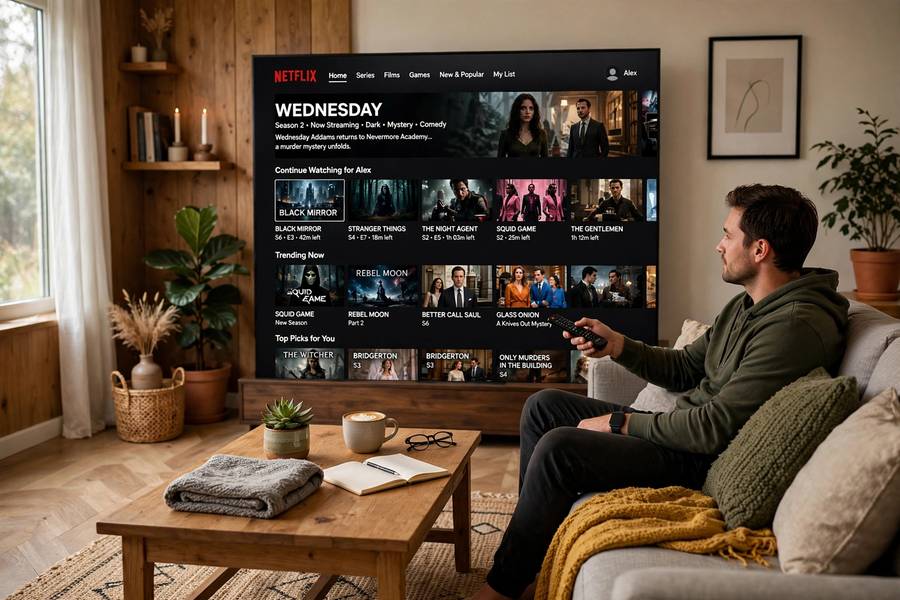
Here’s a party trick I sometimes do: I ask someone to open Netflix on their phone while I open it on mine, and we compare homepages. They’re never the same. Not the rows, not the order, not even the thumbnail artwork for the same show. Two people, same service, same moment — two completely different storefronts. Netflix doesn’t have a homepage. It has 200 million homepages, each assembled for an audience of one.
I’ve been fascinated by this system for years, partly because Netflix is unusually open about how it works — their engineers publish papers and blog posts detailing the machinery. This guide walks through it: the famous rows, the two-tier ranking, the artwork personalization, and why your Netflix looks nothing like your neighbor’s. For the general principles behind all of this, see how recommendation algorithms work.
Table of Contents
- The Homepage Is Not a Page
- Row One: Choosing Which Rows You See
- Row Two: Ranking Titles Inside Each Row
- The Signals: What Netflix Knows About You
- Collaborative Filtering at Netflix Scale
- The Artwork Trick: Same Show, Different Thumbnail
- Offline, Online, and Nearline: The Three Clocks
- Why Your Netflix Looks Nothing Like Mine
- Frequently Asked Questions

The Homepage Is Not a Page
Forget the idea of Netflix having a catalog you browse. What you see is a generated interface: a set of horizontal rows (“Trending Now,” “Because You Watched…,” “Critically Acclaimed Comedies”), each containing a ranked list of titles. Every element — which rows appear, their order, which titles are in them, the titles’ order, even the artwork — is chosen by algorithms, for you, right now.
The system that does this is really two systems stacked: one decides the rows, another ranks within them. Netflix engineers describe it as a two-tier ranking problem, and understanding the tiers is the key to understanding everything else.
The scale is worth appreciating: this runs for hundreds of millions of profiles, across thousands of device types, in dozens of languages, with the catalog differing by country. And it recomputes constantly — your homepage this evening reflects what you watched this afternoon.
Row One: Choosing Which Rows You See
The first tier answers: which rows deserve space on your screen? Netflix has hundreds of possible row types — genre rows, mood rows, “because you watched” rows, trending rows, new-release rows, rows built around a single actor or director you like.
Each row is scored for you personally. The scoring considers your viewing history, the row’s historical performance with people like you, and contextual factors like time of day and device. A “late-night comedy” row scores higher at 11pm; a “kids’ shows” row scores higher on a tablet profile registered as a child.
Rows also compete. Your screen fits only so many, so the system picks the top-scoring set with diversity constraints — it won’t show you five near-identical thriller rows even if they’d all score well. The diversity rules are deliberate: Netflix wants you to feel the catalog is vast, not repetitive.
This is why the rows feel so personal yet so familiar. The row concepts are universal (“Trending Now” exists for everyone); the selection and ordering are yours alone.
Row Two: Ranking Titles Inside Each Row
Once the rows are chosen, the second tier ranks the titles within each row. This is the classic recommendation problem: given everything Netflix knows about you and every title in the catalog, order them by predicted relevance.
The ranking model predicts the probability you’ll engage with each title — not just click, but actually watch and enjoy. Netflix learned long ago that clicks are a noisy signal (we all click on things we abandon in four minutes), so the training target is closer to “meaningful viewing”: did you watch substantially, did you finish, did you come back for more episodes.
Position matters enormously. Titles in the first few slots of the first few rows get orders of magnitude more viewing, which creates a feedback loop: popular titles get prominent placement, which makes them more popular. Netflix’s engineers are aware of this and deliberately inject exploration — showing you things the model is uncertain about — to keep the system learning and to keep your experience fresh.
The Signals: What Netflix Knows About You
The algorithm’s raw material is your behavior, and it’s more granular than most people realize:
Viewing history. What you watched, when, on what device, for how long, whether you finished, whether you rewatched. Completion is the strongest positive signal; abandonment after a few minutes is the strongest negative one.
Interaction history. What you added to your list, what you rated (thumbs up/down replaced stars years ago — binary signals are cleaner), what you searched for, what trailers you watched.
Temporal patterns. When you watch (weekday evenings vs. weekend afternoons), how long your sessions run, whether you binge or sample. The system learns your rhythms.
Device and context. Phone viewing skews toward shorter content; TV toward movies and binges. The algorithm adjusts.
What it notably doesn’t use much: demographic data. Netflix has said explicitly that age, gender, and location matter far less than behavior. Two 30-year-olds can have nothing in common taste-wise, while a teenager in Seoul and a retiree in Ohio might share a profile of preferences. The system clusters by taste, not by census category — which is both more accurate and, frankly, more interesting.

Collaborative Filtering at Netflix Scale
The core technique is collaborative filtering — “people who liked what you liked also liked…” — executed at a scale that breaks naive implementations.
The classic version compares users directly: find people with similar taste, recommend what they loved that you haven’t seen. Netflix’s version is more sophisticated — it uses machine-learned embeddings, where every user and every title is represented as a point in a high-dimensional “taste space.” Titles you love cluster near each other; your profile sits near the cluster of your tastes. Recommendation becomes geometry: find titles near your position that you haven’t watched.
These embeddings capture subtle structure. The system discovers dimensions of taste that have no names — not “comedy” or “drama” but latent patterns like “slow-burn character studies with morally gray protagonists” — because the math finds clusters humans wouldn’t label. This is why Netflix recommendations sometimes feel eerily perceptive: they’re matching patterns in your behavior that you’d never articulate.
The embeddings are learned from the entire user base’s behavior, which is why the system improves with scale. Every viewing session by every user slightly refines the map. Your recommendations are built, in a real sense, from everyone else’s watching.
The Artwork Trick: Same Show, Different Thumbnail
My favorite detail: Netflix personalizes the artwork per user. The same show might show you a romantic-comedy-style thumbnail (the two leads smiling) while showing me an action-style one (explosion, dramatic lighting) — because the system predicts which visual framing will appeal to each of us.
This isn’t decoration; it’s a significant lever. Netflix has published that artwork choice measurably affects what people watch. The system tests thousands of artwork variants and learns which visual cues — faces vs. landscapes, bright vs. dark, which character featured — resonate with which taste clusters.
It’s also slightly unsettling when you notice it, which is why most people never do. But once you’ve seen the same title wearing three different faces across three profiles, you can’t unsee the machinery. Every pixel on that homepage is a prediction about you.
Offline, Online, and Nearline: The Three Clocks
A detail that reveals the engineering sophistication: Netflix computes recommendations on three timescales.
Offline computation runs periodically (think daily) and does the heavy lifting: training the big models, computing the embeddings, pre-ranking the catalog for each profile. This is the batch work that needs serious compute.
Nearline computation updates things within minutes to hours: you finished a series, and the “because you watched” rows refresh. Not instant, but same-session.
Online computation happens in real time when you open the app: given the precomputed rankings and your current context (time, device), assemble the actual page. This has to be fast — milliseconds — because nobody waits for a homepage to load.
The three clocks explain a common experience: you watch something, and your homepage doesn’t change immediately, but by evening it’s different. That’s the nearline clock catching up with your life. (This batch architecture differs from how live streaming works, where latency constraints force everything real-time — Netflix can afford three clocks because your homepage isn’t live video.)
Why Your Netflix Looks Nothing Like Mine
Pulling it together: your Netflix is the product of your behavioral history encoded as a position in taste space, two tiers of ranking (rows, then titles), personalized artwork, and three computation clocks — all filtered through your country’s catalog and your current context.
The result is a service that feels less like a store and more like a friend with unsettlingly good taste in recommendations. That feeling is engineered, and now you know the engineering.
One last thought: the system optimizes for your engagement, not your enrichment. It will happily serve you a ninth consecutive true-crime docuseries because the data says you’ll watch. The algorithm knows what you’ll click; only you know what you’ll be glad you watched. Use the “My List” feature deliberately, rate things honestly, and occasionally browse outside your rows. The machine learns from you — make sure you’re teaching it the right lessons.

Frequently Asked Questions
Netflix uses a two-tier system: one algorithm chooses which rows appear on your homepage, another ranks titles within each row. Both are driven by machine-learned models trained on your viewing behavior — what you watch, finish, rewatch, rate, and abandon — mapped against patterns from the entire user base.
Because Netflix generates a personalized homepage per profile. The rows, their order, the titles inside them, and even the thumbnail artwork are all selected by algorithms based on individual viewing behavior. Two profiles essentially never see the same homepage.
Yes. Netflix personalizes artwork, showing different thumbnails for the same title to different users based on predicted appeal. The system tests which visual cues — characters, mood, style — resonate with each taste cluster, and artwork choice measurably affects viewing.
Very little. Netflix has said behavioral signals — what you actually watch and enjoy — matter far more than demographics. The system clusters users by taste patterns, not census categories, which is why people of wildly different backgrounds can get similar recommendations.
Rate titles with thumbs up/down, use My List deliberately, watch things through when you enjoy them (completion is a strong signal), and use separate profiles for different viewers or moods. The algorithm learns from behavior, so clean, honest signals produce better recommendations.