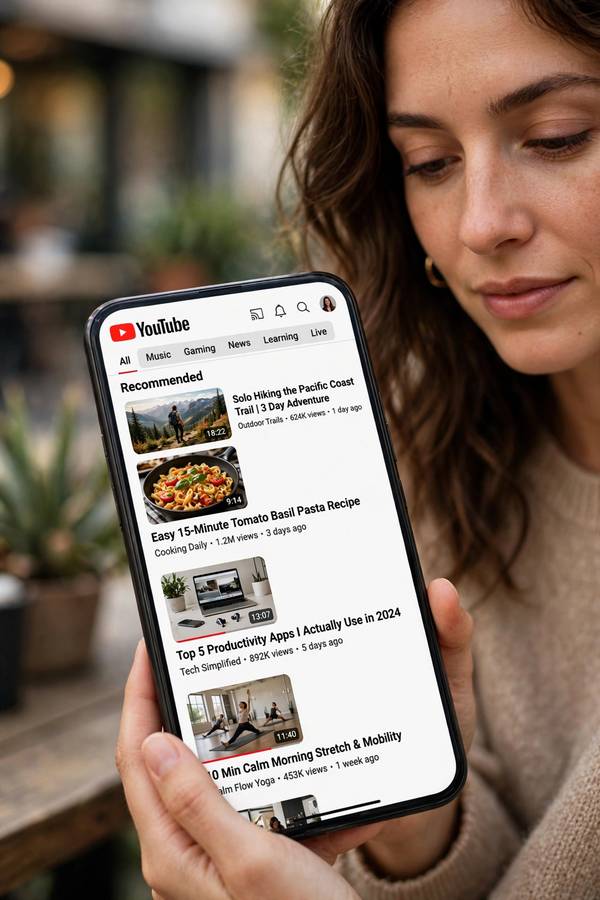
YouTube’s recommendation system is responsible for more than 70% of watch time on the platform. Read that again: the majority of what humanity watches on YouTube wasn’t searched for — it was suggested. The algorithm isn’t a feature of YouTube. It is YouTube, the way the engine is the car.
I find this both marvelous and slightly alarming, and I’ve spent a lot of time understanding the machinery because it shapes what billions of people learn, believe, and care about. YouTube’s engineers have published unusually detailed papers on it, so we know more about this system than almost any other at scale. Here’s how it works: the two-stage ranking, the signals, the Shorts disruption, and the optimization target that explains nearly everything about your feed. The general principles are covered in how recommendation algorithms work.
Table of Contents
- The Scale Problem (Why YouTube Can’t Just List Videos)
- Stage One: Candidate Generation
- Stage Two: Ranking
- The Signals: What the Algorithm Watches
- Watch Time: The Metric That Rules Everything
- Shorts Changed the Game
- The Homepage, Up Next, and Search: Three Different Jobs
- Rabbit Holes: Bug or Feature
- How to Train Your Algorithm
- Frequently Asked Questions
The Scale Problem (Why YouTube Can’t Just List Videos)
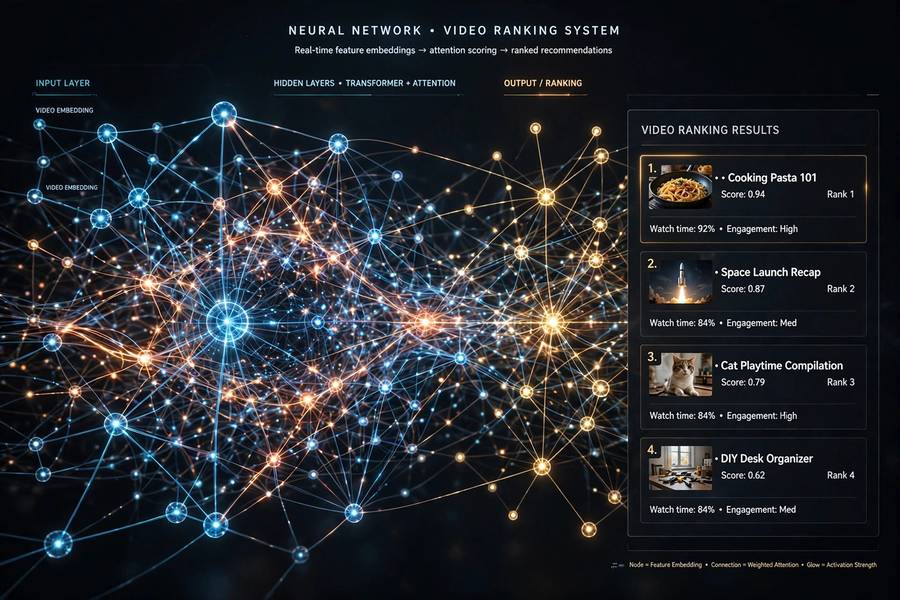
Start with the absurdity of the problem: hundreds of hours of video uploaded every minute, billions of videos in the corpus, two billion users. For each user, at each moment, the system must select a few dozen videos from billions. No model can score billions of candidates in milliseconds. So YouTube splits the problem in two — a coarse filter, then a fine ranker. This two-stage architecture, described in YouTube’s own published research, is the skeleton key to the whole system.
The two stages have different jobs, different models, and different constraints. Understanding them separately is the only way the system’s behavior makes sense — including its most criticized behaviors.
Stage One: Candidate Generation
Candidate generation takes billions of videos and narrows them to a few hundred candidates per user. It has to be fast and broad — more like a bouncer with a guest list than a sommelier.
The technique: the system learns an embedding for each user (based on their watch history, searches, and interactions) and retrieves videos whose embeddings are “close” to the user’s — videos watched by similar users, videos similar to ones the user enjoyed. This is collaborative filtering at planetary scale, implemented as a neural network that maps users and videos into the same space.
The candidate set is deliberately broad and diverse-ish: some videos very close to your established tastes, some from adjacent interests, some broadly popular. The stage-one model doesn’t need to be precise — it needs to not miss. Precision is stage two’s job. If a video never makes the candidate set, it effectively doesn’t exist for you, which is why this quiet first filter shapes your information diet as much as the visible ranking.
Stage Two: Ranking
The ranking stage takes the few hundred candidates and scores each one with a much richer model — hundreds of features per video-user pair — then orders them. This is where the real personalization happens.
The ranker predicts, for each candidate: how likely are you to watch it, how long will you watch, will you like/comment/share/subscribe, will you dismiss it (“not interested” is a strong negative signal). These predictions combine into a single score, weighted by what YouTube has decided to optimize for — which brings us to the metric that explains your entire feed.
The ranking model is retrained continuously on fresh interaction data. Your feed this week reflects what worked last week, for you and for people like you. It’s a living system, constantly re-tuning itself to the moving target of human attention.
The Signals: What the Algorithm Watches
The ranker consumes an enormous feature set. The important ones:
Watch history. Not just what you clicked — what you actually watched, and for how long. A click followed by a 10-second bounce is a negative signal wearing a positive disguise; the system knows the difference.
Engagement depth. Likes, comments, shares, subscribes, playlist adds. Explicit actions are rarer than views but much stronger signals — they’re the user telling the system what they want more of, on the record.
Session context. Time of day, device, how long you’ve been watching. Late-night mobile sessions get different recommendations than Sunday-morning TV sessions. The algorithm knows your rhythms.
Video features. The video’s own history: its average view duration, click-through rate, velocity (how fast it’s gaining views), and freshness. New videos get an exploration boost — the system needs data on them, so it shows them to likely-interested users to learn.
Negative signals. “Not interested,” “don’t recommend channel,” quick dismissals, and the subtle one: videos you consistently scroll past. The algorithm tracks what you ignore as carefully as what you watch.
Watch Time: The Metric That Rules Everything
Here’s the explanatory key to YouTube: the system’s primary optimization target is watch time — more precisely, expected watch time per impression. Not clicks. Not likes. Time spent watching.
This single choice explains an enormous amount. Why are videos getting longer? Because longer videos that retain viewers generate more watch time per click. Why does the algorithm favor channels you binge? Because session watch time compounds. Why does “up next” autoplay feel so sticky? Because removing the decision point between videos maximizes continuous viewing.
YouTube has said it also considers “satisfaction” — survey responses, likes, dismissals — as a counterweight to raw watch time, precisely because pure watch-time optimization has known pathologies (outrage and conspiracy content are extremely watchable). The satisfaction signals are real but secondary; watch time remains the gravitational center.
Once you see this, you can’t unsee it. Every recommendation is a bet: “this video will keep this person watching.” The algorithm doesn’t care if the video enriches you, informs you, or wastes your evening. It cares whether you keep watching. That gap — between what keeps you watching and what’s good for you — is where all the criticism of YouTube lives.
Shorts Changed the Game
Shorts — YouTube’s TikTok competitor — run on a modified version of the system with one crucial difference: the feedback loop is brutally fast. A 30-second video gives the algorithm a complete data point (watched fully? swiped away? replayed?) in half a minute. Long-form takes twenty minutes to generate the same signal.
This speed changes the dynamics. Shorts recommendations adapt to your taste within a single session — watch three woodworking shorts and the feed pivots hard. It also intensifies the optimization: with thousands of micro-decisions per session, the system can fine-tune to your impulses with frightening precision.
The other change: Shorts collapsed the creator barrier. The recommendation system that once elevated polished long-form creators now equally elevates phone-shot 20-second clips, because the metric doesn’t care about production value. This democratized reach and flooded the system with content, making the candidate-generation stage work even harder.
For users, the practical effect is a feed that’s more reactive, more impulsive, and harder to put down. The algorithm learned your reflexes, not just your preferences.
The Homepage, Up Next, and Search: Three Different Jobs
The algorithm wears three hats, and they optimize differently:
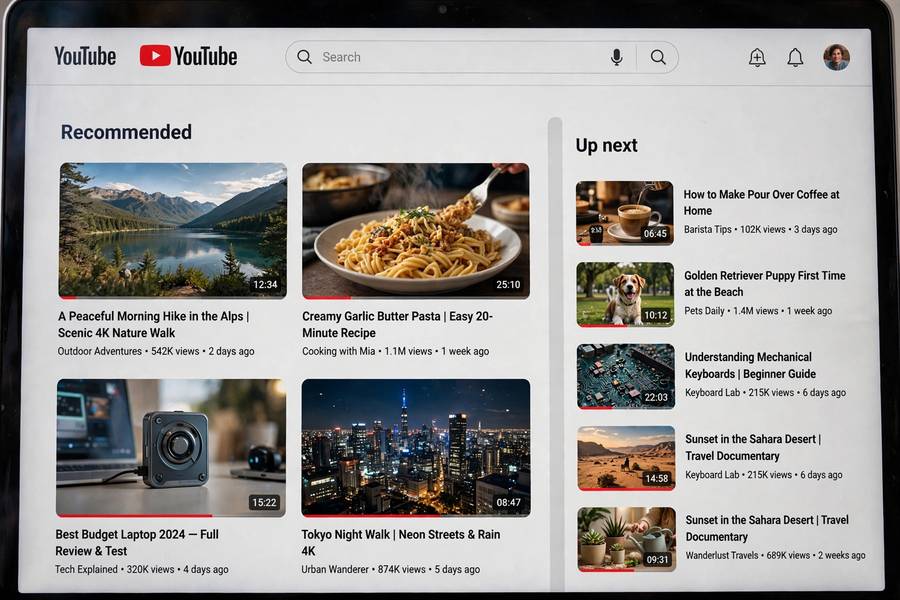
Homepage is pure personalization: “here’s what we think you’ll want, based on everything.” Broad, exploratory, tuned to your taste profile.
Up Next (the sidebar/autoplay) is contextual: “given the video you’re watching now, here’s what follows.” It blends your profile with the current video’s neighborhood — which is why autoplay can walk you from a cooking video to increasingly extreme content: each step is a small, reasonable hop, but the path drifts.
Search is intent-driven: “here’s what matches your query, personalized.” Relevance to the query dominates, with your history as a tiebreaker. It’s the least “algorithmic” of the three in the mysterious sense — closer to traditional search with personalization layered on. YouTube also serves live content — how live streaming works under the hood — and live videos get ranked with an added recency and concurrency boost.
Understanding which hat you’re wearing explains a lot of confusing experiences. “Why is my search full of stuff I didn’t ask for?” — personalization tiebreakers. “Why did autoplay take me somewhere weird?” — contextual drift, hop by hop.
Rabbit Holes: Bug or Feature
The famous criticism: YouTube’s recommendations radicalize, pulling users toward extreme content. The research reality is more nuanced than the headlines, but the mechanism is real and worth understanding.
It works like this: the system optimizes for watch time; emotionally intense content — outrage, conspiracy, grievance — is extremely watchable; the Up Next panel offers small hops from mainstream to intense; each hop is locally reasonable (“people who watched this also watched…”); the path, iterated, leads somewhere the user wouldn’t have chosen directly. No one programmed radicalization. The metric discovered it.
YouTube has intervened: reducing recommendations of “borderline” content, adding information panels, tuning satisfaction signals against pure watch time. These help at the margins. But the underlying dynamic — optimize for engagement, discover that intensity engages — is structural, not a bug to patch. It’s the predictable output of the objective function, and it will keep producing versions of this problem as long as the objective stands.
The user-side defense is awareness plus the tools YouTube provides: “not interested,” “don’t recommend channel,” watch history controls, and the nuclear option of clearing history to reset the profile. The algorithm is powerful, but it’s still trainable — by you.
How to Train Your Algorithm
Practical steps, since you’re stuck with this system:
Use “not interested” aggressively. It’s the strongest negative signal available. Don’t just scroll past junk — tell the system. It listens.
Curate with intention. Like, subscribe, and add to playlists deliberately. Every explicit action is a vote. Passive watching trains the algorithm on your impulses; explicit actions train it on your intentions.
Separate profiles by context. Kids’ viewing on a kid profile, work research on a separate account or in incognito. Mixed signals produce a confused feed.
Audit your watch history. Periodically review and delete the sessions that don’t represent you — the rabbit holes, the accidental clicks, the “someone else used my account” marathons. Your history is the training data; keep it clean.
Remember the objective. The algorithm maximizes your watch time, not your wellbeing. When you feel the pull of “just one more,” that’s the system working as designed. The off button is the only feature it can’t optimize around.
Frequently Asked Questions
YouTube uses a two-stage system: candidate generation narrows billions of videos to a few hundred using your behavioral profile, then a ranking model scores each candidate on predicted watch time, engagement likelihood, and satisfaction signals. The top scorers fill your homepage and Up Next panel.
Watch time — specifically expected watch time per impression. The system primarily optimizes for keeping you watching, with likes, survey responses, and dismissal signals as secondary satisfaction measures. This is why longer, bingeable content tends to be favored.
Usually because of mixed signals in your history — someone else used your account, you watched something out of curiosity once, or you scroll past without using “not interested.” The algorithm learns from behavior, so clean signals (explicit likes, dislikes, and “not interested” clicks) produce better recommendations.
The mechanism is real: Up Next offers small hops from video to video, and since intense content generates high watch time, iterated hops can drift toward extreme material. YouTube has added countermeasures, but the dynamic follows from optimizing for engagement. Using “not interested” and managing watch history are the main user defenses.
Shorts use the same two-stage system but with a much faster feedback loop — each 30-second video gives a complete watch-or-skip data point almost instantly. This makes Shorts feeds adapt within a single session and tune very precisely to impulsive viewing patterns.