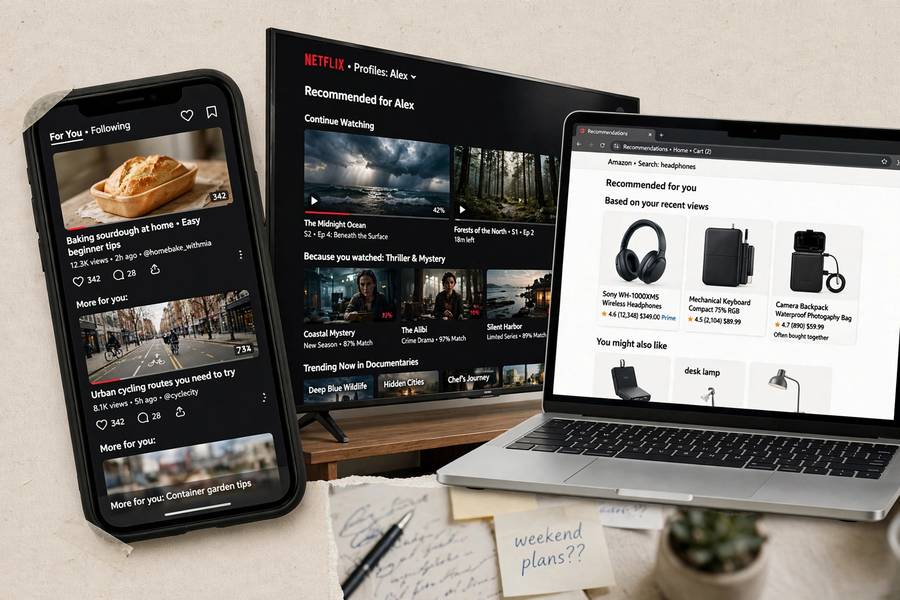
Here’s a thought experiment I like: count how many recommendation algorithms shaped your day before lunch. The news you scrolled, the music you played, the video that autoplayed, the product suggestion in your inbox, the route your map app chose. For most people the answer is somewhere between five and ten — before noon. Recommendation systems aren’t a corner of the internet anymore. They’re the water we swim in.
This guide tours nine of them — the systems you actually encounter daily — with a focus on what makes each one different. Because while they share mathematics, they differ in objective, data, and personality, and those differences explain your experience of each. The shared foundations are in how recommendation algorithms work.
Table of Contents
- 1. Netflix: The Taste Cartographer
- 2. YouTube: The Watch-Time Maximizer
- 3. TikTok: The Fast Learner
- 4. Spotify: The Three-Engine Listener
- 5. Amazon: The Purchase Predictor
- 6. Instagram Explore: The Interest Mapper
- 7. Google Search: The Intent Interpreter
- 8. News Feeds: The Attention Auctioneers
- 9. Dating Apps: The Mutual Matchers
- What the Differences Teach Us
- Frequently Asked Questions
1. Netflix: The Taste Cartographer
What it optimizes: meaningful viewing — completions, continued watching, retention.
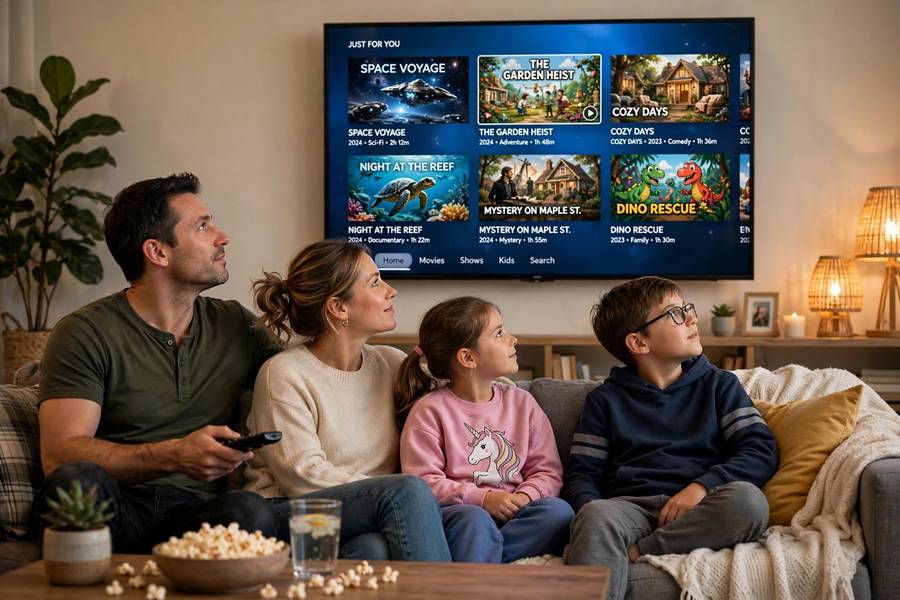
How it works: two-tier ranking (choose rows, then rank titles within rows) driven by neural embeddings that map users and titles into a shared taste space. Personalized artwork per user. Computed on three clocks: offline (daily model training), nearline (hourly updates), online (real-time page assembly).
What makes it different: the row interface makes the personalization visible — you can literally see the system organizing your taste into categories. And the artwork personalization (same show, different thumbnail per user) is the most granular visual targeting in consumer tech.
The personality: a knowledgeable friend with slightly mainstream taste. Rarely shocking, usually satisfying, occasionally eerily perceptive about what you’ll love.
2. YouTube: The Watch-Time Maximizer
What it optimizes: expected watch time per impression, with satisfaction signals as a secondary weight.
How it works: two-stage pipeline — candidate generation (neural retrieval from billions of videos down to hundreds) then ranking (hundreds of features scored per candidate). Separate behaviors for homepage (pure personalization), Up Next (contextual), and search (intent + personalization).
What makes it different: the sheer scale of the corpus and the primacy of watch time as the objective. No other system is as purely optimized for keeping you engaged, which makes it the most powerful and the most criticized.
The personality: an obsessive archivist who noticed you watched one video about submarines and now believes submarines are your entire identity. Generous, relentless, occasionally alarming in its conclusions about you.
3. TikTok: The Fast Learner
What it optimizes: session time and retention, driven primarily by completion rate.
How it works: the For You Page ranks short videos using dense behavioral signals — completions, replays, skips, likes — with new videos distributed in staged test batches that expand based on engagement. Interest graph, not social graph: content performance matters more than follower counts.
What makes it different: learning speed. Short videos generate behavioral data an order of magnitude faster than long-form, so the system converges on your taste in minutes rather than weeks. The full-screen single-video interface makes every swipe a clean signal. (Creators navigating this system should read how to grow on TikTok.)
The personality: a mind-reader with no social graces. Astonishingly quick to understand you, utterly uninterested in broadening you. The friend who finds your niche and never lets you leave it.
4. Spotify: The Three-Engine Listener
What it optimizes: listening time and discovery satisfaction — streams, saves, playlist adds, completion.
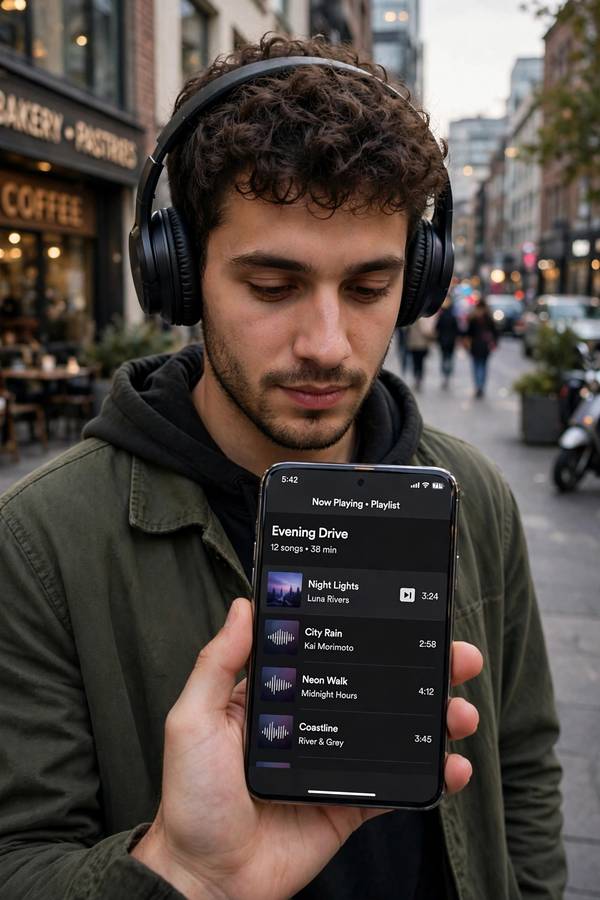
How it works: three combined engines — collaborative filtering (taste neighbors), audio analysis (sonic fingerprints: tempo, energy, danceability), and NLP on web text about music (cultural context). Discover Weekly leans collaborative; Release Radar leans audio/NLP for new tracks.
What makes it different: it’s the only major system that analyzes the content itself at scale — the audio fingerprinting means it can recommend songs nobody has heard yet, purely by how they sound. The NLP layer captures cultural meaning the audio can’t.
The personality: a DJ friend with deep crates. Great at “more like this,” surprisingly good at left-field discoveries, occasionally confused by your ironic listens and your kids’ favorites polluting the profile.
5. Amazon: The Purchase Predictor
What it optimizes: purchase conversion — the probability you’ll buy, and the value of the basket.
How it works: item-based collaborative filtering at massive scale (precomputed item relationships from purchase correlations), layered with deep learning. Personalizes homepage, search ranking, product-page carousels, cart suggestions, and follow-up emails.
What makes it different: the stakes (money, not minutes) and the sparsity (you buy far less often than you watch). Also the sponsored/organic split — a growing share of “recommendations” are paid placements, which no other system on this list does at the same scale.
The personality: a salesperson who remembers everything you ever bought and won’t stop suggesting accessories. Genuinely helpful for complements (“you’ll need the memory card”), relentless about the rest.
6. Instagram Explore: The Interest Mapper
What it optimizes: engagement time and interaction — likes, shares, saves, follows from discovery.
How it works: the Explore page (and Reels feed) rank content from accounts you don’t follow, using your interaction history to map interest clusters. Heavy on visual content features and social signals — what’s performing well within your interest neighborhoods.
What makes it different: the blend of social graph (your follows) and interest graph (Explore). Instagram straddles both worlds — your feed is who you know, Explore is what you like. The Reels push added TikTok-style fast learning to the mix.
The personality: a trend-spotter friend. Great at showing you what’s blowing up in your interest areas, prone to aesthetic convergence — everyone’s Explore starts looking similar within a niche.
7. Google Search: The Intent Interpreter
What it optimizes: task completion — did the search resolve your need (measured by clicks, dwell, reformulation rates, and increasingly by AI-overview satisfaction).
How it works: classic information retrieval (crawl, index, rank) now fused with AI: query understanding via language models, personalized re-ranking based on history and location, and AI-generated overviews synthesizing top results. Less “recommendation” in the feed sense, more “recommendation of information for a stated need.”
What makes it different: it’s pull, not push — you ask, it answers. The intent is explicit (your query), so the system doesn’t need to guess what you want, only which information best satisfies it. The AI Mode evolution is blurring this into answer-engine territory.
The personality: a librarian with infinite patience and slight corporate caution. Answers what you ask, rarely volunteers more, increasingly summarizes so you don’t have to read.
8. News Feeds: The Attention Auctioneers
What it optimizes: engagement — time, interactions, return visits. (Facebook, X, LinkedIn each tune differently, but engagement is the common core.)
How it works: rank posts from your network (and increasingly, non-network content) by predicted engagement: your relationship with the poster, the post’s early performance, content features, recency. LinkedIn weights professional relevance; X weights velocity and your interaction graph; Facebook weights meaningful interactions (comments, shares over likes).
What makes it different: the inventory is your social world, not a catalog. The system mediates relationships, not just content — which posts from which friends you see shapes your social reality. The stakes are civic as well as personal: these feeds influence elections, movements, and public discourse.
The personality: a gossip who decides which of your friends’ news reaches you. Powerful, opaque, and the one on this list with the most contested societal impact.
9. Dating Apps: The Mutual Matchers
What it optimizes: mutual engagement leading to matches and conversations (and ultimately, retention — the cynical note being that a dating app that works too well loses customers).
How it works: two-sided recommendation — the system must predict not just who you’ll like, but who’ll like you back. Tinder’s famous Elo-style desirability scoring (now evolved into more complex models) ranks profiles; Hinge uses preference learning from your likes and passes; all use collaborative signals (people with your taste liked these profiles) plus content features (photos, prompts, stated preferences).
What makes it different: it’s the only recommender here that’s fundamentally two-sided. A great recommendation isn’t one you’ll like — it’s one where the liking is mutual. The system solves a matching problem, not just a ranking problem, which adds a layer of game theory the others don’t have.
The personality: a well-meaning but slightly manipulative matchmaker. Shows you people calibrated to keep you swiping — attractive enough to stay, not so perfect you leave.
What the Differences Teach Us
Step back and the pattern is clear: every system’s personality is its objective function wearing a user interface. Change what you optimize for and you change the system entirely — same math, different soul.
This is why “the algorithm” is never one thing. YouTube’s watch-time maximizer and Spotify’s discovery engine share techniques but produce opposite experiences: one narrows toward engagement, the other broadens toward taste. The difference isn’t the neural networks — it’s what they’re told to want. And each objective produces its own failure modes — the examples of AI bias in recommendations trace back to exactly these design choices.
Three practical lessons:
1. Know the objective. Before trusting any recommender, ask what it optimizes for. Engagement? Purchases? Matches? The objective explains the behavior — including the behaviors that feel wrong.
2. Feed it deliberately. Every system on this list learns from behavior. Explicit signals (likes, saves, “not interested,” follows) are your steering wheel. Passive consumption is autopilot — and autopilot optimizes for the company’s metric, not yours.
3. Diversify your inputs. No single system sees all of you. The user who only lets TikTok learn their taste gets a different self-portrait than the one who also curates Spotify, reads widely, and browses deliberately. You are the only integrator of your own information diet — act like it.
The water we swim in is engineered. Knowing the engineering doesn’t mean you stop swimming — it means you choose your strokes.
Frequently Asked Questions
Everyday examples include Netflix’s personalized rows, YouTube’s Up Next and homepage, TikTok’s For You Page, Spotify’s Discover Weekly, Amazon’s “customers also bought,” Instagram Explore, Google Search personalization, social media news feeds, and dating app matching systems.
It depends on the task. TikTok learns fastest, Spotify is best at content-based discovery through audio analysis, Amazon dominates purchase prediction, and Netflix excels at taste mapping. Each is optimized for a different objective, so “best” really means “best at what it’s designed to do.”
They share core techniques — collaborative filtering, content-based filtering, and neural embeddings — but differ in objective (watch time vs. purchases vs. matches), data (behavioral vs. content features), and interface. The objective function shapes each system’s behavior more than the shared mathematics.
Use explicit signals deliberately: like, save, follow, and tap “not interested” on unwanted content. Keep separate profiles for different contexts, periodically clear history that doesn’t represent you, and remember that every system learns from behavior — passive scrolling trains it on your impulses, not your intentions.