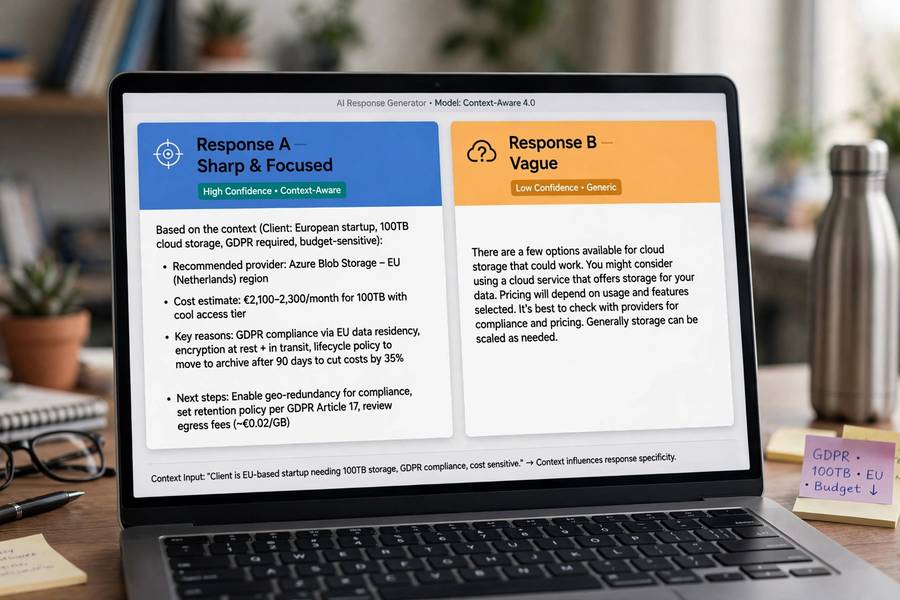
Most people treat the context window as a container — stuff goes in, answers come out, size is the only variable. But the window’s contents actively shape responses in ways that go far beyond “fits or doesn’t fit.” What’s in the window, where it sits, how much there is, and what’s stale versus fresh — all of it influences the quality, style, and accuracy of what the AI produces. The window isn’t a bucket; it’s an environment, and environments shape behavior.
This guide explains the mechanisms by which context affects responses and the practical implications for getting better outputs. For the basics, see what a context window is.
Table of Contents
- Beyond Capacity: Context as Environment
- Relevance: The Signal-to-Noise Effect
- Position Effects: Primacy, Recency, and the Middle
- Style Contagion: The Window Sets the Tone
- Stale Context: When Old Information Misleads
- Contradictions in Context: How Models Cope
- The Few-Shot Effect: Examples as Programming
- Managing Context for Better Responses
- A Worked Example: The Same Question, Two Different Contexts
- Frequently Asked Questions

Beyond Capacity: Context as Environment
The standard mental model — window as container with a size limit — misses most of the story. Better model: the window is the model’s entire perceived world for this response. It doesn’t know what you meant, what you know, or what’s true — it knows what’s in the window, plus its training. Every token in there is evidence the model uses to infer what you want and what a good response looks like.
This means context management is response engineering. The same question gets different answers depending on what surrounds it — not because the model is inconsistent, but because it’s (correctly, from its perspective) responding to different evidence. Change the environment, change the behavior. Once you internalize this, “prompting” expands from “writing good questions” to “curating good contexts.”
Relevance: The Signal-to-Noise Effect
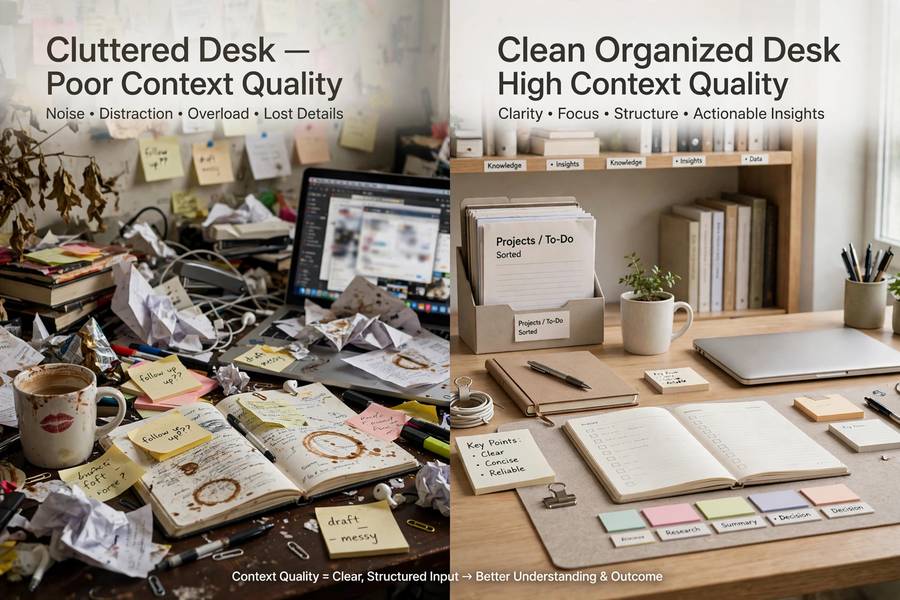
The most important quality variable: how much of the window is relevant to the current request.
High signal: a focused question with pertinent background. The model’s attention concentrates on useful information; responses are sharp, specific, well-grounded.
Low signal: the same question buried in 50,000 tokens of loosely related material. Attention dilutes across the noise; responses get vaguer, more generic, more likely to miss the point or hallucinate connections.
This is the attention-dilution effect, and it’s the strongest argument for context discipline. Every irrelevant token isn’t just wasted money — it actively degrades the response by competing for the model’s finite attention. The cleanest prompt often beats the most comprehensive one.
Practical rule: include what’s needed, exclude what’s merely related. “Might be useful” is the enemy of “actually useful.” When in doubt, start lean — you can always add context in a follow-up.
Position Effects: Primacy, Recency, and the Middle
Where information sits in the window affects how much the model uses it:
Primacy (beginning): gets extra weight. System instructions live here for a reason — the model treats early content as framing for everything after. Put durable instructions and critical context early.
Recency (end): also gets extra weight. The most recent messages strongly influence the immediate response — which is why conversations feel coherent turn-to-turn even when early context is weak.
The middle: systematically underweighted. Information buried mid-window — page 47 of your pasted document, the middle of a long conversation — is most likely to be overlooked. The “lost in the middle” research documents this clearly.
Strategic implications:
– Critical instructions: repeat at the beginning AND end for long contexts (the “sandwich” technique).
– Key facts the response must use: place near the end, just before the question.
– Reference material: beginning is fine for framing; but if the model must USE specific facts, consider extracting and repositioning them.
– Don’t trust middle placement for anything essential — verify.
These aren’t quirks to work around; they’re the physics of the system. Design with them, not against them.
Style Contagion: The Window Sets the Tone
The model mirrors the style of its context — this is one of the most powerful and least discussed effects:
Formal context → formal responses. Paste a legal document and ask a question; the answer comes back legalistic.
Casual conversation → casual responses. A chatty history produces chatty answers, even to new serious questions.
Technical material → technical register. Code and specs in context pull responses toward precision and jargon.
Examples define format. Show the model two Q&A pairs in a format, and it continues the format — this is few-shot prompting, and it works because of style contagion.
Use this deliberately: want concise answers? Keep context concise. Want thorough analysis? Include thorough material. The window teaches by example, constantly. And conversely — if responses feel “off” in tone, check what tone the context is setting. The model is often just matching its environment.
This is also why conversation history matters beyond facts: a long meandering chat produces meandering answers. Fresh conversations for focused tasks isn’t just about token economy — it’s about tonal hygiene.

Stale Context: When Old Information Misleads
Long conversations accumulate stale context — earlier statements that were true then but aren’t now:
Superseded instructions. “Write formally” from an hour ago still influences tone after you’ve moved to casual brainstorming. Old directives linger.
Outdated facts. “The deadline is Friday” — then it changed to Monday, but Friday lives in the history and the model may still reference it.
Abandoned directions. Exploration the conversation moved past — dead ends, rejected ideas — still occupy attention and can resurface confusingly.
Changed preferences. What you wanted at the start may differ from what you want now. The model doesn’t know which “you” to serve.
Management: explicitly update (“forget the Friday deadline — it’s Monday now”), periodically summarize-and-reset long conversations, and for important pivots, start fresh with a clean summary. Don’t assume the model tracks the evolution — it sees all versions simultaneously and must guess which is current.
Contradictions in Context: How Models Cope
When the window contains contradictions — and long contexts often do — models handle them… imperfectly:
They tend to favor recent over old. Recency wins most contradiction contests, which is usually (not always) what you want.
They sometimes blend. Averaging contradictory instructions produces mushy compliance with neither — the worst outcome, and hard to detect.
They rarely flag. The model won’t usually say “hey, these contradict” — it’ll just pick (or blend) silently. You must catch contradictions yourself.
The defense: keep contexts contradiction-free by design. When updating information, explicitly supersede (“X is no longer true; Y is”). For critical decisions, verify which version the model is using before building on it. And in long documents, be aware that internal contradictions in source material become contradictions in the model’s world.
The Few-Shot Effect: Examples as Programming
Including examples in context is the most powerful response-shaping technique — effectively programming by demonstration:
Format programming. Show the output format twice; the model adopts it. More reliable than describing the format in words.
Style programming. Examples in a voice teach the voice better than “write in a professional tone.”
Reasoning programming. Chain-of-thought examples teach the model to show work in a particular way — the technique behind much of prompt engineering’s power.
The mechanism: examples are just context the model mirrors (style contagion, applied deliberately). 2–5 good examples outperform pages of instructions for most formatting and style goals.
The cost: examples consume window space. For simple formats, 2 examples suffice; complex patterns may need more. Balance the programming value against the token cost — and remember that examples also dilute attention for everything else.
Managing Context for Better Responses
The practical synthesis — context hygiene for better outputs:
- Curate ruthlessly. Every token should earn its place. Relevance beats comprehensiveness.
- Position strategically. Critical content at beginning or end; never trust the middle for essentials.
- Mind the tone. The window’s style becomes the response’s style — curate accordingly.
- Update explicitly. Supersede stale information clearly; don’t let old and new coexist ambiguously.
- Fresh starts for fresh tasks. Don’t drag irrelevant history into new work — tonal and attentional hygiene.
- Use examples deliberately. Few-shot programming beats verbal instructions for format and style.
- Verify critical usage. For important tasks, check that the model actually used the key context — don’t assume.
- Learn how to get better answers from ChatGPT — the tactical companion to this strategic guide.
The meta-lesson: you’re not just asking questions, you’re designing the model’s world. World-design is the actual skill — and like all design, it’s about deliberate choices, not accumulation.
A Worked Example: The Same Question, Two Different Contexts
Same question — “Is this a good deal?” — asked about the same two-page term sheet, in two different contexts.
Context A: fresh conversation, term sheet pasted, question asked. The response cites specific clauses: the 2x liquidation preference in section 3, the vesting schedule, the pro-rata rights. Sharp, grounded, useful.
Context B: the same term sheet pasted two hours into a meandering conversation covering three other deals, a hiring discussion, and a long debate about office snacks. The response is vague — “the terms seem standard, though you should consider the liquidation preference” — generic observations that could apply to any term sheet.
Nothing about the model changed. Nothing about the question changed. The environment changed, and the environment is the response. I’ve run this comparison deliberately more than once, and Context B loses every time. Curate the world, get a better answer — it’s that mechanical.
Frequently Asked Questions
Beyond just capacity: relevance (signal-to-noise) determines sharpness, position affects usage (beginning/end weighted over middle), context style infects response tone, stale information misleads, and examples program behavior. The window is an environment shaping responses, not just a container.
Attention dilution (more tokens competing for finite attention), stale context (superseded instructions lingering), tonal drift (meandering history producing meandering answers), and lost-in-the-middle effects. Fresh conversations with curated summaries beat marathon sessions for focused work.
At the beginning (primacy effect, durable framing) or the end just before the question (recency effect). For long contexts, use both — the “sandwich” technique. Never bury critical instructions in the middle, where they’re systematically underweighted.
Including examples in the prompt to teach the model a format, style, or reasoning pattern by demonstration. 2–5 good examples typically outperform pages of verbal instructions. It works through style contagion — the model mirrors its context — applied deliberately.
No — relevance beats comprehensiveness. Every irrelevant token costs money AND degrades responses through attention dilution. Include what’s needed, exclude what’s merely related. Start lean; add context in follow-ups if needed.
Keep reading: