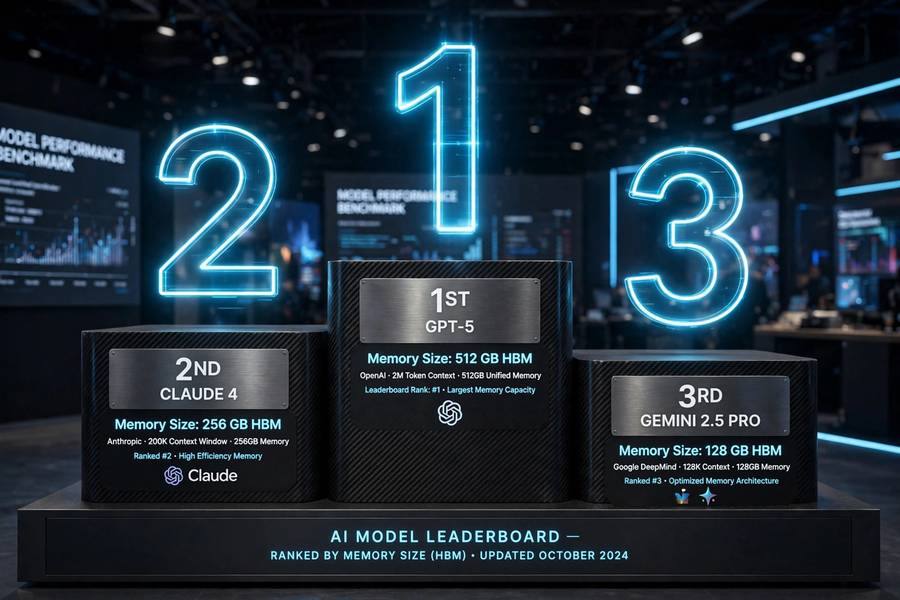
The context window arms race is AI’s most entertaining spec war: millions of tokens announced like horsepower figures, each lab outbidding the last, the numbers growing faster than anyone’s ability to use them. But as with horsepower, the headline number tells you less than the fine print — and the fine print (effective comprehension, cost, availability) is where the real comparison lives.
This guide surveys the landscape: who’s offering what, what the numbers mean in practice, and how to think about “largest” beyond the marketing. For the underlying concept, see what a context window is.
Table of Contents
- The Current Landscape (and Why Dates Matter)
- The Major Players and Their Numbers
- Advertised vs Effective: The Number Behind the Number
- Why Labs Race on Context Size
- The Trade-offs of Giant Windows
- Open Models: The Other Race
- How to Actually Compare
- Does “Largest” Matter for You?
- The 15-Minute Test That Beats Any Leaderboard
- Frequently Asked Questions
The Current Landscape (and Why Dates Matter)
A necessary disclaimer: this landscape moves FAST. Specific numbers in any article — including this one — decay within months. What’s stable: the major labs (those behind the leading AI assistants) all offer 128K–1M+ token windows on flagship models, the numbers keep growing, and the competitive dynamic shows no signs of slowing.
Rather than reciting figures that’ll be stale by publication, here’s how to read the landscape:
- Flagship models from major labs: 128K minimum, commonly 1M, pushing multi-million. If a flagship launched with less than 128K recently, that’s notable (and usually a cost-optimized variant).
- The frontier sits at 1M+ tokens, with experimental pushes toward 10M. These are real but come with real costs and caveats.
- Mid-tier and efficient models often offer 32–128K — plenty for most uses, at better prices.
When evaluating any specific claim, check the date. A “largest ever!” announcement from last year is today’s mid-range. The only durable knowledge is the framework for evaluation — which is what this guide teaches.
The Major Players and Their Numbers
Without pretending to be a live leaderboard, the pattern among leading AI labs:
The frontier labs (behind the most capable assistants) compete directly on context size — it’s a headline feature in every major release. Their flagships define the state of the art, and each release tends to push the number higher.
The efficiency players offer smaller windows at dramatically lower prices — 32–128K with excellent quality per dollar. For most applications, these are the rational choice.
The open ecosystem (open-weight models) has closed the gap remarkably — million-token open models exist, though serving them requires serious hardware.
The specialists — models optimized for specific domains or constraints — trade window size for other virtues (speed, cost, capability in their niche).
The competitive dynamic: context size is one of the few specs that’s both easily marketable (“1 million tokens!”) and genuinely useful, so it gets emphasized. But it’s not the only axis — and often not the most important one.
Advertised vs Effective: The Number Behind the Number
The most important section of this guide. Every context window claim has two numbers:
Advertised: tokens the model accepts. The marketing number. The API won’t reject your 1M-token input.
Effective: tokens the model actually uses well. Measured by needle-in-haystack tests, long-context benchmarks, real-task performance. Almost always smaller — sometimes dramatically.
The gap varies by model and task: – Retrieval (find this fact): effective windows closest to advertised, but still degrade with length. – Multi-hop reasoning (connect facts across the span): the gap widens significantly. – The middle problem: information in the middle of long contexts is systematically underused.
How to assess effective size: look for independent long-context benchmark results (there are established suites now), not just the headline number. A model with a 500K window that uses 400K well beats a 2M-window model that effectively uses 200K — but only the benchmarks reveal this.
The rule: divide advertised claims by your skepticism. For critical applications, test with your content at your lengths. The spec sheet is a starting point, not a guarantee.
Why Labs Race on Context Size
Understanding the incentives explains the marketing:
It’s legible. “1 million tokens” is instantly graspable in a way “better reasoning” isn’t. Marketing loves legible numbers.
It enables demos. “Watch it analyze 500 documents at once” is a compelling demo — visceral in a way benchmarks aren’t.
It’s genuinely useful. Unlike some spec races, this one delivers real capability — long context enables real applications. The race isn’t pure theater.
It’s competitive differentiation. When models are close on quality, context size is a clear axis to win on.
It drives infrastructure moats. Serving giant windows requires serious systems engineering — a capability advantage that’s hard to replicate quickly.
But the race also distorts: labs optimize for the headline number sometimes ahead of effective comprehension, and users overvalue size relative to other qualities. Healthy skepticism about any single metric applies.
The Trade-offs of Giant Windows
Bigger isn’t free — the costs:
Price. Input pricing scales with tokens. Giant windows mean giant per-query costs. The most capable long-context models are also the most expensive per token.
Latency. Processing millions of tokens takes time — seconds to tens of seconds for the largest windows. Real-time applications can’t wait.
Attention dilution. The more in the window, the less attention per token. Giant windows can produce worse results than focused smaller ones for tasks not needing the scale.
Diminishing returns. Going from 8K to 128K transformed usage. Going from 1M to 10M? The marginal applications are narrower. The transformative jumps get rarer as numbers grow.
Evaluation difficulty. Testing million-token comprehension is itself hard — the benchmarks are still maturing, which means claims are harder to verify.
The pattern: each order of magnitude costs more and delivers less marginal transformation than the last. We’re past the revolutionary jumps into evolutionary refinement — still valuable, but with clearer-eyed cost-benefit thinking.
Open Models: The Other Race
The open-weight ecosystem deserves separate mention:
The gap closed fast. Open models now offer context windows competitive with proprietary flagships — a remarkable achievement given the resource asymmetry.
The serving challenge. A million-token open model needs enormous GPU memory to actually run — the weights are free, the hardware isn’t. “Available” and “usable” differ.
The customization advantage. Open models can be fine-tuned for long-context tasks, extended with new techniques, deployed privately. For organizations with the infrastructure, this flexibility outweighs raw window size.
The trend: open windows keep growing, and efficient architectures (state-space models, hybrids) may eventually deliver huge effective contexts on modest hardware. The open race matters because it democratizes the capability.
How to Actually Compare
Forget the leaderboard. Compare on what matters for YOUR use:
- Effective comprehension at YOUR lengths — benchmark with your content, not synthetic needles.
- Cost per task — not per token, per completed task. A cheaper model needing 3 attempts loses to a pricier one-shot.
- Latency — does it respond fast enough for your application?
- Ecosystem — tooling, documentation, community, reliability. The model doesn’t exist in isolation.
- The other qualities — reasoning ability, instruction following, output quality. A giant window on a mediocre model is still mediocre.
The “best” model is the best for your specific task at your specific constraints. Leaderboards optimize for generality; you should optimize for specificity. Understanding how ChatGPT works as a product — not just a model — illustrates why the surrounding system often matters more than any single spec.
Does “Largest” Matter for You?
Probably less than you think:
Most tasks fit comfortably in 32–128K windows. If your documents are tens of pages, not thousands, the giant windows are irrelevant to you.
The tasks needing giant windows — corpus analysis, codebase comprehension, massive synthesis — are real but specialized. Know whether you’re actually in that territory.
The price of “largest” is real money and real latency. Pay it when the task demands it, not as a default.
Future-proofing is the one argument for caring — choosing platforms investing in long-context capability. But that’s about trajectory, not today’s number.
The healthy attitude: know the landscape, understand the trade-offs, choose based on your tasks. The memory crown is interesting; the right tool for your job is important. They’re rarely the same thing.
The 15-Minute Test That Beats Any Leaderboard
Forget benchmark tables. Here’s the test I actually run before committing to a model for long-context work — it takes fifteen minutes and tells you more than any leaderboard:
- Take YOUR actual document (not a synthetic test) at the length you’ll actually use.
- Plant five verifiable facts at known positions: one near the start, one at 25%, one dead center, one at 75%, one near the end. Use distinctive details — names, numbers, dates.
- Ask the model one question per fact, in separate fresh prompts (so answers don’t contaminate each other).
- Score it: 5/5 is excellent, 4/5 is workable, 3/5 means the effective window is much smaller than advertised for your content.
Then run the harder version: ask a question requiring connecting the 25% fact to the 75% fact — multi-hop reasoning across the span. This is where most models fall apart, and it’s the capability that actually matters for analysis work.
I’ve watched models with half the advertised window beat models with double it on this test. The leaderboard measures the spec; this measures your task. Fifteen minutes, five facts, one hard question — and you’ll know more than the marketing ever told you.
Frequently Asked Questions
The leadership changes frequently as labs compete — flagship models commonly offer 128K to 1M+ tokens, with experimental pushes toward 10M. Check current specs for exact numbers, but focus on effective comprehension (benchmarked) rather than just the advertised figure.
Advertised is tokens the model accepts; effective is tokens it actually uses well, measured by benchmarks. The gap is real — needle-finding degrades with length, middle content gets lost, and multi-hop reasoning over long spans is hardest. Test with your content at your lengths.
Probably not — most tasks fit in 32–128K windows. Giant windows matter for corpus-scale analysis, entire codebases, and massive synthesis. They cost significantly more per query and run slower. Choose based on your actual tasks, not the headline number.
Yes — open-weight models now offer windows competitive with proprietary flagships. The catch is serving: running million-token open models needs serious GPU hardware. The weights are free; the infrastructure isn’t. But the flexibility (fine-tuning, private deployment) is a real advantage.
It’s marketable (legible numbers), enables compelling demos, delivers genuine capability, differentiates competitively, and builds infrastructure moats. But diminishing returns apply — each order of magnitude costs more while delivering less marginal transformation than the last.