Parents ask me which is better — home daycare or a center — expecting a clear answer. There isn’t one. I have seen children thrive in both and struggle in both. The right choice depends on your child’s temperament, your family’s logistics, and what you actually value, not on which model has better marketing.
What I can give you is the honest comparison: where each model genuinely wins, where each genuinely loses, and the questions that reveal which fits your family. I write this as someone who advises childcare businesses — including the full process of how to start a daycare — so I know both models from the inside, including the parts neither side advertises.
Table of Contents
- The Core Difference in One Paragraph
- Home Daycare: The Real Pros
- Home Daycare: The Real Cons
- Daycare Center: The Real Pros
- Daycare Center: The Real Cons
- Cost Comparison
- Socialization: The Most Misunderstood Factor
- Which Fits Your Child
- Red Flags in Either Model
- Frequently Asked Questions
The Core Difference in One Paragraph
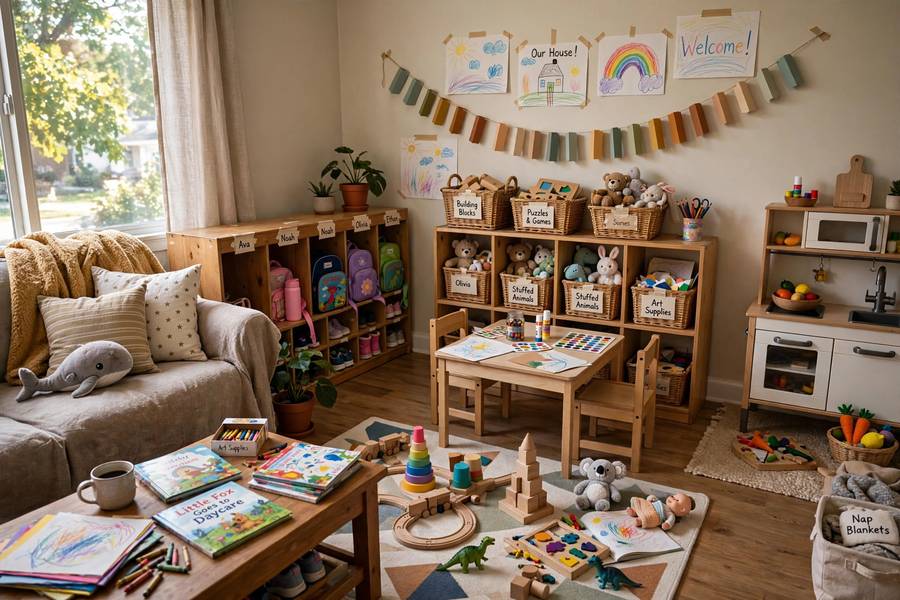
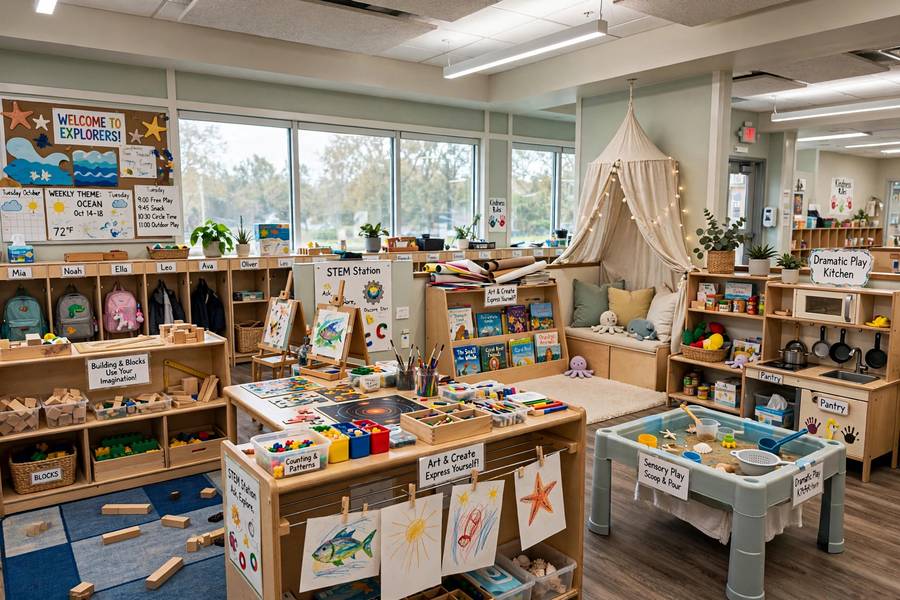
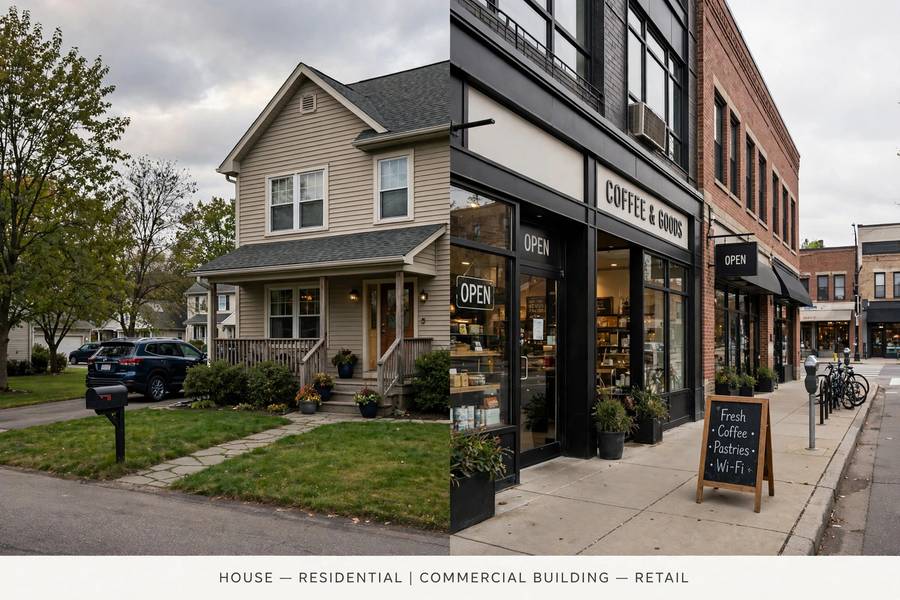
A home daycare is a small, mixed-age group (usually 6–12 children) cared for by one provider, often with an assistant, in a residence. A center is a larger commercial operation with age-separated classrooms, multiple staff, and institutional systems. The fundamental tradeoff: home daycare offers intimacy and flexibility; centers offer resources and redundancy. Everything else is detail.
Home Daycare: The Real Pros
Genuine intimacy. With 6–12 children and one consistent caregiver, your child is known — their quirks, their hunger cues, their nap patterns. That depth of individual attention is structurally impossible at center scale. For infants especially, this matters enormously.
Mixed-age socialization. Home daycares group ages together, which mirrors family and neighborhood life. Younger children learn from older ones; older children develop empathy and leadership. It is a more natural social environment than a room of twelve identical-age two-year-olds.
Flexibility. Home providers can often accommodate odd hours, part-time schedules, and sick-day nuances that centers — with their fixed classrooms and shift schedules — cannot. If your work schedule is irregular, this alone can decide it.
Fewer illnesses. Smaller groups mean fewer germ vectors. Parents consistently report fewer colds and stomach bugs in home daycare, particularly in the first year. This is not a small thing when you are counting sick days against your PTO.
Lower cost. Home daycare typically runs 20–40% cheaper than centers in the same market. The provider’s overhead is lower, and the savings pass through.
Consistency of caregiver. Your child sees the same face every day, for years potentially. Attachment research is unambiguous that consistent caregiving relationships benefit young children.
Home Daycare: The Real Cons
No backup. This is the big one. If the provider is sick, on vacation, or has a family emergency, there is no daycare that day. You need a backup plan, and you will use it. Ask any prospective provider: “What happens when you’re sick?” The good ones have a substitute network; the honest ones admit the gaps.
Variable quality. The range in home daycare is wider than in centers. The best home providers are extraordinary educators; the worst are babysitters with a license. There is less institutional oversight smoothing out the variance, so your due diligence matters more.
Less structure and fewer resources. A single provider cannot offer the specialized art room, the gymnasium, the music teacher, or the curriculum library of a center. Many home providers do wonderful things with limited resources, but the resource ceiling is real.
** blurred boundaries.** It is someone’s home. Naps happen where the provider’s family lives. Pets, family members, and household life are part of the environment. Most of this is fine and even enriching — but it requires comfort with less separation between “facility” and “home.”
Social circle size. Six to twelve children is intimate but small. If your child does not click with the group, there are fewer alternatives within the program.
Daycare Center: The Real Pros
Redundancy. Teachers get sick, quit, and take vacations — and the center stays open. Multiple staff per classroom means coverage is structural, not personal. For working parents, reliability is worth real money.
Age-appropriate programming. Classrooms separated by age allow curriculum targeted at developmental stages. The infant room, the toddler room, and the pre-K room can each do what their age group needs. This is centers’ genuine educational advantage.
Resources and specialists. Dedicated art spaces, playgrounds built to commercial specs, music and movement programs, libraries, sometimes on-site nurses or specialists. The per-child resource investment is higher.
Oversight and accountability. Directors, assistant directors, and corporate structures (for chains) create layers of supervision. Problems are more likely to be caught by the system rather than depending on one person’s integrity.
Peer socialization at scale. Twenty same-age peers offer a social laboratory that small groups cannot match — more complex play, more conflict resolution practice, more diverse friendships.
Regulatory scrutiny. Centers face more frequent inspections and stricter requirements in most states. That scrutiny is a feature for parents: more eyes on the operation.

Daycare Center: The Real Cons
Caregiver turnover. This is centers’ open wound. Childcare wages are low, the work is exhausting, and annual turnover of 25–40% is normal. Your child may bond with a teacher who leaves in six months. Ask about turnover directly — the answer tells you everything about management quality.
Illness factory. Large groups of small children are extraordinarily efficient disease vectors. The first year of center care typically means 8–12 minor illnesses. Budget the sick days and the pediatrician copays.
Less individual attention. Ratios are legal minimums, not ideals. A 1:4 infant ratio means your baby gets, on average, fifteen minutes of undivided attention per hour — and that is the good ratio. Check your state’s actual ratio requirements to calibrate expectations.
Rigidity. Fixed hours, strict pickup penalties, inflexible sick policies, vacation weeks you pay for anyway. Centers are systems, and systems do not bend for individuals.
Cost. Full-time infant center care exceeds $15,000/year in most states and $25,000+ in expensive metros. It is one of the largest household expenses families face — often exceeding housing.
Institutional feel. Some children thrive in bustle; others wilt. If your child is slow to warm up, highly sensitive, or very young, the noise and scale of a center can be genuinely overwhelming.
Cost Comparison
Rough national medians for full-time care, one child:
| Home Daycare | Center | |
|---|---|---|
| Infant | $800–$1,200/mo | $1,200–$2,200/mo |
| Toddler | $700–$1,000/mo | $1,000–$1,800/mo |
| Preschool | $600–$900/mo | $900–$1,500/mo |
Your market may differ significantly — urban coastal cities run 50–100% above these medians; rural areas run below. But the ratio holds: home daycare is consistently 20–40% cheaper. Over four years, that difference can exceed $20,000 per child.
Socialization: The Most Misunderstood Factor
The standard claim — “centers are better for socialization” — is half-true at best. Children under three engage mostly in parallel play (playing near, not with, other children). What they need is secure attachment and language-rich interaction, which small groups deliver beautifully.
From age three up, interactive play develops and larger peer groups offer more complex social learning. So the honest developmental guidance: home daycare is developmentally ideal for under-threes; from three on, either model works, with centers offering an edge in peer social complexity.
The variable that matters more than model is quality of interaction. A warm, talkative home provider beats a disengaged center classroom for social development, and vice versa. Judge the caregiver, not the category.
Which Fits Your Child
Lean home daycare if: your child is under two; slow to warm up or highly sensitive; thrives on routine and familiar faces; gets sick often; or your schedule needs flexibility.
Lean center if: your child is three or older and very social; energized by activity and variety; you need bulletproof reliability for work; or you value structured school-readiness programming.
Either works if: the specific provider or center is excellent. A great home provider beats a mediocre center every time, and a great center beats a mediocre home provider. The individual operation matters more than the model — which is why touring with a critical eye, using a daycare safety checklist for parents, beats theorizing.
Red Flags in Either Model
Walk away from any provider — home or center — that shows these:
- Reluctance to let you observe or visit unannounced
- No written policies (discipline, illness, emergency)
- Caregivers who seem overwhelmed, disengaged, or outnumbered
- Dirty bathrooms or kitchens (the visible proxy for invisible hygiene)
- High turnover they will not discuss honestly
- No parent references, or references that feel coached
- Licensing violations they cannot explain clearly
Trust your gut on the visit. Parents’ instincts about caregiving environments are better calibrated than they think — if something feels off, it usually is.
Frequently Asked Questions
Neither is universally better. Home daycare offers intimacy, flexibility, fewer illnesses, and lower cost; centers offer reliability, age-targeted programming, more resources, and larger peer groups. For under-threes, home daycare’s consistent caregiving is developmentally ideal; from age three, both work well. The specific provider’s quality matters more than the model.
Yes — home daycare typically costs 20–40% less than centers in the same market. Over four years the savings can exceed $20,000 per child. The tradeoff is less backup coverage when the provider is unavailable.
There is usually no daycare that day — this is home daycare’s biggest structural drawback. Good providers have substitute networks or partner providers; always ask about the backup plan before enrolling, and maintain your own backup childcare arrangement.
Generally yes. Smaller groups mean fewer germ vectors, and parents consistently report fewer illnesses in home daycare — especially in the first year. Large center classrooms are highly efficient at circulating common childhood illnesses.
There’s no required switch — many children stay in home daycare through pre-K. If you want larger peer-group socialization or more structured school-readiness programming, age 3–4 is the natural transition point, when interactive play and group learning become developmentally central.