When people ask about the first AI robot, they’re usually picturing something like Shakey — the famous 1960s machine that could look at its surroundings, plan, and move blocks around. Shakey is the textbook answer, and it’s a good one. But the real story starts twenty years earlier, with two mechanical tortoises that behaved so lifelike their inventor wondered if he’d accidentally created something alive.
The question of “first” is genuinely tricky here because robots and AI grew up as separate fields that kept colliding. Let me walk you through the candidates in order — each one earned its place. For the wider context of how AI itself developed, see my history of artificial intelligence.
In This Guide
- What Counts as an “AI Robot”?
- 1948: Elmer and Elsie, the Tortoise Robots
- 1951: Minsky’s Learning Maze Runner
- 1966–1972: Shakey, the First True AI Robot
- What Made Shakey Revolutionary
- The Robots That Followed
- Honorable Mentions: Other “First” Contenders
- Why This History Matters Today
- Frequently Asked Questions
What Counts as an “AI Robot”?
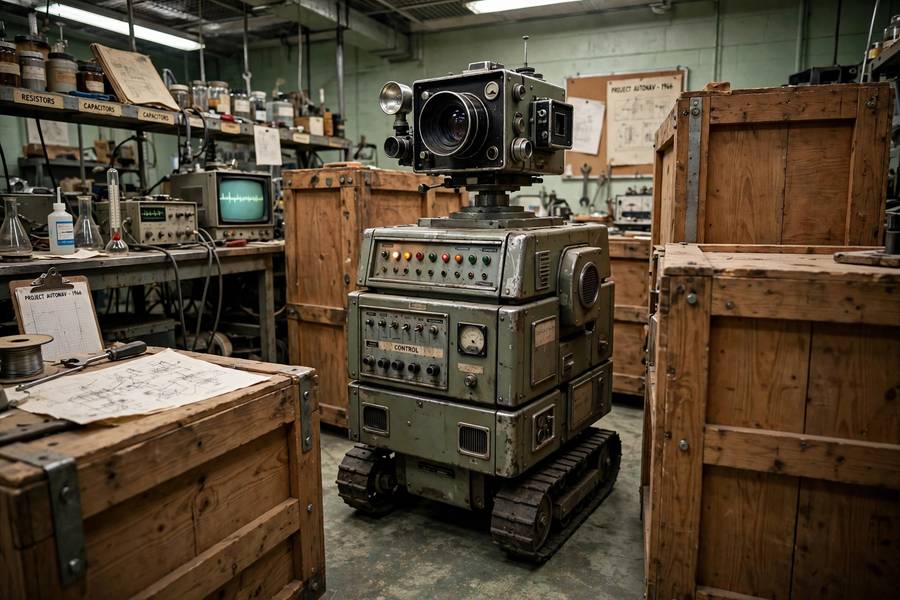
Before naming a winner, we need a definition — because “robot” and “AI robot” are different things. A robot is a machine that acts in the physical world. An AI robot is one whose actions are guided by something we’d call intelligence: sensing, reasoning, learning, or planning — not just following a fixed script.
By that standard, a factory arm repeating the same weld isn’t an AI robot (it’s a very useful automaton). A machine that looks at a messy room, figures out a plan, and executes it — that’s an AI robot. The distinction matters because the earliest “robots” were mostly the first kind.
1948: Elmer and Elsie, the Tortoise Robots
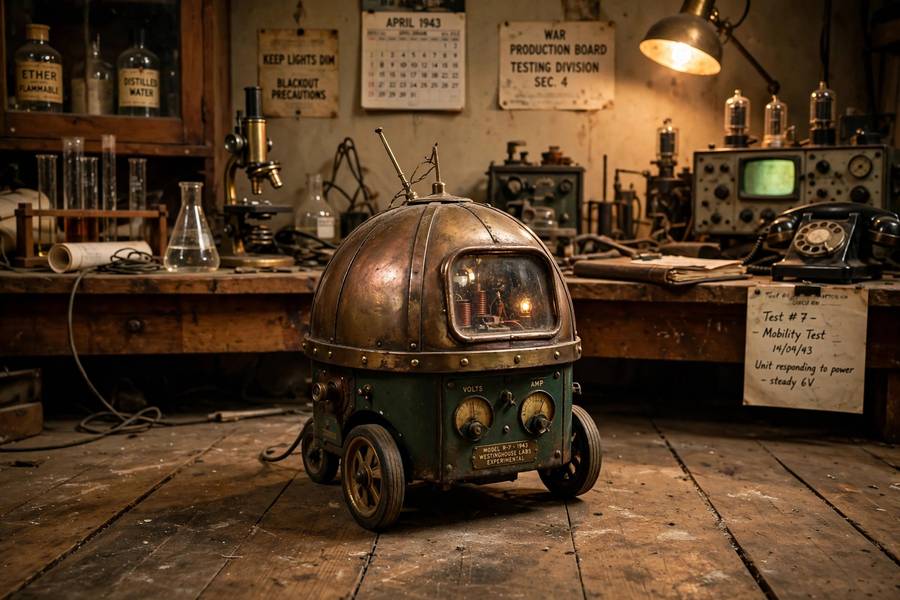
The first machines I’d call proto-AI robots were built in 1948 by William Grey Walter, a neurophysiologist at the Burden Neurological Institute in Bristol, England. He built two small three-wheeled machines — he named them Elmer and Elsie — housed in tortoise-like shells.
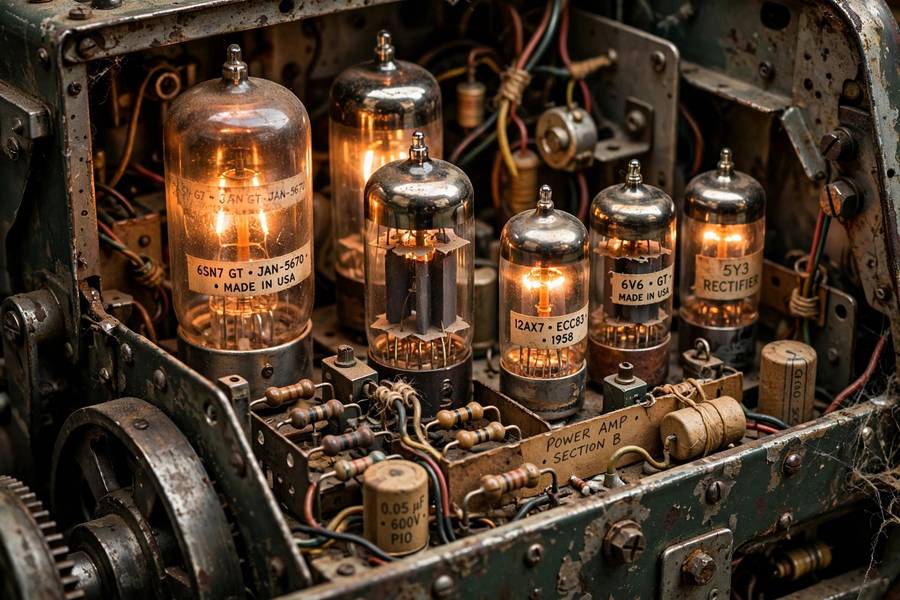
Each tortoise had a light sensor, a touch sensor, a steering motor, and — crucially — just two vacuum-tube “brain cells” wired to produce surprisingly complex behavior. The tortoises would wander, seek out light, avoid obstacles, and when their batteries ran low, they’d find their charging hutch and plug themselves in. Walter described them as having “free will” — not because they did, but because their behavior was rich enough that observers projected intention onto them.
Here’s what makes Elmer and Elsie historically important: they demonstrated that complex, lifelike behavior could emerge from very simple mechanisms. That insight — emergence from simplicity — is one of the deepest ideas in AI and robotics. Walter’s tortoises were doing in 1948 what took the rest of the field decades to appreciate.
They weren’t intelligent by any modern measure. But they were the first machines whose behavior made serious scientists reach for psychological vocabulary. That counts for something.
1951: Minsky’s Learning Maze Runner
In 1951, a 24-year-old Marvin Minsky — later one of AI’s founding fathers — built SNARC (Stochastic Neural Analog Reinforcement Computer) at Princeton. It was a network of 40 artificial neurons, implemented with vacuum tubes and clutches, wired to control a virtual rat learning to navigate a maze.
SNARC learned by reinforcement: successful moves were strengthened, unsuccessful ones weakened. It worked. Slowly, clunkily, with hardware that constantly needed maintenance — but it learned. This was arguably the first machine that learned in the modern machine-learning sense, and it controlled something we’d recognize as a robot (even if the “body” was simulated).
If your definition of AI robot requires learning, SNARC has a real claim to the title — five years before the term “artificial intelligence” even existed.
1966–1972: Shakey, the First True AI Robot
The consensus answer — and the one I’d give — is Shakey, built at Stanford Research Institute (SRI) between 1966 and 1972 under Charles Rosen, with key contributions from Nils Nilsson, Bertram Raphael, and others.
Shakey was about the size of a small refrigerator, rolled on wheels, and carried a TV camera, range finders, and bump sensors on a turret-like head. What made it historic wasn’t the hardware — it was the software. Shakey could:
- Perceive its environment through its camera, building an internal model of rooms, doorways, and large colored blocks
- Plan using STRIPS, one of the first AI planning systems — breaking a goal like “push the box to the platform” into ordered steps
- Act by executing the plan, monitoring progress, and replanning when reality didn’t match expectations
Watch the old footage and you’ll see something remarkable: Shakey looks around, pauses (sometimes for a long time — planning was slow), then moves with purpose. It wasn’t following a script. It was deciding.
The project also produced foundational AI technologies as side effects: the A* search algorithm (still used in everything from video games to route planning) and early computer vision techniques. Shakey’s lab essentially invented mobile robotics as a discipline.
What Made Shakey Revolutionary
Three things, and they’re worth spelling out because they define AI robotics to this day:
The sense-plan-act loop. Shakey pioneered the architecture where a robot senses the world, builds a model, plans, acts, and repeats. Modern robots still use versions of this loop — though today’s best systems blur the boundaries with learned end-to-end approaches.
Deliberation over reaction. Earlier robots reacted to stimuli. Shakey thought first. That pause — the visible moment of computation before action — was the birth of deliberative robotics. It’s also why Shakey was slow: thinking took minutes on 1960s computers.
Generality. Shakey wasn’t built for one task. Given a new arrangement of rooms and blocks and a new goal, it could figure out a plan. That generality — the same system handling novel situations — is what separates AI robots from automation.
The Robots That Followed
Shakey’s children are everywhere:
- 1970s: The Stanford Cart, which navigated obstacles using vision — a direct descendant of Shakey’s approach
- 1980s: Industrial robots got smarter with better sensing, though most remained non-AI automation
- 1990s: Rodney Brooks’s behavior-based robots (like Allen and Herbert) challenged Shakey’s deliberative paradigm with purely reactive designs — the field’s great architectural debate
- 2000s: The DARPA Grand Challenges proved autonomous vehicles could handle the real world; Roomba brought robots into homes
- 2010s–2020s: Deep learning transformed robot perception, and today’s humanoids and warehouse robots combine Shakey’s sense-plan-act heritage with learned models trained on vast data — the same training paradigm I describe in how AI models are trained
Honorable Mentions: Other “First” Contenders
Historians argue about the “first” because the definition keeps shifting. A few more claimants deserve their footnote:
- Grey Walter’s later tortoises (1950s): He kept building — CORA, a tortoise that learned conditioned responses, and even a “free will” machine. The tortoise lineage alone could fill a book.
- The Johns Hopkins “Beast” (1960s): An autonomous robot that roamed hallways seeking power outlets to recharge itself — arguably the first robot with a survival instinct.
- WABOT-1 (1973, Waseda University): The first full-scale humanoid robot. It could walk, grip objects, and carry on simple Japanese conversations — bipedal ambition decades before Boston Dynamics.
Each represents a different “first”: first learned behavior, first self-preservation, first humanoid form. Shakey still takes the crown for general-purpose reasoning, but the race had many runners.
Why This History Matters Today
Modern robotics is reliving Shakey’s debates. The hottest question in the field right now: should robots plan like Shakey (explicit models, deliberate reasoning) or learn everything end-to-end from data (the deep learning approach)? The frontier labs are converging on hybrids — learned perception feeding classical planning, or planners guiding learned policies.
Grey Walter’s tortoises would recognize the argument. Seventy-five years later, we’re still negotiating the balance between simple reactive mechanisms and deliberate thought. The first AI robots didn’t just start a field — they framed its central questions, and we haven’t finished answering them.
So: Elmer and Elsie for the philosophers, SNARC for the learning theorists, Shakey for the history books. If someone asks you at a dinner party, say Shakey (1966–1972, SRI). If they push back, you’ve now got the full story.
Frequently Asked Questions
Shakey (1966-1972, Stanford Research Institute) is the consensus answer — the first mobile robot that could perceive its environment, plan actions, and execute them. Earlier candidates include Grey Walter’s tortoise robots (1948) and Minsky’s learning machine SNARC (1951).
Shakey could navigate rooms, avoid obstacles, and manipulate large blocks to achieve goals. It used a camera to perceive its surroundings, the STRIPS planning system to devise multi-step plans, and replanned when things went wrong — the first true sense-plan-act robot.
The word “robot” comes from Karel Čapek’s 1920 play R.U.R. The first programmable industrial robot was Unimate (1961) by George Devol and Joseph Engelberger. But the first AI robot — one that reasons and plans — was Shakey, built at SRI starting in 1966.
Built in 1948, Elmer and Elsie were small wheeled machines with just two vacuum-tube “brain cells” that displayed lifelike behaviors: seeking light, avoiding obstacles, and returning to recharge. They demonstrated that complex behavior can emerge from simple mechanisms.
Yes — Shakey is preserved at the Computer History Museum in Mountain View, California, where visitors can see the machine that launched AI robotics. It was inducted into the Robot Hall of Fame in 2004.