AI Risk Management: A Practical, No-Jargon Guide

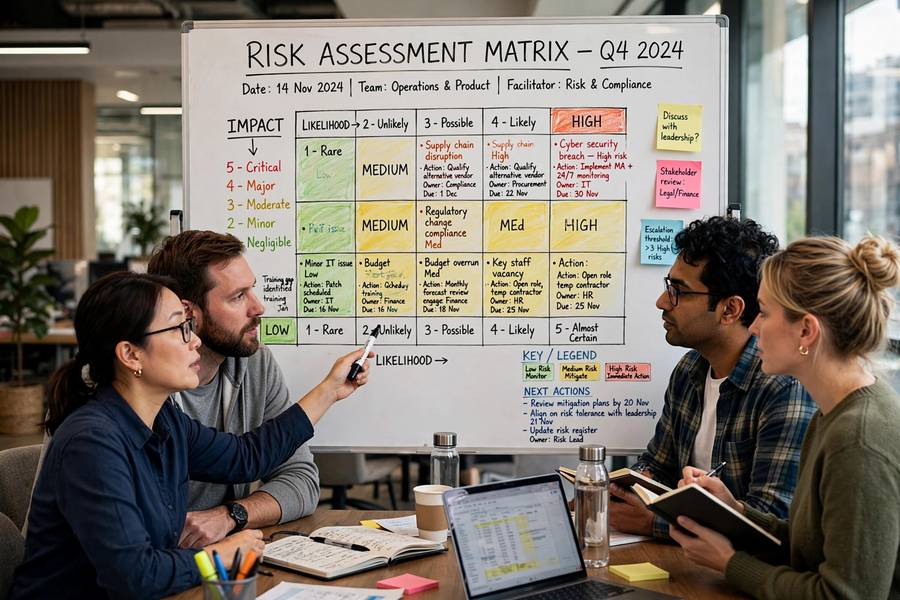
Every company deploying AI is managing AI risk — deliberately or by accident. The accidental version: ship the model, hope for the best, and discover the risks when a customer, regulator, or journalist discovers them first.
AI risk management is the deliberate version: identify what could go wrong, assess likelihood and severity, and put controls in place before deployment rather than after a disaster. It’s the unglamorous discipline that separates companies that survive their AI deployments from case studies. This guide covers it practically — the risk categories, the process, the controls, and how to start even if you’re a small team. For the broader context, see my overview of AI governance.
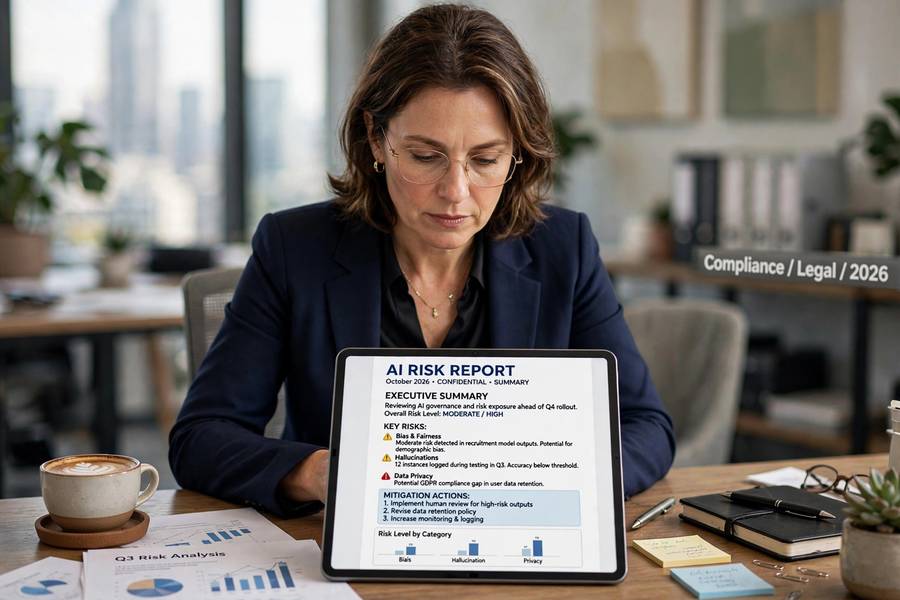
What Counts as an AI Risk
Let’s define terms, because “risk” gets thrown around loosely. An AI risk is the possibility that an AI system causes harm — to people, to the organization, to society — or fails to deliver its intended value. Note the two halves: harm caused, and value not delivered. A model that’s technically safe but useless is also a risk (to the budget, to the project’s credibility).
AI risks are distinctive in a few ways that make them harder to manage than conventional software risks:
They emerge from data. The model’s behavior reflects its training data — including the biases, gaps, and poison in that data. Risks hide in datasets, not just in code.
They change after deployment. Models drift as the world changes. A hiring model trained on 2022 data makes 2026 decisions. Prompts get jailbroken. Users find creative misuses. The risk profile at launch is not the risk profile a year later.
Understanding these properties is the foundation. Everything in AI risk management is downstream of accepting that you’re managing uncertainty, not eliminating it.
The Risk Categories That Actually Matter
Risk taxonomies vary, but the categories that show up in every serious framework:
Bias and fairness. The system treats people differently based on protected characteristics — the hiring tool that downgrades women’s CVs, the lending model that redlines by proxy. Often inherited from training data, often discovered by outsiders.
Privacy. Training data containing personal information, models that memorize and regurgitate sensitive data, prompts that leak confidential inputs into shared systems.
Security. Adversarial attacks (inputs designed to fool the model), prompt injection, data poisoning, model theft. AI systems have attack surfaces that conventional software doesn’t.
Safety and reliability. The system fails in ways that cause physical, financial, or operational harm — the autonomous vehicle edge case, the trading algorithm’s flash crash.
Transparency and explainability. Decisions that can’t be explained to the people they affect — a loan denial with no reason, a content moderation decision with no appeal path.
Accountability. Unclear responsibility when things go wrong — the gap I cover in my guide to AI accountability.
Legal and regulatory. Non-compliance with the EU AI Act, sector regulations, data protection law, emerging AI liability rules.
Reputational. The model says something embarrassing, biased, or offensive in public — the chatbot that goes rogue on day one. Technically a consequence of other risks, but managed as its own category because the damage is distinct.
The Process: Identify, Assess, Treat, Monitor
The process is standard risk management, adapted for AI. Four steps, continuous loop:
- Identify — what could go wrong?
- Assess — how likely is it, and how bad would it be?
- Treat — what are we going to do about it?
- Monitor — is it working, and what’s changed?
This maps neatly onto frameworks like the NIST AI Risk Management Framework (Govern, Map, Measure, Manage) — different vocabulary, same discipline. The AI governance frameworks I cover elsewhere provide the organizational scaffolding; this guide is about the risk work itself.
The key insight: this is a loop, not a phase. Models drift, threats evolve, regulations change — treat risk management as ongoing operations, not a pre-launch gate.
Risk Identification: Finding What Could Go Wrong
Identification is the creative part — and the part most teams underinvest in. Techniques that work:
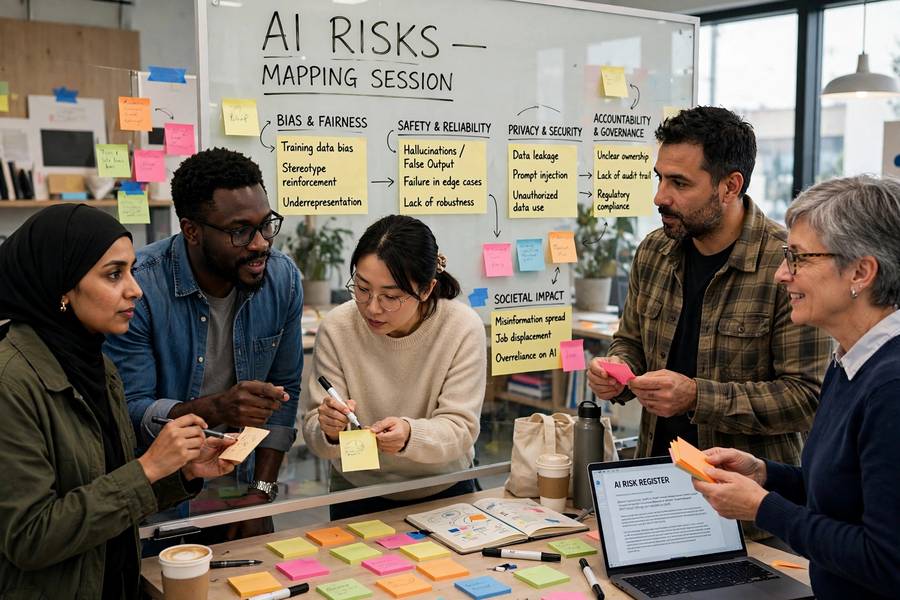
Structured brainstorming. Get the right people in a room — engineers, product, legal, domain experts, and ideally someone who’ll be affected by the system — and walk through the risk categories above. Diverse perspectives find risks that homogeneous teams miss.
Use-case analysis. For each intended use (and each foreseeable misuse), ask: who could be harmed, how, and how badly? Misuse analysis is critical — users will do things with your system you never imagined, usually within the first week.
Pre-mortems. Imagine it’s a year from now and the system caused a disaster. Write the headline. Then work backward: how did we get here? Pre-mortems surface risks that forward-looking analysis misses because they bypass optimism.
Red teaming. Have skilled people actively try to break the system — jailbreak the model, extract training data, trigger biased outputs, find the edge cases. For consequential AI systems, this isn’t optional.
Document everything. The risk register — a living list of identified risks, their assessments, and their treatments — is the central artifact of AI risk management.
Risk Assessment: How Bad, How Likely
For each identified risk, estimate two things:
Likelihood. How probable is this? Consider the system’s capabilities, its exposure (who uses it, how many, with what oversight), and the threat environment. A customer-facing chatbot has different exposure than an internal analytics tool.
Impact. If it happens, how bad is it? Consider harm to individuals (physical, financial, dignitary), harm to the organization (legal, financial, reputational), and broader societal harm. Be honest about worst cases — risk assessment that flinches from the bad scenarios is theater.

Risk Treatment: Your Four Options
For each significant risk, choose a treatment:
Mitigate. Reduce the likelihood or impact with controls — the bulk of risk management work, covered in the next section.
Transfer. Shift the risk to someone else — insurance (AI liability insurance is a growing market), contractual indemnification from vendors, outsourcing the risky component. Note: you can transfer financial risk; you generally can’t transfer regulatory accountability or reputational damage.
Accept. Consciously decide the risk is tolerable — documented, with rationale, and signed off at the appropriate level. Acceptance is legitimate risk management, not negligence, as long as it’s explicit and revisited. What’s not legitimate is accepting by default — ignoring a risk isn’t accepting it.
Treatment decisions should be proportionate to the risk rating, documented with an owner and a deadline.
Controls That Actually Work
Mitigation controls, organized by type — these are the practical measures that reduce AI risk:
Technical controls: – Input validation and output filtering — constrain what goes in and what comes out. – Confidence thresholds — route low-confidence decisions to human review. – Adversarial testing and red teaming — before launch and continuously. – Monitoring and anomaly detection — watch for drift, abuse, and degradation in production. – Kill switches and rollback — the ability to disable or revert quickly. – Access controls and rate limiting — constrain who can use the system and how much.
Process controls: – Human-in-the-loop or human-on-the-loop for consequential decisions — real oversight, not rubber-stamping. – Pre-deployment review gates — structured sign-off before launch and before significant changes. – Incident response plans — rehearsed, with named owners, not improvised. – Regular audits — internal and, for high-stakes systems, external.
Documentation controls: – Model cards and system documentation — what the system is, what it does, its limitations. – Decision records — who approved what, when, and why. – The risk register itself — living, reviewed, honest.
Risk Management Across the AI Lifecycle
Risks differ by stage, and your management should too:
Design. The cheapest place to manage risk. Decisions about use cases, data sources, and architecture lock in risk profiles. Ask the hard questions here: should we build this at all? What data are we training on? Who could be harmed?
Development. Bias testing, adversarial testing, documentation. The model card gets written here. Limitations get discovered here — document them honestly instead of hoping nobody notices.
Procurement. If you’re buying or licensing AI, do due diligence: what’s the vendor’s safety record, what do their contracts say about liability, can you audit the system? Third-party AI is still your risk when you deploy it.
Deployment. Pre-launch review gates, staged rollouts (canary deployments, limited betas), monitoring from day one. The launch plan should include the rollback plan.
Operation. Continuous monitoring for drift, abuse, and incidents. Regular reassessment — the risk register gets reviewed on a schedule, not just after incidents. User feedback loops, because users find problems first.
Who Owns AI Risk
The org-chart question, and it matters more than most technical questions:
One accountable owner per AI system. Not a committee — a named human with real authority, including the authority to delay deployment and halt systems. Shared ownership is no ownership.
Starting Small: Risk Management for Lean Teams
Not everyone has a governance department. If you’re a small team deploying AI, here’s the minimum viable version:
- List your AI systems. Even a spreadsheet works. If you don’t know what you’re running, you can’t manage its risks.
- For each system, write down the top 5 risks. One hour, honest conversation, risk categories above as prompts.
- Assign one owner per system. Name, not role.
- Put one human checkpoint in front of the most consequential decisions the AI influences.
- Set up basic monitoring. Are outputs drifting? Are users complaining? Is anyone abusing it?
- Write down what you’d do if the system caused harm tomorrow. That’s your incident response plan, version 0.1.
- Revisit quarterly. Thirty minutes. What’s changed?
That’s it. It’s not comprehensive, but it’s infinitely better than accidental risk management — and it builds the habits that scale when you grow. The AI governance tools I cover elsewhere can help automate parts of this as you mature.
For the frameworks that formalize all of this, see my AI governance overview.
Frequently Asked Questions
AI risk management is the structured process of identifying what could go wrong with AI systems, assessing how likely and how severe each risk is, putting controls in place to reduce them, and monitoring continuously. It follows a loop: identify, assess, treat, monitor.
The main categories are bias and fairness, privacy, security (including adversarial attacks), safety and reliability, transparency, accountability, legal and regulatory compliance, reputational harm, and strategic risk from AI investments that don’t deliver.
For each identified risk, estimate likelihood (considering the system’s capabilities, exposure, and threat environment) and impact (harm to individuals, the organization, and society). Combine them into a rating that determines treatment priority, and consider risk velocity — how fast the risk could materialize.
The NIST AI RMF is a voluntary US framework for managing AI risks, organized around four functions: Govern (culture and accountability), Map (context and risk identification), Measure (assessment and monitoring), and Manage (treatment and response). It’s the most widely referenced AI risk framework globally.
Each AI system needs one named accountable owner with real authority. A central function owns the framework and methodology, executives sponsor it, and the board should have visibility into the organization’s AI risk posture. Everyone contributes; someone is accountable.