Best Car Detailing Equipment for Startups: The Lean Buy List

New detailers waste more money on equipment than on anything else. They buy the $900 polisher before the $400 extractor, the pro-grade everything before the first customer. I have watched startups burn $6,000 on gear and then have no cash left for the insurance and marketing that actually generate revenue.
The lean rule is simple: buy the cheapest tool that produces professional results, and upgrade with profit, not credit. This is the buy list I would follow if I were starting a car detailing business tomorrow with $3,000 in equipment money. It reflects the reality of what a startup actually is — a machine for testing what works before you spend big.
The Lean Equipment Philosophy
Equipment does not win customers. Results win customers, and results come from technique plus adequate tools — not premium tools. A $180 dual-action polisher in skilled hands beats a $600 polisher in unskilled hands every time. Spend your first months getting good, not getting geared up.
Three rules govern every purchase on this list:
- Revenue first. Every tool must pay for itself within 20 jobs. A $400 extractor that enables $129 interior add-ons pays for itself in 4 jobs. A $900 polisher you use twice a month does not.
- Buy once in the $200-$400 tier. The cheapest tools ($50 polishers, $30 vacuums) break, overheat, and produce amateur results. The mid-tier — Griot’s, Chemical Guys pro line, Adam’s — is the professional floor. Above that is luxury until you are booked solid.
- Rent or borrow the rare stuff. Ozone machines, steam cleaners, paint thickness gauges — you need these occasionally, not daily. Rent them per job ($40-$80) until the math says buy.
With that philosophy set, here is the kit, category by category.
Wash and Rinse: The Core Kit
This is where you start, because every job begins with a wash. Buy quality here — wash-induced swirls are the number one cause of customer complaints.
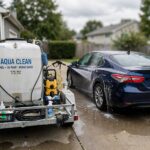
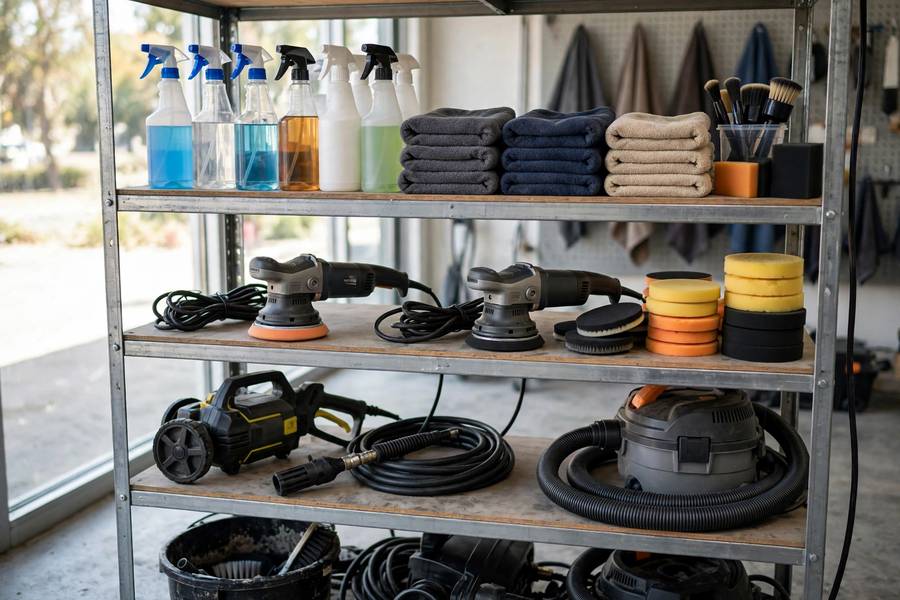
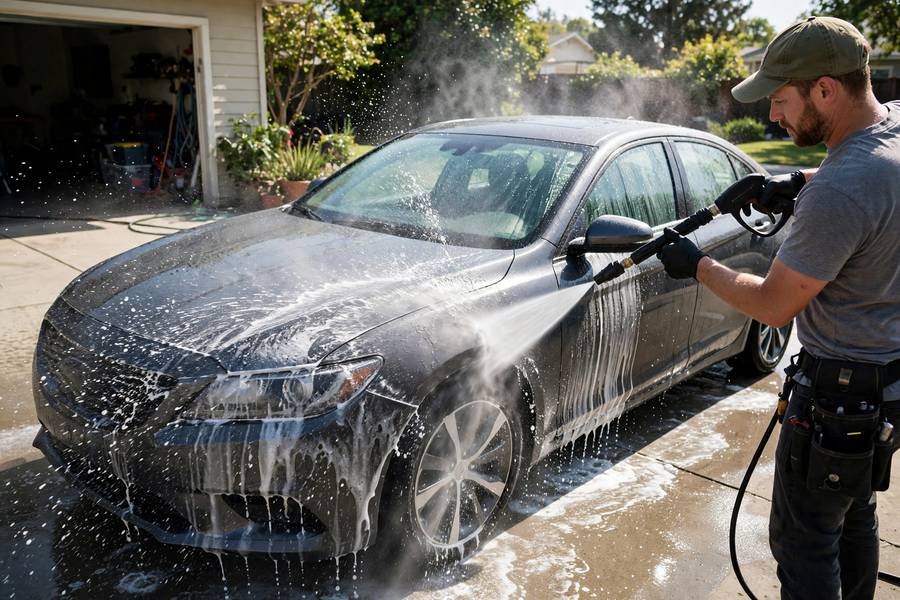
- Pressure washer ($250-$450): An electric 1,800-2,000 PSI unit (Karcher, Ryobi, Sun Joe pro models) is enough for 95% of detailing work. Gas units give more power but more noise and maintenance. For mobile work, electric plus a generator is the quiet, reliable combo.
- Foam cannon ($30-$60): Non-negotiable. Foam loosens dirt before contact, which is what prevents scratches. Any brass-body cannon with adjustable fan works.
- Two buckets with grit guards ($40): The two-bucket method (wash/rinse) is detailing 101. Grit guards trap dirt at the bottom. Cheap, essential.
- Wash mitts ($30 for 3-4): Microfiber chenille mitts. Replace them when they flatten — a worn mitt scratches paint.
- Drying towels ($40-$60): Large twisted-loop microfiber drying towels (1,200+ GSM). Buy four; launder properly, never with fabric softener.
- Wheel brushes and tire brush ($40): A long-reach wheel brush, a lug-nut brush, and a stiff tire brush. Wheels sell the whole job visually — do not cheap out here.
- Air blower ($60-$150): A dedicated car dryer or a strong leaf blower. Blowing water out of mirrors, grilles, and trim before towel-drying prevents the drips that ruin a finished job.
Wash kit total: $490-$850. This kit alone lets you sell $99-$149 maintenance details — the product that funds everything else.
Polishing and Paint Correction Gear
Paint correction is your highest-margin service ($299-$899), but it is also where beginners overbuy. Start with a one-step setup and expand when correction work is 20%+ of your revenue.
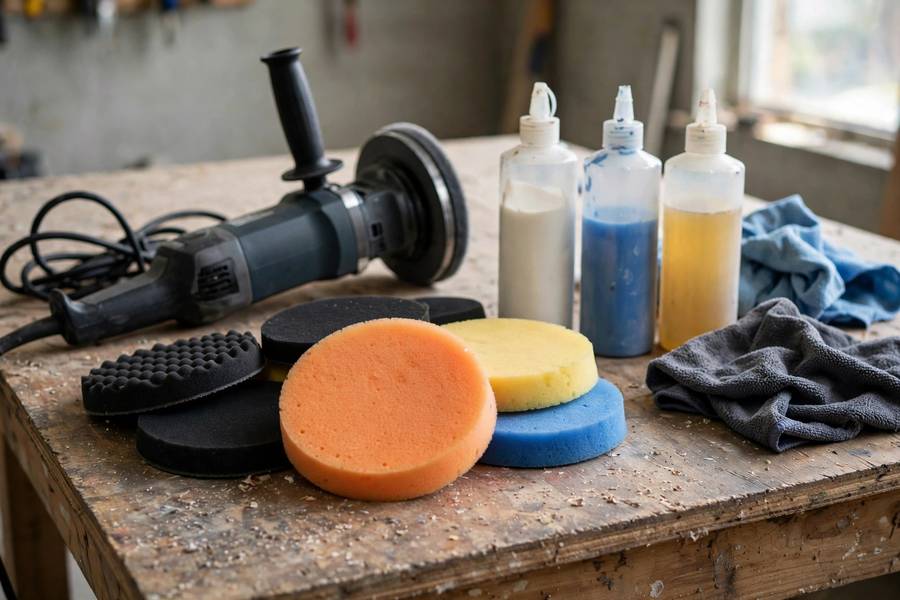
- Dual-action polisher ($180-$350): A 15mm or 21mm throw DA (Griot’s G15/G21, Adam’s Swirl Killer) is the startup standard. Random orbital is forgiving — it will not burn paint the way a rotary can. Do not buy a rotary until you have corrected 50+ cars.
- Pad set ($60-$100): Six to eight pads: cutting (orange/yellow), polishing (white), finishing (black). Lake Country and Buff and Shine are the workhorses.
- Compound and polish ($50-$80): One cutting compound and one finishing polish. Meguiar’s M105/M205 or the Griot’s system. You do not need six brands — you need one system you know deeply.
- Paint thickness gauge ($150-$250): This is your insurance policy. Measuring clear coat before correction prevents burn-through on thin factory paint. Buy it before your first paid correction job.
- Inspection light ($40-$80): A handheld LED inspection light reveals swirls and holograms that daylight hides. If you cannot see the defect, you cannot fix it — and the customer will find it later.
- Clay bars or clay mitts ($20-$30): Decontamination before correction. A clay mitt is faster and lasts 30+ cars.
Correction kit total: $500-$890. Do not sell correction until you have practiced on 5-10 junk panels or your own vehicles. A burned edge on a customer’s car costs more than the entire kit.
Interior Equipment That Pays for Itself
Interior work is where startups make their best margins — low product cost, high perceived value, and customers who cannot stop talking about a transformed cabin.
- Heated extractor ($400-$650): The single highest-ROI tool on this entire list. A heated extractor (Bissell Big Green commercial, Mytee) pulls stains from seats and carpets that no amount of scrubbing matches. It enables $129-$229 interior details and $40-$80 stain add-ons. If you buy one premium tool first, make it this one.
- Wet/dry vacuum ($80-$150): A 4-6 gallon shop vac with crevice tools and brush attachments. Dedicated car vacuums are underpowered; a real shop vac is not.
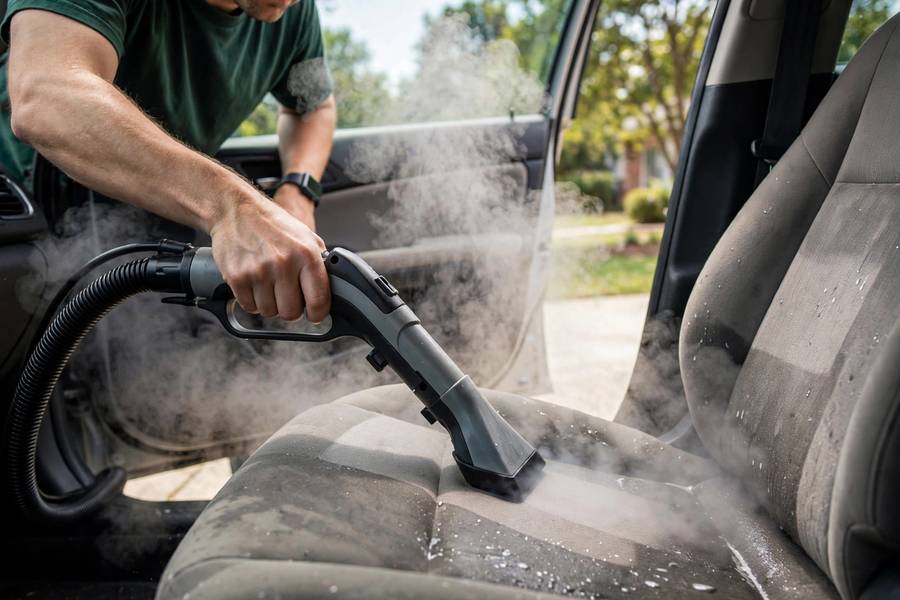
- Steamer ($150-$300): A handheld or canister steamer for vents, cup holders, door jambs, and sanitizing. Steam cleans without chemicals in places chemicals should not go.
- Interior brushes and tools ($50): Soft bootee brushes for leather, stiff brushes for carpets, an air compressor blow gun or tornador-style tool for crevices.
- Tornador/air pulse tool ($80-$120): Blasts dirt out of vents, seams, and textured plastics with compressed air. Requires a compressor ($100-$200 for a small one) — the combo is a pro-level interior setup.
Interior kit total: $860-$1,470. This kit unlocks your two most profitable beginner services: interior details and full details. Most startups earn back this entire investment within the first month of steady bookings.
Water Supply and Power Setup
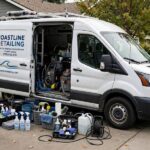
For shop operators, this section is a paragraph: get a hose bib and a 20-amp circuit. For mobile operators, it is the business.
- Water tank ($150-$300): 65-100 gallons, food-grade poly. Mount it low and centered — 65 gallons weighs 540 pounds, and a shifting tank in a hard stop is genuinely dangerous.
- 12V pump ($80-$150): On-demand pump with pressure switch, 3-5 GPM. Runs off the vehicle battery or a deep-cycle auxiliary battery.
- Hose reels ($60-$100): Two reels — one for water, one for air or power. Reels are not luxury; tangled hoses cost you 15 minutes a job.
- Generator ($600-$1,200): 3,500W inverter generator for the pressure washer, extractor, and vacuum. Quiet models (under 62 dB) are worth the premium for residential work.
- Extension cords and power strips ($80): Heavy-gauge (12 AWG) cords, 50-100 feet. Cheap cords overheat and trip breakers mid-job.
Mobile utilities total: $970-$1,830. Shop operators can skip most of this and spend the money on a better extractor instead.
What to Skip (for Now)
Discipline is a competitive advantage. These are the purchases that tempt every beginner and pay off for almost none of them early:
- Rotary polisher. Faster cutting, much faster damage. Until you have 50+ corrections under your belt, the DA does everything you need.
- Ceramic coating inventory. Do not stock $400 coating kits before you have sold three coating jobs. Buy per job until coatings are 15% of revenue.
- Ozone machine. Rent it per odor job ($40-$60) until you are doing 4+ odor treatments a month.
- Second polisher. One DA is enough. Buy the second when you hire your first employee, not before.
- Branded everything. Decals on the van: yes. $400 embroidered uniforms and custom chemical labels: later. Customers pay for results, not merch.
- The $2,000 “pro starter bundle.” Bundles from retailers mix what you need with what they need to sell. Buy the list above à la carte and you will spend 30% less for better gear.
Every dollar you do not spend on gear you do not need is a dollar of runway. Runway is what keeps you in business long enough to get good.
Total Equipment Budget Breakdown
| Category | Budget Range |
|---|---|
| Wash and rinse kit | $490-$850 |
| Paint correction kit | $500-$890 |
| Interior kit | $860-$1,470 |
| Mobile water/power (if mobile) | $970-$1,830 |
| Chemicals starter shelf | $300-$500 |
| Towels, brushes, consumables | $150-$250 |
| Shop-based total | $2,300-$3,960 |
| Mobile total | $3,270-$5,790 |
These are real numbers for professional-grade work, not hobby numbers. And here is the part beginners miss: this equipment has a productive life of 2-4 years across thousands of jobs. Amortized over 1,000 jobs, a $4,000 kit costs $4 per job. Equipment is the cheapest input in your business — labor and customer acquisition are the expensive ones. Buy the right tools once, then spend your energy on technique and marketing.
One related skill worth learning early: how to clean car headlights — headlight restoration is a $79-$149 add-on that uses $5 in product and the polisher you already own. That is the kind of leverage this equipment list is built for.
Frequently Asked Questions
A professional startup kit costs $2,300-$3,960 for shop-based or $3,270-$5,790 for mobile, including wash gear, a DA polisher setup, interior extractor, chemicals, and (for mobile) water tank and generator. Amortized over 1,000 jobs, that is about $4 per job in equipment cost.
The heated extractor ($400-$650) has the highest ROI — it enables $129-$229 interior details that no amount of hand scrubbing can match. After that: a quality pressure washer, a mid-tier dual-action polisher, and a real shop vacuum.
No. A dual-action polisher ($180-$350) handles everything a beginner should sell, and it will not burn paint the way a rotary can. Wait until you have completed 50+ paint corrections before adding a rotary.
An electric 1,800-2,000 PSI unit ($250-$450) is enough for 95% of detailing work. Electric is quieter and lower-maintenance than gas, which matters for residential and mobile jobs. Pair it with a foam cannon ($30-$60) to prevent wash scratches.
Usually not. Retailer bundles mix essentials with slow-moving stock, and buying the lean list a la carte typically costs 30% less for better gear. The exception: a bundle that exactly matches your buy list at a genuine discount — compare item by item before deciding.
Skip the rotary polisher, ceramic coating inventory (buy per job until coatings are 15% of revenue), ozone machines (rent per job), a second polisher, and premium branded gear. Every dollar saved on unneeded equipment is runway that keeps you in business while you build skill and customers.