How to Play Catan: Rules, Setup, and Winning Strategy for Beginners

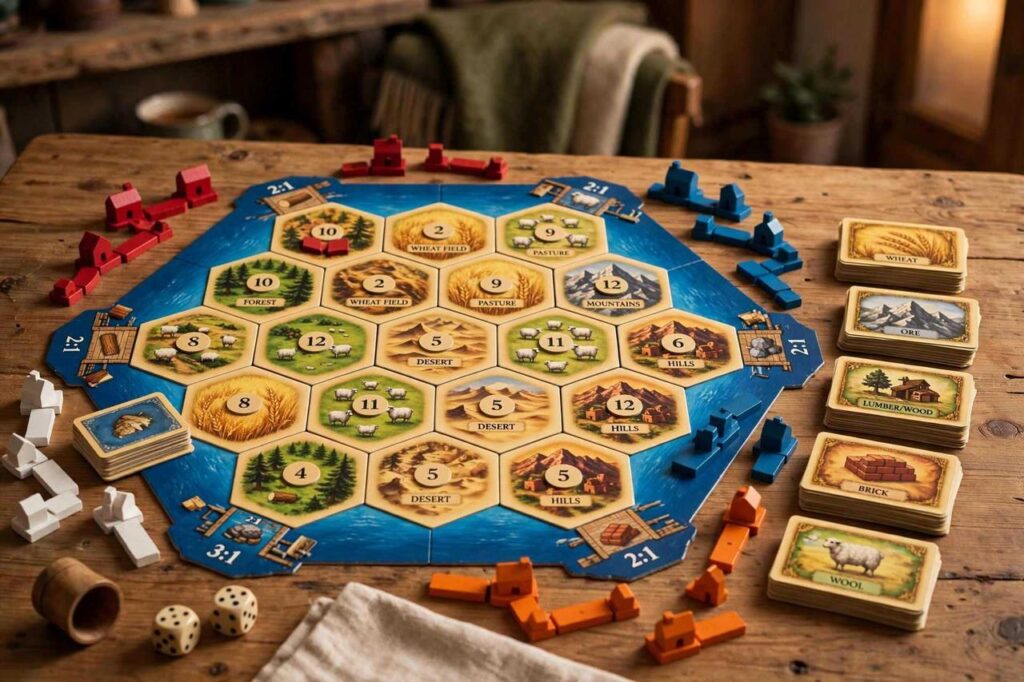
Learning how to play Catan is one of the best investments a game night can make. Catan (formerly Settlers of Catan) is the modern board game that started it all: a strategy game of trading, building, and just the right amount of luck where three to four players compete to settle a fictional island and reach ten victory points first. I’ve taught Catan to dozens of people, and the pattern is always the same: ten minutes of “wait, what?” followed by three hours of “one more game.”
This guide walks you through everything a beginner needs: what’s in the box, how to set up the island, what you actually do on your turn, the trading rules, and the strategies that separate winners from everyone else. By the end, you’ll be ready to play confidently at your very first session.
What Is Catan and Why Is It So Popular?
Catan was designed by Klaus Teuber and first published in 1995. It went on to sell tens of millions of copies and is widely credited with launching the modern board game renaissance. Unlike older roll-and-move games where you mostly watch, Catan gives you meaningful decisions every single turn: which resources to trade for, where to build, and who to negotiate with.
A typical game takes 60 to 120 minutes, supports 3 to 4 players out of the box (expansions add a 5 to 6 player option), and the recommended starting age is 10 and up. The core loop is simple to learn but has surprising depth, which is exactly why it has stayed on shelves for three decades.
What’s in the Box
Before your first game, make sure you have all the pieces. A standard Catan set includes 19 hexagonal terrain tiles, 6 sea frame pieces, 18 number tokens, a robber pawn, 95 resource cards, 25 development cards, 4 sets of player pieces (settlements, cities, roads in 4 colors), and 2 dice. Resource cards come in five types: brick, lumber, wool (sometimes called sheep), grain (wheat), and ore.
Each terrain type produces a specific resource, and that’s the heart of the game:
- Hills produce brick
- Forest produces lumber
- Mountains produce ore
- Fields produce grain
- Pasture produces wool
- Desert produces nothing (and it’s where the robber starts)
How to Set Up Catan
Setup takes about five minutes once you’ve done it once. Here is the beginner layout, step by step:
- Build the island: Arrange the 19 terrain hexes inside the sea frame in a random or beginner-suggested layout.
- Place the number tokens: Put one number token on each land hex (skip the desert). Each hex’s number corresponds to the dice roll that produces its resource.
- Place the robber: The robber starts on the desert hex.
- Place starting settlements and roads: Each player places two settlements and two roads. In beginner games, the rulebook suggests fixed spots. In standard rules, the oldest player goes first, and each player in turn order places one settlement and one road, then the order reverses for the second round so the last player places twice in a row.
- Collect starting resources: After your second settlement is placed, you collect one resource card for each terrain hex that borders that settlement.
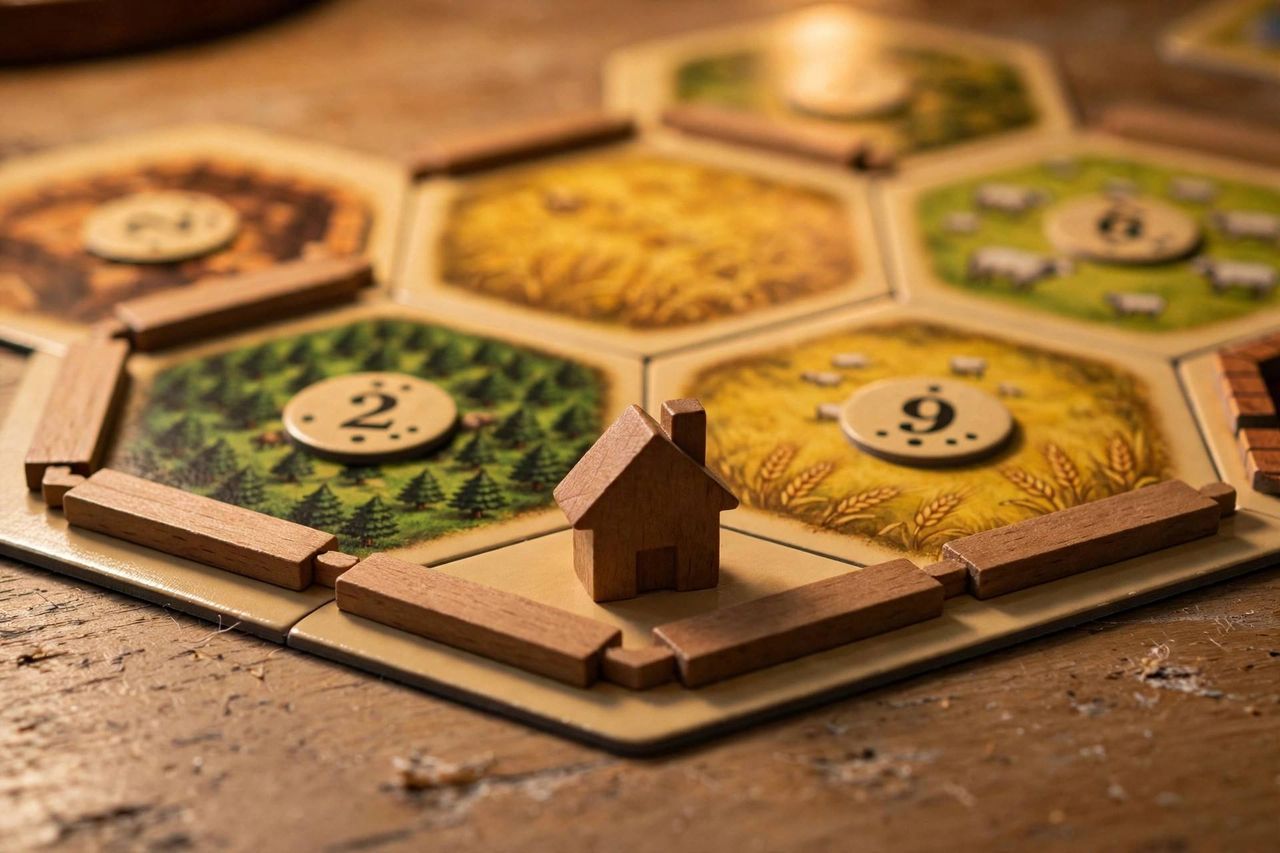
Two rules matter here: settlements must be placed on intersections (corners where hexes meet), and the distance rule means no settlement can be built adjacent to another settlement, there must be at least one empty intersection between them. Each settlement must also connect to one of your roads.
How to Play Catan: The Turn Structure
Every turn in Catan follows the same three phases, in order. Once you memorize this loop, the game clicks.
1. Roll the dice (production phase)
Roll both dice. The total determines which hexes produce resources: every player with a settlement or city bordering a hex with that number token collects resource cards. Settlements collect one card; cities collect two. If you roll a 7, no one produces. Instead, the active player moves the robber, steals a card from someone, and everyone with more than seven cards in hand discards half (rounded down). Rolling a 7 with a full hand is the game’s most painful moment, so plan ahead.
2. Trade
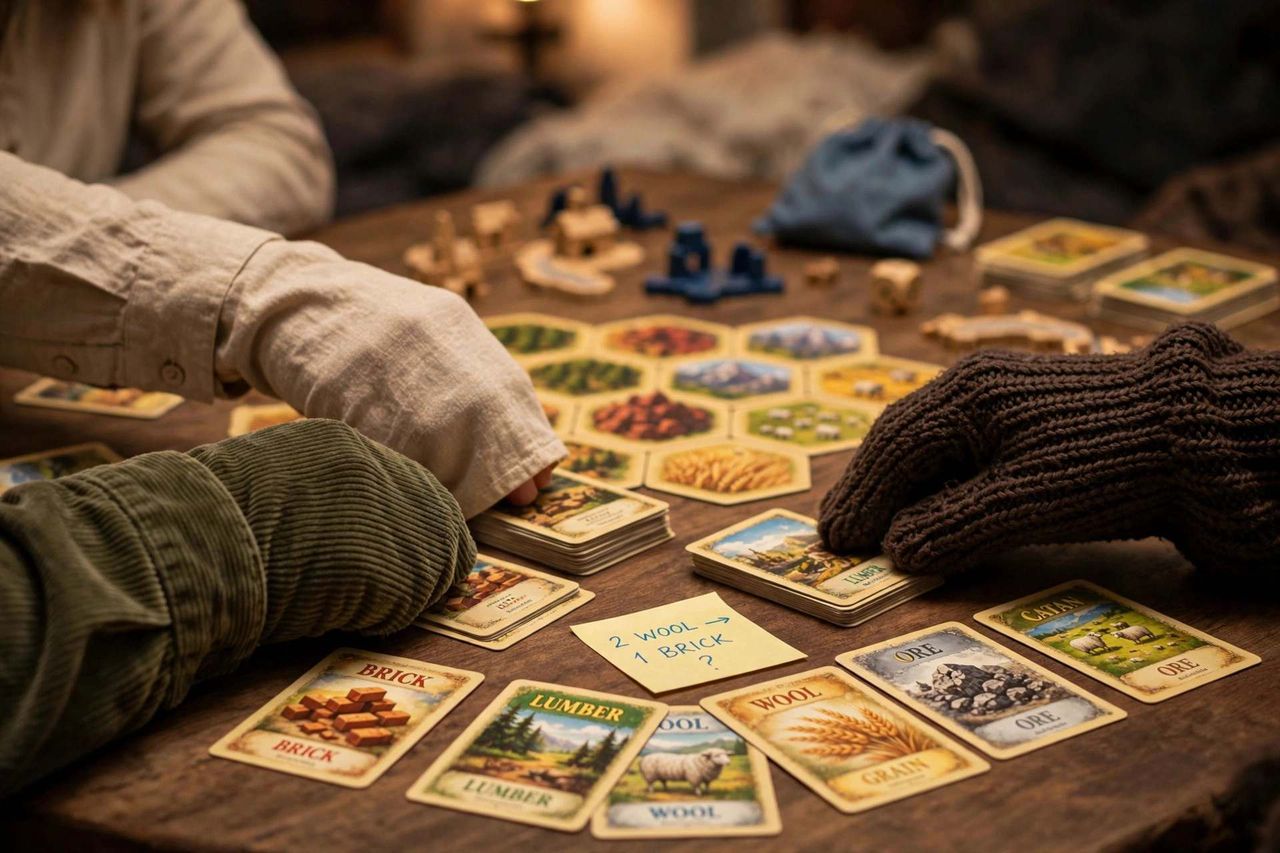
Trading is what makes Catan a social game. On your turn, you can trade with other players on any terms you both accept (“I’ll give you two wool for one brick”), and you can also trade with the bank at a 4:1 ratio. Ports improve that rate: 3:1 ports accept any resource, and 2:1 ports are specific to one resource type. Settlements built on port intersections unlock these rates.
New players often under-trade. Don’t. The game rewards dealmakers, because hoarding a resource you can’t use helps no one.
3. Build
Finally, spend resources to build. The costs are printed on the handy building-costs card:
- Road – 1 brick, 1 lumber
- Settlement – 1 brick, 1 lumber, 1 wool, 1 grain (worth 1 victory point)
- City – 2 grain, 3 ore; upgrades a settlement (worth 2 victory points)
- Development card – 1 wool, 1 grain, 1 ore (can grant victory points, knights, or progress cards)
You win the moment you reach 10 victory points on your turn. Watch out: victory point development cards count toward your total but are kept hidden until the game ends, so the leader on the board isn’t always the leader in the race.
Special Cards and the Robber
Development cards are the game’s wildcards. Knight cards let you move the robber and steal. Collecting knights earns the Largest Army card (2 victory points for the most knights). Progress cards like Road Building and Year of Plenty give you bursts of resources. And Longest Road awards 2 victory points to whoever has the longest unbroken road of at least five segments.
The robber is Catan’s chaos agent. When moved to a hex, that hex stops producing for everyone until the robber leaves. Robber placement is also diplomacy: park it on the leader, and you make an enemy; park it on a hex that hurts you too, and nobody believes you’re innocent.
Beginner Strategy: How to Win Your First Games
Here is the advice I give every new player before their first game:
- Settle on the good numbers first. Number tokens have dots showing how likely each number is to roll. 6 and 8 have five dots each, 5 and 9 have four, and the robber-prone 2 and 12 have just one. Intersections touching 6s and 8s are gold.
- Diversify your resources. Settlements that touch three different terrain types give you flexibility, which is more valuable than a triple-brick start.
- Build toward ports. A 2:1 port on a resource you produce in bulk turns surpluses into whatever you need.
- Watch the 7s. If you’re holding 8+ cards at the end of your turn, you’re gambling. Spend or trade down before someone rolls a 7.
- Don’t build roads to nowhere. Roads cost resources; every road should head toward a settlement spot, a port, or the Longest Road.
- Track the victory points. Cities are the most reliable path to 10 because they double production and add a point. Someone quietly buying development cards may be sitting on hidden victory points.
Common Beginner Mistakes
The number one mistake is placing starting settlements on bad numbers because the spot “looks central.” Probabilities beat geography. Second is never trading; Catan is a negotiation game, and the player who makes the most fair deals usually wins. Third is ignoring opponents: if someone is one city away from winning, it’s time to rob them, not your friend in last place.
Catan Expansions Worth Trying
Once the base game feels comfortable, three expansions add the most value. Seafarers adds ships and new islands, making the map bigger and exploration a real factor. Cities & Knights deepens the strategy with commodities and barbarian invasions; it’s the favorite of experienced players. Traders & Barbarians is a collection of scenarios and variants, best for groups that like variety.
Advanced Catan Tactics for Your Second Game
Once the basics click, these are the plays that win games. Trade with intent: every trade should move you toward a specific build, and the best traders make deals that help both sides just enough to keep offers coming. Time your development cards: buying a card early gives knights time to earn you the Largest Army; buying late hunts hidden victory points. Use the robber as diplomacy: robbing the leader is expected, but robbing someone twice in a row creates a grudge that outlasts the game. And watch the board, not just your hand: the player quietly upgrading settlements while everyone fights over Longest Road is usually the real threat.
Two house rules worth adopting: first, many groups play that you can’t win on a development-card victory point drawn on the final turn without announcing it, check your group’s convention. Second, the “friendly robber” rule (no robbing a player with only two victory points) makes learning games far more pleasant. Agree on both before you start.
Frequently Asked Questions
How long does a game of Catan take?
A 4-player game typically takes 60 to 90 minutes once everyone knows the rules. Your very first game will run closer to two hours because of teaching and setup. Three-player games are a bit faster, and experienced groups can finish in under an hour.
Can you play Catan with 2 players?
The base game officially supports 3 to 4 players. There are fan-made 2-player variants online, and the digital versions handle two players better. For the tabletop box, 3 to 4 is the real experience.
What happens when you roll a 7 in Catan?
Rolling a 7 activates the robber: no hexes produce that turn, the roller moves the robber to any hex and steals one random resource card from an opponent with a settlement bordering it, and any player holding more than seven cards must discard half, rounded down.
Can you win Catan on someone else’s turn?
No. You only win when you reach 10 victory points during your own turn. Even if an opponent’s build accidentally gives you the Longest Road, the victory waits until your turn begins.
Is Catan mostly luck or skill?
Both matter, but skill dominates over a few games. Dice add randomness, yet experienced players consistently beat beginners because setup choices, trading discipline, and timing matter far more than any single roll.
What is the best first move in Catan?
Place your first settlement on an intersection with high-probability numbers (6 or 8) covering two or three different resources, and point your roads toward a second strong spot or a useful port. Avoid starting on a single resource type.