What Is a Caldera? Inside the Giant Craters Left by the Biggest Eruptions

Most volcano features are built up — cones, domes, ridges of lava. A caldera is the opposite: it is what remains when a volcano removes its own foundations. The basic definition takes two lines, and our guide to the parts of a volcano already carries it; what that guide cannot do is justice to the scale. So this article assumes you know a caldera is a collapse depression, and spends its length where the real interest is: how the collapse actually happens, the famous calderas and their measured sizes, the strange ones that rise again after falling in, and what lives inside them afterward.
The Short Answer
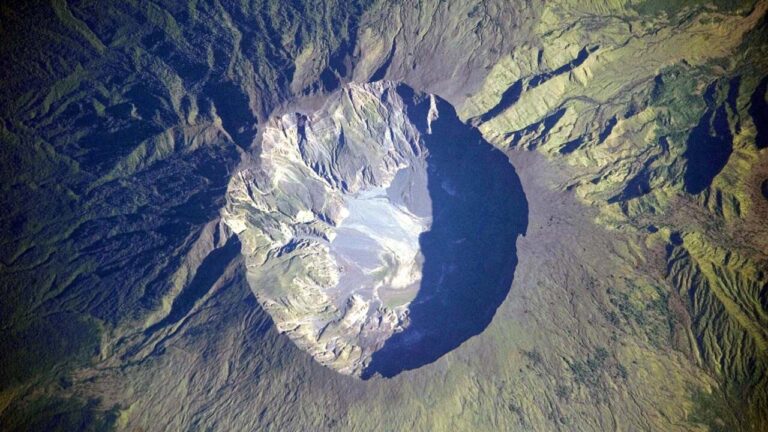
A caldera is a large, basin-like depression that forms when a volcano erupts so much magma, so fast, that the ground above the emptied magma chamber collapses into the space left behind. For where a crater ends and a caldera begins, see the parts guide — the distinction matters, and it is made there. Here, we go deep instead of wide: the calderas below are measured in tens of kilometers, and they were dug by the largest eruptions Earth produces.
How a Caldera Forms, Step by Step
Step 1 — A chamber fills. Beneath the volcano sits a magma chamber, holding a body of partially molten rock. In the systems that form calderas, this body is enormous — you will see below that Yellowstone’s measures some 80 by 20 kilometers.
Step 2 — A giant eruption empties it, fast. The eruption that makes a caldera is not an ordinary one. The USGS reserves the top of its explosivity scale, VEI 8, for eruptions whose measured deposits exceed 1,000 cubic kilometers — and caldera-forming eruptions are of this class: eruptions so voluminous that the chamber below is drained faster than the rock around it can adjust. As the encyclopedia account of Yellowstone puts it, volcanic eruptions sometimes empty their stores of magma so swiftly that the overlying land collapses into the emptied magma chamber, forming the depression called a caldera.
Step 3 — The roof gives way. The ground above the chamber was, in effect, a roof resting on the magma beneath it. Remove the support quickly enough and the roof does not sag politely; it founders, dropping down into the emptied space along fractures, and the volcano’s summit region becomes a basin. This is why a caldera is not a hole blown out by an explosion. The material did not mostly go up; the ground went down. The depression is the scar of a collapse, not of a blast.
Step 4 — The new landscape settles. What remains is a broad, roughly circular or oval depression — in the famous cases, tens of kilometers across — often with the volcano’s surviving rim around it, and a floor that may later collect lakes, new lava flows, and, in some cases, a slowly rising center. That last possibility has its own section below.
The Famous Ones
| Caldera | Size | The eruption that made it |
|---|---|---|
| Yellowstone (USA) | 55 × 72 km | Lava Creek eruption, ~630,000 years ago — about 1,000 km³ of material |
| La Garita (USA) | 100 × 35 km | Fish Canyon Tuff eruption, ~27.8 million years ago — 5,000 km³ |
| Long Valley (USA) | — (see note) | Bishop Tuff eruption, ~760,000 years ago — 600 km³, VEI 7 |
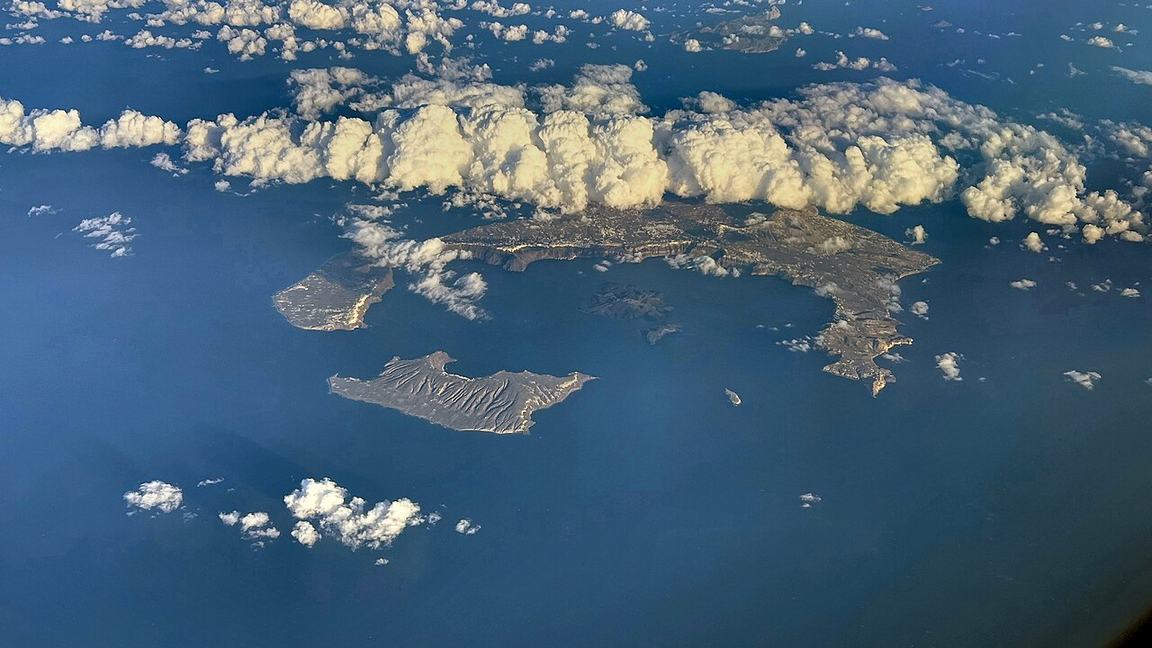
Yellowstone is the reference case, the one the word “supervolcano” was practically coined for — and even there, the single caldera visitors stand in is the youngest of three. The calderas at Yellowstone were created by large eruptions 2.1 million, 1.3 million, and about 630,000 years ago; the present one, measuring 34 by 45 miles (55 by 72 km), came from that last event, the Lava Creek eruption, which ejected roughly 1,000 cubic kilometers of rock, dust, and ash.
Hold the size steady in your mind: 55 by 72 kilometers is not a crater you photograph from its rim; it is a landscape you can live inside without realizing there is a rim.
La Garita, in Colorado’s San Juan volcanic field, is larger still — 100 by 35 kilometers — and was dug by the Fish Canyon Tuff eruption some 27.8 million years ago, at 5,000 cubic kilometers one of the largest single eruptions known. It rewards a comparison I use in class: Yellowstone’s caldera-forming eruption, the event that defines the category for most people, moved about a fifth of La Garita’s volume.
Long Valley, in eastern California, is the junior of the three in this table and the most instructive: its Bishop Tuff eruption, about 760,000 years ago, produced some 600 cubic kilometers of material — a VEI 7, one full step below the supereruption threshold, and it still excavated a caldera.
Collapse, in other words, is about the chamber emptying, not about crossing a magic number on the scale. (Our sources give Long Valley’s eruption volume but not its caldera dimensions, so the table leaves that cell empty rather than fill it from memory — the honest dash is a feature of this article, and the eruptions that dig calderas are ranked properly in their own guide.)
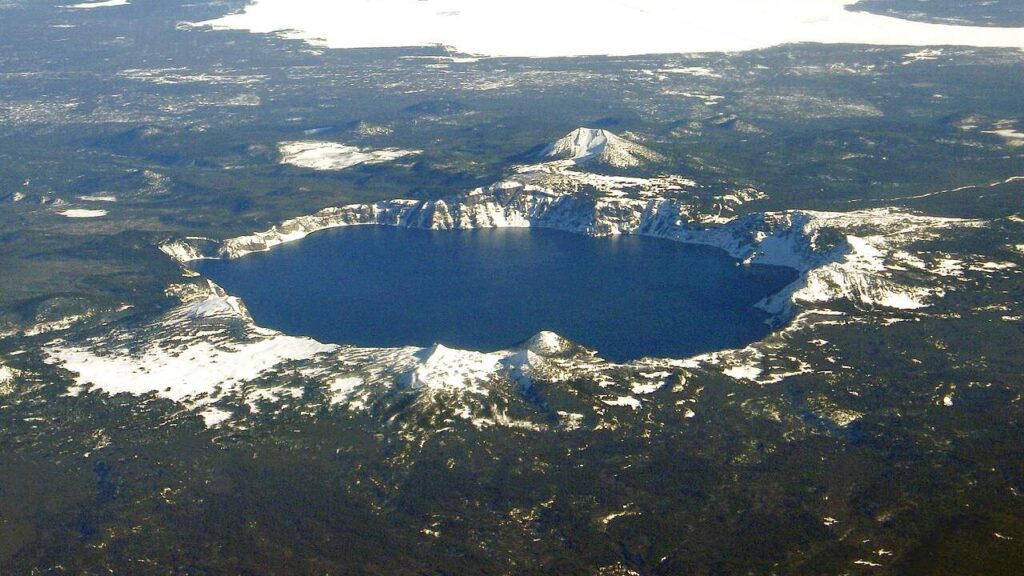
The USGS’s own list of supervolcanoes adds two more names every student should have seen at least once: Toba, in Indonesia, and Taupo, in New Zealand — Taupo being where the most recent supereruption on Earth occurred, about 27,000 years ago. And in Oregon, Crater Lake sits inside a caldera of its own — this article names it without dimensions, because our sources for this guide do not give its measurements, and a number from general knowledge is still a number without a source.
Calderas That Rise Again: Resurgent Calderas
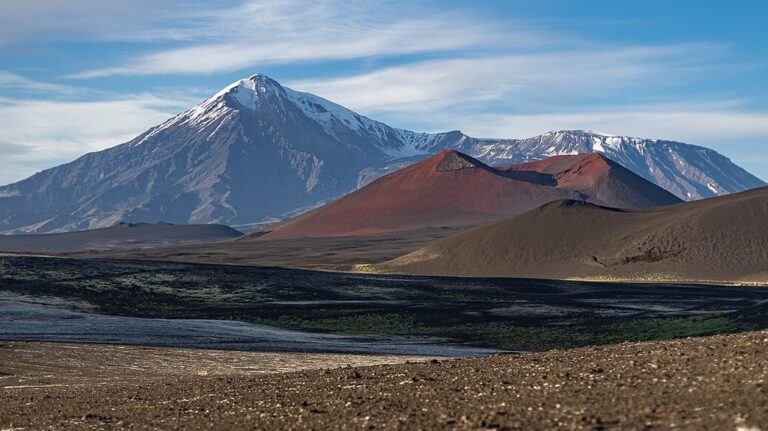
Some calderas do the least intuitive thing a collapsed landscape can do: after the floor drops, the center of the caldera rises again. These are called resurgent calderas, and the standard example is Pacana, in Chile — the list of largest eruptions records that Pacana forms a resurgent caldera. Resurgence tells you something important about what a caldera is. The collapse was never the end of the magmatic system; it was one episode in its life. Fresh magma arriving beneath a caldera floor can lift the very ground that foundered — the depression is a chapter, not a tombstone. When you read that a caldera is “old,” then, ask which part is old: the hole, or the system beneath it. They keep different clocks.
Life Inside a Caldera
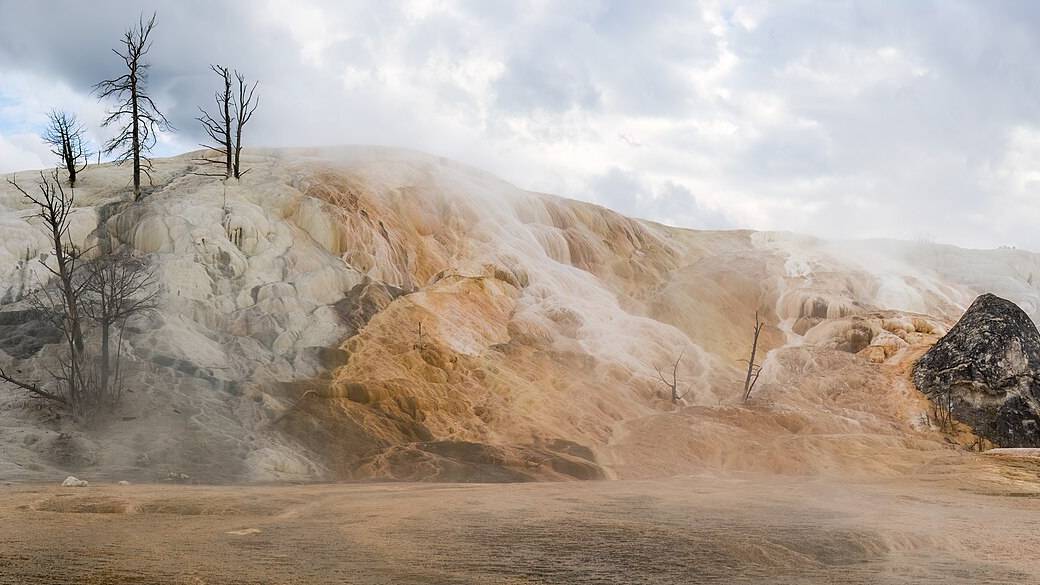
A caldera does not stay an empty bowl. Water collects, and caldera lakes form; heat from the still-warm system below expresses itself at the surface as geothermal features — Yellowstone’s geysers, hot springs, steam vents, and mudpots are exactly that, the visible breath of the system that dug the basin they sit in. And volcanism itself continues, at reduced scale: in the roughly 640,000 years since Yellowstone’s last giant eruption, about 80 relatively nonexplosive eruptions have occurred there, producing mostly lava flows — the most recent lava flow about 70,000 years ago.
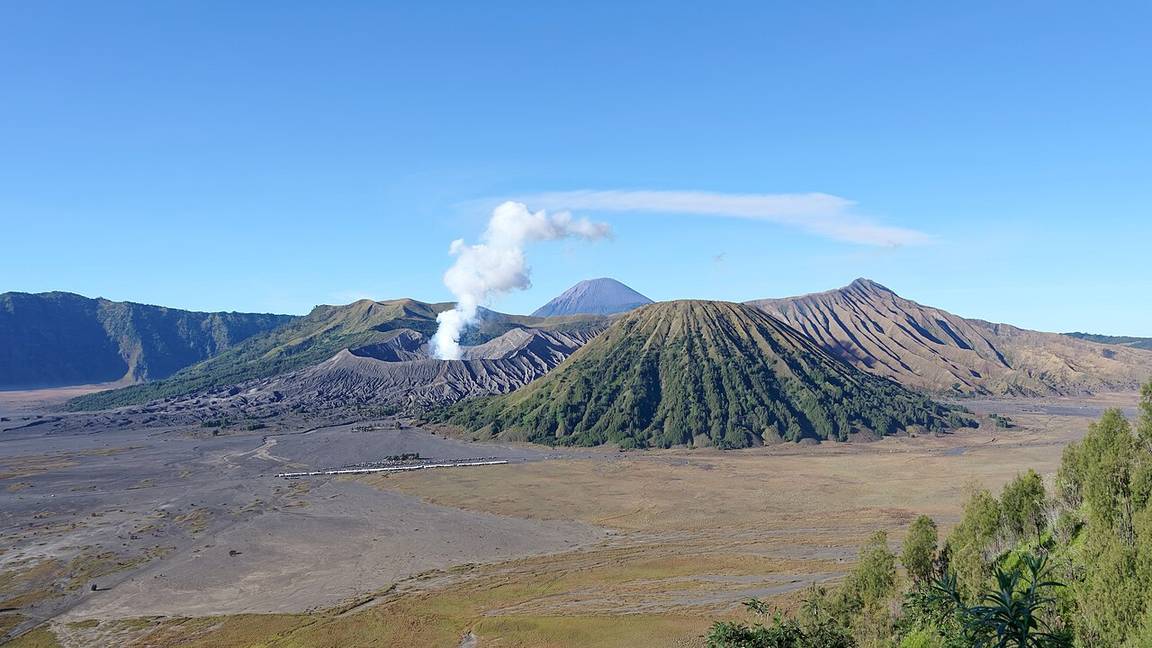
The heat expresses itself explosively, too, on a smaller stage: a steam explosion about 13,800 years ago left a crater 5 km across at Mary Bay, on the edge of Yellowstone Lake — which sits, of course, in the center of the caldera. Geologists monitoring the plateau also watch the caldera floor rise and fall measurably with changes in the chamber below.
So the correct mental model of a famous caldera is not a dead crater with a lake in it. It is a working volcanic system wearing a very large, very old scar — monitored, restless at small scale, and in Yellowstone’s case shared with one of the most visited landscapes on Earth.
The Chamber Below: Yellowstone
Since the collapse is caused by a chamber emptying, the natural final question is what the chamber looks like now. Analysis of earthquake data gives the Yellowstone magma chamber as about 80 km long and 20 km wide, with an underground volume of some 4,000 cubic kilometers — of which only 6–8% is molten rock. Even that considerable chamber turned out, when the earthquake-data analysis was published, to be about 2.5 times bigger than scientists had previously imagined — a useful humility check for the whole subject: the biggest volcanic system in North America sat under the most studied landscape in volcanology, substantially underestimated, for decades.
Read that percentage twice, because it recalibrates the whole subject: the chamber is a mostly solid body with melt distributed through it, and the same USGS body of work describes the system as two stacked bodies — a shallower rhyolite body about 5–17 km down, itself only 5–15% melt, over a deeper basalt reservoir 20–50 km down. The proportion of molten rock matters more than the chamber’s impressive volume: it is the reason the scientists who measured it concluded the melt fraction is far too low to allow another supereruption in the foreseeable future, and the reason the caldera above it is a landscape of lakes and geysers rather than a ticking headline.
Frequently Asked Questions
No. A crater is the bowl at a volcano’s summit, excavated and built up around the vent by eruptions themselves; a caldera is a far larger depression formed when the ground collapses into an emptied magma chamber. The parts guide on this site draws the distinction properly; the short version is that craters are made by material going out, and calderas by the ground going down.
The sources behind this article define calderas by their mechanism — collapse into an emptied chamber — rather than by a minimum size, and the famous examples show the scale involved: 55 × 72 km at Yellowstone, 100 × 35 km at La Garita. If it formed by collapse above a drained chamber, it is a caldera; size is a consequence, not the criterion.
The USGS’s own assessment puts the yearly probability of another caldera-forming eruption at roughly 1 in 730,000 — approximately the chance of a large asteroid impact — and states there is no evidence such an eruption is imminent. The measured chamber below is only 6–8% molten, a fraction scientists consider far too low for a supereruption.
A caldera whose floor, after collapsing, rises again as magma returns beneath it. Pacana in Chile is the standard example in the eruption lists. Resurgence is the clearest evidence that a caldera-forming collapse does not end a volcanic system.