Why Do People Keep Diaries? The Real Reasons Explained

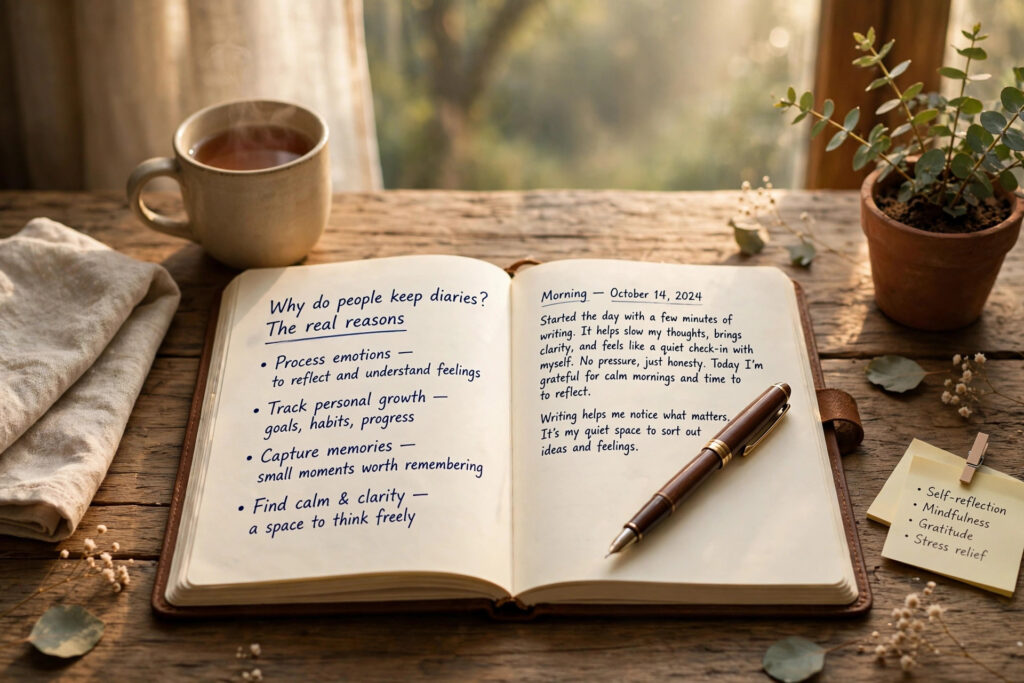
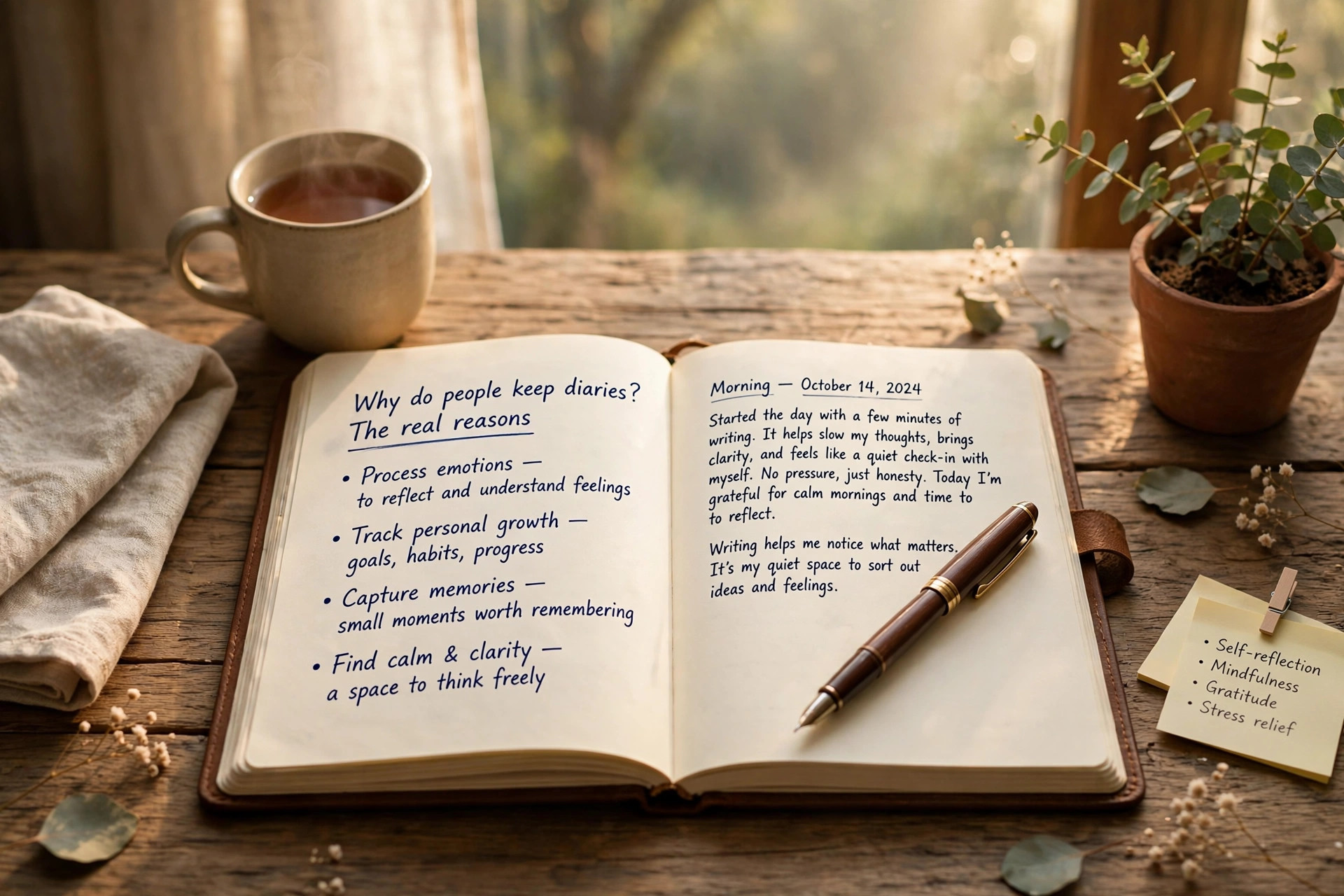
People have been writing private journals for thousands of years, long before the word “diary” existed in any language. So why do people keep diaries today, when we already document our lives in photos, messages, and endless scrolling feeds? The short answer is that a diary does something no camera or chat thread can do: it holds the inside of your life, not just the outside. A diary keeps your thoughts, feelings, decisions, and the small moments you’d otherwise forget by next Tuesday.
I started my first diary when I was fourteen, mostly because a friend at school had one and it looked sophisticated. That diary was embarrassingly dramatic. It contained detailed reviews of cafeteria food, long passages about a crush who barely knew my name, and several entries where I declared that nothing would ever be the same again. And you know what? It was worth every page. Because now, years later, I can open it and step straight back into a bedroom I haven’t lived in for decades, with thoughts I no longer think but once believed with my whole heart.
This article looks at the real reasons millions of people keep diaries, from memory preservation and emotional processing to creativity, health habits, and plain old entertainment. If you’ve ever wondered whether starting a diary is worth the effort, the evidence from millions of journal-keepers — and more than a little history — says it might be one of the best habits you can pick up.
Why Do People Keep Diaries? The Core Reasons
Ask ten diary-keepers why they do it and you’ll get twelve different answers. But the reasons cluster around a handful of deep human needs that haven’t changed much since the days of parchment.
To remember what life actually felt like
The number one reason people keep diaries is memory. Human memory is shockingly unreliable. Ask someone what they ate for dinner three Tuesdays ago, and they’ll stare at you blankly. Ask what they were worried about six months ago, and they’ll probably give you the current worry instead of the old one. A diary is a fix for this built-in amnesia.
Diaries don’t just record events; they record the feeling of the events. A photograph shows you the beach trip, but only a diary tells you that you almost didn’t go, that you argued in the car on the way there, and that you ended up staying until sunset because nobody wanted the day to end. That emotional layer is what makes old diary entries so powerful to reread.
There’s a practical side too. People use diaries to track progress: fitness goals, savings, career moves, projects. A daily line about what you did turns a vague sense of “I’m working on it” into a visible record of actual effort. Many people say the diary is what finally made them honest about whether they were moving forward or standing still.
To process emotions and quiet the noise

A second big reason is emotional processing. When something upsetting happens, the mind tends to replay it on a loop. Writing it down breaks the loop. You take the messy, tangled feeling and force it into sentences, and sentences have a way of revealing structure you couldn’t see before.
Psychologists call this expressive writing, and studies going back to the 1980s have found that writing about emotional experiences for even fifteen or twenty minutes can reduce stress and improve mood in the weeks that follow. You don’t need to write beautifully. You don’t even need to be coherent. The point is getting the thoughts out of your head and onto something you can look at from the outside.
Many people treat the diary as a conversation partner who never interrupts. You can write the thing you’d never say out loud: the anger at a coworker, the fear about a health scare, the guilt about a decision. Once it’s written, people often describe feeling lighter, as if the thought has been filed away instead of circling endlessly.
This is also why diaries help with decisions. Big choices — leaving a job, ending a relationship, moving cities — are hard because feelings pull in different directions. Writing pros and cons sounds like a school exercise, but it works precisely because it forces the swirling feelings into an order you can examine.
To create a space that is entirely theirs
In a world where every opinion can be screenshotted and every photo can be judged, a diary is one of the last private spaces. You don’t edit for an audience. You don’t soften your views. You don’t make yourself look interesting. For many people, this privacy is the whole point.
That privacy has a creative effect. Writers, artists, and musicians have kept diaries for centuries precisely because the notebook is where bad ideas are allowed. You can write a terrible poem, sketch a strange idea, or plan an impractical project without anyone raising an eyebrow. Plenty of real projects — books, businesses, inventions — started as half-serious notes in a diary margin.
What History Tells Us About Diary Keeping
Diary keeping isn’t a modern habit. The Roman emperor Marcus Aurelius kept what amounts to a diary — his private notes, later published as the Meditations, were never meant for readers. They were reminders he wrote to himself about how to be a decent person. If the most powerful man in the ancient world needed a notebook to sort out his thoughts, the rest of us are in good company.
In Japan, court ladies of the tenth and eleventh centuries kept pillow books and diaries that are now considered classics of world literature. Sei Shonagon’s Pillow Book is essentially a diary of observations, lists, and opinions — including strong complaints about people who chewed loudly. Eight hundred years later, it reads like a modern blog: personal, opinionated, and funny.
During the nineteenth century, diary keeping became widespread with cheaper paper and mass literacy. Then came the wars of the twentieth century, which produced some of the most famous diaries ever written. Anne Frank’s diary turned a private notebook into one of history’s most powerful documents — which raises an important point: we never know which ordinary diaries will matter to the future.
The Types of Diaries People Actually Keep
Not all diaries look the same. The word covers a whole family of habits, and part of the reason so many people keep one is that there’s a version for almost every temperament.
The daily log
This is the classic: a few lines every day about what happened. No deep thoughts required. The daily log is popular because it has the lowest barrier to entry. Some people write a single sentence. Others fill a page. The value compounds over months — a year of daily logs is a map of a whole year of your life.
The dream journal
Some people keep a diary specifically for dreams, jotting down what they remember on waking. Even skeptics of dream interpretation say the habit makes dreams more vivid and memorable, and the entries make entertaining reading later. Dreams are famously strange, and a dream journal is proof that your sleeping brain is the weirdest novelist you’ll ever meet.
The gratitude or reflection journal
These focus on the positive: three good things from the day, one thing learned, one thing to improve. This format is popular because it takes five minutes and gives structure to people who find a blank page intimidating. It also shifts attention — on a bad day, the journal forces you to find at least one decent thing.
The travel diary
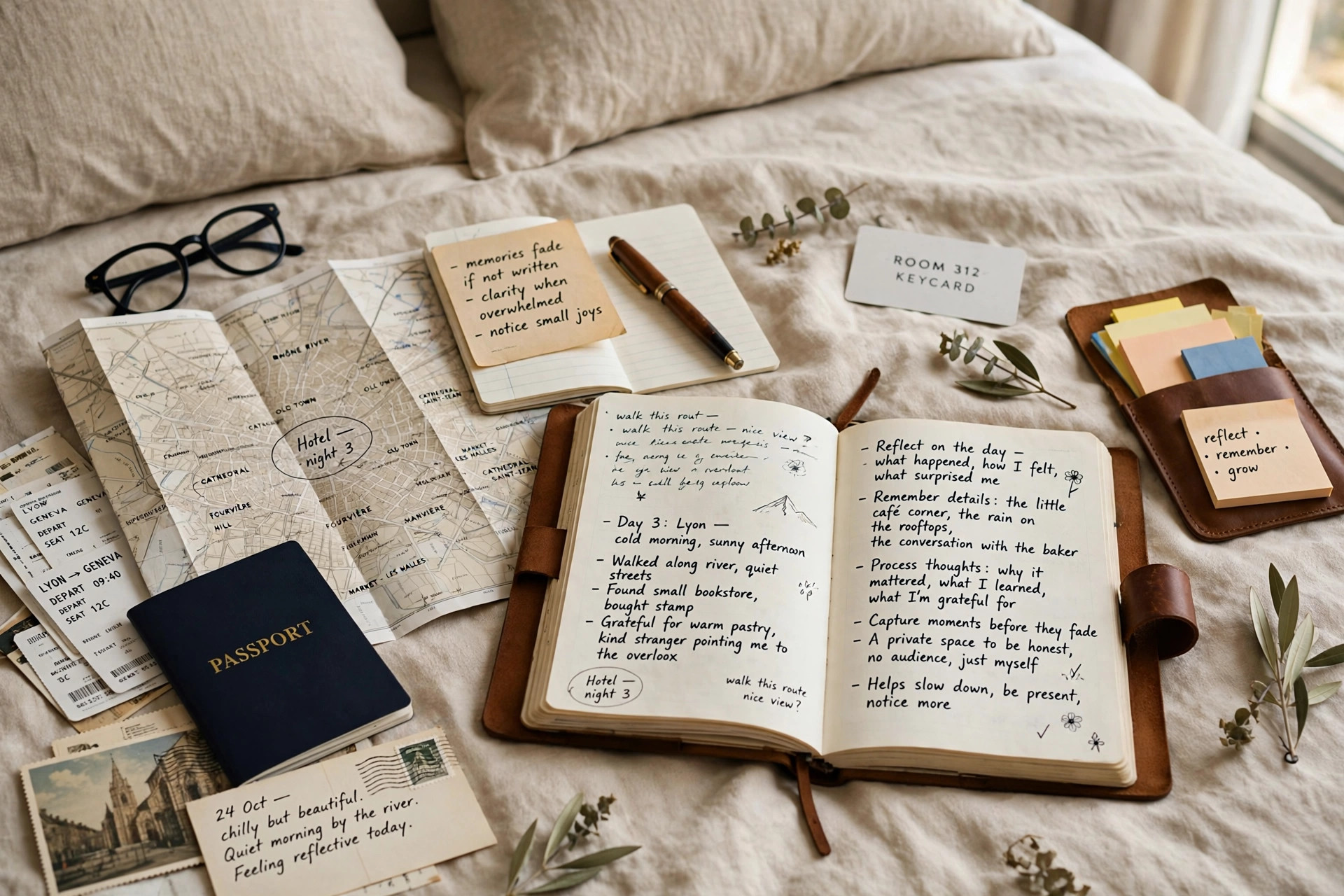
Trips produce more memories per day than ordinary life, and travel diaries capture them. People paste in ticket stubs, sketch maps, record the meal that was unexpectedly amazing and the hotel that was unexpectedly terrible. Years later, the travel diary is often the souvenir people value most — more than any object bought on the trip.
The project or work diary
Builders, researchers, gardeners, and students keep diaries of specific projects: what was planted when, what the experiment did, what the code change broke. These are half diary and half logbook, and they turn out to be genuinely useful references. The gardener who writes down planting dates and weather gets better results every year because they’re running an experiment with notes instead of a hobby with guesses.
What Stops People — And Why the Excuses Don’t Hold Up
The most common reason people don’t keep diaries is the belief that they have nothing interesting to write about. This is backwards. Diaries don’t record interesting lives; they make ordinary lives interesting. The diary of an ordinary day in 1990 is fascinating in 2026. Your ordinary day today will be fascinating in 2060, even to your own grandchildren.
The second excuse is time. But a diary entry can be two sentences. “Busy day, nothing special. Had lunch with Priya and laughed about the printer disaster.” That’s enough. The habit matters more than the length. Many long-term diary keepers say their most consistent periods were when they wrote the least per day.
The third excuse is fear that someone will read it. This is a real concern, and it’s why plenty of people use a password-protected app or a notebook kept somewhere private. But it’s worth noting that most people who find a diary are family members after someone’s death — and opinions differ about whether that’s a violation or a gift. Anne Frank wrote expecting to be read; Marcus Aurelius wrote expecting never to be read. Both approaches are valid.
How to Start a Diary You’ll Actually Keep
If the reasons above have convinced you, the best time to start is tonight. Here is the stripped-down version of what works for long-term diary keepers.
Pick a format you won’t fight with. Some people love a beautiful notebook; others lose it and write in a phone app. The best format is the one you’ll actually open at 11 PM. Don’t buy a fancy journal and wait for the “right” moment — the right moment is the messy first entry.
Set the bar on the floor. Promise yourself one sentence a day. That’s it. On days when you have more to say, you’ll write more. On days when you don’t, one sentence keeps the chain alive. Chains matter: a diary with 365 short entries is infinitely more valuable than a diary with three long ones.
Write the truth, badly. Your diary doesn’t need wit or insight. It needs honesty. Write what you actually think, not what you think you should think. Future you will thank present you for being unfiltered.
Date everything. This sounds obvious and people forget anyway. Five years from now, the date is half the value of the entry. It’s what turns a note into a time capsule.
And if you outgrow the private notebook and want to share your writing with the world, that’s a different but equally rewarding habit. Plenty of diary keepers eventually start publishing their thoughts online — our guide on how to start a blog walks through turning private writing into a public project when you’re ready.
Frequently Asked Questions
Why do people keep diaries instead of just taking photos?
Photos capture what things looked like, but diaries capture what they felt like. A photo of a birthday dinner doesn’t record who argued, who laughed hardest, or what you were privately worried about that week. People keep diaries because the inner story is the one they’d actually miss — and the one cameras can’t take.
Is keeping a diary good for mental health?
Research on expressive writing suggests it can help. Studies have repeatedly found that writing about emotional experiences for short sessions reduces stress and improves mood. It’s not a replacement for professional help with serious issues, but as a daily habit for processing ordinary life, it’s one of the cheapest mental-health tools available.
What should I write about in a diary if nothing interesting happens?
Write the ordinary stuff: what you ate, who you talked to, what annoyed you, what you’re thinking about. Ordinary details are exactly what become interesting with time. A 2026 entry about a bus ride is boring now; the same entry will be fascinating to someone reading it in 2046, including future you.
Is a paper diary better than a digital one?
Neither is objectively better — the best diary is the one you actually use. Paper fans say writing by hand slows them down and feels more personal; digital fans point to searchability, password protection, and always having it with them. Try one for a month and switch if it isn’t working. The habit matters, not the medium.
How often should you write in a diary?
As often as you like, but consistency beats volume. Daily one-sentence entries build a better record than monthly essays. That said, there’s no diary police — some people write three times a day during big life events and then skip a month. The diary doesn’t judge. That’s part of why people love it.