
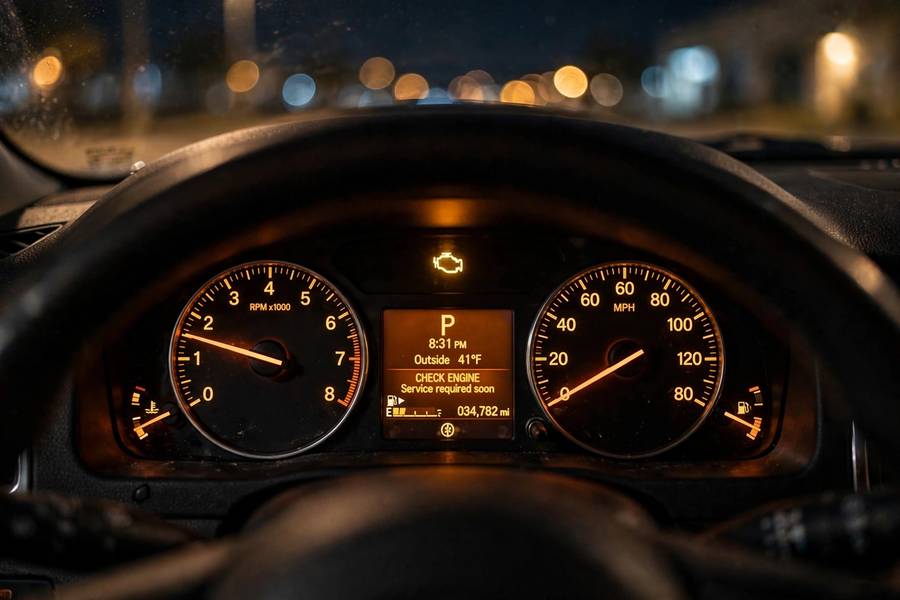
That little amber engine icon is the most misunderstood light on your dashboard. I’ve had customers drive in panicking over a loose gas cap, and I’ve had customers ignore a flashing light until their catalytic converter melted. Both reactions come from the same problem: nobody explained what the check engine light actually means.
Ten years in and around repair shops, and I’ve diagnosed thousands of these. Here’s the no-panic, no-nonsense guide — what the light means, when it’s urgent, the most common causes, and how to read the codes yourself for twenty bucks.
Contents
- What the Light Actually Is
- Solid vs Flashing: The Only Distinction That Matters
- The 7 Most Common Causes (In Order)
- How to Read the Codes Yourself
- Can You Drive With It On?
- Will It Turn Off By Itself?
- When to Actually Panic
What the Light Actually Is
The check engine light (formally the Malfunction Indicator Lamp) is your car’s way of saying “the computer found something outside normal parameters.” Your car’s computer constantly monitors dozens of sensors — oxygen levels in the exhaust, engine misfires, fuel system pressure, emissions equipment — and when readings go out of range, it stores a diagnostic trouble code and lights the lamp.
Crucially: the light doesn’t tell you what’s wrong. It tells you something is wrong and where to look. The actual diagnosis lives in the stored code. Anyone who tells you “check engine light means you need X” without reading the code is guessing — and guessing with your money.
Solid vs Flashing: The Only Distinction That Matters
Forget everything else and learn this:
Solid (steady) light: Something needs attention, but it’s not an emergency. Drive normally, get it checked within days. The vast majority of check engine lights are solid.
Flashing/blinking light: This means an active engine misfire severe enough to damage the catalytic converter. Reduce speed, avoid hard acceleration, and get to a shop now — as in today, not next week. Continuing to drive hard on a flashing light can turn a $200 ignition coil into a $2,000 catalytic converter. I’ve seen it happen more times than I can count.
That’s it. That’s the triage. Solid = schedule a visit. Flashing = go now.
The 7 Most Common Causes (In Order)
From my shop experience, roughly in order of frequency:
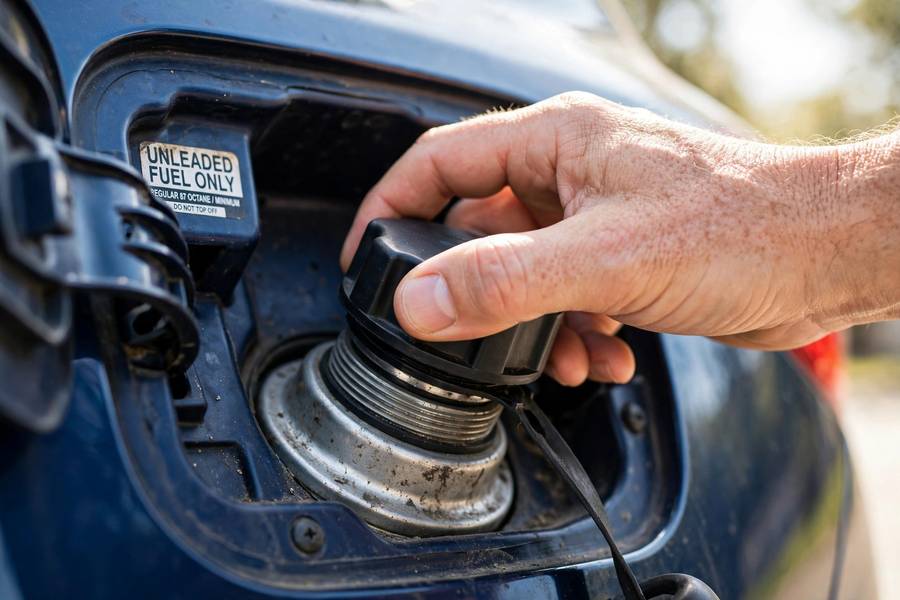
1. Loose or faulty gas cap. The fuel system is sealed and pressurized; a loose cap triggers an evaporative emissions code. It’s the #1 cause and the #1 embarrassment. Tighten it (click it three times), drive for a few days, and the light often clears itself.
2. Failing oxygen sensor. O2 sensors measure exhaust oxygen to manage the fuel mixture. They wear out every 60,000–100,000 miles. Symptoms: worse fuel economy, sometimes rough idle. Not urgent, but don’t ignore it for months — a bad O2 sensor can kill the catalytic converter downstream.
3. Bad catalytic converter. Often the result of ignoring #2 or driving with misfires. Symptoms: rotten egg smell, loss of power, rattling underneath. Expensive — this is the repair everyone fears, and it’s frequently preventable.
4. Worn spark plugs or ignition coils. Causes misfires — rough running, hesitation, and (if severe) the flashing light. Plugs are cheap maintenance; coils cost more but are straightforward.
5. Mass airflow sensor issues. The MAF measures incoming air; when it’s dirty or failing, the fuel mixture goes wrong. Sometimes fixed with a $10 can of MAF cleaner spray. Sometimes it needs replacement.
6. EVAP system leaks. Beyond the gas cap: cracked hoses, bad purge valves, leaking charcoal canisters. Annoying to find (mechanics use smoke machines to locate them), rarely urgent.
7. Thermostat or coolant sensor faults. The engine running too cool (stuck-open thermostat) hurts efficiency and emissions. Usually a cheap part, moderate labor.
Notice: most of these are maintenance items, not catastrophes. The light feels scary; the reality is usually mundane.
How to Read the Codes Yourself
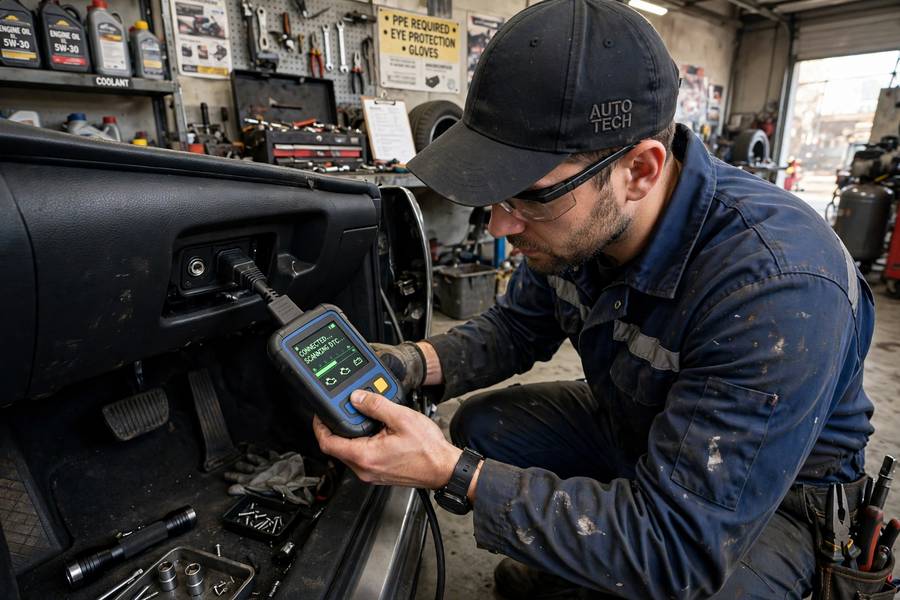
You don’t need a mechanic just to find out what the light means. A basic OBD2 scanner costs $20–30 and plugs into the diagnostic port under your dashboard (usually left of the steering column).
- Plug it in with the engine off, then turn the key to ON (don’t start).
- Read the codes — they’ll look like P0301 (cylinder 1 misfire) or P0420 (catalyst efficiency below threshold).
- Write down the exact code. Google it with your car’s year, make, and model.
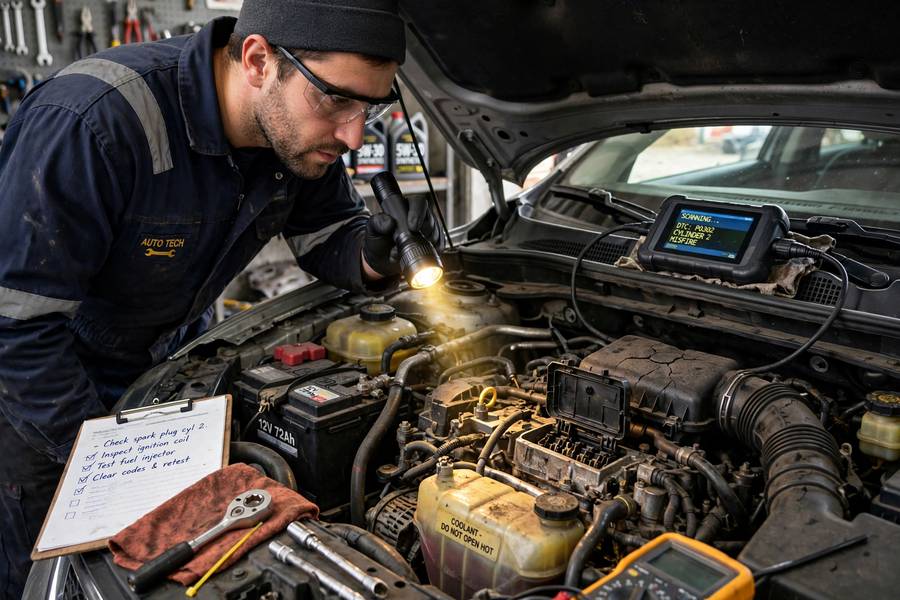
The code tells you the circuit or system with the fault, not necessarily the exact failed part. P0301 means cylinder 1 is misfiring — could be the plug, coil, injector, or compression. The code is the starting point for diagnosis, not the diagnosis itself. Anyone selling you a part based solely on a code is skipping steps.
Bluetooth adapters ($15) paired with a phone app work great too and show live sensor data — genuinely useful for watching what’s happening in real time.
Can You Drive With It On?
Solid light, car driving normally: yes, with common sense. Get it diagnosed within a week or two. You’re not going to explode, but don’t road-trip across the country ignoring it either.
Solid light with symptoms (rough running, loss of power, strange smells, overheating): drive gently to the nearest shop. Symptoms + light = the car telling you something is actively wrong.
Flashing light: minimize driving. If you’re on the highway, take the next exit. If you’re close to a shop, go gently. If you’re far from help, call a tow — a $100 tow beats a $2,000 converter.
Red oil pressure or temperature light (different lights!): stop immediately, engine off. Those aren’t “check soon” lights — they’re “stop now or buy an engine” lights. Don’t confuse them with the amber check engine light.
Will It Turn Off By Itself?
Sometimes. If the fault was transient — the loose gas cap you tightened, a one-time misfire from bad fuel — the computer will clear the light after a number of drive cycles without the fault recurring. Typically the light goes off after about 3 consecutive fault-free drive cycles, while the stored code itself clears after roughly 40–80 warm-up cycles (or immediately with a scanner).
But “the light went off” doesn’t mean “the problem is fixed.” Intermittent faults come and go. If the light returns, the underlying issue is still there, and the stored code history will show it even when the light’s off. Get it checked anyway.
And please: don’t just clear the code and hope. Clearing without fixing is like snoozing a fire alarm. The problem remains, and you’ve erased the evidence that would help diagnose it.
When to Actually Panic
Panic is rarely useful, but act urgently when:
- The light is flashing
- There’s a burning smell, smoke, or visible fluid loss
- The engine is overheating (temperature gauge in the red)
- There’s a sudden loss of power or violent shaking
- Multiple warning lights come on together
Otherwise: read the code, do a little research, and make a plan. The check engine light is your car’s way of asking for attention, not delivering a death sentence. While you’re in car-basics mode, learn what cruise control is actually doing behind the scenes — and keep how to jump start a car bookmarked for the day the battery, not the engine, is the problem. Understand it instead of fearing it, and you’ll save yourself both panic and money.
Emissions Testing and the Check Engine Light
One practical consequence people discover at the worst moment: in most places with emissions testing, a lit check engine light is an automatic failure — regardless of what the code is or how the car runs.
This creates a perverse situation I’ve seen repeatedly: someone clears the code the morning of the test hoping to sneak through. It doesn’t work. Modern OBD2 emissions tests check readiness monitors — internal self-tests the computer runs on the emissions systems. Clearing codes resets these monitors to “not ready,” and the test station sees that and fails you (or tells you to come back after driving enough for the monitors to complete, typically 50–100 miles of varied driving).
The legitimate path: fix the underlying problem, drive normally for a few days while the monitors run their self-tests, then go for the inspection. If the light stays off and the monitors show “ready,” you pass.
A related trap: buying a used car right after the seller “just cleared a code.” Always check readiness monitors (any OBD2 scanner shows them) before buying — “not ready” on a car that’s supposedly been driven normally means someone recently cleared codes, and you should find out why before money changes hands. This thirty-second check has saved several friends from buying other people’s problems.
Frequently Asked Questions
It means your car’s computer detected something outside normal parameters in the engine or emissions system and stored a diagnostic trouble code. It indicates where to look, not the exact fault — reading the code with an OBD2 scanner reveals the specific issue.
A solid light means something needs attention soon but isn’t an emergency. A flashing light indicates a severe engine misfire that can damage the catalytic converter — reduce speed, avoid hard acceleration, and get to a shop immediately.
A loose or faulty gas cap is the most common cause — it triggers an evaporative emissions code. Tighten the cap until it clicks three times and drive normally for a few days; the light often clears itself.
With a solid light and no symptoms, yes — get it checked within a week or two. With symptoms (rough running, power loss, smells) drive gently to a shop. With a flashing light, minimize driving and seek immediate service to avoid catalytic converter damage.
Buy a basic OBD2 scanner ($20–30), plug it into the diagnostic port under your dashboard, turn the key to ON, and read the codes (e.g., P0301). Look up the exact code with your car’s year, make, and model — it identifies the affected system, which is the starting point for diagnosis.