What Is the Solar Wind? The Stream That Shapes Space Weather

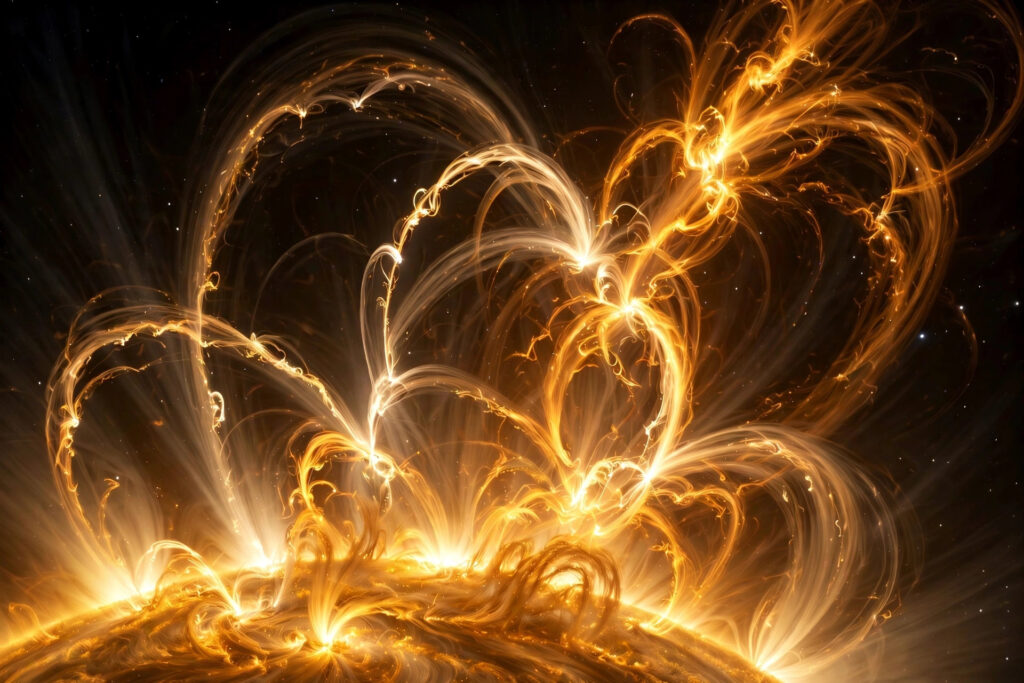
Here is a thought that has never stopped amazing me: the space between the planets is not empty. It is blowing. Right now, a thin, invisible wind of charged particles is streaming past Earth at hundreds of kilometers per second — particles that left the Sun a few days ago and will keep going to the very edge of the solar system.
This is the solar wind: a continuous flow of plasma — mostly protons and electrons, with a few percent helium and traces of heavier elements — escaping the Sun’s outer atmosphere, the corona, and rushing outward in every direction. By the time it reaches Earth it is staggeringly thin: roughly a few particles per cubic centimeter — far emptier than the best laboratory vacuum. But it never stops, and it shapes everything it touches.
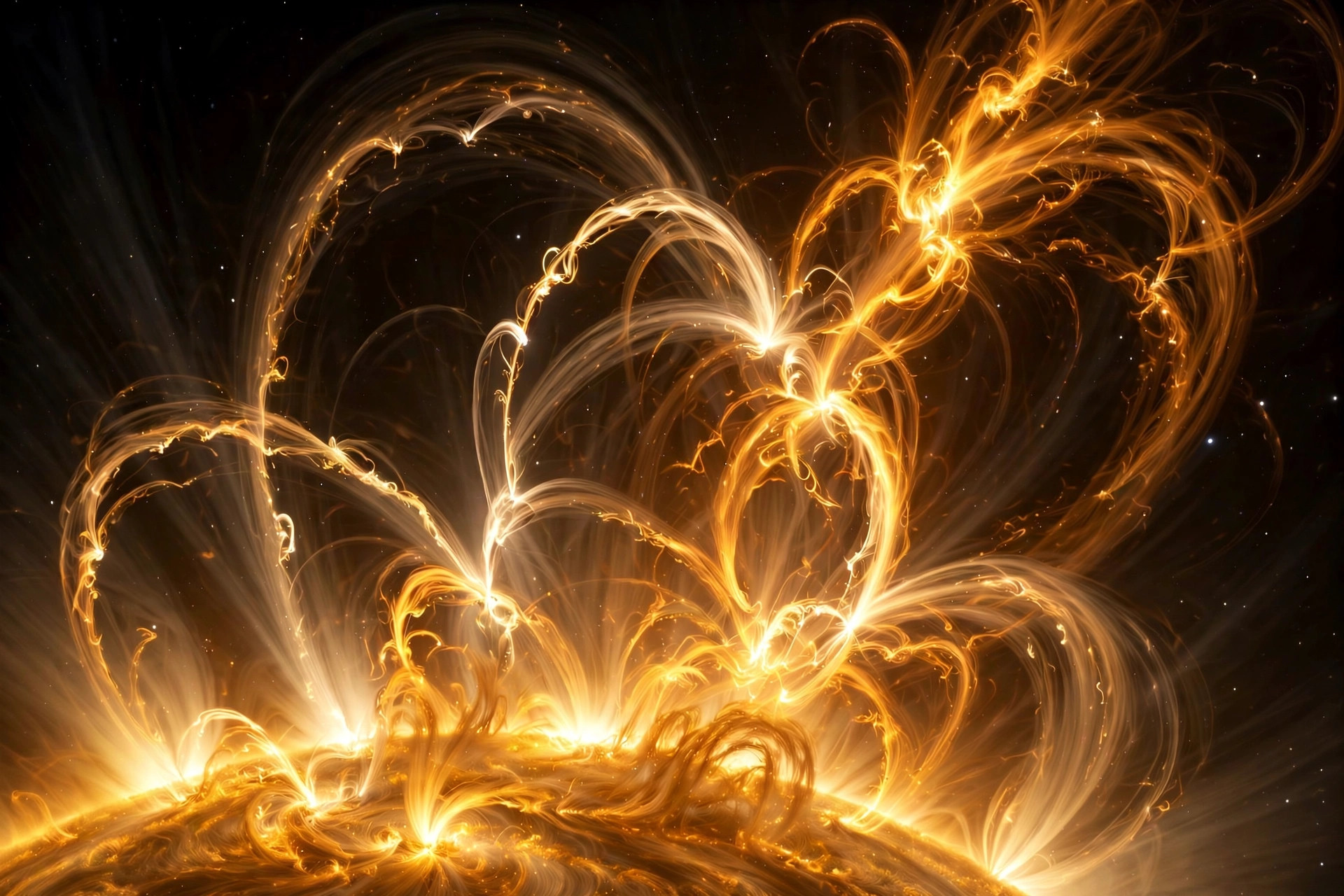
The idea that the Sun emits a wind was proposed in the late 1950s by American physicist Eugene Parker. He argued, from theory alone, that the million-degree corona could not sit in calm equilibrium — its outer layers had to be streaming into space. Colleagues were skeptical; a continuous wind from the Sun sounded strange. Then early spacecraft in the 1960s flew through it and measured it directly. The wind was real, and Parker — like Einstein with his rings — was right about something nobody had seen.
How Fast Is It? Two Winds, Actually
Here is how I think about the solar wind’s speed: the “slow” solar wind moves at roughly 400 kilometers per second — about 1.4 million kilometers per hour. The “fast” solar wind blows at roughly 750 km/s, nearly double that.
Those two speeds are not random; they come from two different neighborhoods on the Sun. The slow wind rises from around the Sun’s equatorial belt, a region called the streamer belt, where plasma travels along closed magnetic loops. The fast wind pours out of coronal holes — gaps in the corona where magnetic field lines open straight into space, like water spraying from an open hose instead of looping back.
At Earth’s orbit, the slow wind is the usual weather; fast wind arrives in gusts when a coronal hole rotates to face Earth. Violent solar eruptions occasionally send blasts past 1,000 km/s — but those are storms, not the everyday breeze. When fast streams catch up with slow streams ahead of them, the collision builds turbulent regions that can rattle Earth’s magnetic field.
The Parker Spiral: Why the Wind Does Not Fly Straight Out
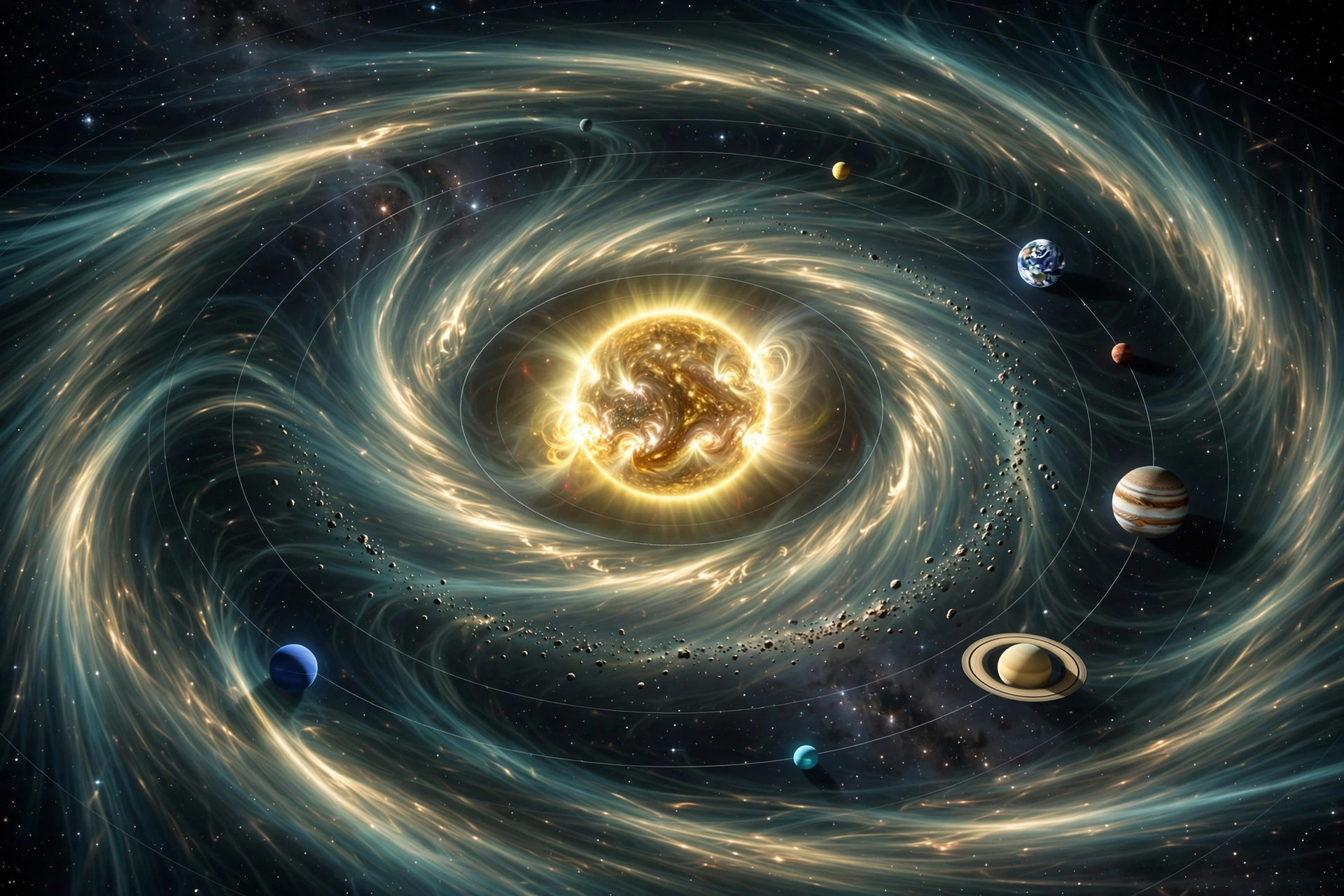
You might assume this wind flies radially outward in straight lines, like sparks from a sparkler. Close to the Sun, that is roughly true. But the Sun rotates — once every 27 days or so — and the wind carries the Sun’s magnetic field with it, twisting the field into an enormous spiral. Picture a spinning garden sprinkler seen from above: the water arcs out in a spiral pattern. The solar wind does the same thing on a solar-system scale. This is the Parker spiral — another of Eugene Parker’s predictions. By the time the wind reaches Earth, the arriving field lines make an angle of about 45 degrees to the outward direction.
Meeting Earth: Auroras and Geomagnetic Storms
Eventually, after its two-to-four-day journey across about 150 million kilometers, the solar wind arrives at Earth — and this is where the story gets visual.
Earth is wrapped in a protective magnetic bubble called the magnetosphere. The solar wind cannot blow through it; instead it flows around it, squeezing it into a comet-like shape. But some particles do get in, funneling down field lines toward the poles.
When those charged particles slam into gases high in the atmosphere, they excite the atoms — and the atoms release that energy as light. That light is the aurora. The green in photos comes from oxygen; reds and purples from nitrogen and high-altitude oxygen. Every aurora is a visible message from the solar wind, announcing that the stream has arrived.
Most days the wind is gentle and auroras stay near the poles. But when the Sun sends a faster, denser burst — especially a coronal mass ejection, a billion-ton bubble of plasma — the wind can compress and shake Earth’s magnetosphere hard. These geomagnetic storms push auroras far toward the equator, induce currents in power lines and pipelines, disrupt radio and GPS signals, and raise radiation risks for astronauts and satellites. That is why the solar wind sustains a round-the-clock space-weather watch: the difference between “pretty lights” and a multi-billion-dollar forecasting effort.
One more striking fact: a comet’s tail always points away from the Sun — not because of the comet’s motion, but because the solar wind pushes its evaporating gas and dust outward. Comet tails are weather vanes for the solar wind.
The Heliosphere: The Wind’s Bubble
The solar wind does not go on forever. As it streams past all the planets it gradually slows and thins — and eventually runs into the thin gas between the stars. The enormous bubble the wind inflates around the solar system is called the heliosphere, and its outer edge is where the Sun’s influence gives way to interstellar space.
Key landmarks: the termination shock, where the wind slows abruptly from supersonic to subsonic; then the heliosheath; then the heliopause, the true edge where the wind’s pressure balances the interstellar medium. NASA’s Voyager 1 and 2 crossed the heliopause and are still sending back data on radio whispers from interstellar space.
I like to think of the heliosphere as the Sun’s actual size. We draw the solar system as ending at Neptune, but the Sun’s real reach — its wind, its magnetic field — extends more than a hundred times farther. We live inside the Sun’s atmosphere, in a sense; we just happen to live in its outermost, coldest, most tenuous outskirts.
How Scientists Measure the Wind
You cannot stick an anemometer in the solar wind, so how do we know all this? We have sent instruments into it, and we keep building better ones.
The modern era of solar-wind science rests on two great missions. NASA’s Parker Solar Probe, launched in August 2018, is the closest any human-made object has come to a star — diving through the Sun’s corona within about 6.2 million kilometers of the surface at speeds up to 720,000 km/h. It flies through the birthplace of the wind itself, sampling plasma where the wind is still accelerating, and where the strange S-shaped magnetic kinks called solar switchbacks turned out to be abundant.
ESA’s Solar Orbiter, launched in February 2020, takes the complementary approach: staying farther out (closest approach about 42 million kilometers) but combining cameras with in-situ instruments, so it can photograph the Sun’s surface while tasting the wind that the photographed region produces. It is also tilting its orbit to eventually see the Sun’s poles — the first proper view of the Sun’s top and bottom.
Together they are answering Parker’s original questions: how the wind gets its speed, and why the corona is hundreds of times hotter than the Sun’s surface. One big recent finding came from Parker getting close enough to look inside coronal holes: it found magnetic “funnels,” only about 20,000 kilometers above the surface, where reconnection of magnetic field lines hurls particles outward with 10 to 100 times the energy of the slow wind. The fast wind’s engine, glimpsed at last.
There are also spacecraft parked permanently upstream of Earth, like weather buoys. Positioned at the L1 Lagrange point, about 1.5 million kilometers sunward of Earth, solar-wind monitors measure speed, density, and magnetic field in real time — giving roughly a half-hour to an hour of warning before a gust reaches us.
Why It All Matters
Let me bring this home, because the solar wind can sound like abstract plasma physics until you connect it to your life. The solar wind sculpts the magnetosphere that shields our atmosphere from being stripped away. It drives the auroras that draw travelers north every winter. It is why Mars — with no global magnetic field — lost most of its atmosphere, while Earth’s held on. It sets the weather for every satellite and every astronaut. And it defines the true boundary of the solar system: a bubble over 100 astronomical units wide, blown by nothing more than a hot star exhaling.
The next time you see a photo of the northern lights, remember what you are looking at: particles that left the Sun a few days earlier, riding a spiral of magnetism 150 million kilometers to reach us. The wind never stops blowing. We just learned how to feel it.
A continuous stream of charged particles — mostly protons and electrons, with a few percent helium and traces of heavier elements — flowing outward from the Sun’s corona. This thin plasma carries the Sun’s magnetic field across the solar system.
Two speeds: the slow wind at roughly 400 km/s, and the fast wind at roughly 750 km/s. The slow wind comes from the Sun’s equatorial streamer belt; the fast wind streams out of coronal holes, where magnetic field lines open into space.
The spiral pattern of the solar wind’s magnetic field. Because the Sun rotates while the wind flows outward, the field lines carried by the wind get wound into a spiral — like water from a spinning garden sprinkler. At Earth, they arrive at about a 45-degree angle to the outward direction.
Solar-wind particles funnel into Earth’s magnetosphere and collide with atmospheric gases near the poles, exciting oxygen and nitrogen atoms that release the energy as green, red, and purple light.
The giant bubble blown by the solar wind around the entire solar system. Its outer boundary, the heliopause, is where the wind’s outward pressure meets the interstellar medium. NASA’s Voyager 1 and 2 have crossed it and are now in interstellar space.
NASA’s Parker Solar Probe (launched August 2018), which dives through the Sun’s corona closer than any spacecraft before it, and ESA’s Solar Orbiter (launched February 2020), which combines solar imaging with in-situ wind measurements. Monitors at the L1 point provide real-time space-weather data.