Solar Orbiter Just Cracked a Solar Mystery: What Switchbacks Are — and Why They Warn of Coming Storms

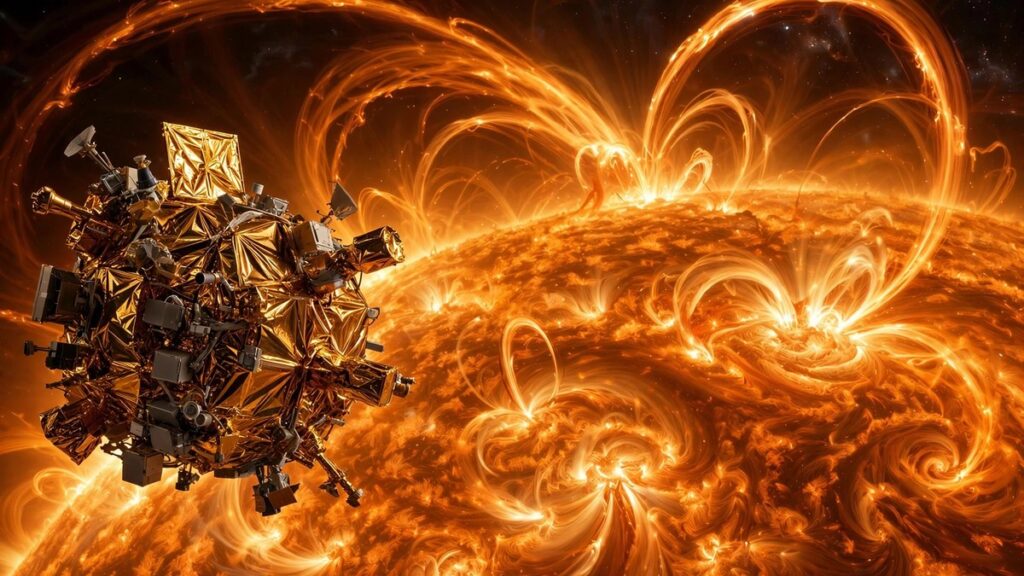
The Sun keeps folding its own magnetic field into S-shaped kinks — Solar Orbiter has finally traced where they are born.
Solar switchbacks are sudden, S-shaped bends in the magnetic field of the solar wind — the stream of charged particles that flows continuously from the Sun into space. In October 2026, scientists using the European Space Agency’s Solar Orbiter spacecraft announced they had traced one of these structures all the way back to the Sun’s surface. The particles inside it carried a chemical “fingerprint” proving that switchbacks are born when magnetic field lines snap and reconnect in the Sun’s hot atmosphere.
What Is the Solar Wind?
The Sun has an intense, restless magnetic field. That field is dragged outward by the solar wind: a continuous stream of hot charged particles (plasma) pouring from the Sun into space. The solar wind washes over every planet, shapes comet tails, and carries the magnetic disturbances that drive space weather at Earth.
Because the magnetic field is dragged along by this flowing plasma, its field lines can twist, snap and fold back on themselves on their journey through the solar system. The result is a constantly changing magnetic landscape — and, as scientists have found, sharp folds called switchbacks.
The Mystery: What Causes the S-Shaped Bends?
Switchbacks have been detected often near the Sun, but scientists debated how they form. In 2022, Solar Orbiter observed one from a distance and confirmed its characteristic S-shape — something scientists had predicted but never seen directly. Their exact origin, however, remained uncertain.
The breakthrough came when Solar Orbiter flew straight through a particularly large switchback. Because the structure was so big, the spacecraft could sample the plasma inside it in unusual detail — and that plasma carried tell-tale fingerprints of where it came from.
The Discovery: A Fingerprint Points to the Sun’s Surface
The research team, led by Jesse Coburn of CNRS/LPP in France, used Solar Orbiter’s Solar Wind Analyser (SWA) to sample the plasma making up the switchback. At the time, the spacecraft was roughly halfway between Earth and the Sun.
What they found was a mix of charged oxygen and carbon particles that, according to their analysis, could only have formed in one way: within hot magnetic field loops anchored at the surface of the Sun. Data from NASA’s Solar Dynamics Observatory helped them connect the spacecraft’s measurements to the specific structures on the solar surface, revealing the switchback’s solar source in unprecedented detail.
As Coburn put it: “Solar Orbiter flew through a very large switchback. Because of this, we were able to sample rarely observed particles there that have tell-tale fingerprints of their origin.”
The paper, “On the Coronal Origin of Magnetic Switchbacks in the Solar Wind,” was published in Nature Astronomy on October 8, 2026, as ESA reported (DOI: 10.1038/s41550-026-02928-0). The underlying measurements were taken on March 2, 2022, when Solar Orbiter sampled the giant switchback roughly halfway between Earth and the Sun.
Interchange Reconnection: The Birth of a Switchback
The particle fingerprint points to a process called interchange reconnection. Here is how it works:
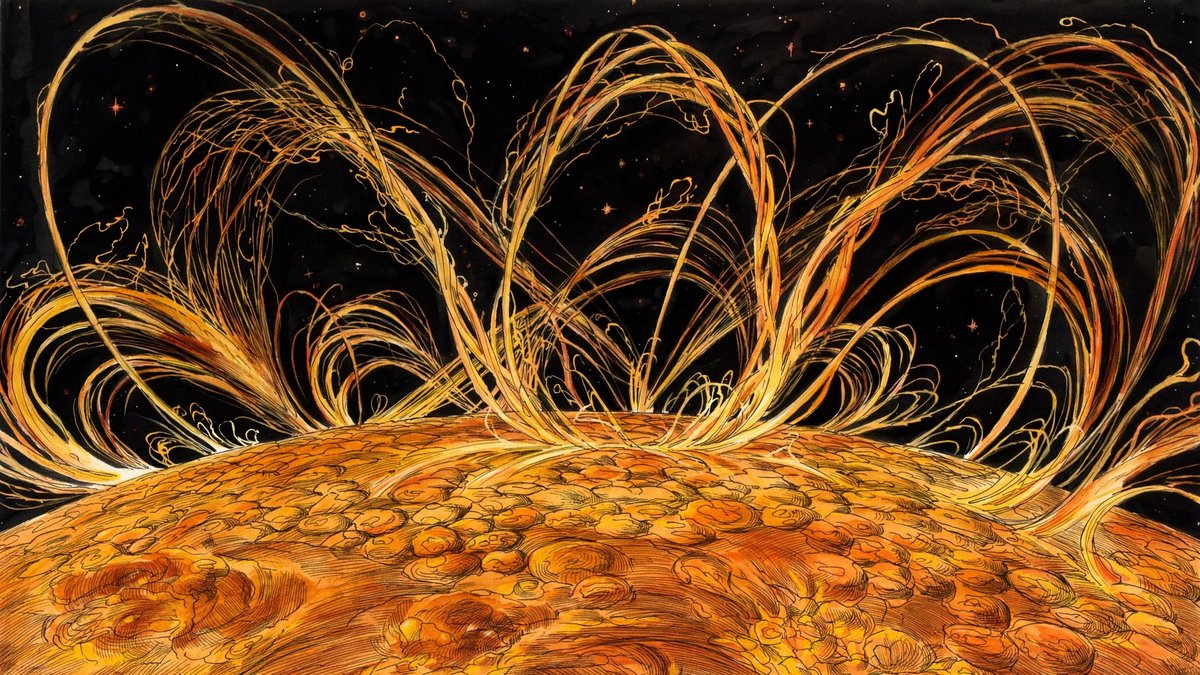
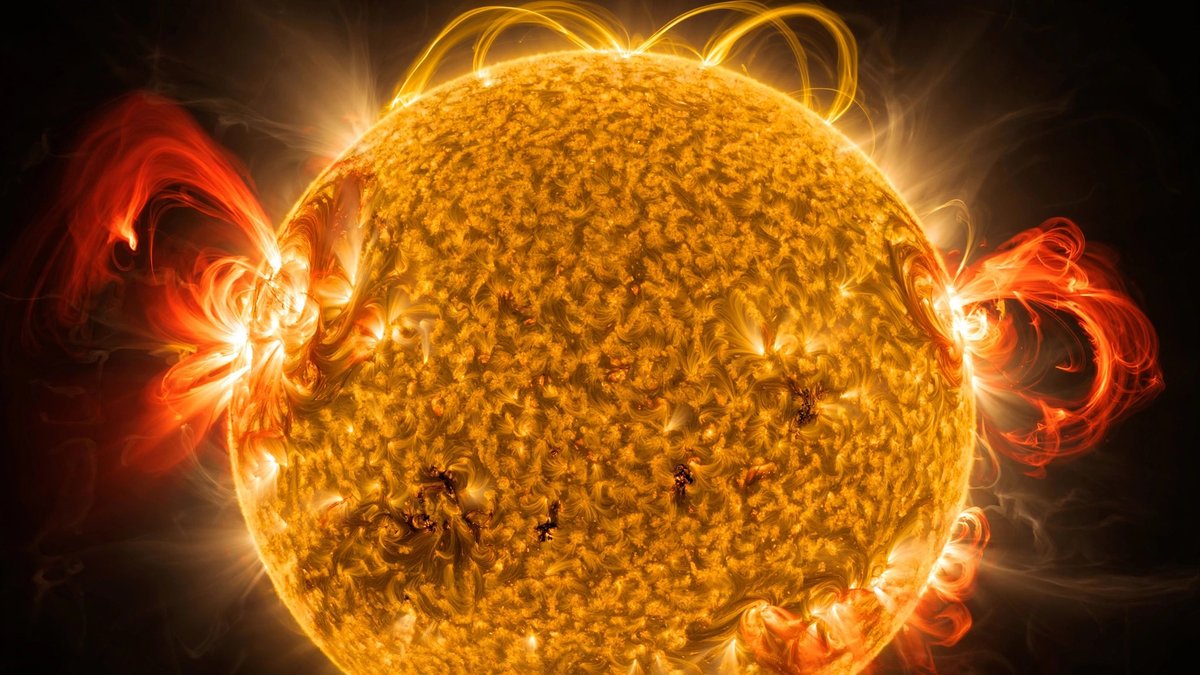
The Sun’s atmosphere has two kinds of magnetic regions. Open regions have field lines that stretch away from the Sun like highways, letting material zoom along them into space. Closed regions have field lines that initially extend outward but then curve back down to the Sun, trapping plasma inside magnetic loops.
When an open region interacts with a neighbouring closed one, the field lines can crowd together, snap open and reconnect in new configurations. In doing so, plasma that was previously trapped inside the closed loop escapes into the open field lines and flows out into space. That escaping burst of loop plasma is what forms the switchback.
“There are two main competing theories for how a switchback, and by extension the solar wind, forms,” Coburn said. “The specific mix of particles detected by Solar Orbiter is the smoking gun for a formation process known as interchange reconnection.”
But Waves Matter Too — at a Different Stage
The team also found signs of a competing explanation: waves and turbulence in the solar wind. But they concluded that these processes dominate later in the switchback’s life. Co-author Stephanie Yardley of Northumbria University, UK, explained: “Once the switchback has left the Sun, waves and turbulence take over and govern how it moves. Overall, it seems that both processes — interchange reconnection and waves and turbulence — are involved in how switchbacks form and move through space. Our finding reconciles the two, showing that they simply operate at different stages in a switchback’s lifetime.”
The researchers caution that this result comes from one particularly large switchback — it does not settle the formation pathway for every switchback in the heliosphere, where conditions vary with distance and solar activity.
Why This Matters: Reading the Sun’s History — and Protecting Our Tech
Looking beyond switchbacks, the finding reveals how the Sun heats its atmosphere and accelerates solar wind particles into space. It also shows something powerful: the Sun’s atmosphere imprints its signature onto the particles making up the solar wind, giving scientists a way to read the history of solar plasma even far from the Sun.
That matters because the solar wind ties the Earth to the Sun, and severe solar storms can damage satellites and other space-based infrastructure. “Our understanding of its dynamics has key implications for how we keep our planet safe from extreme space weather events,” said Daniel Müller, ESA Project Scientist for Solar Orbiter. “The more we know, the better we can prepare for solar storms to protect our space-based infrastructure and technology.”
Key concepts: Switchbacks · Solar wind · Alfvén waves · Interchange reconnection · Solar Orbiter
Solar switchbacks are sudden, S-shaped bends or kinks in the magnetic field carried outward by the solar wind. They have been detected often near the Sun, and ESA’s Solar Orbiter confirmed their S-shape in 2022.
According to research published in Nature Astronomy in October 2026, switchbacks are born through “interchange reconnection”: when open magnetic field lines extending into space reconnect with closed magnetic loops at the Sun’s surface, trapped plasma escapes and forms the S-shaped bend. Particle fingerprints inside one switchback proved this origin.
It is a magnetic process in the Sun’s atmosphere where field lines from “open” regions (stretching into space) interact with “closed” loops (curving back to the Sun). The lines snap and reconnect, releasing plasma that was previously confined inside the loops.
The solar wind is a continuous stream of hot charged particles (plasma) that flows outward from the Sun into space, dragging the Sun’s magnetic field with it. It shapes comet tails, influences planets and drives space weather at Earth.
Switchbacks are a clue to how the Sun releases particles and magnetic energy into space. Understanding them improves our knowledge of how the Sun heats its atmosphere and accelerates the solar wind — and helps us assess space-weather events that can affect satellites and other infrastructure.