What Is Gravitational Lensing? The Cosmic Magnifying Glass That Lets Astronomers Weigh Galaxies

Gravity bends light, galaxies become telescopes, and astronomers weigh things they cannot see — lensing is the strangest measuring tool in science.
Gravitational lensing is what happens when a massive object — a galaxy or a whole cluster of galaxies — warps the fabric of space and time so strongly that light from objects behind it bends around it, like light passing through a glass lens. In October 2026, NASA shared a Hubble Space Telescope image of the galaxy cluster SDSS J1038+4849 that shows the effect beautifully: two bright galaxies look like eyes, and curved arcs of bent light look like a smile. The image, originally captured in 2015, went viral as the universe’s “cosmic smile.”
How Gravity Bends Light
Einstein’s General Theory of Relativity, published in 1915, describes gravity not as a force pulling things together but as the curvature of spacetime itself — space and time fused into a single entity. A useful picture: imagine space as a stretched rubber sheet. Put a bowling ball on it and the sheet dents. Roll a marble nearby and it curves around the dent instead of traveling straight.
Light does the same thing. When light from a distant galaxy passes near a massive object, the warped spacetime bends the light’s path. From our viewpoint, the background object appears distorted, magnified, shifted — or even multiplied.
Three years before publishing his theory, Einstein had already recorded his thoughts on how gravity might act as a lens for light. In 1919, the British astronomer Arthur Eddington tested it: during a total solar eclipse, he photographed stars near the Sun’s edge and showed their light was deflected by the Sun’s gravity, just as Einstein had predicted.
Strong, Weak and Microlensing
Astronomers divide the effect into three types:
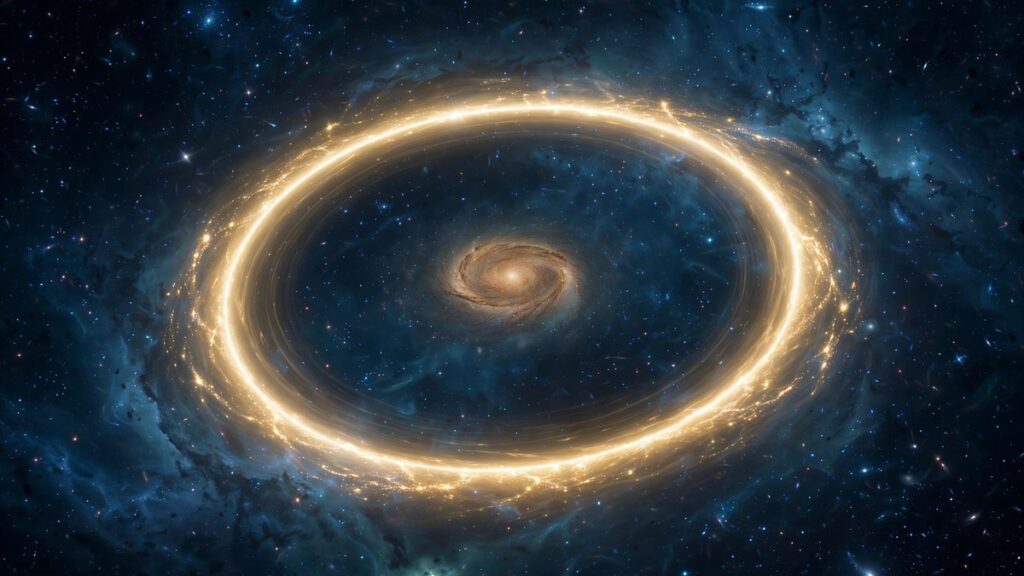
Strong lensing is the dramatic version: the background object’s light is visibly distorted into arcs, rings or multiple images. When a distant light source, a powerful lens and the observer line up perfectly, the bent light forms a near-complete ring called an Einstein Ring. The “cosmic smile” is strong lensing: the smile lines are arcs of a single background galaxy’s light, stretched around the foreground cluster.
Weak lensing is subtler. It stretches the shapes of distant galaxies by tiny amounts that are only measurable across thousands of galaxies. It is one of the main tools for mapping dark matter on large scales.
Microlensing happens when individual stars act as lenses. It briefly magnifies the light of a background star — and if the foreground star has planets, they leave their own fingerprints. Hubble and the Keck Observatory used this technique to discover a Uranus-sized planet orbiting far from its star.
The Cosmic Smile, Decoded
NASA posted the smiling cluster on its X account in mid-October 2026. The agency explained that the “eyes” are actually two very bright galaxies, and the “smile lines” are arcs caused by strong gravitational lensing — light from a much more distant background galaxy, magnified and curved by the cluster’s enormous mass.
Social media users were delighted. One commented that gravitational lensing is “genuinely one of the coolest things in astronomy… the universe literally bends light to show us objects we could barely see otherwise.” Another joked that aliens had finally discovered emojis.
Why Scientists Care: Nature’s Own Telescopes
Gravitational lensing is far more than a pretty picture. Astronomers use galaxy clusters as natural magnifying glasses to study galaxies and other objects that would otherwise be too faint or distant to detect. Because lensed light lets us peer so far back, Hubble’s observations help us understand the conditions in which galaxies formed and evolved.
Some highlights from NASA’s own lensing record:
- The Einstein Cross (1990): Five months after its launch, Hubble captured a quasar lensed four times by a nearby galaxy — four images of one object.
- Icarus and Earendel: Hubble found the two most distant individual stars ever seen, magnified by lenses so extreme that their light traveled 9 and 12.9 billion years to reach us.
- Supernova Refsdal: a stellar explosion 9.3 billion light-years away, split into four images.
- Lensed supernova 2025wny: followed up by astronomers in October 2026 and magnified 19 times by its lens.
Mapping the Invisible: Dark Matter
Lenses also reveal what we cannot see at all. Dark matter never shines, so it can only be detected by its influence on light. Large galaxy clusters, and the powerful lenses they create, give astronomers a way to read dark matter’s signature: by studying the magnified and distorted images, they can piece together where the invisible mass sits.
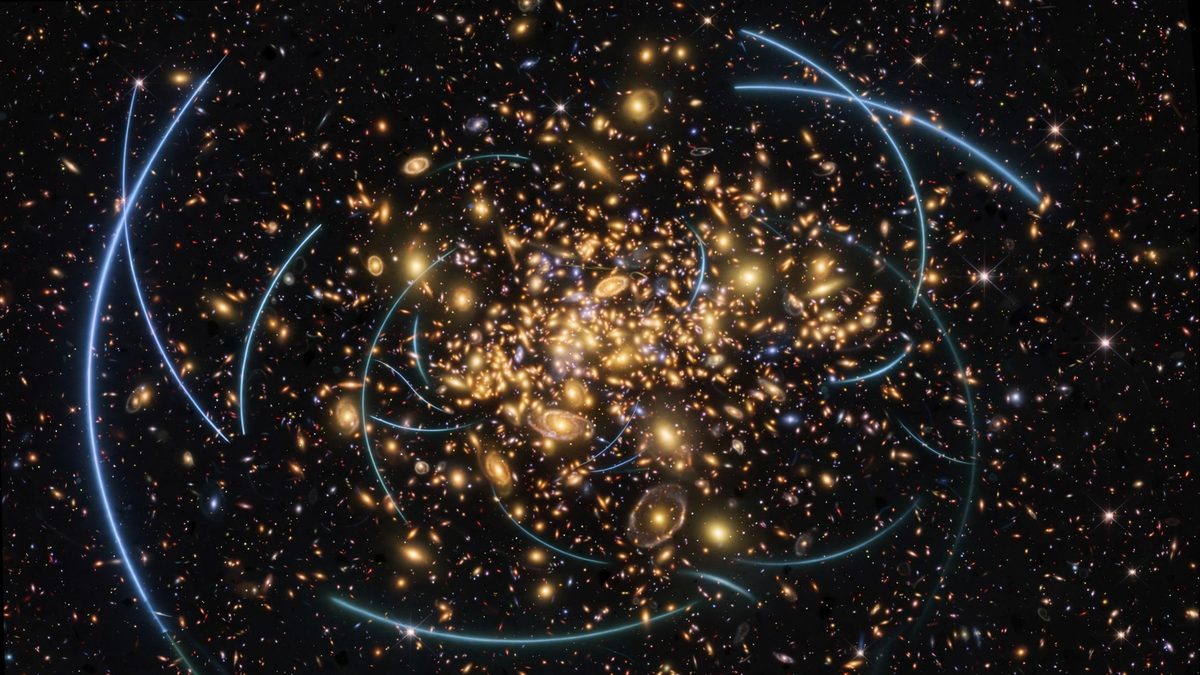
Researchers have even combined strong and weak lensing to build detailed mass maps of clusters such as Abell 2744, identifying substructures that challenge and refine computer simulations of how the universe’s largest structures form. In 2023, Hubble and the James Webb Space Telescope combined their observations of the galaxy cluster MACS0416, about 4.3 billion light-years away, using its lensing power to study magnified background objects in one of the most colourful views of the universe ever made.
Weak Lensing: The Subtle Version
While strong lensing produces the dramatic arcs and rings that make headlines, weak lensing is the quiet workhorse. It stretches the shapes of distant galaxies by amounts far too small to see in any single galaxy — only by measuring thousands of them together can astronomers detect the pattern. Combined with strong-lensing models of cluster cores, weak-lensing measurements from deep Hubble and James Webb imaging extend the mass map all the way out to a cluster’s outskirts, giving the complete picture of where dark matter sits.
Key concepts: Gravitational lensing · Einstein ring · Dark matter · General relativity · Hubble constant
Gravitational lensing is the bending of light from a distant object as it passes through space that has been warped by a massive object, such as a galaxy cluster. The lens magnifies, distorts or multiplies the background object’s image, acting like a giant natural telescope.
A Hubble Space Telescope image of the galaxy cluster SDSS J1038+4849 (captured in 2015, shared October 2026). Two bright galaxies look like eyes, and arcs of strongly lensed light from a background galaxy form a smile. NASA posted it as an example of warped spacetime.
Albert Einstein predicted it in his General Theory of Relativity (1915). Arthur Eddington confirmed the bending of starlight by the Sun’s gravity during the total solar eclipse of 1919. The first observed lens — the double quasar Q0957+561 — was announced about 70 years later.
An Einstein Ring is a special case of strong gravitational lensing: when a distant light source, a massive lens and the observer align perfectly, the bent light curves symmetrically around the lens, forming a ring-like structure. Hubble’s observations more than quadrupled the number of known visible Einstein Rings.
Dark matter does not emit light, but its gravity still bends spacetime. By studying how a galaxy cluster’s lens distorts and magnifies background galaxies, astronomers can reconstruct where the invisible mass is concentrated.