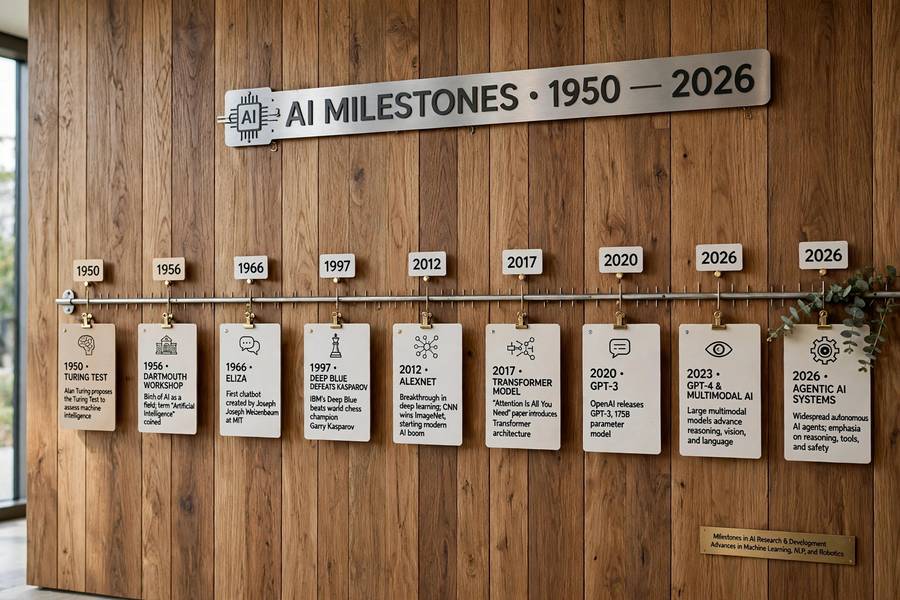
AI history isn’t a smooth upward curve — it’s a series of euphoric springs, disillusioned winters, and unexpected breakthroughs. Understanding the timeline matters because the pattern keeps repeating: every era was certain it had cracked intelligence, and every era was wrong about the timeline (though occasionally right about the direction). I’ve always found that knowing this history is the best antidote to both hype and despair about current AI.
This is the chronological spine: the milestones that actually changed the field’s trajectory, from Turing’s question to today’s agents. For the narrative version, see history of artificial intelligence.
Table of Contents
- 1950s: The Dream Is Born
- 1960s–1970s: Early Triumphs and First Doubts
- 1980s: Expert Systems and the Second Spring
- 1990s: The Quiet Revolution
- 2000s: Data Arrives
- 2012–2017: The Deep Learning Explosion
- 2017–2022: Transformers Take Over
- 2022–Today: The Generative Era
- The Pattern: Springs and Winters
- Frequently Asked Questions
1950s: The Dream Is Born
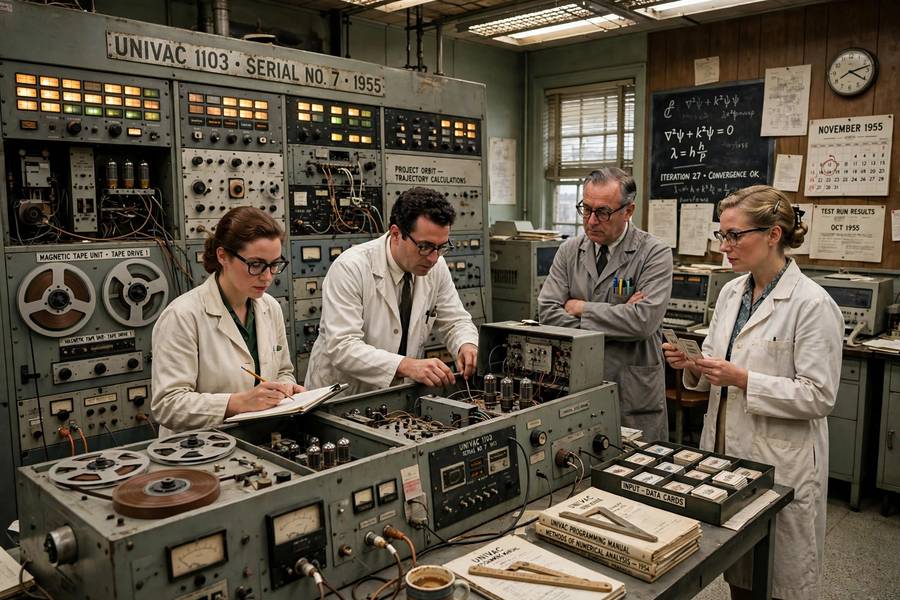
1950 — The Turing Test. Alan Turing publishes “Computing Machinery and Intelligence,” asking “can machines think?” and proposing the imitation game as an operational test. It’s a philosophical paper that becomes the field’s founding document — and its most debated one.
1956 — The Dartmouth Conference. John McCarthy, Marvin Minsky, Nathaniel Rochester, and Claude Shannon organize a summer workshop at Dartmouth. McCarthy coins “artificial intelligence.” The proposal famously suggests that “significant advance can be made” in two months. The optimism is total; the timeline is fantasy. The field is born.
1957 — The Perceptron. Frank Rosenblatt builds the Perceptron, a neural network that learns to classify patterns. It’s a genuine breakthrough — and the seed of both future triumphs and future disappointments.
1958–59 — Early programs. IPL and Lisp are created (AI’s native languages). Arthur Samuel’s checkers program learns from experience — arguably the first machine learning. The dream feels within reach.
1960s–1970s: Early Triumphs and First Doubts
1966 — ELIZA. Joseph Weizenbaum’s chatbot parodies a psychotherapist, and users — including his secretary — attribute understanding to it. The ELIZA effect (seeing intelligence in pattern matching) is identified here and never really goes away.
1969 — Perceptrons (the book). Minsky and Papert publish a devastating critique showing single-layer perceptrons can’t solve simple problems like XOR. Funding for neural networks collapses. The critique is technically correct but overgeneralized — multi-layer networks would solve XOR, but nobody’s listening.
1973 — The Lighthill Report. In the UK, James Lighthill’s report concludes AI research has failed to deliver, triggering massive funding cuts. Combined with DARPA cutbacks in the US, this begins the first AI winter — a decade-plus of reduced funding, diminished expectations, and researchers avoiding the term “AI.”
The lesson of the era: demos impress, but scaling to real problems is brutally hard. The field learns this lesson repeatedly.
1980s: Expert Systems and the Second Spring
Early 1980s — Expert systems boom. Programs encoding human expertise as rules (MYCIN for identifying infections, XCON for configuring computers) achieve commercial success. Japan launches the Fifth Generation Computer Project, betting big on AI. Funding flows back.
1986 — Backpropagation popularized. Rumelhart, Hinton, and Williams publish the backprop paper, showing how multi-layer neural networks can learn. The technique that powers modern deep learning is now available — but computers are too slow and data too scarce for it to matter yet. The seed waits 25 years to sprout.
Late 1980s — The second winter begins. Expert systems prove brittle — expensive to build, impossible to maintain, useless outside narrow domains. The Lisp machine market collapses. Funding dries up again. AI becomes a label researchers avoid; “machine learning” and “informatics” are the safe terms.
1990s: The Quiet Revolution
The 90s look quiet from the outside — no winters, no springs, just work. In retrospect, it’s the most important decade:
Probabilistic methods win. Speech recognition, computer vision, and NLP quietly adopt statistical approaches. They’re unglamorous and they work — the field learns to prefer methods that handle uncertainty over methods that pretend it away.
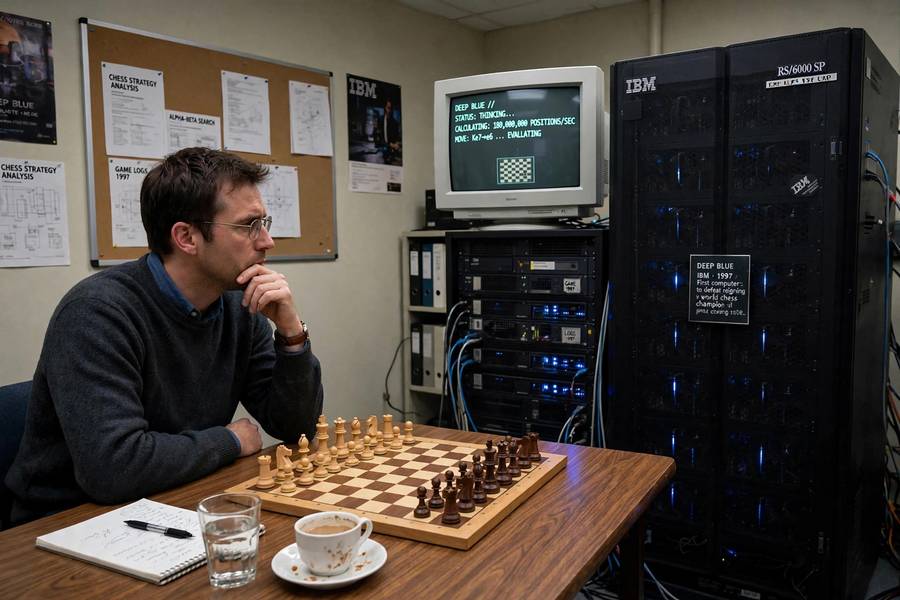
1997 — Deep Blue beats Kasparov. IBM’s chess computer defeats the world champion. It’s a milestone the public understands — though insiders note it’s brute force plus chess knowledge, not general intelligence. Still: a machine beat the best human at humanity’s hardest game. The symbolism matters.
Support vector machines, random forests, Bayesian methods — the statistical toolkit matures. Nobody calls it AI. Everybody uses it.
2000s: Data Arrives
The internet changes everything. Suddenly there’s data at unprecedented scale — text, images, clicks, everything. Machine learning researchers realize the bottleneck was never just algorithms; it was training data. The algorithms from the 80s and 90s start working dramatically better with 1000x more data.
2006 — Deep learning’s quiet restart. Hinton’s deep belief networks show that deep architectures can be trained effectively. The term “deep learning” is coined. Almost nobody outside the field notices.
2009 — ImageNet. Fei-Fei Li’s dataset of 14 million labeled images gives vision researchers the benchmark they need. It’s infrastructure, not a breakthrough — but breakthroughs need infrastructure.
Reinforcement learning matures. From game-playing to robotics, RL starts producing real results. The ideas are old (going back to the 50s); the compute to run them is new.
2012–2017: The Deep Learning Explosion
2012 — AlexNet. A deep convolutional network crushes the ImageNet competition, halving the error rate. This is the Big Bang of modern AI — within months, every vision lab switches to deep learning. GPUs, data, and backprop finally align. (How AI models are trained explains the process.)
2014 — GANs. Goodfellow’s generative adversarial networks can generate photorealistic images. AI goes from classifying to creating — a psychological shift as much as technical.
2015 — ResNet. 152-layer networks train successfully via residual connections. Depth stops being the barrier; the field learns to go very deep.
2016 — AlphaGo beats Lee Sedol. DeepMind’s system defeats the world Go champion — a game with more positions than atoms in the universe, long considered AI-proof. Unlike Deep Blue’s brute force, AlphaGo learns. The “AI can’t do intuition” argument dies here.
The pattern: each breakthrough follows the same formula — old idea + massive compute + massive data = sudden capability jump. The ideas were mostly decades old. The scale was new.
2017–2022: Transformers Take Over
2017 — “Attention Is All You Need.” Vaswani et al. introduce the Transformer architecture. It’s designed for translation; it turns out to be good at everything. This paper is the most consequential in modern AI — every major model since is a Transformer descendant.
2018 — BERT and GPT. Bidirectional pretraining (BERT) and generative pretraining (GPT) show that training on raw text at scale produces general language capabilities. The “pretrain then fine-tune” paradigm is born.
2020 — GPT-3. 175 billion parameters. Few-shot learning — the model does new tasks from examples in the prompt, no fine-tuning needed. The scale at which “emergent” capabilities appear becomes the industry’s obsession.
2021–22 — Multimodal and code. DALL-E 2 and Stable Diffusion bring generative images mainstream. Codex and Copilot show AI writing useful code. The models stop being text-only.
2022–Today: The Generative Era
November 2022 — ChatGPT. The interface breakthrough: RLHF-tuned GPT made conversational and accessible. 100 million users in two months. AI goes from research topic to dinner-table conversation overnight. The technology existed; the packaging changed the world.
2023 — The open floodgates. GPT-4, open-source models (LLaMA derivatives), agents (BabyAGI, AutoGPT), multimodal everything. The ecosystem explodes — thousands of startups, billions in funding.
2024 — Reasoning models. Systems trained to “think longer” (chain-of-thought at scale) show dramatic gains on hard problems. The paradigm shifts from bigger models to more inference-time compute.
2025–26 — Agents go mainstream. AI systems that do things — research, code, operate software — move from demos to deployments. Machine learning’s story continues in real time — see machine learning vs deep learning for how the paradigms differ.
The Pattern: Springs and Winters
Looking across 70+ years, the cycle is unmistakable:
- Breakthrough demo generates excitement
- Optimistic predictions (“human-level AI in 20 years” — said in 1960, 1980, 2000, 2020)
- Scaling difficulties emerge — the demo doesn’t generalize
- Disillusionment — funding cuts, talent exodus, the dreaded “winter”
- Quiet progress — unglamorous work on fundamentals during the winter
- New breakthrough — often from combining old ideas with new scale
We’re in a spring now — the biggest one yet. The honest question isn’t whether winter comes (something always disappoints eventually) but what the quiet work of this era is building for the next spring. If history is a guide, the most important current research looks boring right now — just as backprop looked boring in 1986 and the Transformer looked boring in 2017.

Frequently Asked Questions
Key milestones: 1950 Turing Test, 1956 Dartmouth Conference (field founded), 1966 ELIZA, 1986 backpropagation, 1997 Deep Blue beats Kasparov, 2012 AlexNet (deep learning Big Bang), 2016 AlphaGo, 2017 Transformer architecture, 2020 GPT-3, November 2022 ChatGPT launch, and the 2024–26 agent era.
Periods of reduced funding and interest following unmet expectations — notably the mid-1970s to early 1980s (after the Lighthill Report and perceptron critique) and the late 1980s to early 1990s (after expert systems proved brittle). Each winter ended when new approaches (statistical methods, then deep learning) delivered real results.
The field was founded at the 1956 Dartmouth Conference, where John McCarthy coined the term “artificial intelligence.” Foundational ideas go back further — Turing’s 1950 paper, McCulloch and Pitts’ 1943 neural network model — but 1956 marks AI’s birth as an organized research field.
The convergence of three things around 2012: GPUs providing massive parallel compute, internet-scale datasets (like ImageNet), and old algorithms (backpropagation from 1986, CNNs from the 90s) finally having the scale they needed. The ideas were decades old; the scale was new.
We’re in the biggest AI spring in history, with real capabilities and real revenue — unlike pure hype cycles. But history shows every spring has overpromising (timelines especially), and some current expectations will disappoint. The pattern suggests continued progress with periodic corrections, not a single winter-style collapse given today’s commercial grounding.