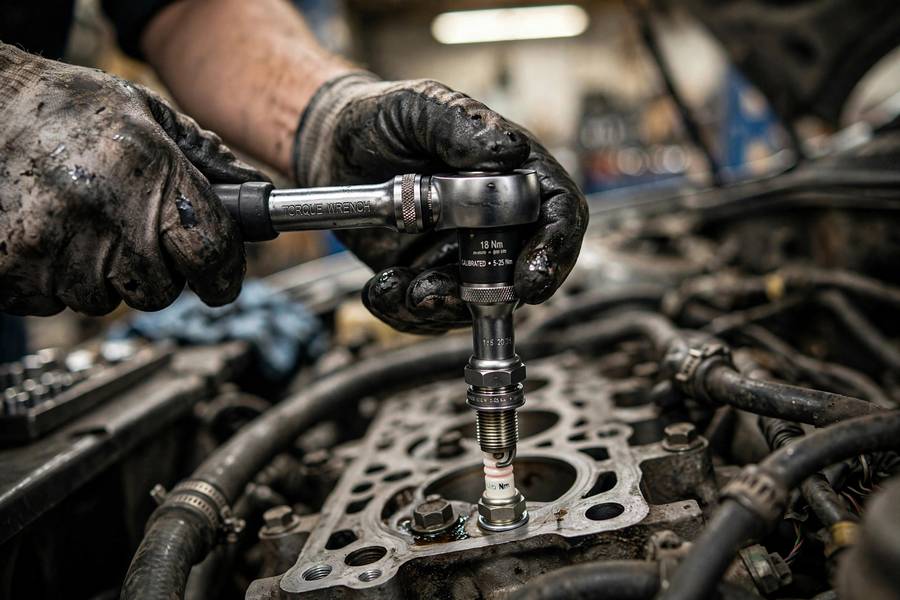
If I had to pick the single most misunderstood part of a spark plug job, it isn’t the gap or the heat range — it’s the torque. I’ve watched grown men treat a spark plug like a lug nut, reefing on it with a long ratchet, and I’ve watched the opposite: plugs so loose they were practically finger-tight, slowly backing out of the head. Both mistakes are expensive. Neither is hard to avoid.
Here’s what surprises most DIYers: spark plugs need surprisingly little torque. We’re talking “firm handshake,” not “arm wrestling.” And the exact number depends on your plug’s thread size, seat type, and whether your cylinder head is aluminum or cast iron. Let me give you the numbers and — more importantly — the feel and technique behind them.
Contents
- Why Torque Matters More Than You Think
- Torque Specs by Thread Size and Seat Type
- Tapered Seat vs. Gasket Seat: Why It Changes Everything
- Aluminum Heads vs. Cast Iron Heads
- How to Tighten Them Right: My Technique
- The Lubricated Thread Torque Problem
- What Goes Wrong: Too Loose and Too Tight
Why Torque Matters More Than You Think
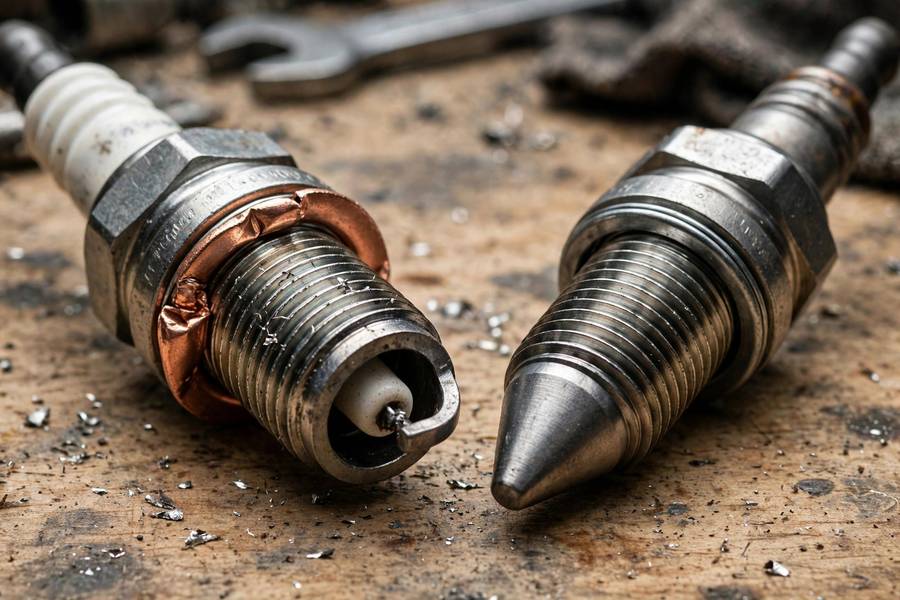
A spark plug does three jobs that all depend on proper tightness: sealing combustion pressure, transferring heat from the firing tip into the cylinder head, and staying put through millions of vibration cycles. Too little torque and you lose the seal, the heat transfer, and eventually the plug itself. Too much and you strip the threads in the head. The window between “right” and “wrong” is narrower than most people expect — which is exactly why guessing is a bad strategy. If you’ve ever wondered what torque means in cars beyond this job, it’s the same principle everywhere: clamping force, applied precisely.
Torque Specs by Thread Size and Seat Type
These are the widely published values from the major plug manufacturers (NGK, Denso, Champion, Autolite publish nearly identical charts). They assume clean, dry threads in good condition — more on the anti-seize caveat below. Always check your vehicle’s service manual first; the manufacturer spec for your specific engine wins over any general chart.
| Thread diameter | Seat type | Cast iron head | Aluminum head |
|---|---|---|---|
| 14mm (13/16″ hex) | Gasket | 25–30 ft-lbs | 18–25 ft-lbs |
| 14mm (13/16″ hex) | Tapered | 10–15 ft-lbs | 7–15 ft-lbs |
| 12mm (5/8″ hex) | Gasket | 15–20 ft-lbs | 10–18 ft-lbs |
| 10mm | Gasket | 8–12 ft-lbs | 7–10 ft-lbs |
Look at those numbers. A 14mm tapered-seat plug in an aluminum head — one of the most common setups on the road — wants roughly 7–15 ft-lbs. That’s barely more than snug. If you’ve been tightening plugs by feel with a standard ratchet, you’ve almost certainly been overdoing it.
A note on the smaller plugs: many modern engines use 12mm or even 10mm thread plugs, and their torque values are tiny. At 7–10 ft-lbs, you’re barely past finger-tight. These small plugs in aluminum heads are the easiest to strip in the business. Respect the small numbers.
Tapered Seat vs. Gasket Seat: Why It Changes Everything
This distinction trips up more people than anything else in plug torque, so let me make it crystal clear.
Gasket-seat plugs have a flat seating surface with a crush washer. You tighten them until the washer compresses — that’s where most of the torque goes. The standard guidance for a new gasket plug (no torque wrench) is roughly a half to two-thirds turn past finger-tight; for a reused plug with an already-crushed washer, about a twelfth of a turn. The washer is doing the sealing, and crushing it takes real force.
Tapered-seat plugs have no washer. The plug’s tapered nose wedges directly into a matching taper in the head. Metal-on-metal sealing needs far less force — that’s why the specs are roughly half. The no-wrench guidance is about a sixteenth of a turn past finger-tight. That’s it. A sixteenth. People used to gasket plugs will massively over-torque a tapered plug on instinct, and tapered seats in aluminum heads are exactly where I see the most thread damage.
How do you tell which you have? Look at the plug. Washer under the hex = gasket seat. Smooth taper below the hex, no washer = tapered seat. Match the spec to what you’re holding, not what you assume.
Aluminum Heads vs. Cast Iron Heads
Almost every modern passenger car has aluminum cylinder heads. Aluminum is soft and expands more when hot — so torque specs run about 25–30% lower than iron, and you must install plugs in a cold engine. Torquing into a hot aluminum head gives a false reading, and hot aluminum galls and tears easily.
My rule, no exceptions: if the engine has run in the last hour, wait. Aluminum heads plus hot engine plus steel plug threads is the exact recipe for thread damage, and no torque spec in the world saves you if the head is heat-expanded when you tighten.
How to Tighten Them Right: My Technique
Here’s the exact sequence I use in the shop, and the one I teach every DIYer:
- Thread the plug by hand first. Use just the spark plug socket on an extension — no ratchet attached. Turn it clockwise gently. It should spin in smoothly with almost no resistance. If you feel binding, stop immediately, back it out, and restart. Cross-threading happens in the first two turns, and hand-threading is how you prevent it.
- Snug it with the ratchet once it’s fully hand-threaded — short, gentle pressure until it seats.
- Set your torque wrench to the spec for your plug and head combination. If the manual gives a range, aim for the middle.
- Apply smooth, steady pressure until the wrench clicks. One smooth pull — don’t jerk it.
- Stop at the click. Treating the click as a suggestion and giving it “one more little bit” is where threads die.
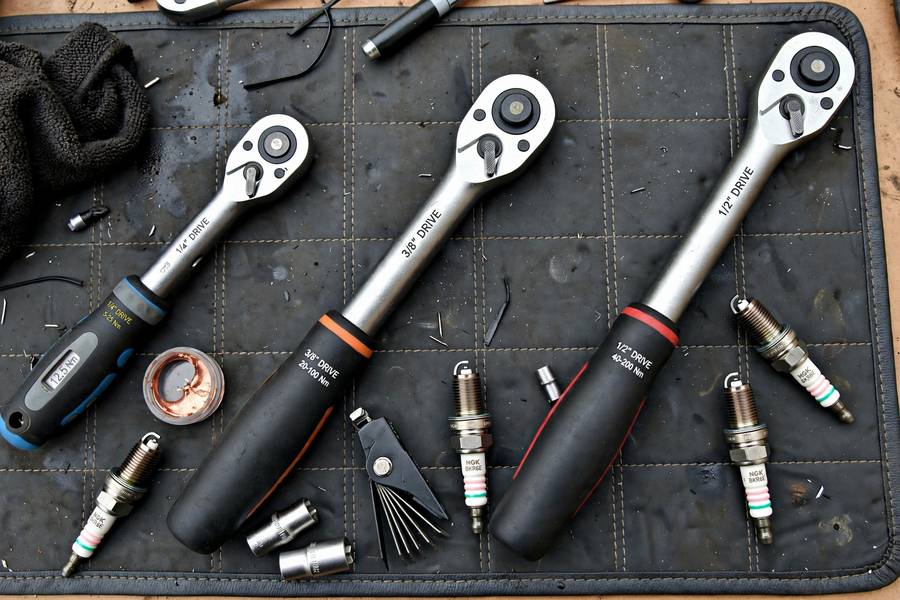
If you don’t own a torque wrench: buy one. A serviceable 3/8″ click-type wrench costs $25–40 — roughly a tenth of what a single stripped plug hole costs to repair. The angle method (turn past finger-tight) works in a pinch, but it’s a substitute, not an equivalent. Human “feel” varies wildly, especially at an awkward angle under a cowl.
One more technique note: torque wrenches are least accurate at the very bottom of their range. If your wrench goes 10–150 ft-lbs and your spec is 12, you’re in the sloppy zone. A smaller 1/4″ or 3/8″ wrench with a lower range (say 5–80 ft-lbs) is the right tool for plugs. Using a big 1/2″ breaker-bar-sized torque wrench on spark plugs is like performing surgery with a chainsaw — technically a cutting tool, practically a disaster.
The Lubricated Thread Torque Problem
This deserves its own section because it quietly invalidates the torque chart above. Anti-seize is a lubricant. Lubricated threads need significantly less torque to achieve the same clamping force — the general rule is a 20–30% reduction from dry specs. If you slather anti-seize on the threads and then torque to the dry spec, you’ve effectively over-torqued the plug.
This is also why several major plug manufacturers now advise against anti-seize entirely: many modern plugs come with special anti-seize plating on the threads from the factory, and adding more just throws off the torque. My position: follow the plug manufacturer’s guidance. If they say the threads are coated, install them dry and torque to spec. If you’re working with older uncoated plugs or dissimilar-metal situations where you choose to use anti-seize, reduce your torque accordingly and apply it sparingly — a thin smear on the threads only, kept well away from the electrodes.
Either way, pick one approach and torque for it. The worst outcome is anti-seize plus full dry-spec torque, which is how I see a lot of stripped holes happen.
What Goes Wrong: Too Loose and Too Tight
Too loose is the underappreciated danger. A loose plug leaks combustion pressure (you’ll sometimes hear a ticking or puffing sound), runs hot from poor heat transfer, and vibrates. Given enough time and vibration, a loose plug can back completely out of the head — and I have personally seen a spark plug launch out of an aluminum head like a bullet, taking the coil and part of the threads with it. The customer described “a loud bang and then it ran terrible.” That’ll do it.
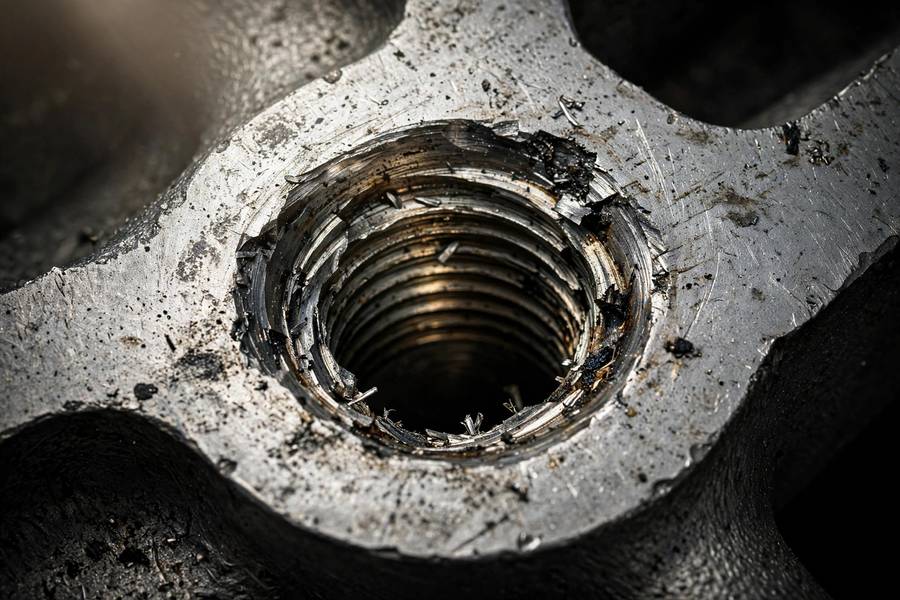
Too tight strips the threads in the head. On an aluminum head, this can happen with depressingly little force. The repair is a thread insert (Heli-Coil or Time-Sert style) — a $300–500 job at a shop, and the reason I get almost religious about torque wrenches.
There’s also a middle failure people forget: uneven torque across cylinders doesn’t cause immediate damage, but it means inconsistent heat transfer and sealing from hole to hole. It takes thirty extra seconds per plug to do them all the same. Do them all the same.
Torque isn’t the exciting part of a plug job — nobody brags about their torque specs at a car meet. But it’s the difference between a $30 Saturday job and a $500 Monday problem. The wrench clicks, you stop, and you never think about it again. That’s the whole game. For the full procedure this fits into — tools, gapping, order of operations — my guide to how to change spark plugs puts it all together, and if you’re rotating through general maintenance, how to change a tire is the other job where a torque wrench earns its keep (lug nuts have specs too, and yes, they matter just as much).
Frequently Asked Questions
It depends on thread size, seat type, and head material. Common values: 14mm gasket-seat plugs in aluminum heads, 18–25 ft-lbs; 14mm tapered-seat, 7–15 ft-lbs; 12mm gasket-seat, 10–18 ft-lbs. Always check your vehicle’s service manual first — the manufacturer spec for your engine wins.
Over-tightening strips the threads in the cylinder head, especially soft aluminum heads. Repair requires drilling and installing a thread insert, typically costing $300–500. It can also crack the plug’s ceramic insulator. Always use a torque wrench and stop at the click.
You can in a pinch: hand-thread the plug fully, then turn about a half-turn past finger-tight for a new gasket-seat plug, or about a sixteenth of a turn for a tapered-seat plug. But a $25–40 torque wrench is far more reliable and pays for itself the first time it prevents thread damage.
Many modern plugs come with anti-seize coating from the factory, and their manufacturers advise installing them dry. If you do use anti-seize, reduce torque by 20–30% from the dry spec, because lubricated threads achieve the same clamping force with less torque. Follow the plug manufacturer’s guidance.
Always on a cold engine. Aluminum heads expand when hot, giving false torque readings, and hot aluminum threads gall and tear easily. Wait at least an hour after driving before removing or installing spark plugs.