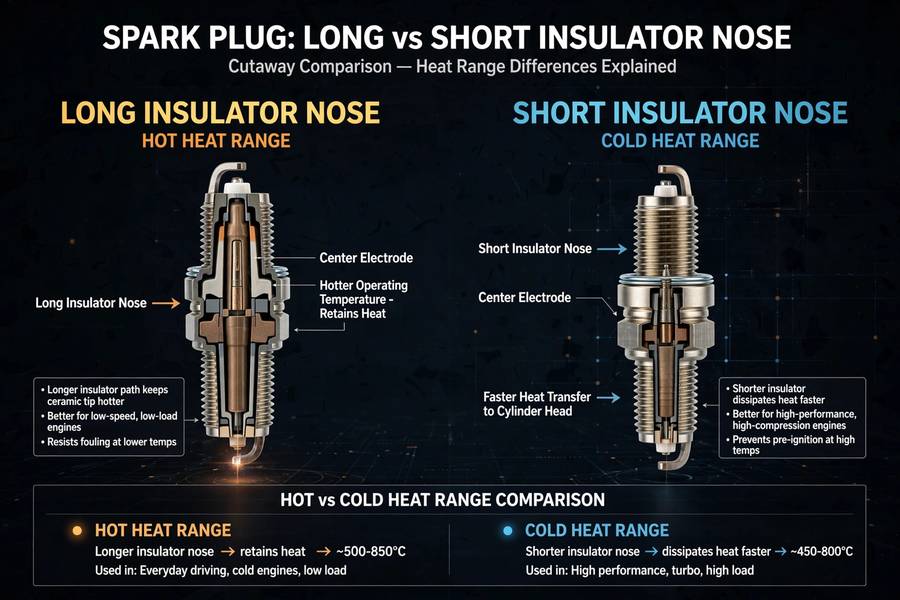
Of all the spark plug specs that confuse people, heat range is the champion. Gap is intuitive — it’s a distance you can measure. Torque is a number on a wrench. But heat range? It’s invisible, the numbering runs backwards between brands, and getting it wrong can either foul your plugs or melt your pistons. No wonder people just grab whatever the computer at the parts store suggests.
I ignored heat range for my first couple of years turning wrenches, and I paid for it — a set of “equivalent” plugs in the wrong heat range that fouled in 3,000 miles taught me more than any textbook. Here’s the concept in plain English, how to read it, and the situations where it actually matters.
Contents
- What Heat Range Actually Means
- Hot Plugs vs. Cold Plugs
- How Heat Travels Through a Plug
- Reading Heat Range in Part Numbers
- What Happens With the Wrong Heat Range
- When You’d Ever Change Heat Range
- Why Stock Is Almost Always Right
What Heat Range Actually Means
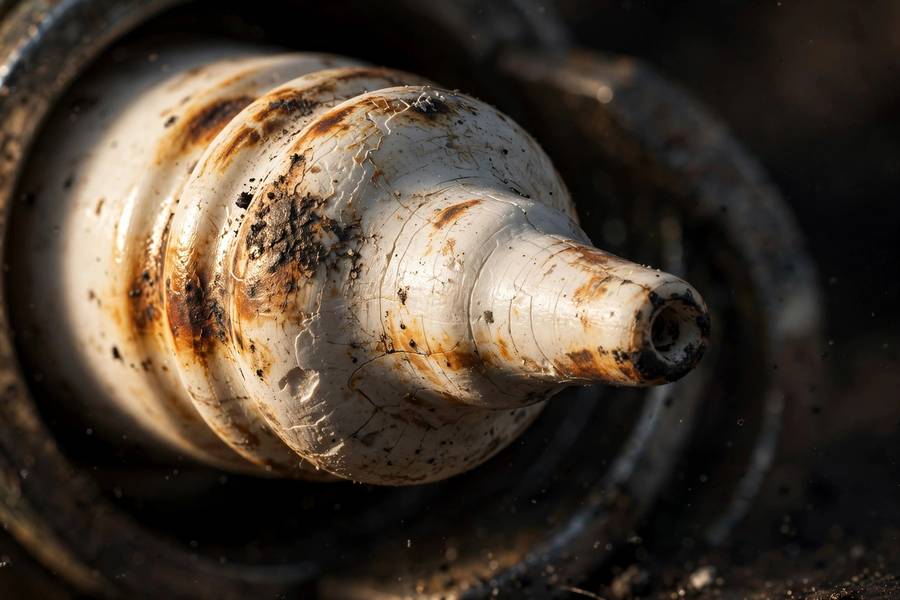
Heat range is a measure of how quickly a spark plug transfers heat away from its firing tip into the cylinder head. That’s it. It’s not about the spark being “hotter” — a common misconception. The spark is the same. What differs is how much heat the plug’s tip retains between firings.
Think of it like a frying pan on a stove. A thin pan (hot plug) holds heat at the cooking surface; a thick pan with cooling fins (cold plug) sheds heat fast. The burner — your engine’s combustion — is the same either way. The plug just decides how much of that heat stays at the tip.
Engineers pick a heat range so the plug’s firing tip stays in a Goldilocks zone: roughly 500–850°C (about 950–1550°F). Below that range, carbon and fuel deposits don’t burn off, and the plug fouls. Above it, the tip itself gets hot enough to ignite the fuel before the spark does — pre-ignition — which can destroy an engine with shocking speed. The correct heat range keeps the tip in that window across your engine’s normal operating conditions.
Hot Plugs vs. Cold Plugs
A “hot” plug retains more heat at the firing tip. It has a longer insulator nose — more ceramic between the tip and the metal shell — so heat takes a longer path to escape into the head. Hot plugs are specified for engines that run cooler or under lighter loads: the extra retained heat burns off deposits that would otherwise foul the plug.
A “cold” plug sheds heat quickly. Shorter insulator nose, shorter path to the shell, heat dumps into the head fast. Cold plugs are specified for engines that generate a lot of combustion heat: high-compression, turbocharged, supercharged, or high-RPM engines. The plug needs to stay cool enough to avoid becoming a glow plug that ignites fuel on its own.
The naming is backwards from what your instincts say: a “hot” plug doesn’t make a hotter spark or suit a hot engine. It’s the opposite. Hot plug = retains heat = for cooler-running engines. Cold plug = sheds heat = for hotter-running engines. I still have to pause and think about it every time, and I’ve been doing this a decade. Don’t feel bad.
How Heat Travels Through a Plug
Follow the heat’s journey: combustion heats the firing tip and insulator nose. That heat conducts through the ceramic insulator into the metal shell, then through the threads into the cylinder head, and finally into the coolant. The length of the insulator nose is the main control knob — longer nose, longer heat path, hotter tip.
This is why heat range and the cooling system are quietly related. The cylinder head is the plug’s heat sink, and the head’s temperature is managed by the cooling system. An engine running hot from cooling problems pushes every plug toward the overheating end of its range — which is one reason I take cooling maintenance seriously. If you’re fuzzy on the system, read what coolant does in a car — it’s the other half of your engine’s temperature story.
It also explains why the same plug can be “right” in one engine and “wrong” in another. Heat range is relative to the engine’s combustion temperatures, not an absolute property. A plug that’s perfectly cold for a turbocharged four-cylinder might be too cold (and foul) in a lazy V8.
Reading Heat Range in Part Numbers
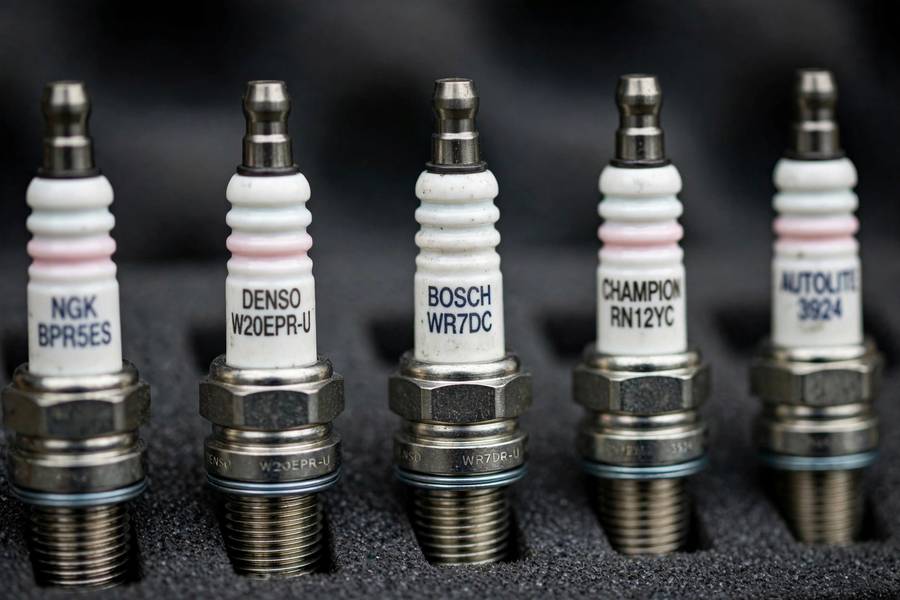
Here’s where it gets annoying: every manufacturer numbers heat range differently, and two of the big ones run in opposite directions.
- NGK: Higher number = colder plug. A BKR7E is colder than a BKR6E. (Lower number = hotter.)
- Denso: Higher number = hotter plug. An IK20 is hotter than an IK16. The exact opposite of NGK.
- Champion: Higher number = hotter plug (like Denso).
- Autolite/Bosch: Each has its own scheme — check the catalog.
This is a genuine trap. I’ve seen people cross-reference a plug by number alone and end up two heat ranges off because they assumed the numbering worked like the other brand. When you’re buying plugs, don’t decode the heat range yourself from the part number — look up the application. The catalog (or the manufacturer’s website) lists the correct plug for your exact engine, and that plug is the correct heat range by definition. The number on the ceramic is for nerds and racers; the application listing is for everyone else.
What Happens With the Wrong Heat Range
Too hot (hotter than spec): The tip retains too much heat. Deposits burn off beautifully — but under load, the tip gets hot enough to ignite the mixture before the spark fires. That’s pre-ignition, and it’s violent: uncontrolled combustion while the piston is still rising hammers the pistons, rings, and bearings. In extreme cases, sustained pre-ignition melts piston crowns. I’ve seen the aftermath — it looks like someone took a cutting torch to the piston. This is the dangerous direction.
Too cold (colder than spec): The tip never gets hot enough to burn off deposits. Carbon and fuel accumulate on the insulator nose, eventually creating a conductive path that bleeds off the spark voltage — the plug fouls and misfires. This is the annoying direction: poor running, rough idle, fouled plugs, but no engine damage. My 3,000-mile fouling lesson was a too-cold plug, and while it was embarrassing, the engine was fine.
Notice the asymmetry: too hot can kill an engine; too cold just kills drivability. That’s why, in the rare cases where you’re between choices, the conservative move is well understood by tuners — but for a stock car, you should never be choosing at all. Stock is the answer.
When You’d Ever Change Heat Range
For 95% of drivers: never. But there are legitimate exceptions, and they’re all about engines operating outside their factory conditions:
Forced induction or nitrous added to a stock engine. More air and fuel = more combustion heat = the stock plug may now run too hot. The standard tuner move is one heat range colder, sometimes two for serious boost. This is the most common legitimate heat range change in the world.
Sustained high-RPM use. Track days, road racing, or engines that live near redline generate far more heat than street driving. Race engines often run plugs several ranges colder than the street version of the same engine.
Oil burning or chronic fouling. Occasionally, going one range hotter helps a worn engine that keeps fouling plugs — the hotter tip burns off deposits the tired engine keeps making. This is a band-aid, not a fix (the engine still needs its oil consumption addressed), but it can keep a beater running reliably.
Extreme climates and use cases. An engine that only ever does short trips in a cold climate can benefit from staying at the hotter end of the acceptable range. This is marginal — don’t overthink it.
In every case, the change is one step at a time, and you read the plugs afterward to verify. Change one range, drive, pull a plug, read it. The plug tells you if you went the right direction. That’s the discipline that separates tuning from guessing.
Why Stock Is Almost Always Right
Here’s my closing argument, and it’s simple: your engine’s manufacturer spent millions calibrating the ignition system — plug heat range included — across every operating condition from -40° cold starts to desert hill climbs with a trailer. The stock heat range isn’t a guess; it’s the product of more testing than any of us will ever do.
Every heat-range problem I’ve diagnosed in a stock street car came from someone deviating from stock: the “equivalent” plug from a brand with different numbering, the “high performance” plug that was actually two ranges colder, the well-meaning upgrade that solved nothing and created a fouling problem. The plug companies aren’t lying when they list an application-specific plug — that listing IS the heat range recommendation.
So: understand heat range so you respect it, then buy the plug the catalog specifies for your engine and never think about it again. Spend your mental energy on the things that actually need attention — correct gap, proper torque, fresh plugs on schedule. And while you’re in maintenance mode, don’t neglect the simple stuff that keeps combustion clean: how to change your engine air filter is a fifteen-minute job that prevents the rich-running conditions that foul plugs regardless of heat range.
Heat range is fascinating physics. It’s also, for your daily driver, a solved problem. Let it stay solved — and if you’re doing the job yourself, my full procedure is in how to change spark plugs.

Frequently Asked Questions
Heat range measures how quickly a spark plug transfers heat from its firing tip into the cylinder head. A “hot” plug retains more heat (longer insulator nose); a “cold” plug sheds heat faster (shorter nose). It has nothing to do with spark temperature — it’s about keeping the tip in the 500–850°C window where deposits burn off but pre-ignition can’t occur.
A too-hot plug retains excessive heat at the tip, which can cause pre-ignition — the fuel igniting before the spark fires. Pre-ignition creates violent uncontrolled combustion that can melt pistons and destroy an engine. This is the dangerous direction for heat range errors.
A too-cold plug never gets hot enough to burn off carbon deposits, so it fouls — causing misfires, rough idle, and poor running. Unlike a too-hot plug, a too-cold plug won’t damage the engine; it just runs badly until replaced with the correct heat range.
No — they run opposite. For NGK, a higher number means a colder plug. For Denso and Champion, a higher number means a hotter plug. Never cross-reference heat range by number alone between brands; always look up the plug by your specific vehicle application.
If boost was added to an engine that didn’t come with it, going one heat range colder is the standard tuner practice, since forced induction raises combustion temperatures. For a factory-turbocharged car, use the stock heat range — the manufacturer already accounted for the boost. Change one step at a time and read the plugs afterward.