Short Wedding Vow Examples: 30 Brief & Beautiful Vows

Not everyone wants to deliver a speech at their wedding. Short vows — 30 seconds to a minute — can be more powerful than long ones, because every word has to earn its place. After hearing hundreds of vow exchanges, I can tell you: some of the most moving ceremonies I’ve witnessed had vows under 100 words. Here’s how to write short vows that land, with 30 examples to inspire you.
Why Short Vows Work
Short vows are easier to memorize, less nerve-wracking, harder to mess up, and often more emotional — there’s no filler for the feeling to hide behind. They force clarity: you can’t ramble, so you distill. And distillation is where the poetry lives.
There’s also a practical argument: wedding ceremonies have a natural rhythm, and long vow exchanges can stall it. Two minutes of vows total (one minute each) keeps the energy moving while still giving the moment its weight. Your guests stay present; your partner stays engaged; nobody checks their watch.
Classic Short Vows
“I take you as you are, loving who you are now and who you are yet to become. I promise to listen, to learn, and to love you — today, tomorrow, and always.”
“You are my best friend, my greatest adventure, and my home. I choose you, in this moment and in every moment to come.”
“I promise to stand beside you in joy and in sorrow, to celebrate your victories and carry your burdens, all the days of my life.”
“From this day forward, you will never walk alone. My heart will be your shelter, and my arms will be your home.”
Classic short vows borrow the cadence of traditional vows — parallel structure, timeless language — without the length. They feel weighty because the form carries centuries of meaning.
Modern Short Vows
“I didn’t believe in soulmates until I met you being exactly yourself. I promise to keep choosing that person — you — every day.”
“You’re my favorite notification, my best decision, my person. I’m all in.”
“I love you. I like you. I’m yours. Let’s do this.”
“Whatever the future holds — the moves, the chaos, the 2am worries — I want to face it with you. You’re my team.”
Modern doesn’t mean shallow — it means honest in your own voice. If you don’t talk like a Victorian poet, don’t vow like one. Your partner fell in love with how you actually speak; let your vows sound like you.
Funny Short Vows
“I promise to love you, feed you, and never make you watch my shows alone. You’re stuck with me.”
“I vow to always share my fries — mostly. And to love you forever — completely.”
“I promise to laugh at your jokes, even the ones I’ve heard eleven times. Especially those.”
Short and funny is a great combination — the brevity keeps the humor sharp. One laugh line plus one sincere line is the perfect ratio for short funny vows. The laugh opens the heart; the sincerity fills it.
One-Line Vows
The ultimate short vows — single lines with complete meaning: “I choose you.” “You’re my home.” “Always.” “I do — and I will, every day.”
One-line vows work best paired with traditional vows or a longer reading — they land as the emotional punctuation, not the whole ceremony. Spoken slowly, looking into your partner’s eyes, two words can carry more weight than two hundred. The pause before and after is part of the vow.
Short Vows for Elopements
Elopements and short vows are natural partners — the intimacy of just-you-two invites brevity and honesty: “It’s just us, this mountain, and a promise: I’m yours.” “We came here alone because this moment is ours. I love you. I choose you. Let’s go.”
Without an audience, vows can be more raw, more personal, more YOU. Say the things you’d never say in front of 100 people. That’s the gift of eloping — total honesty. For more on intimate ceremonies, see our guide on how to elope.
When to Go Short
Go short when: you’re nervous speakers, your ceremony is already long, you prefer private depth over public performance, or your partner is going short (always match lengths). Consider longer when: writing is how you express love and you genuinely have more to say — but even then, edit ruthlessly.
The most common regret I hear isn’t “my vows were too short” — it’s “I rambled.” Nobody has ever wished their vows were longer. Brevity is almost always the safer choice.
Making Short Vows Personal
Pick ONE specific detail — a memory, a quirk, a promise — and build around it. “From the burnt toast mornings to the 2am talks: I choose this life, with you, on purpose.” One true detail beats ten generic lines.
The “because” technique doubles meaning without doubling length: “I choose you — because you make ordinary days feel like adventures.” “You’re my home — because wherever you are, I’m at peace.” Try it: take any short vow you like and add “because…” — watch it come alive.
For longer examples, see wedding vow examples. For ceremony readings to pair with short vows, wedding ceremony readings has beautiful options.
Delivery Tips
Short vows are made for memorizing — 60 seconds of words, delivered looking into your partner’s eyes, no cards needed. Speak slowly. Let each line land. The pause between sentences is where the emotion lives.
Practice aloud three times. Time yourself — you’ll be surprised how fast nerves make you rush. And on the day: breathe, look at your partner (not the guests), and let yourself feel it. The emotion is the point.
Vow Writing Prompts: Finding Your Words
Stuck staring at a blank page? These prompts unlock vows:
Complete these sentences: “I knew I loved you when…” / “My favorite thing about you is…” / “You make me laugh when…” / “I feel safest when you…” / “I promise to…” / “In ten years, I want us to…” / “Thank you for…” — Write quickly, don’t edit. Your vows are hiding in these completions.
The memory mine: list 10 specific memories (first date, the fight you survived, the trip, the ordinary Tuesday that felt perfect). Circle the 2–3 that make you FEEL something. Those are your vow material — not the grand gestures, but the true moments.
The qualities list: write 5 things you admire about your partner (not “kind” — the SPECIFIC kind things they do). “You call your mom every Sunday.” “You always order extra for the table.” “You cried at that dog video.” Specificity is what makes vows feel personal instead of generic.
The edit: once you have raw material, cut it in half. Then cut it in half again. What’s left is your vow. Short vows aren’t about having less to say — they’re about saying only what matters most. The constraint IS the craft.
Vow Books and Cards: What to Write Them On
The physical vows matter — they’re keepsakes and photo subjects:
Vow books: small, elegant booklets (Etsy, $15–30 for a set). They photograph beautifully and become keepsakes. Choose ones that match your wedding aesthetic. Cards: heavy cardstock, handwritten. Simple, classic, personal. Use a good pen (no ballpoint — it looks cheap in photos). What NOT to use: your phone (dies, looks bad in photos, notifications pop up), loose printer paper (flimsy, unphotogenic), or nothing (winging it).
Handwriting tips: write slowly (rushing looks rushed). Use large, clear writing (you’ll be nervous — small writing becomes unreadable). Number the cards/pages (dropping them mid-ceremony is a real fear — numbers save you). Have a backup: give a copy to your officiant or maid of honor. If you lose yours, the ceremony continues.
After the wedding: store them with your marriage license and wedding photos. Some couples frame them, some keep them in a memory box, some read them on anniversaries. They’re among the most precious things you’ll own — treat them that way from the start.
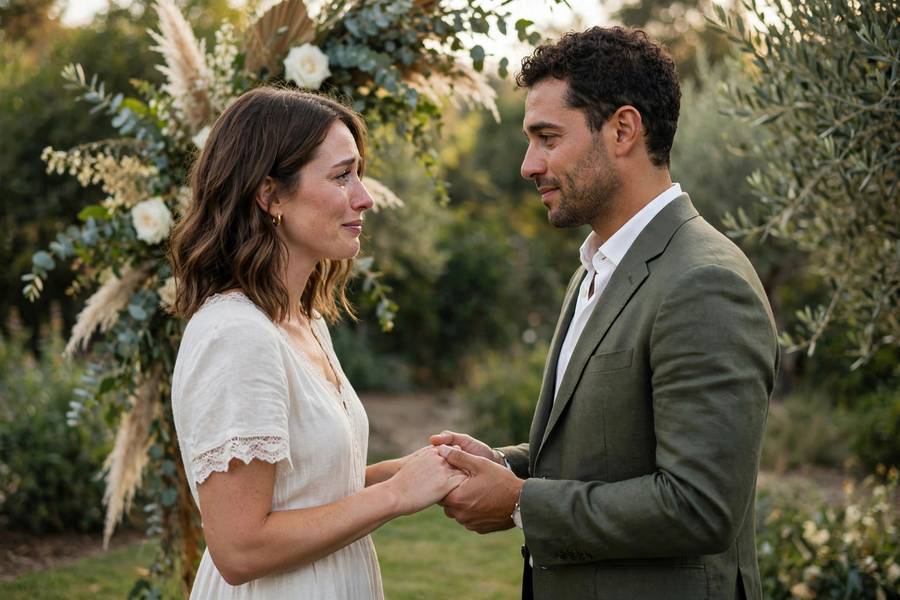
As short as 30 seconds (50–75 words) — there’s no minimum. Sincerity matters more than length. Even one line, delivered with conviction and eye contact, can be a complete and powerful vow. Many officiants will tell you the shortest vows they’ve heard were the most moving.
‘You are my best friend, my greatest adventure, and my home. I choose you, in this moment and in every moment to come.’ — under 30 seconds, complete, specific, and moving. Or even shorter: ‘I choose you. In every universe, in every timeline — I choose you.’
Yes — agree on length in advance. Mismatched lengths (one minute vs five) create an awkward imbalance that guests notice and the shorter-vow partner regrets. Match each other; it’s a partnership, not a competition.
Absolutely — pick one specific detail (a memory, quirk, or promise) and build around it. One true detail beats ten generic lines. ‘From the burnt toast mornings to the 2am talks: I choose this life, with you, on purpose.’
Much — easier to memorize, less nerve-wracking, harder to mess up. Ideal for nervous speakers, intimate ceremonies, and elopements. Practice aloud three times and time yourself; nerves make everyone rush.
When you’re nervous speakers, the ceremony is already long, you prefer depth over performance, or your partner is going short. Nobody has ever regretted brevity; many have regretted rambling. When in doubt, go shorter.