How to Start Journaling Daily: A Beginner’s Guide That Actually Sticks


Every January, thousands of people buy a beautiful blank journal, write three enthusiastic pages, and then never open it again. If that has been you, please know it was never a discipline problem. It was a starting-too-big problem. Learning how to start journaling daily is not about grand revelations or perfect handwriting. It is about building a small, kind ritual that fits into your real life. This guide will show you how to begin with just five minutes a day, and how to keep going long after the novelty wears off.
Why Bother Journaling Every Day?
Before the how, a quick word on the why, because motivation matters on the days you would rather skip. A daily journaling practice gives your thoughts somewhere to land instead of circling in your head at 2 a.m. Many people find it reduces mental clutter, sharpens self-awareness, and makes patterns visible: the weeks you sleep badly, you feel worse; the days you move your body, your mood lifts. You cannot see those patterns until you write them down.
Journaling also creates a record of your actual life, not the highlight reel. A year from now, reading today’s ordinary entry will feel like a gift. And unlike most habits, this one asks almost nothing of you: a notebook, a pen, five minutes.
Choose Your Journaling Style (There Is No Wrong Answer)
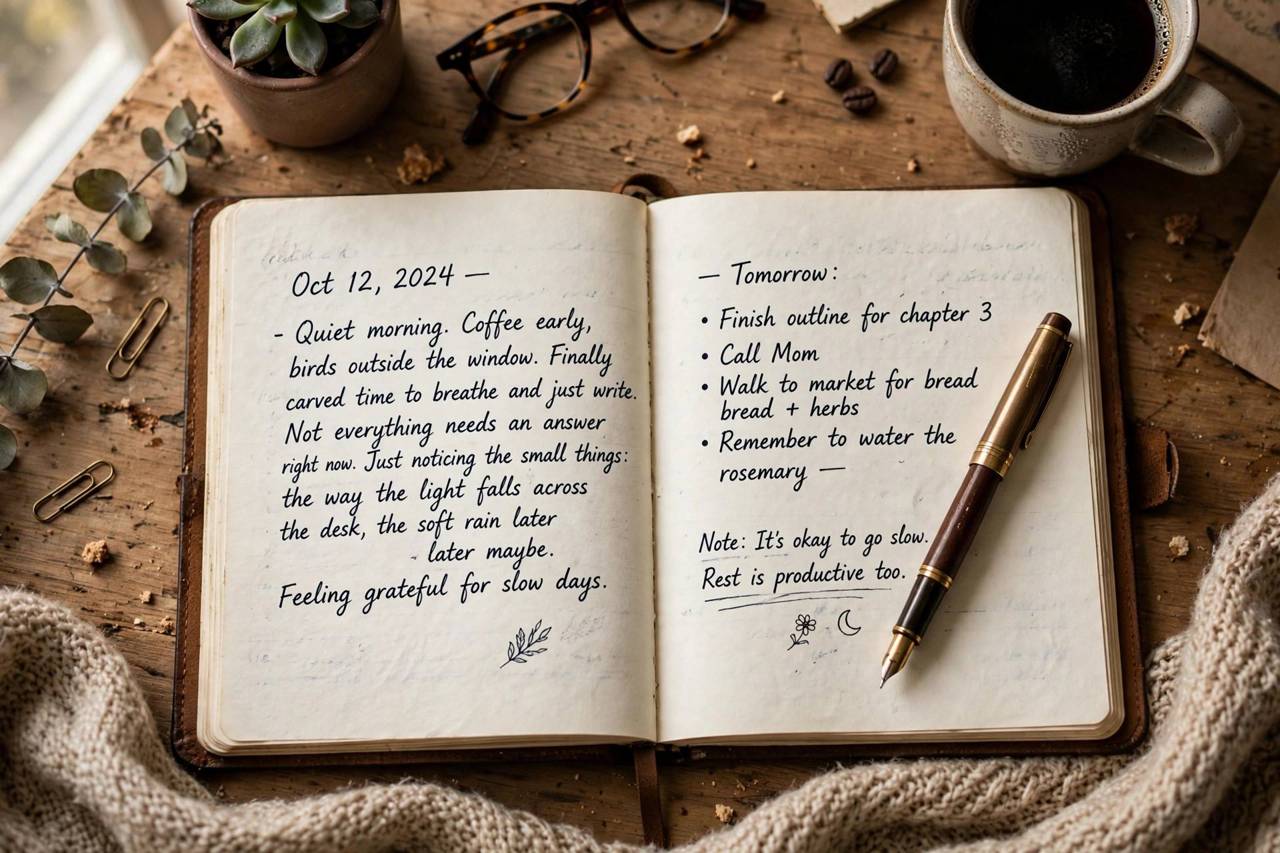
One reason beginners quit is that they pick a style that fights their personality. Here are the main approaches, pick the one that sounds like relief, not homework:
Free writing. Set a timer and write whatever comes out, no editing, no judgment. Messy is the point. Best for overthinkers who need to empty their heads.
Gratitude journaling. Three things you are grateful for, one or two sentences each. Deceptively simple and remarkably powerful over time.
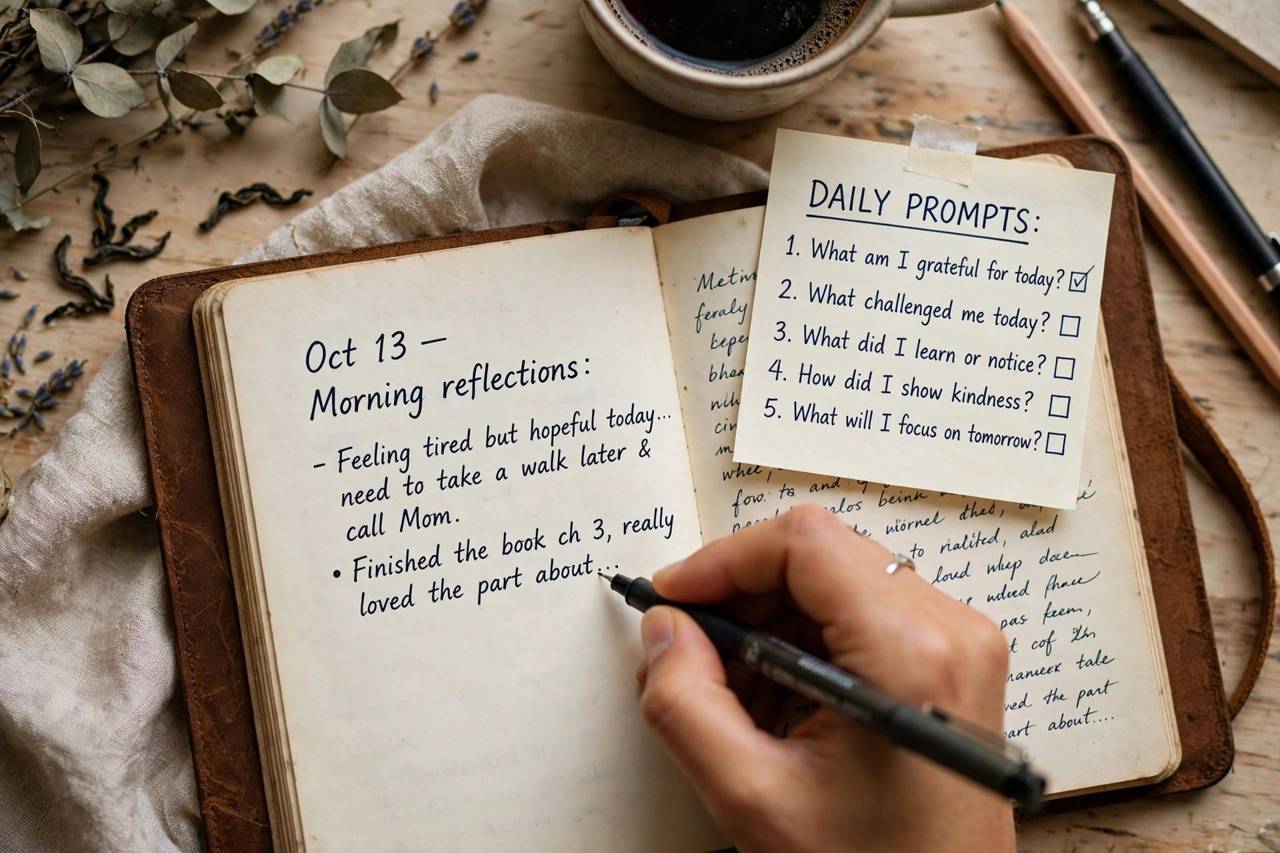
Prompt-based. Answer one question per day from a prompt list. Great if blank pages paralyze you. I have included starter prompts below.
Bullet journaling. Short lines, symbols, rapid logging. Ideal if you hate writing paragraphs but love lists and structure.
Morning pages. Three longhand pages first thing in the morning, stream of consciousness. A bigger commitment, but devotees swear by it.
Paper or digital? Paper slows you down in a good way and keeps you off screens, but the best journal is the one you will actually open. A notes app you use daily beats a leather-bound journal gathering dust.
How to Start Journaling Daily: The 5-Minute Method
Here is the entire method. It is deliberately small, because small is what survives busy weeks.
Step 1: Anchor it to something you already do. Habit science is clear on this: new habits stick when attached to existing ones. Journal with your morning coffee, right after brushing your teeth at night, or during your lunch break. The anchor does the remembering for you. If you are building other routines too, our guide on how to create a daily routine pairs beautifully with this.
Step 2: Set a timer for five minutes. Not thirty. Not “until I feel done.” Five minutes. You can do anything for five minutes, and you are allowed to stop when the timer dings. Most days you will keep going; the permission to stop is what gets you started.
Step 3: Use a starter sentence. Begin every entry with the same simple line: “Today I feel…” or “Right now, on my mind is…” A fixed opening removes the hardest part, which is always the first sentence.
Step 4: Close the loop. End with one line about tomorrow: “Tomorrow I want to…” This tiny forward glance turns journaling from a diary into a gentle planning tool.
30 Starter Prompts for Your First Month
Staring at a blank page is the number one journaling killer. Keep this list handy and just pick whatever calls to you:
Week one, noticing: What is weighing on me right now? What went well today, even something small? What do I need more of in my life? What do I need less of? What am I avoiding, and why? What would I tell a friend in my situation? What made me smile today?
Week two, gratitude and grounding: Three good things about today. Someone I appreciate and why. A small comfort I take for granted. Something in nature I noticed recently. A strength I used today. A challenge that taught me something. What does a good day look like for me?
Week three, dreams and direction: Where do I want to be in a year? What would I do if I were not afraid? What habit would change my life if I kept it? What does my ideal morning look like? What am I curious about lately? What project keeps calling to me? What would “enough” look like?
Week four, reflection: What pattern do I notice in this month’s entries? What advice would past-me give present-me? What am I proud of lately? What do I want to let go of? What is one kind thing I can do tomorrow? What have I learned about myself? How do I want next month to feel?
What to Do When You Miss a Day (You Will)
Let us get this out of the way: you will miss days. Everyone does. The difference between people who journal for years and people who quit in February is not perfection. It is what happens after the missed day.
The rule is simple: never miss twice. One missed day is life. Two is the start of quitting. When you miss, do not try to “catch up” by writing about yesterday. Just write today’s entry, even if it is two sentences: “Missed yesterday. Busy day. Today I feel tired but okay.” That counts. That is journaling.
Also, release the idea that entries must be profound. “Went to work. Ate soup. Tired.” is a perfectly valid entry. The habit matters more than the content, especially in the first month. Depth comes later, on its own.
Going Deeper: Growing Your Practice Over Time
After a month or two of daily entries, you might feel the itch to go deeper. That is a lovely sign. Some directions to explore: monthly reviews where you reread entries and note themes; themed journals for gratitude, dreams, or creative ideas; longer weekly entries on Sundays to complement short daily ones; or combining journaling with a calmer evening wind-down, perhaps with tea and soft lighting in a cozy hygge-inspired ritual.
You might also notice journaling making the rest of your life calmer and more organized. Writing things down externalizes mental load, and many journalers find their homes and schedules tidying up as a side effect. If that appeals to you, our article on how to be more organized builds on the same gentle-systems philosophy.
The beautiful thing about a journaling practice is that it meets you where you are. Five honest minutes today is worth more than a perfect system you never start. So grab any notebook, set your timer, and write that first sentence. Future you is already grateful.
Paper vs. Digital: An Honest Comparison
The paper-versus-app debate generates strong opinions, so let us settle it practically. Handwriting has real advantages: it slows your thinking, which tends to deepen reflection, and it creates a physical artifact that many people treasure. There is also something psychologically powerful about closing a filled notebook and starting a fresh one. The downsides are equally real: it is slower, harder to search, and useless if you hate your handwriting or journal on the go.
Digital journaling wins on convenience and features. Your phone is always with you, entries are searchable, and you can add photos. Apps like Day One, Journey, or even a simple notes app with a daily template remove nearly all friction. Some apps add prompts, streaks, and reminders, which genuinely help beginners. The risk is distraction: opening a journaling app next to your social media apps takes discipline.
A hybrid approach works well for many people. Use a phone app for quick daily capture, the two-minute “today I feel” check-in, and keep a paper notebook for longer weekly reflections. Or do the reverse: paper daily, digital for travel. There is no purity test here.
One more consideration is privacy. Paper journals can be read by anyone who finds them, while apps offer passcodes and encryption. If you write honestly about sensitive topics, digital with a strong passcode, or a paper journal kept somewhere genuinely private, matters more than you might think. Choose the medium that lets you be fully honest, because a journal you censor is a journal that does not work.
Whichever you choose, commit for at least 30 days before switching. The medium is never the reason journaling fails. Quitting is.
Key Takeaways: Your First Week
Starting tomorrow, here is all you need to do. Pick a notebook or app you already have, anchor journaling to something you do every day like morning coffee, and set a timer for five minutes. Open with “Today I feel…” and write whatever comes. End with one line about tomorrow. That is the whole system.
When you miss a day, and you will, do not catch up and do not feel guilty. Just write today’s entry and keep the streak of showing up alive. Depth, insight, and beautiful prose are lovely side effects that arrive on their own after a few weeks. The only thing you need to manufacture is the daily appointment with the page. Keep it tiny, keep it kind, and keep going.
FAQ
How long should I journal each day?
Five to ten minutes is plenty for beginners. Consistency matters far more than length. You can always write longer on days you feel like it, but keep the minimum tiny so the habit survives busy days.
Is it better to journal in the morning or at night?
Neither is objectively better. Morning journaling sets intentions and clears mental clutter for the day; evening journaling processes what happened and aids reflection. Choose whichever you will actually do consistently.
What if I do not know what to write about?
Use prompts. Start every entry with “Today I feel…” and follow the thought wherever it goes. The prompt list in this article gives you 30 days of starting points.
Should I journal by hand or use an app?
Handwriting slows your thinking in a beneficial way and keeps you away from screens, but a phone app you open daily beats a neglected paper journal. Pick the medium with the least friction for you.
Do I need to reread my old entries?
Not at first. Just build the writing habit for a month or two. Later, occasional rereads reveal patterns in your mood, habits, and growth that are genuinely eye-opening.