
How to Do a Life Audit: A Gentle Guide to Taking Stock


Every now and then, life asks for a pause. Not a crisis, not a breakdown — just a quiet moment to look around and ask: how is this actually going? That’s a life audit. Not a performance review with yourself as the disappointed boss, but an honest, gentle inventory.
I’m not interested in the kind of self-improvement that makes you feel worse. This is the other kind: slow, honest, and kind. Let’s take stock together — and find the small, doable shifts that quietly make everything better.
What a Life Audit Actually Is
A life audit is a structured look at the main areas of your life — health, work, relationships, money, growth, joy, home, and purpose — to see what’s thriving, what’s surviving, and what’s quietly draining you.
It’s not: – A reason to feel bad about yourself – A 47-point optimization project – A comparison with anyone else’s life – A one-time fix
It is: – An honest snapshot of right now – A way to notice what you’ve been too busy to notice – The starting point for small, intentional changes – Something you revisit, gently, a few times a year
Think of it like tidying a room: you’re not judging the mess, you’re just seeing what’s there so you can decide what stays. (If the tidying metaphor speaks to you, my piece on decluttering your closet works on the same principle, applied to stuff.)
When to Do One
The obvious times: new year, birthdays, big transitions (new job, move, breakup, new baby). But honestly? The best time is when you feel a quiet restlessness — not unhappiness exactly, just a sense that you’re on autopilot.
I do mine quarterly, loosely tied to the seasons. There’s something fitting about taking stock as the light changes. But once a year, done well, is plenty. The cadence matters less than the honesty.
Don’t do one when you’re in acute crisis or deep exhaustion. An audit needs a relatively steady hand. If you’re barely holding on, skip the audit and focus on rest — the inventory will wait.
Set the Scene (This Matters)
This sounds precious, but I mean it practically: where and how you do this affects what you discover.
- Time: 1-2 unhurried hours. Not squeezed between meetings.
- Place: Somewhere you feel calm and unobserved. A favorite café, a park bench, your own quiet corner.
- Tools: Paper and pen, ideally. There’s something about handwriting that bypasses the inner editor. A simple notebook is perfect.
- State: Fed, rested, reasonably calm. Don’t audit your life at midnight after a terrible day — you’ll just inventory the terrible day.
- Phone: Away. Not on silent — away.
Pour something warm. This is a conversation with yourself, and it deserves the same care you’d give a conversation with a friend.
The 8 Areas to Assess
For each area, you’ll reflect and score (more on scoring below). Don’t rush — a few honest sentences per area is plenty.
1. Health & Energy
Not “are you fit” — how is your energy? Sleep, movement, food, rest. Do you wake up restored or already behind? Is your body asking for something you’ve been ignoring?
2. Work & Career
Beyond the job title: does your work feel meaningful? Sustainable? Are you growing or stagnating? Is the shape of your workdays working — the hours, the pace, the people? (If balance is the issue, my guide on balancing work and personal life goes deeper.)
3. Relationships
Partner, friends, family, community. Not the count — the quality. Do you feel seen? Are you investing where it matters? Is there a relationship asking for attention?
4. Money & Security
Not wealth — peace. Do you feel basically secure? Is money a background hum or a constant alarm? Are your habits aligned with what you actually value?
5. Personal Growth
Are you learning? Curious? Becoming someone you’re glad to be? This isn’t about productivity — it’s about aliveness. Stagnation has a particular quiet ache.
6. Joy & Play
When did you last do something purely for delight? Not productive, not impressive — just fun. Adults systematically starve this area and wonder why life feels gray.
7. Home & Environment
Your physical space shapes your inner state more than we admit. Does your home restore you or drain you? Is there one corner that bothers you every day?
If you want the complete picture, How to Be More Organized at Home covers it step by step.
8. Purpose & Meaning
The big one, held lightly. Do your days connect to something larger than the to-do list? This doesn’t require a grand mission — it might be raising kind kids, making beautiful things, or being useful to your corner of the world.

How to Score Honestly
For each area, give two things:
A number, 1-10. Not a grade — a snapshot. 1 = deeply neglected, 10 = genuinely thriving. Most areas will land 4-7, and that’s normal. A life of all 8s is a fantasy; a life of all 4s is a signal.
A sentence or two. Why this number? “6 — work is fine but I’m bored in meetings and haven’t learned anything new in a year.” The sentence matters more than the number. It’s where the insight lives.
The honesty rules: – No one sees this but you. There’s no prize for high scores. – Score now, not your potential or your past. – Notice the urge to inflate. Gently set it aside. – A low score isn’t a failure — it’s information. It’s a gift, actually: now you know.
Finding Your Patterns
Once you’ve scored all eight, look across them. Patterns hide in the aggregate:
The energy leak. One low area often drags others down. Poor sleep (Health: 3) tanks work, relationships, and joy. Fix the source, not the symptoms.
The neglected joy. Almost everyone scores Joy lowest. We’ve built lives of obligation with play scheduled never. This is the cheapest area to improve and the one we resist most.
The “fine” trap. Areas scored 6-7 with sentences like “it’s fine, I guess.” Fine is where dreams go to wait. Not urgent, but worth a gentle question: what would an 8 look like here?
The trade-off you’re making. Sometimes a low score is a choice — a new baby tanks sleep, a startup tanks balance. Naming the trade-off consciously is completely different from drifting into it.
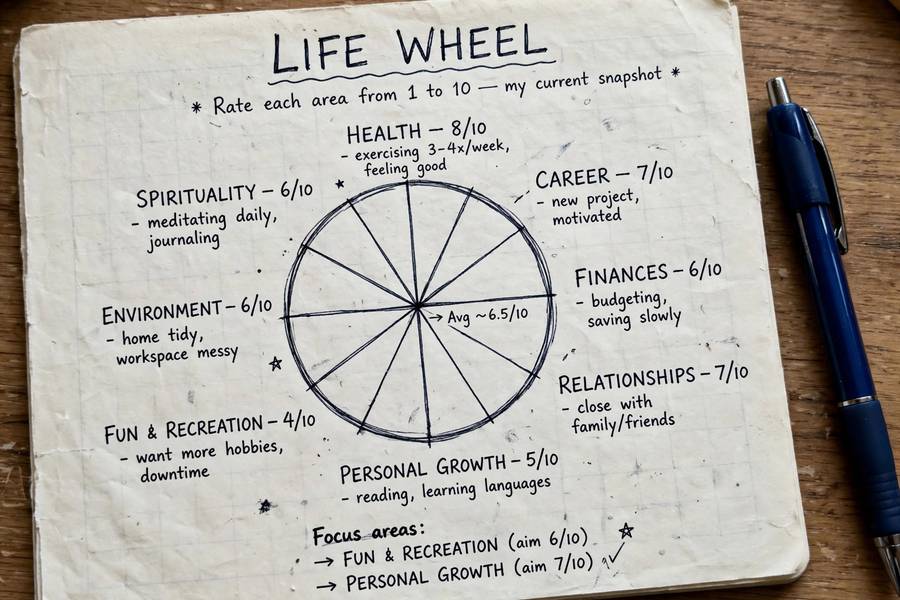
Draw it. A simple wheel — eight spokes, one per area, shaded to your score. The visual makes imbalances obvious in a way numbers don’t. Wonky wheels are normal. Perfectly round ones are suspicious.
Choosing What to Change (Less Than You Think)
Here’s where most life audits go wrong: they produce a 20-item action plan that collapses by February. Let’s do less, better.
Pick ONE area. The one with the lowest score, or the one whose improvement would lift others (often Health or Joy). Just one.
Pick ONE small shift. Not “transform my health” — “walk 20 minutes after lunch.” Not “fix my marriage” — “phone-free dinners.” Small enough to do on a bad day. That’s the test.
Make it stupidly specific. When, where, how. “Exercise more” fails. “Tuesday and Thursday, 7 AM, 20-minute walk around the block” has a chance.
Add, don’t just subtract. “Less phone” is hard. “Read for 20 minutes before bed instead” gives the evening a shape. Nature abhors a vacuum; so does your schedule.
Write it down. One sentence, somewhere you’ll see it. That’s your whole plan. Everything else is just the audit doing its quiet work in the background.
This philosophy — small, doable, kind — is the heart of the hygge lifestyle too: not overhauling life, but warming the parts you’re already in.
The 90-Day Gentle Check-In
Set a calendar reminder for 90 days out. When it arrives:
- Re-score the eight areas (fresh, not comparing to last time while scoring).
- Compare. What moved? What didn’t?
- Notice without judgment. Some things will have improved on their own — attention is a slow fertilizer.
- Pick the next one small thing. Or keep the current one. Both are fine.
The audit isn’t a project with an end date. It’s a practice — like stretching, like tidying, like calling your mother. Done lightly and regularly, it keeps you oriented toward the life you actually want, instead of the one that just happens.
And that, really, is the whole point: not a perfect life, but an examined one. Examined gently, held kindly, adjusted slowly. That’s enough. That’s everything.

Frequently Asked Questions
Set aside 1-2 unhurried hours with pen and paper. Assess 8 areas (health, work, relationships, money, growth, joy, home, purpose), scoring each 1-10 with a sentence explaining why. Look for patterns across areas, then pick ONE area and ONE small, specific change. Revisit in 90 days.
The essential eight: health and energy, work and career, relationships, money and security, personal growth, joy and play, home and environment, and purpose and meaning. Together they give a complete picture without becoming overwhelming.
Quarterly is ideal for most people (it maps nicely to seasons), but once a year done well is plenty. Avoid auditing during acute crisis or deep exhaustion — you need a relatively steady hand for honest reflection. The cadence matters less than the honesty.
A visual tool for life audits: draw a circle divided into 8 segments (one per life area) and shade each to your 1-10 score. The resulting shape makes imbalances immediately obvious — wonky wheels are normal and informative. It’s the fastest way to see your whole life at a glance.
Pick ONE area (the lowest score, or the one whose improvement lifts others) and ONE small, specific change — small enough to do on a bad day. “Walk 20 minutes after lunch” beats “transform my health.” Add rather than subtract where possible, write it down, and check in after 90 days.
No — an audit comes first and is descriptive (what’s true right now?), while goal setting is prescriptive (what should change?). Auditing without immediate goal pressure produces more honest results. Let the audit sit for a day or two before deciding what, if anything, to change.