

I’m Marcus. Customers ask me about turbos constantly — usually right after test-driving something with one and feeling that shove in the back when the boost hits. “How does it make so much power from such a small engine?” The answer is one of the cleverest ideas in automotive history: the turbocharger takes energy your engine was throwing away and feeds it back in as power.
No magic. Just physics, spinning very, very fast.
In This Guide
- The Core Idea: Free Energy From Exhaust
- The Two Halves of a Turbo
- How Boost Actually Builds
- What Is Turbo Lag?
- The Intercooler: Why Cold Air Matters
- Turbo vs Supercharger
- Turbo Maintenance: What Owners Get Wrong
- Frequently Asked Questions
The Core Idea: Free Energy From Exhaust
An engine makes power by burning fuel with air. More air + more fuel = bigger bang = more power. The traditional way to get more air is a bigger engine — more cylinders, more displacement. But bigger engines are heavier and thirstier.
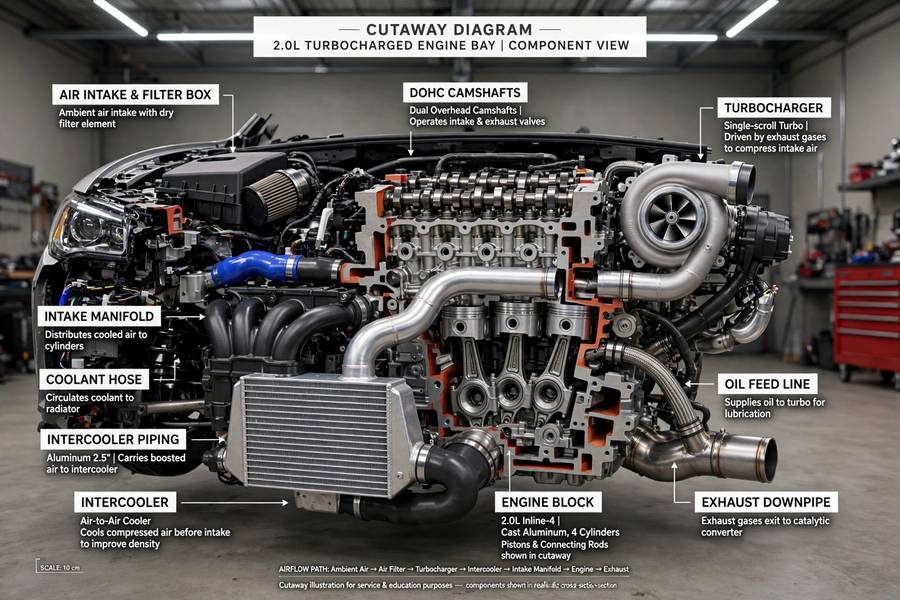
A turbocharger cheats this trade-off. Your engine’s exhaust — hot gas rushing out that would otherwise just make noise out the tailpipe — contains a lot of wasted energy. A turbo captures that energy with a turbine wheel, uses it to spin a compressor wheel, and that compressor forces extra air into the engine. More air in means the engine can burn more fuel per cycle, which means more power from the same small engine.
That’s the whole trick: recycling waste energy into power. A 2.0-liter turbocharged four-cylinder can make the power of a 3.5-liter V6 while sipping fuel like a four-cylinder when you’re driving gently. This is why nearly every manufacturer has gone turbo — it threads the needle between performance and efficiency regulations.
The Two Halves of a Turbo
A turbocharger is essentially two fans on a single shaft, housed in one unit:
The turbine side (hot side). Exhaust gases from the engine spin a turbine wheel. This side glows with heat — exhaust temperatures can exceed 1,000°F, which is why the housing is heavy cast iron or high-nickel alloy. The turbine can spin at 100,000 to 250,000 RPM. For perspective, your engine redlines around 6,000–7,000 RPM. The turbo shaft spins roughly thirty times faster.
The compressor side (cold side). On the other end of the same shaft, a compressor wheel sucks in fresh outside air and squeezes it — compressing it to above atmospheric pressure — before sending it into the engine’s intake. Compressed air is denser, so more oxygen molecules fit into each cylinder.
Between them: a bearing system (usually oil-fed journal bearings or ball bearings) that lets that shaft survive those insane speeds, fed by the engine’s oil supply. This is why turbo engines are picky about oil quality and change intervals — that bearing lives a harder life than almost anything else in the car.
How Boost Actually Builds
“Boost” is the extra air pressure the turbo creates, measured in PSI above atmospheric. Here’s the sequence when you press the gas:
- You open the throttle; the engine burns more fuel and pushes out more exhaust.
- The increased exhaust flow spins the turbine faster.
- The compressor, on the same shaft, spins faster too, forcing more air into the engine.
- More air lets the engine burn more fuel, making more exhaust — which spins the turbo faster still.
It’s a positive feedback loop, and it’s self-reinforcing up to the designed limit. That’s where the wastegate comes in — a valve that bleeds off excess exhaust gas once target boost is reached, preventing runaway pressure that would damage the engine. Modern cars control the wastegate electronically with extreme precision, which is part of why today’s turbos feel so smooth compared to the on/off monsters of the 1980s.

What Is Turbo Lag?
Turbo lag is the delay between pressing the accelerator and feeling the boost. It exists because the turbo needs exhaust flow to spin up — at low RPM with light throttle, there’s not enough exhaust energy to get the turbine moving quickly.
Manufacturers have fought lag for decades, and modern solutions work well:
- Smaller turbos spin up faster (but make less peak power).
- Twin-scroll turbos separate exhaust pulses to hit the turbine more efficiently.
- Twin-turbo setups use a small turbo for low RPM and a larger one for high RPM.
- Variable-geometry turbos adjust the turbine vanes to work efficiently across RPM ranges.
- Electric assist / mild-hybrid turbos spin the compressor electrically before exhaust takes over — nearly eliminating lag.
In a modern turbo car, lag is mostly a memory. If you drive something from the last five years and feel a big delay, something’s probably wrong — get it checked.
The Intercooler: Why Cold Air Matters
Compressing air heats it up — physics doesn’t negotiate. Hot air is less dense, which partly defeats the purpose of compressing it, and it increases the risk of engine knock (premature detonation).
The intercooler solves this: it’s a radiator-like heat exchanger that cools the compressed air before it enters the engine. Cooler, denser air means more oxygen per cylinder and safer combustion. That’s the chunky radiator-looking thing with fat pipes you’ll see at the front of turbo cars — it’s doing critical work.
This is also why turbo cars lose a bit of edge on very hot days. The intercooler can only cool air relative to ambient temperature; when it’s 100°F outside, intake temperatures climb and the computer pulls back power to protect the engine. Normal behavior, not a fault.
Turbo vs Supercharger
Both force extra air into the engine (“forced induction”), but they get their energy differently:
- Turbocharger: powered by exhaust gas (waste energy). More efficient, slight lag, the dominant choice today.
- Supercharger: belt-driven directly off the engine’s crankshaft. Instant response, no lag — but it consumes engine power to make engine power, so it’s less efficient.
Superchargers survive in niches — American V8 muscle, some performance applications — where instant throttle response matters more than efficiency. But for 95% of the market, the turbo won. It’s simply the better engineering compromise.
Turbo Maintenance: What Owners Get Wrong
Turbos are reliable today — but they punish neglect. From my service bay, the rules:
Oil is everything. The turbo’s bearings are oil-fed and oil-cooled. Use the manufacturer-specified oil (usually full synthetic), change it on time or early, and never let the level run low. Most turbo failures I see trace back to oil problems. This is the single most important thing in this entire article.
Let it cool after hard driving. After sustained high-boost driving (towing, mountain passes, spirited runs), idle for 30–60 seconds before shutting off. This lets oil circulate and cool the turbo’s bearings. Shutting down immediately after hard use can “coke” the oil — bake it into deposits inside the bearing. Normal commuting doesn’t require this ritual.
Don’t lug the engine. Flooring it at 1,500 RPM in top gear puts maximum stress on the turbo at minimum oil flow. Downshift. Your turbo will thank you.
Fix boost leaks promptly. Cracked intercooler hoses or loose clamps cause power loss, poor economy, and check-engine lights. The hoses live in a brutal heat/pressure environment — inspect them when you’re under the hood.
Use decent fuel. Turbo engines with high compression are knock-sensitive. If the manual says premium, use premium — the knock sensors will retard timing on regular fuel, costing you the power you bought the turbo for.
Get these right and a modern turbo will outlast the car around it. And while you’re learning your car’s systems, it’s worth understanding the driver aids too — like what cruise control does behind the scenes — and the roadside basics like how to jump start a car, because even turbocharged cars have ordinary batteries.
A turbocharger is waste-energy recycling at 200,000 RPM: exhaust spins a turbine, the turbine drives a compressor, the compressor packs more air into your engine, and a small engine punches like a big one. Maintain the oil, respect the heat, and it’ll return the favor for hundreds of thousands of miles.
Frequently Asked Questions
A turbocharger uses waste exhaust gas to spin a turbine, which drives a compressor that forces extra air into the engine. More air lets the engine burn more fuel per cycle, producing more power from a smaller engine. It’s essentially recycling energy the engine would otherwise throw away out the tailpipe.
Turbo lag is the brief delay between pressing the accelerator and feeling the turbo’s power boost. It happens because the turbo needs exhaust flow to spin up. Modern technologies — twin-scroll turbos, variable geometry, and electric assist — have reduced lag to nearly nothing in current cars.
Yes, when maintained properly. The key is oil: use the manufacturer-specified full synthetic oil, change it on time, and never run low — the turbo’s bearings are oil-fed and live an extremely hard life. With proper maintenance, modern turbos routinely last the life of the vehicle.
A turbocharger is powered by waste exhaust gas, making it more efficient but with slight lag. A supercharger is belt-driven off the engine itself, giving instant response but consuming engine power to operate. Turbos dominate the modern market due to better efficiency.
After hard driving (towing, mountain roads, sustained high boost), idle 30–60 seconds before shutdown so oil can cool the turbo bearings — this prevents oil coking. For normal commuting and gentle driving, it’s unnecessary; modern water-cooled turbos handle regular shutdowns fine.