How Does a Cruise Ship Float? The Buoyancy Trick Explained

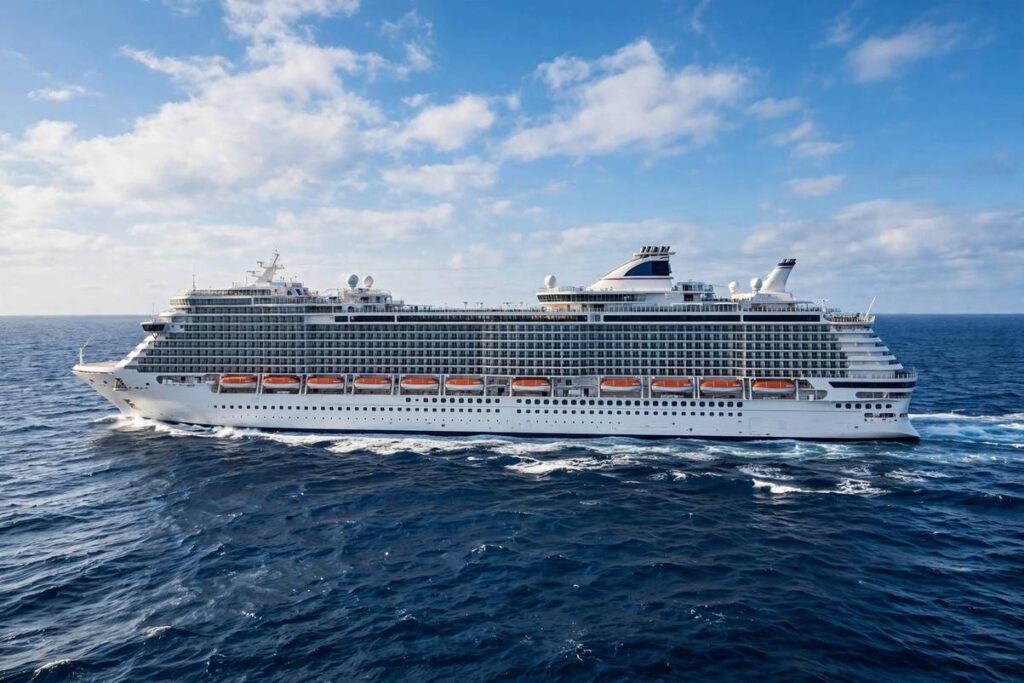
Stand on a dock next to a modern cruise ship and the scale breaks your brain a little. These floating cities can weigh over 100,000 tons — thousands of cabins, pools, restaurants, theaters — all sitting on water like it’s nothing. So how does a cruise ship float? The answer is over two thousand years old, fits in one sentence, and still feels like a magic trick: the ship floats because it pushes aside a weight of water equal to its own weight. That ancient insight — Archimedes’ principle — is the entire secret, and everything about a ship’s design flows from it.
Let’s unpack how displacement works, why the shape of the hull matters more than the weight, what keeps these giants stable in rough seas, and why they don’t just tip over.
How Does a Cruise Ship Float? Archimedes’ Principle in Plain English
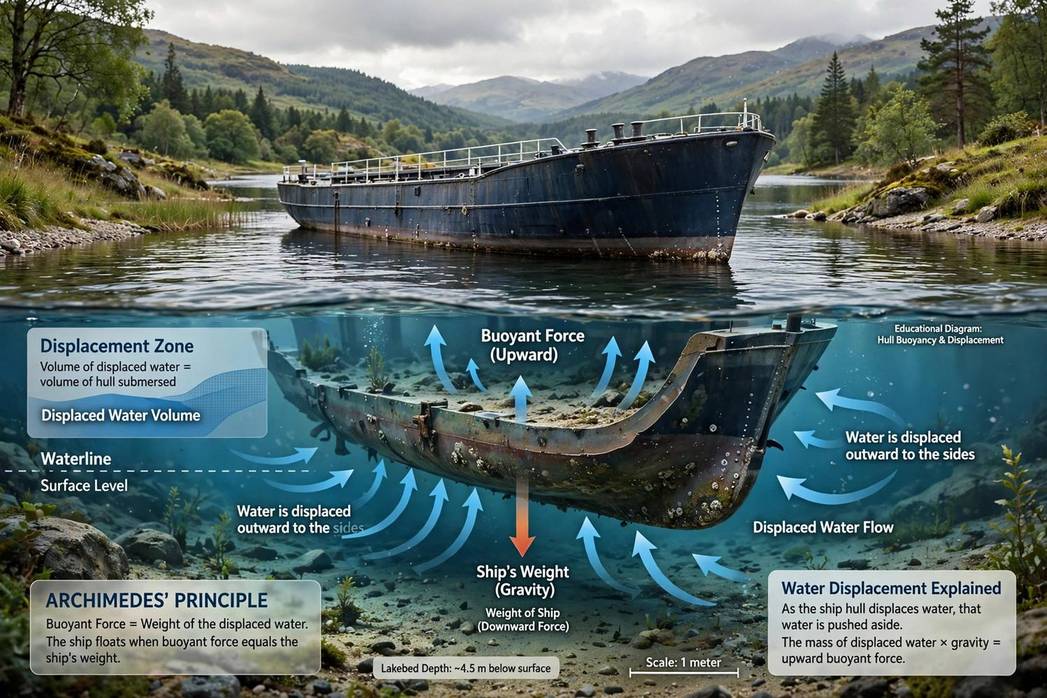
Here’s the principle: when you lower an object into water, the water pushes back up with a force equal to the weight of the water the object displaces — shoves aside. If that upward push (buoyancy) equals the object’s weight, it floats. If the object is too dense and can’t displace enough water before submerging completely, it sinks.
A cruise ship is mostly empty space — air-filled cabins, atriums, theaters. Its average density (total weight divided by total volume, air included) is far lower than water’s. So as the hull settles into the sea, it displaces an enormous volume of water, and the weight of that displaced water eventually equals the ship’s weight. At that point the forces balance, and the ship rides at a stable draft — typically around 8 to 9 meters of hull below the waterline for a large cruise ship, with the vast bulk of the vessel above it.
The classic demonstration: a solid steel ball sinks, but the same steel hammered into a hollow bowl floats. The material didn’t change — the shape did, because the shape determines how much water gets displaced. A cruise ship is the ultimate steel bowl.
Why the Hull Shape Matters More Than the Weight
Naval architects obsess over hull shape because it controls three things: how much water is displaced, how the ship moves through it, and how stable it stays. The wide, rounded hull of a cruise ship displaces a huge volume with relatively shallow draft — important because these ships visit ports that aren’t enormously deep.
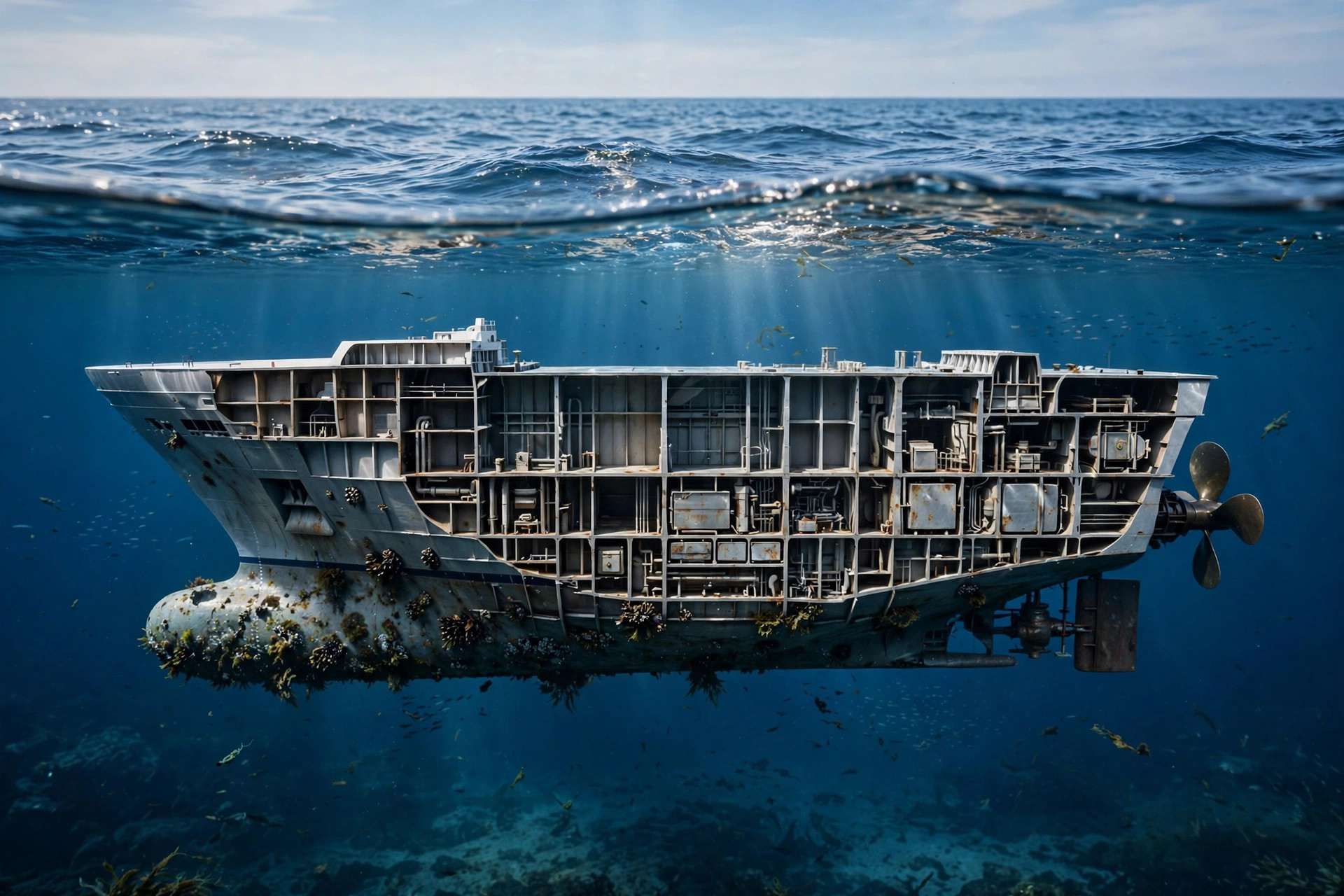
The hull also narrows toward the bow to part the water efficiently, reducing drag and fuel burn. And below the waterline, you’ll find features most passengers never see: the bulbous bow (that torpedo-like protrusion at the front) which cancels out the bow wave and saves fuel, and stabilizer fins that extend sideways to dampen rolling in rough seas.
What Keeps It From Tipping Over?
This is the question that bothers people once they accept the floating part. A cruise ship is enormously tall — a dozen or more decks above the water — so why doesn’t wind or a big wave knock it over? The answer is the relationship between two points naval architects care about deeply: the center of gravity (where the ship’s weight effectively acts) and the center of buoyancy (where the water’s upward push effectively acts).
When a ship heels (tilts) to one side, the underwater shape changes, and the center of buoyancy shifts toward the low side — creating a righting force that pushes the ship back upright. The heavy machinery, fuel tanks, and ballast water are all placed low in the hull to keep the center of gravity down, which strengthens this self-righting effect. Modern cruise ships are designed to recover from rolls far beyond anything passengers would ever experience. They’re also fitted with active stabilizers — computer-controlled fins — that smooth out the motion in normal seas.
Ballast, Draft, and the Load Line
Ships don’t just float and forget it — they manage their floating constantly. Ballast tanks take on or pump out seawater to adjust the ship’s trim (level) and stability as fuel burns off and supplies are consumed during a voyage. Ever notice a ship sitting a little differently at the end of a cruise? That’s ballast management at work.
And if you look at a ship’s hull near the waterline, you’ll see the load line markings — the Plimsoll mark. These show the maximum safe draft in different water conditions, because seawater density varies with temperature and salinity, and a ship that floats safely in cold North Atlantic water sits lower in warm tropical seas. Loading beyond the mark is illegal for good reason.
Could a Cruise Ship Actually Sink?
Only if the displacement equation breaks — which means water getting inside the hull in large quantities. That’s what watertight compartments are for: the hull is divided into sections by bulkheads, so a breach floods one compartment, not the whole ship. Modern cruise ships are built to survive multiple compartments flooding and stay afloat. It takes catastrophic, multi-compartment damage — the kind of event that makes global news — to actually sink one. Day to day, the physics is overwhelmingly on the ship’s side.
Planning to experience all of this firsthand? Our cruise packing checklist covers what to bring so you can spend less time worrying about luggage and more time marveling at the engineering from the top deck.
The Biggest Floating Objects Humans Have Built
To appreciate what Archimedes’ principle is doing, consider the scale. The largest cruise ships in service are among the biggest moving objects humans have ever constructed — longer than three football fields, carrying thousands of passengers and crew, with neighborhoods, parks, and water slides stacked a dozen decks high. And every one of them floats on exactly the same principle as a rubber duck: displace enough water, and up you go.
What’s changed over the decades isn’t the physics but the engineering confidence. Each generation of ships has pushed bigger, because naval architects understand stability so precisely they can model exactly how a vessel will behave before it’s built. Computer simulations test hull designs against virtual storms; scale models get tank-tested; and the full-size ship does sea trials to verify. The result is that modern mega-ships are, by most measures, more stable and safer than their smaller predecessors — size, handled correctly, is an asset, not a risk.
It’s worth pausing on how strange this is. A structure heavier than a small town’s worth of buildings, floating. Every passenger who boards without a second thought is trusting — correctly — a principle discovered in a bathtub over two thousand years ago.
What Happens When the Sea Gets Rough?
The question every first-time cruiser asks: what does all this engineering feel like in a real storm? The honest answer has two parts: what the ship does, and what you feel.
What the ship does: modern cruise ships actively avoid the worst weather. Captains receive constant weather routing and will alter course to skirt storms — sometimes adding distance to the voyage to stay in calmer water. If rough seas are unavoidable, the ship slows down and may turn to take waves at a safer angle. Stabilizer fins extend and work continuously, and ballast is adjusted. The crew has done this thousands of times; heavy weather is routine operations, not an emergency.
What you feel: in moderate seas, most passengers feel gentle motion — many describe it as soothing, like being rocked. In genuinely rough weather, you’ll feel the ship move more distinctly: a slow roll side to side, a pitch up and down. It’s uncomfortable for some — seasickness medication exists for exactly this — but it’s well within what the ship is designed for. The vessel’s size works in your favor here: big ships bridge across waves that would toss a small boat around, so the motion is slower and more gradual.
The ships also have a deep safety margin most passengers never think about. Stability standards require cruise ships to withstand flooding, high winds, and rolls far beyond anything they’d encounter in service — the regulations assume worst cases and then add margin. Feeling the ship move in a storm isn’t a sign of danger; it’s a sign of a very large object doing exactly what the physics says it will do.
The Plimsoll Mark: A Line That Saves Lives
Those load-line markings on the hull have a remarkable backstory. In the 19th century, unscrupulous shipowners routinely overloaded vessels — sometimes deliberately, for the insurance money when they sank — in what became known as the scandal of “coffin ships.” Sailors died in large numbers. Samuel Plimsoll, a British member of Parliament, campaigned relentlessly against the practice, and in 1876 his efforts produced the law requiring every ship to carry a load line: a mark showing the maximum safe draft.
The mark — a circle with a horizontal line through it, plus additional lines for different water conditions — is still painted on every commercial ship in the world, and it’s still called the Plimsoll mark in his honor. It’s one of history’s clearest examples of a simple regulation saving countless lives: a painted line, backed by law, that says “this much floating, and no more.” Next time you see a cruise ship’s hull markings near the waterline, you’re looking at a 150-year-old safety reform doing its quiet job.
FAQ: How Cruise Ships Float
How much of a cruise ship is underwater?
Surprisingly little — typically around 8 to 9 meters of draft for a large ship, which is a small fraction of its total height. Most of what you see towering above the dock is the whole story; the underwater part is just the hull’s lower section.
Why don’t cruise ships tip over in storms?
Low center of gravity (heavy machinery and ballast low in the hull), a wide hull form, and the physics of buoyancy: when the ship heels, the center of buoyancy shifts and creates a righting force. Active stabilizer fins smooth the ride further. They’re designed to recover from far worse than any storm they’d sail through.
What’s the heaviest thing on a cruise ship?
Usually the propulsion machinery, engines, and fuel — deliberately placed as low as possible. That low heavy mass is a feature: it keeps the center of gravity down and the ship stable.
Do cruise ships float differently in fresh vs. salt water?
Yes, slightly. Salt water is denser, so a ship floats a touch higher in the ocean than in fresh water. Ships transiting places like the Panama Canal (freshwater locks) account for this — it’s one reason load lines have different marks for different water types.
What is the bulbous bow for?
That torpedo-shaped protrusion below the waterline at the bow creates its own wave that cancels out the ship’s bow wave, reducing drag. It can cut fuel consumption noticeably — a big deal when you’re pushing 100,000 tons through water.