
Why Do We Get Brain Freeze? The Ice-Cream Headache Explained


You know the exact moment. One enthusiastic spoonful of ice cream too many, and suddenly there’s a stabbing ache blooming behind your forehead like someone flicked a switch. Why do we get brain freeze — and why does it vanish as mysteriously as it arrived, usually within a minute? The phenomenon has a proper scientific name (sphenopalatine ganglioneuralgia, if you want to impress people at parties), and the mechanism is a fascinating case of your body’s alarm system misfiring. Your brain isn’t actually freezing. It’s being lied to by a nerve.
Let’s trace exactly what happens from spoon to forehead, why the pain shows up where it does, and the tricks that stop it fast.
Why Do We Get Brain Freeze? The Nerve Behind It
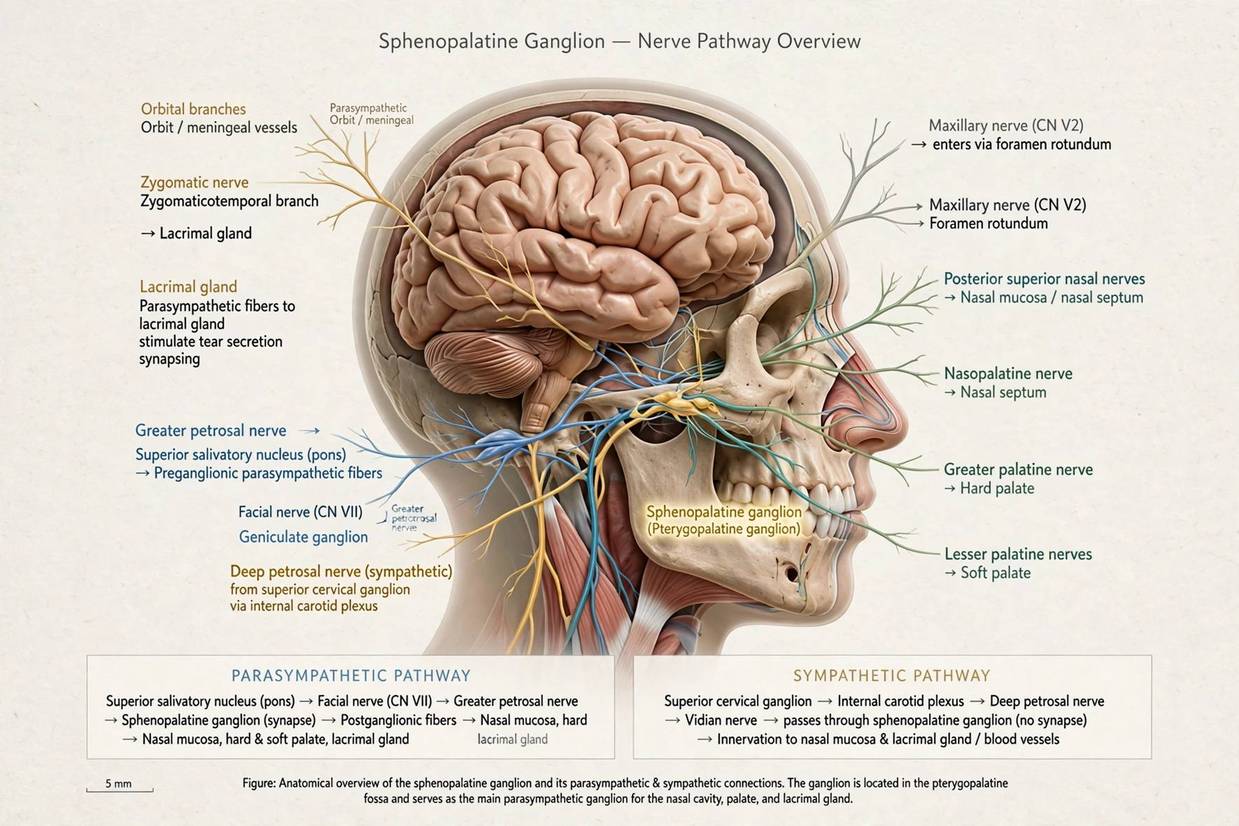
When something very cold hits the roof of your mouth (the palate) and the back of your throat, it rapidly chills the blood vessels in that area. Your body reads this sudden cold as a potential threat and reacts defensively: the blood vessels constrict, then quickly dilate again. That rapid change is detected by a bundle of nerves called the sphenopalatine ganglion, sitting just behind your nose.
Here’s the misfire: the sphenopalatine ganglion is closely wired to the trigeminal nerve, the main sensory nerve of the face and forehead. When the ganglion fires its alarm, the brain misinterprets the signal’s origin — a phenomenon called referred pain — and you feel the pain in your forehead instead of on the roof of your mouth where the cold actually is. Same reason heart problems can manifest as arm pain: the brain sometimes gets the address wrong.
Why So Fast, and Why Does It Stop So Quickly?
Brain freeze is built for speed because it’s a reflex, not an injury. The cold hits, the vessels react within seconds, the nerve fires, and you feel it almost immediately — typically peaking within 20 to 30 seconds. And it resolves just as fast because the trigger is temporary: once the cold source is gone and the tissues warm back up, the vessels stabilize, the nerve calms down, and the false alarm ends.
This is also why brain freeze is self-limiting and harmless. Nothing is damaged; no part of your brain actually changes temperature in any meaningful way. The brain itself is well insulated and bathed in warm blood — the whole episode is a signaling glitch, start to finish.

Why the Forehead? The Referred Pain Detour
Referred pain deserves a closer look because it’s genuinely strange. The trigeminal nerve serves a huge territory — forehead, cheeks, jaw, and parts of the mouth and throat. When intense signals arrive from the palate region, the brain’s sensory map can misattribute them to another branch of the same nerve. Most people feel brain freeze in the forehead or behind the eyes; some feel it at the temples.
Interestingly, not everyone gets brain freeze, and researchers aren’t entirely sure why. It may come down to individual differences in the anatomy of the sphenopalatine region, or in how sensitive someone’s trigeminal system is. People who get migraines seem more prone to brain freeze, which makes sense — the trigeminal nerve is heavily involved in migraine pain too, and some scientists study brain freeze as a simple, harmless model for understanding headache mechanisms.
How to Stop Brain Freeze in Seconds
The goal is simple: warm the roof of your mouth back up as fast as possible, which tells the blood vessels to stand down. The classic remedies all work on this principle:
- Press your tongue to the roof of your mouth. Your tongue is warm and right there — this is the fastest fix and it works remarkably well.
- Press a warm thumb or palm against the roof of your mouth. Same idea, more surface area. (Wash your hands first, obviously.)
- Drink something warm. A sip of warm — not hot — water or coffee rewarm the palate quickly.
- Cover your mouth and nose and breathe. Trapping warm exhaled air raises the temperature around the palate and throat.
- Press your palms to your forehead. This one’s more about counter-stimulation — the warmth and pressure give your brain a competing signal — but many people swear by it.
And prevention is even simpler: eat cold things more slowly, keep them toward the front of your mouth rather than gulping them to the back of the throat, and give your palate a break between bites. Revolutionary advice, I know.
The Migraine Connection: Why Scientists Care
Brain freeze might seem like a trivial topic, but headache researchers take it seriously. Both brain freeze and migraines involve the trigeminal nerve and rapid changes in blood vessel diameter in the head. Because brain freeze is easy to trigger on demand, completely harmless, and over in a minute, it’s a convenient natural experiment — studying it may shed light on the vascular side of migraine pain.
Some researchers have even speculated about an evolutionary angle: the rapid vessel response might be the body’s overzealous way of protecting the brain from perceived cold threats, a defense mechanism firing at a false positive. Whether or not that’s true, it’s a reminder that even our glitches have structure worth studying.
Your Body’s Cold Sensors: Why Cold Can Feel Like Pain
To understand brain freeze fully, it helps to know how your body senses cold in the first place. Scattered through your tissues are specialized nerve endings with cold-sensing receptors — the best-studied is called TRPM8, sometimes nicknamed the “menthol receptor” because menthol triggers it too (that’s why mint feels cool). These receptors fire when temperatures drop, giving you the sensation of cold.
But cold and pain share wiring. When cold becomes extreme or sudden, the signal crosses from “that’s cold” into “that might be damaging” — and the nervous system treats potential tissue damage as pain. This is protective: cold can injure tissue, so an alarm that fires early keeps you from holding ice against your skin indefinitely. The roof of your mouth is densely packed with nerve endings and sits close to major blood vessels, so it’s an especially sensitive trigger zone — a small patch of tissue with an outsized alarm system.
This also explains why brain freeze is about speed as much as temperature. Slowly sipping something cold rarely triggers it, because the vessels adjust gradually. It’s the sudden plunge — the big gulp of slushie, the heaped spoonful — that the system reads as an emergency. Your nerves are essentially running a rate-of-change detector, not just a thermometer.
Brain Freeze’s Cousins: Other Referred Pains
Referred pain — feeling pain somewhere other than its source — is a whole family of neurological mix-ups, and brain freeze is just the most entertaining member:
- Heart and arm: the classic example. During cardiac distress, pain is often felt in the left arm, shoulder, or jaw rather than the chest, because the heart’s nerve signals converge with those regions in the spinal cord. It’s the same wiring-confusion principle as brain freeze, with far more serious stakes — which is why unexplained arm or jaw pain is always worth taking seriously.
- Diaphragm and shoulder: irritation of the diaphragm (from gallbladder issues, for instance) is often felt as shoulder pain, because the phrenic nerve serving the diaphragm shares spinal pathways with shoulder nerves.
- Teeth and sinuses: upper tooth pain is frequently actually sinus inflammation, and vice versa — the nerves of the upper jaw and the sinuses are close neighbors that the brain struggles to tell apart.
- The “ice cream headache” and migraines: as discussed, both run through the trigeminal system, which is why researchers study the harmless one to understand the painful one.
The pattern in all of these: the nervous system is an old, patched-together network, and signals sometimes arrive at the brain’s map room with the wrong return address. Brain freeze is the version you can trigger with dessert — a harmless demonstration of one of neurology’s quirkiest features.
Can You Build Tolerance to Brain Freeze?
Ask around and you’ll find people who claim they never get brain freeze no matter how fast they eat ice cream, and others who get it from a single sip of a cold drink. So can you train yourself out of it? The honest answer: there’s no solid evidence you can build meaningful tolerance, and the mechanism suggests why.
Brain freeze is a reflex — a hardwired protective response, not a skill or a sensitivity that adapts much with practice. Reflexes don’t typically “learn” the way muscles or taste preferences do. The people who never get it likely have anatomical differences (the shape and nerve layout of the sphenopalatine region varies person to person), not superior training. And self-reported “tolerance” is usually just behavior change in disguise: people who eat ice cream often unconsciously learn to eat it in a way that avoids triggering the reflex — smaller bites, slower pace, keeping it forward in the mouth.
That said, the behavioral workaround is the practical answer. You can’t rewire the reflex, but you can stop tripping it: pace yourself, keep cold food toward the front of the mouth, and let each bite warm slightly before the next. It’s not tolerance — it’s technique. And frankly, eating ice cream slowly enough to taste it properly is its own reward.
FAQ: Brain Freeze
Can brain freeze cause any real damage?
No. Despite the dramatic name, nothing in your head actually freezes and no tissue is harmed. It’s a brief nerve signaling event — uncomfortable, startling, and completely harmless.
Why do some people never get brain freeze?
Likely anatomical differences in the sphenopalatine region or in trigeminal nerve sensitivity. If you’ve never had one, consider yourself lucky — and maybe don’t go chasing your first one.
Does brain freeze happen with cold drinks or only ice cream?
Anything very cold hitting the back of the palate fast enough can do it — ice cream, slushies, ice water gulped quickly. Slushies are notorious because they’re both very cold and easy to drink fast.
Why does pressing my tongue to the roof of my mouth help?
It directly rewarms the chilled tissue, which stops the blood vessels’ panicked constrict-dilate cycle and quiets the nerve signal. Warmth at the source ends the false alarm.
Is there any link between brain freeze and migraines?
There’s an association — migraine sufferers report brain freeze more often — and both involve the trigeminal nerve system. Researchers study brain freeze partly because it may illuminate headache mechanisms, but having brain freeze doesn’t mean you’ll get migraines.