Car Detailing Pricing Guide for Beginners: Packages, Rates & Rules


Every beginner in this business makes the same mistake: they price like a hobbyist and wonder why they are exhausted and broke. I have seen talented detailers charge $89 for a five-hour job, net about $12 an hour, and quit within six months — not because they were bad at detailing, but because they were bad at pricing.
Pricing is not about picking numbers that feel fair. It is about knowing your cost per job, your target hourly rate, and the psychology of how customers buy. This car detailing pricing guide for beginners covers all three — part of our larger how to start a car detailing business series, and the single most profitable hour you will spend on your business this month.
Why Beginners Underprice (and How to Stop)
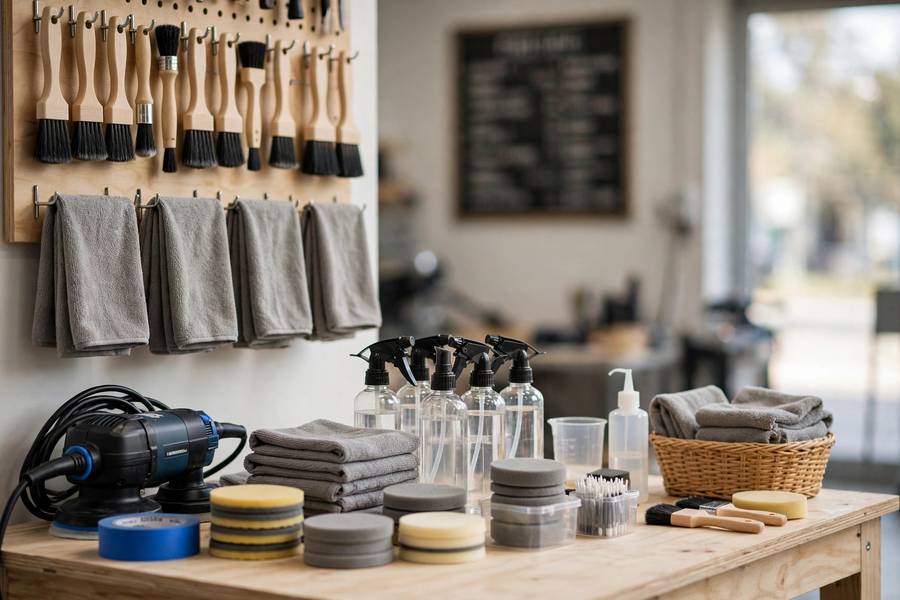
Beginners underprice for three predictable reasons. First, imposter syndrome — you feel guilty charging $199 when the shop down the street charges $249, even though your work is better. Second, you compare yourself to car washes, which is like a steakhouse comparing itself to a vending machine. Third, you price for the customer you imagine instead of the one you have: you assume everyone is broke, when plenty of people happily pay $250 for someone they trust with their car.
Here is the reframe that fixes it: you are not selling labor, you are selling a result. A customer does not care that the job took you four hours. They care that their car looks new, smells clean, and they did not have to think about it. Price the result, not the hours.
The other beginner trap is competing on price to “get started.” It backfires twice: cheap prices attract the most demanding, least loyal customers, and raising prices later feels impossible because your whole customer base was bought on discounts. Start at real prices. If you need practice, do free jobs for friends — do not do cheap jobs for strangers. Free builds goodwill and reviews; cheap builds a reputation you cannot escape.
Know Your True Cost Per Job
Before you set a single price, calculate what each job actually costs you. Most beginners guess; professionals know.
Direct costs per vehicle: – Chemicals and consumables: $8-$15 (soap, dressings, compounds, towels amortized) – Fuel/vehicle wear: $5-$12 for mobile, less for a shop – Water/power: $1-$3
Labor cost: This is where honesty matters. If your target is $60/hour and a full detail takes 3.5 hours, your labor cost is $210. Beginners routinely skip this line, which is exactly why they work for $12/hour.
Overhead per job: Add up monthly fixed costs (insurance, rent or vehicle payment, phone, software, marketing) and divide by expected monthly jobs. At $1,500/month overhead and 60 jobs, that is $25 per job.
So a full detail costs you roughly $25 (products) + $210 (labor) + $25 (overhead) = $260 in true cost. If you charge $299, you are making $39 of profit — an 13% margin, which is thin. If you charge $249, you are losing money on every job and do not know it. This is the math how to become an entrepreneur teaches the hard way: the business dies quietly, one underpriced job at a time.
Do this exercise for every service on your menu. It takes an hour and will change every price you ever set.
Pricing Tiers That Sell Themselves
The three-tier menu is the most tested pricing structure in the service business. It works because customers hate choosing between two options and love having a middle ground. Your tiers:
Good — “The Refresh” ($99-$149). A maintenance wash and interior wipe-down. 60-90 minutes. This is your entry point and your recurring-revenue engine. Market it as the monthly plan.
Better — “The Full Detail” ($199-$299). Deep interior clean plus exterior detail. 2.5-4 hours. This should be your best seller — design the pricing so it is. Price it so the jump from Refresh feels small and the value feels large.
Best — “The Showroom” ($349-$499). Everything in Full Detail plus paint decontamination, machine polish, engine bay, and premium protectants. 5-7 hours. Most customers will not buy it. That is fine — its job is to make the middle tier look reasonable, and the 15-20% who do buy it are your highest-margin work.
The psychology: with three options, roughly 60-70% of buyers pick the middle. One tier means a yes/no decision; three tiers mean a “which one” decision, and “which one” closes far more often. This is also what branding actually means in practice — your menu design shapes what customers perceive as premium, standard, and cheap.
Rule: never present more than 5 packages total including add-ons on the first quote. Too many options cause decision paralysis, and paralyzed customers say “let me think about it” — which means no.
Typical Price Ranges by Service
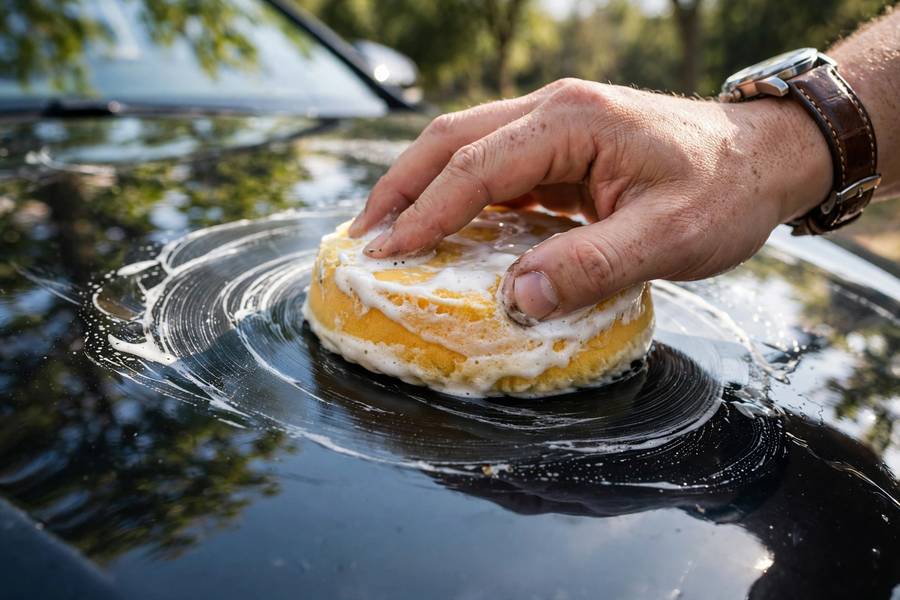
Use these 2026 US market ranges as your starting grid, then adjust ±20% for your local market. Call three competitors this week and ask for quotes — that is your real data.
| Service | Typical Range | Time |
|---|---|---|
| Exterior wash + wax | $59-$99 | 45-75 min |
| Interior detail | $129-$199 | 2-3 hours |
| Full detail (in + out) | $199-$349 | 3-5 hours |
| Paint correction (1-step) | $299-$499 | 4-6 hours |
| Paint correction (2-step) | $499-$899 | 8-12 hours |
| Ceramic coating (consumer) | $500-$900 | 1-2 days |
| Engine bay detail | $49-$99 | 30-60 min |
| Headlight restoration | $79-$149 | 45-75 min |
| Pet hair removal | $40-$80 add-on | 30-60 min |
| Odor treatment | $60-$120 add-on | 1-2 hours |
Vehicle size multipliers are standard practice: add 15-25% for full-size SUVs and trucks, 10-15% for three-row vehicles. Condition matters too — a “biohazard” interior (spills, stains, years of neglect) justifies a 25-50% surcharge. Quote condition-based pricing in person or from photos, never blind.
Mobile premium: add 10-20% to shop-equivalent prices. You are delivering convenience. Customers understand this instantly and rarely push back.
Add-Ons: Where Beginners Actually Profit
Your base packages get customers in the door. Your add-ons pay your rent. A customer who books a $249 full detail and adds engine bay ($69), pet hair removal ($59), and odor treatment ($89) just became a $466 ticket — and the add-on labor is 90 minutes of work you were already halfway set up for.
Rules for add-ons that work:
- Price add-ons at 60-70% margin minimum. They are incremental sales to a committed buyer — the highest-converting, highest-margin revenue in your business.
- Offer them at booking, not at pickup. “While we’re in there, would you like the engine bay done for $69?” closes at 40-50%. Offering at pickup, when the customer is paying and leaving, closes at 10%.
- Bundle smartly. A “Road Trip Ready” bundle (interior + odor + headlights) at $329 feels like a deal and locks in margin. Bundles raise average tickets 25-35% with zero extra marketing.
- Name them results, not processes. “Odor Elimination” outsells “ozone treatment” 3-to-1. Customers buy outcomes.
Track your average ticket monthly. If it is not rising as you add services and add-ons, your upsell process is broken. A healthy beginner operation should see average tickets climb from ~$150 to ~$220 within the first six months.
Raising Prices Without Losing Customers
You will need to raise prices — every year, roughly 5-10%, just to keep up with costs. Beginners dread this. Here is how professionals do it without drama:
- Raise prices on new customers first. Existing customers keep old rates for 60-90 days, then move up. Nobody feels ambushed.
- Grandfather loyal regulars selectively. Your 20 monthly-plan customers are gold — raise them last, or raise them half as much. Losing a $129/month recurring customer to save a $10 increase is terrible math.
- Add value, then raise. Add a small upgrade (free air freshener, tire dressing upgrade) the month before the increase. Customers notice the improvement and accept the price.
- Never apologize for the price. “Our full detail is now $279” beats “I’m sorry, but I had to raise prices to $279.” The first is a professional announcing a rate; the second invites negotiation.
- Watch the booking rate, not complaints. A 10% price increase that drops bookings 5% still raises revenue. Only roll back if bookings fall more than 15% and stay down for a month.
The operators who raise prices confidently every year end up charging double the timid ones within three years — for the same work. Pricing confidence is a skill. Practice it.
Frequently Asked Questions
Beginners should charge market rates from day one: $99-$149 for maintenance details, $199-$299 for full details, with 10-20% more for mobile service. Do not discount to “get started” — do free practice jobs for friends instead, and charge real prices for paying customers.
Add your direct costs per job (chemicals $8-$15, fuel $5-$12), your labor cost (target hourly rate times hours per job), and your overhead per job (monthly fixed costs divided by monthly jobs). That total is your true cost — your price must sit above it with at least a 20-30% margin.
Yes. The industry standard is a 15-25% surcharge for full-size SUVs and trucks and 10-15% for three-row vehicles, reflecting the extra time and product. Heavily soiled “biohazard” interiors justify a 25-50% condition surcharge quoted from photos or in person.
Healthy detailing operations run 30-50% net margins on labor-based services, with add-ons at 60-70% margins. If your margin is under 20%, you are almost certainly underpricing or spending too long per job — fix pricing first.
Plan on 5-10% annual increases to keep pace with costs. Raise new customers first, give existing customers 60-90 days notice, and grandfather your best recurring customers. Watch booking rates — a 10% increase that only drops bookings 5% still grows revenue.
Add-ons are the highest-margin revenue in detailing — engine bays, pet hair removal, and odor treatment run 60-70% margins. Offer them at booking (40-50% close rate) rather than at pickup (10%), and use named bundles to lift average tickets 25-35%.