18 Best Courtroom Drama Movies That Still Hit Hard

I’ve spent the better part of a decade on the entertainment beat — premieres, press junkets, festival screenings, the lot — and I’m convinced the best courtroom drama movies are the purest writing test in Hollywood. No CGI cavalry, no car chases, no third-act volcano. Just twelve chairs, a flag, and the question of whether the person standing in front of you is telling the truth. When a courtroom film works, nothing on screen holds a room the way a great cross-examination does.
I rewatched every film on this list with a lawyer friend who fact-checks my opinions for fun, and I ranked them by one standard: how tight the script is, how the room feels when the verdict lands, and whether I’d still recommend it to a friend tonight. Here is where eighteen of them fall.
In this guide:
- Why courtroom dramas never go out of style
- The 18 best courtroom drama movies, ranked
- How I ranked them
- Frequently asked questions
Why courtroom dramas never go out of style
A courtroom is the most efficient stage ever built. Two sides, one argument, a referee with a gavel, and an audience that has to stay seated until it’s over. Screenwriters love it because the structure is already there: opening statements, the middle where everything goes wrong, and a closing argument that doubles as a finale monologue. Actors love it because a great speech scene can define a career in four minutes flat.
What separates the classics from the forgettable is respect for the room. The best courtroom dramas treat procedure like a sport — the rules matter, and breaking them has consequences. That’s why real lawyers are obsessed with this genre and merciless about the entries that phone it in. The good ones make the law feel like theater. The great ones make the theater feel like law.
The 18 best courtroom drama movies, ranked
1. 12 Angry Men (1957)
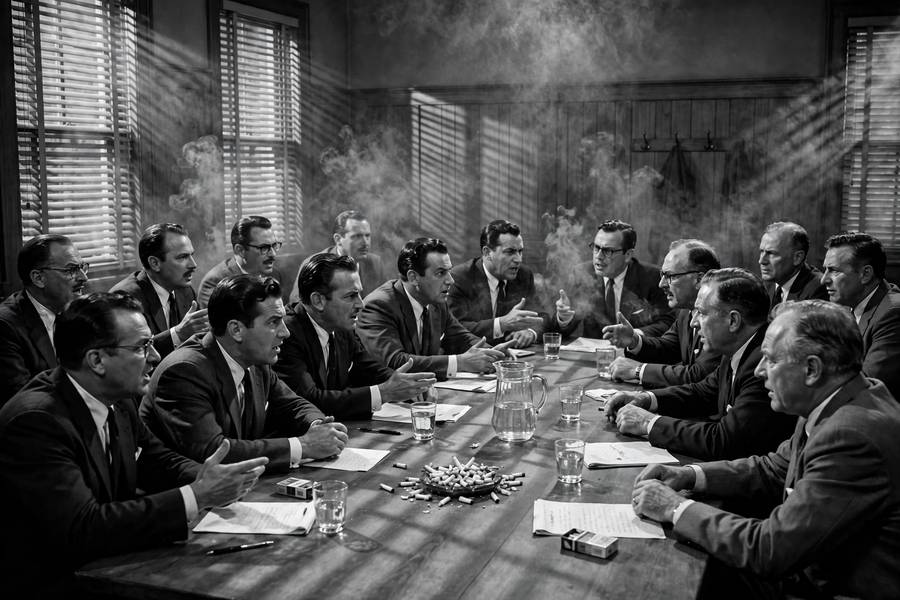
Sidney Lumet’s debut is almost entirely one room, twelve men, and a murder case that looks open-and-shut until Henry Fonda’s juror number 8 asks the table to slow down. It is the genre’s gold standard and probably always will be: a script so tight you could tune a piano with it, and a masterclass in how reasonable doubt actually works. If you only watch one film on this list, make it this one.
2. To Kill a Mockingbird (1962)
Gregory Peck won the Oscar for playing Atticus Finch, and sixty years later it’s still the performance people cite when they talk about moral authority on screen. The trial of Tom Robinson is the film’s center of gravity, but what makes it endure is Scout’s narration — a child watching the adult world fail its own standards in real time. The closing argument alone is worth the running time.
3. A Few Good Men (1992)
“You can’t handle the truth!” entered the language the week this came out and never left. Rob Reiner directs Aaron Sorkin’s stage play like a heavyweight fight, with Tom Cruise’s Navy lawyer finally growing a spine against Jack Nicholson’s Colonel Jessup. It gave us one of the most quoted lines in the best movie quotes of all time — and a courtroom showdown that earns every bit of its legend.
4. The Verdict (1982)
Paul Newman plays Frank Galvin, a washed-up Boston lawyer who takes a medical malpractice case he has no business winning, and gives the performance of his life. David Mamet’s screenplay refuses every easy button: Galvin screws up, the opposition outguns him, and the win — when it comes — feels like it cost him a year of his life. This is the one lawyers themselves name when you ask for the most honest courtroom film.
5. Witness for the Prosecution (1957)
Billy Wilder turned Agatha Christie’s play into a legal chess match where every scene rearranges what you thought you knew. Charles Laughton is magnificent as the ailing barrister, Marlene Dietrich is up to something from her first entrance, and the final twist still catches people who think they’ve seen everything. Wilder reportedly kept the ending secret from the cast until the last day of shooting.
6. Anatomy of a Murder (1959)
Otto Preminger’s film was genuinely shocking in 1959 for how frankly it talked about what happens in a rape trial, and it’s still startling how modern it feels. James Stewart plays a folksy small-town lawyer who is much sharper than he looks, Duke Ellington wrote the jazz score, and the courtroom procedure is so accurate that law schools have used the film in teaching. Two and a half hours, and it never drags.
7. Primal Fear (1996)
A prestige-star vehicle that accidentally launched one of the best acting careers of the generation. Richard Gere is fine as the defense attorney; Edward Norton, in his film debut as the stuttering altar boy accused of murder, is a force of nature. The final revelation is one of the great plot twists in movie history, and it works because Norton sells both halves of it.
8. Judgment at Nuremberg (1961)
The heaviest film on this list, and it should be. A fictionalized account of the judges’ trials after World War II, with Spencer Tracy presiding and Maximilian Schell winning the Oscar as the defense counsel. Abby Mann’s script asks the question no one else dared ask on a studio budget: what do you do with judges who applied the law while the law was monstrous? It answers it without flinching.
9. My Cousin Vinny (1992)
The comedy entry, and the one working lawyers cite most often for getting trial procedure right. Joe Pesci’s Brooklyn lawyer bumbles through an Alabama murder trial while Marisa Tomei steals the film — and the Oscar — as his fiancée, whose expert testimony on positraction is, improbably, sound. It belongs on every list of the best comedy movies ever made, and it earns its courtroom seat honestly.
10. Philadelphia (1993)
Tom Hanks won his first Oscar playing a lawyer fired for having AIDS, and Denzel Washington is just as good as the homophobic attorney who takes his wrongful-termination case. Jonathan Demme directs it like a classical courtroom drama and lets the performances do the arguing. The opera scene — “La mamma morta” — is one of the most quietly devastating sequences of the nineties.
11. A Time to Kill (1996)
John Grisham’s adaptation machine was running hot in the nineties, and this is its best courtroom entry. Matthew McConaughey’s young Mississippi lawyer defends a father who killed the men who attacked his daughter, and Samuel L. Jackson is a force as the defendant. The closing argument is pure theatrical manipulation — and the film knows it, which is exactly why it works.
12. Inherit the Wind (1960)
A fictionalized Scopes “monkey trial” with Spencer Tracy and Fredric March going at each other like prizefighters, and the courtroom scenes still crackle. It’s stagey — it was a stage play, and Stanley Kramer keeps it that way — but the final argument about the right to think is one of the great closing statements in any American film. Watch it with a friend who likes to argue.
13. The Trial of the Chicago 7 (2020)
Aaron Sorkin writes and directs the trial of the anti-war protesters charged after the 1968 Democratic convention, and the courtroom becomes a pressure cooker for everything America was arguing about then and now. The ensemble is stacked — Sacha Baron Cohen is genuinely great as Abbie Hoffman — and the procedural chess of the defense outmaneuvering a biased judge makes for propulsive viewing.
14. Kramer vs. Kramer (1979)
A custody hearing is the courtroom here, and it’s the most brutal kind: two people who loved each other trying to prove the other unfit to raise their son. Dustin Hoffman and Meryl Streep both won Oscars, and the film won Best Picture. The courtroom scenes are quiet devastation — no shouting, just a marriage being itemized for a judge. It still hurts to watch.
15. The Lincoln Lawyer (2011)
Matthew McConaughey works out of the back of a Lincoln Town Car as a defense attorney who realizes his rich client is guilty of something worse than he’s charged with. It’s a Grisham-free zone — adapted from Michael Connelly’s novel — and it plays like a great legal thriller should: smart, paced, and just cynical enough. The rare mid-budget courtroom film that found its audience twice, once in theaters and again on streaming.
16. Erin Brockovich (2000)
Not a trial film so much as a case-building film, and that’s what makes it interesting — most of the legal drama happens in offices, kitchens, and records rooms, which is where real class-action work gets done. Julia Roberts won the Oscar playing the real-life legal assistant who took on a California utility company, and Steven Soderbergh keeps it moving like a thriller. The settlement scene is enormously satisfying.
17. Marshall (2017)
Chadwick Boseman plays a young Thurgood Marshall, decades before the Supreme Court, defending a Black chauffeur accused of attacking his white employer in 1940s Connecticut. It’s a crisp, classical courtroom drama — the kind they supposedly don’t make anymore — and Boseman’s charisma does a lot of the heavy lifting. A good reminder that the genre’s history is longer and richer than the usual suspects.
18. Anatomy of a Fall (2023)
Justine Triet’s French courtroom drama won the Oscar for its screenplay, and the trial scenes are extraordinary: a courtroom trying to reconstruct a marriage from fragments, with a child, a dog, and a recording as the key witnesses. Sandra Hüller is magnificent as the novelist accused of killing her husband. Proof that the genre is still evolving — the courtroom as a place where the truth is genuinely unknowable.
How I ranked them
Three things decided the order, and I’ll own all of them. First, the script: does the argument actually hold together, or does it lean on a speech to cover a plot hole? Second, the room: how does it feel when the verdict lands — earned, or engineered? Third, rewatchability: would I put it on for a friend tonight, knowing I’ve seen it five times already? The top five all pass that test without breaking a sweat. The bottom three are films I respect enormously and will happily rewatch — they just didn’t beat the classics above them.
Frequently asked questions
My pick is 12 Angry Men (1957). It’s the purest distillation of the genre — one room, twelve jurors, and a script with no wasted motion. To Kill a Mockingbird and A Few Good Men are the sentimental and the crowd-pleasing runners-up, respectively.
Several. Inherit the Wind dramatizes the Scopes trial, Judgment at Nuremberg is based on the post-war judges’ trials, Marshall follows a real early case of Thurgood Marshall’s, and Erin Brockovich tells a true story about a landmark class-action case. My Cousin Vinny is fiction, but lawyers routinely call it one of the most accurate trial films ever made.
Lawyers I know tend to name two: Anatomy of a Murder (1959), which law schools have actually used in teaching because its procedure is so sound, and The Verdict (1982), for its honest depiction of how a malpractice case really grinds forward. My Cousin Vinny also gets constant praise from working attorneys for getting the small procedural details right.
A Few Good Men (1992), without contest: “You can’t handle the truth!” — Jack Nicholson’s courtroom explosion is one of the most quoted lines in film history. Honorable mention goes to Atticus Finch’s closing argument in To Kill a Mockingbird, which generations of viewers can recite from memory.
Famously, yes — to the point that law professors have written about it. The trial procedure, the rules of evidence, the objections, and even the expert testimony on automotive evidence all hold up under scrutiny. It’s the rare comedy that working lawyers watch without wincing.