The AI search space went from zero to crowded in about eighteen months — dedicated answer engines, AI modes in traditional search, chatbot-search hybrids, each claiming to be the future of finding information. They’re not all the same, and the differences matter: accuracy, sources, features, pricing, and philosophy vary enormously. Picking blind means either overpaying or under-verifying.
This guide compares the landscape: the categories, what distinguishes them, and how to choose. Specific product rankings age fast in this space, so I focus on the durable evaluation framework plus the current archetypes. For the concept, see what AI search is.
Table of Contents
- The Categories of AI Search
- Dedicated Answer Engines
- AI Modes in Traditional Search
- Chatbot Search Hybrids
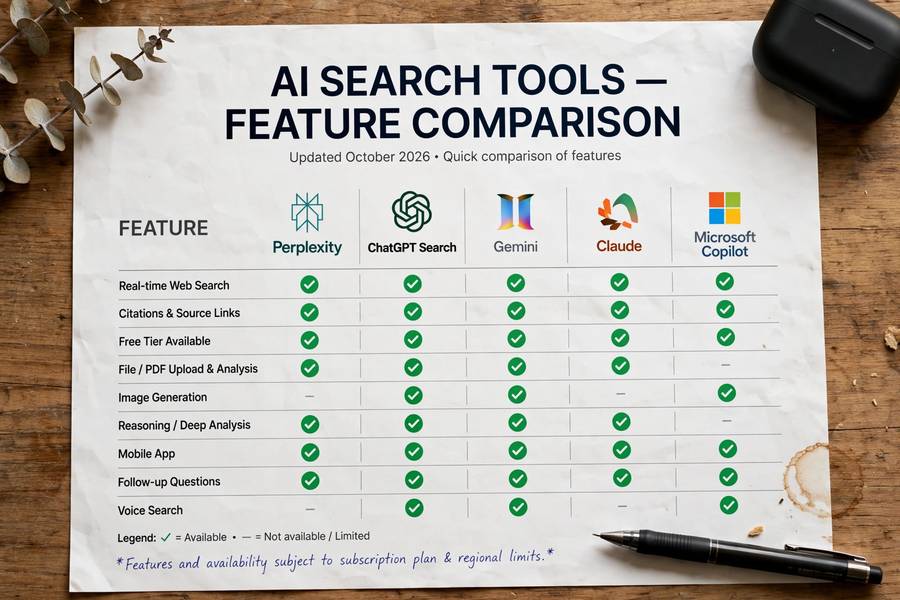
- What to Compare: The Evaluation Framework
- Accuracy: The Hardest Thing to Judge
- Free vs Paid Tiers
- Privacy Considerations
- Choosing for Your Needs
- When Engines Disagree: A Decision Protocol
- Frequently Asked Questions

The Categories of AI Search
Three archetypes, different trade-offs:
Dedicated answer engines. Built from the ground up for AI search — retrieval plus synthesis as the core product. Usually the most refined answer experience, with citations and follow-up as first-class features.
AI modes in traditional search. The classic search engine with an AI answer layer on top — generated summaries above the traditional results. Best of both worlds in theory: the AI brief plus the link list for verification.
Chatbot search hybrids. Conversational AI with browsing/retrieval added — ask in chat, get grounded answers. Strongest for follow-up conversation, sometimes weaker on systematic retrieval.
Most users will encounter all three. They’re not mutually exclusive — the sophisticated approach uses different ones for different needs.
Dedicated Answer Engines
The purists — products where AI search IS the product:
Strengths: the answer experience is the most polished — fast, well-cited, designed around synthesis. Often the best at complex questions requiring multi-source reasoning.
Typical features: cited answers, follow-up questions, source panels, sometimes “pro” modes with deeper research (multi-step retrieval and synthesis for hard questions).
Weaknesses: smaller indexes than the search giants (less breadth for obscure topics), business model uncertainty (how do they make money long-term?), and the verification burden — beautiful answers that still need checking.
Best for: research questions, explanations, comparisons — anywhere the synthesis is the value. The “ask a smart analyst” use case.
Evaluation notes: test with YOUR question types. The quality differences between answer engines are most visible on hard questions — easy questions everyone answers well. Also check citation quality specifically: do the cited sources actually support the claims?
AI Modes in Traditional Search
The incumbents’ response — AI layered over classic search:
Strengths: massive indexes (the broadest coverage), the traditional results still there for verification, integration with the search ecosystem you already use.
The experience: typically an AI-generated overview at the top, traditional links below. You get the synthesis AND the sources in one view — arguably the best verification setup.
Weaknesses: the AI layer is sometimes thinner than dedicated engines (less sophisticated synthesis), and the business model tension — AI answers reduce clicks, which is how search makes money. Watch how this evolves.
Best for: everyday searching with AI assistance — the default mode for most users, combining convenience with the safety net of traditional results.
The strategic question: can incumbents do AI search well while protecting their ad business? The product decisions here are fascinating — and worth watching as a user, because they shape what you get.
Chatbot Search Hybrids
Conversational AI with retrieval:
Strengths: the conversation — follow-ups, clarifications, building understanding over turns. For exploratory topics where you don’t know what to ask yet, this is unmatched.
Weaknesses: retrieval is often less systematic than dedicated engines (more “browse when needed” than “always grounded”), and the chat format can obscure sourcing.
Best for: learning journeys, brainstorming with grounding, topics where the question evolves as you learn.
The blurring: chatbots keep adding search features; search keeps adding conversation. The categories are converging — but the design centers differ, and those differences persist in the experience.
What to Compare: The Evaluation Framework
Forget feature lists. Evaluate on:
1. Answer quality on YOUR questions. Test with real questions from your work — not demos. Hard questions reveal differences; easy ones don’t.
2. Citation quality. Do citations support claims? Are they specific (this sentence → this source) or vague? Can you actually verify? This is the most important differentiator and the least marketed.
3. Source breadth and freshness. Obscure topics, recent events — where does each engine’s coverage break? Your edge cases matter more than common cases.
4. Follow-up handling. How well does it maintain context across refinements? For research workflows, this is crucial.
5. Transparency. Does it show its work — sources retrieved, confidence, limitations? Or present answers as oracles?
6. Speed. Latency affects daily usability enormously. The best engine you won’t wait for loses to the good-enough fast one.
7. Cost. Free tiers’ limits, paid tiers’ value. Match to your usage volume.
8. Privacy. What happens to your queries? Retention, training use, data sharing — the fine print matters.
Run the same 5–10 real questions through contenders and compare. An hour of testing beats a week of reading reviews.
Accuracy: The Hardest Thing to Judge
The central evaluation challenge: you can’t easily tell when AI search is wrong — that’s the whole problem.
Approaches: – Spot-check citations on answers where you know the domain. If citations check out on known territory, that’s signal (weak but real). – Test with known answers. Ask questions you know the answer to, including tricky ones with common misconceptions. See if it gets them right. – Compare across engines. Disagreement between engines signals uncertainty — investigate the disagreement, don’t just pick one. – Watch for hedging vs confidence. Engines that express uncertainty appropriately are more trustworthy than confidently-wrong ones — though this is hard to evaluate systematically.
The uncomfortable truth: no consumer can fully evaluate AI search accuracy — it requires domain expertise across arbitrary topics. The practical stance: trust but verify, with verification effort proportional to stakes. The engines are tools, not authorities.
Free vs Paid Tiers
The pricing landscape:
Free tiers are generous — most engines offer substantial free usage, enough for casual to moderate use. The free tier is the right starting point for everyone.
Paid tiers typically offer: more powerful models, higher limits, priority speed, advanced features (deeper research modes, file uploads, API access).
When paid makes sense: heavy daily use (limits bite), professional reliance (reliability matters), advanced features you actually use (not just nice-to-have).
When free suffices: casual use, evaluation, supplementary use alongside other tools. Most users never need paid — be honest about your volume before subscribing.
The value question: a paid AI search subscription competes with just using a good chatbot plus traditional search free. The marginal value must justify the cost — test whether the paid features change your outcomes, not just your experience.
Privacy Considerations
What happens to your questions:
Query logging. Most engines log queries — for product improvement, and potentially for training. Check retention policies.
Training use. Whether your queries train future models varies by provider and tier (paid tiers often exclude training use — one of the quiet benefits of paying).
Sensitive queries. Health, legal, financial, personal — think before typing. The convenience of AI search doesn’t override privacy judgment.
Enterprise options. Business tiers with data processing agreements, retention controls, and compliance certifications — necessary for organizational use.
The rule: don’t put in AI search what you wouldn’t put in an email to the provider. The interface feels private; the infrastructure isn’t.
Choosing for Your Needs
Casual everyday use: the AI mode in your existing search engine — zero friction, good enough, free.
Research and deep questions: a dedicated answer engine — the synthesis quality justifies the separate tool.
Learning journeys: a chatbot hybrid — the conversation supports exploration.
Professional reliance: evaluate paid tiers on your actual workload — the reliability and limits matter at volume.
Privacy-sensitive: check policies carefully; consider paid tiers with training exclusion or enterprise options.
The portfolio approach: most sophisticated users don’t pick one — they use traditional search for verification, an answer engine for synthesis, and chatbots for exploration. Different tools for different jobs, chosen per task. Understanding how a search engine works traditionally helps you keep the verification layer strong regardless of which AI tools you adopt.
When Engines Disagree: A Decision Protocol
Sooner or later you’ll run the same question through two engines and get different answers. Most people just pick the one they like. Don’t — disagreement is information. It means the sources conflict, the question is genuinely hard, or one engine’s synthesis went sideways. Here’s how I handle it:
Check the citations first. Which side’s claims are actually sourced? An unsourced confident answer loses to a hedged cited one, every time.
Compare source quality, not answer polish. A peer-reviewed paper beats a blog post, even when the blog-backed answer reads better. Fluency is not evidence.
Separate facts from interpretation. If they disagree on a checkable fact, verify it directly. If they disagree on interpretation, that’s a judgment call — and now it’s yours, not theirs.
Escalate with stakes. Low stakes: pick the better-cited answer and move on. High stakes: read the primary sources yourself. That’s what they’re for.
My rule of thumb: agreement across engines on cited facts is reasonably safe; disagreement is the signal worth investigating. The interesting part of any hard question lives exactly where the engines diverge.
Frequently Asked Questions
It depends on your needs: dedicated answer engines excel at synthesis quality, AI modes in traditional search offer the best verification setup, chatbot hybrids win for conversational exploration. Test contenders with YOUR real questions — an hour of testing beats a week of reviews. Specific rankings age fast; the evaluation framework endures.
Varies by engine and question — and it’s hard for consumers to judge fully. Spot-check citations in domains you know, test with questions where you know the answers (including tricky ones), and compare engines on disagreements. Treat outputs as smart briefs to verify, not authorities, with verification effort proportional to stakes.
Yes — most offer generous free tiers sufficient for casual to moderate use. Paid tiers add more powerful models, higher limits, speed, and advanced features. Start free; upgrade only when limits bite or professional reliance justifies it. Most users never need paid.
Varies significantly — check query retention, training use, and data sharing policies. Paid tiers often exclude training use. Don’t input sensitive information you’d hesitate to email the provider. Enterprise tiers offer proper data processing agreements for organizational use.
They’re converging — traditional search adds AI answers, AI search adds traditional verification features. The likely future is hybrid: AI synthesis with transparent sourcing. For now, sophisticated users combine both: AI for synthesis, traditional for verification, choosing per task.