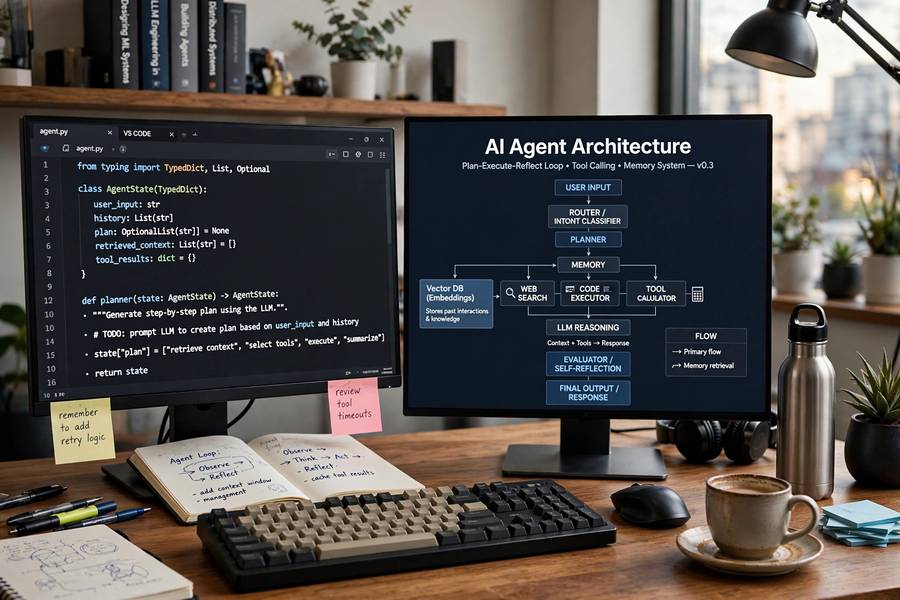
Every developer has had the 2 AM moment: the demo works beautifully, then you ask for something slightly different and the agent confidently does something insane. That gap between “impressive demo” and “reliable system” is where AI agent frameworks live. They’re the scaffolding that turns a clever language model into something that can actually do work: plan multi-step tasks, remember what it’s doing, use tools, and recover when things go sideways.
Table of Contents
- What an AI Agent Framework Actually Is
- The Core Loop: Perceive, Plan, Act
- Component 1: The Brain (LLM Reasoning)
- Component 2: Planning and Task Decomposition
- Component 3: Memory (Short-Term and Long-Term)
- Component 4: Tools (Giving the Agent Hands)
- Component 5: Perception and Action Interfaces
- The Framework Landscape: What’s Out There
- ReAct, Plan-and-Execute, and Other Patterns
- Multi-Agent Frameworks: Teams of Agents
- What Demos Hide: The Production Problems
- Choosing a Framework: Practical Advice
- Frequently Asked Questions
What an AI Agent Framework Actually Is
Strip away the marketing and an AI agent framework is a software library (or platform) that provides the infrastructure for building agents: the loop that lets a language model perceive its environment, decide what to do, take actions through tools, observe the results, and repeat. The model provides the intelligence; the framework provides everything else.
Without a framework, you’d hand-roll all of this: the prompt templates, the tool-calling logic, the memory management, the error handling, the loop control. People did this in the early days, and it was miserable — every agent was a bespoke snowflake of spaghetti prompts. Frameworks standardize the patterns that work, so you can focus on what your agent should do rather than how agents work at all.
The Core Loop: Perceive, Plan, Act
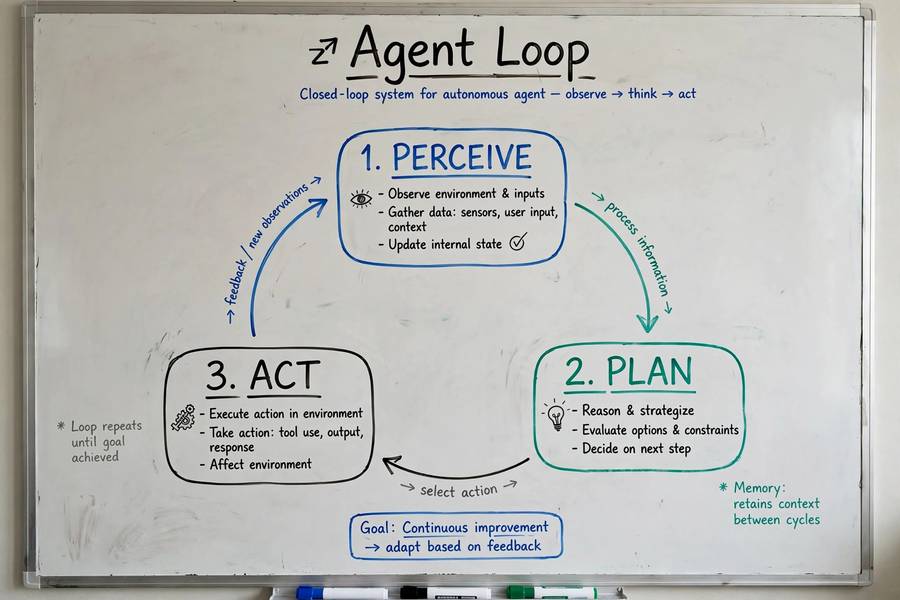
Every agent framework implements some version of this loop:
- Perceive. Gather information about the current state — the user’s request, tool outputs from previous steps, retrieved documents, whatever the environment provides.
- Plan. Decide what to do next — reason about the goal, break it into steps, choose the next action.
- Act. Execute the action — call a tool, query a database, send a message, write a file.
- Observe. Take in the result of the action.
- Repeat until the goal is achieved (or the agent gives up, hits a limit, or asks for help).
The loop needs guardrails: maximum iterations, timeouts, cost limits, and human-in-the-loop checkpoints for consequential actions. A framework without these is a footgun.
Component 1: The Brain (LLM Reasoning)
The language model is the agent’s reasoning engine. It interprets the goal, decides on plans, chooses tools, and generates responses. Frameworks typically let you plug in different models — GPT-class, Claude-class, open models — because the choice of brain affects everything: capability, cost, latency, and reliability.
A few things I’ve learned about the brain component:
Component 2: Planning and Task Decomposition
Planning is how agents handle tasks too complex for a single step. The framework provides patterns for breaking goals into sub-tasks, sequencing them, and adapting when steps fail.
The common planning approaches:
Reflection and self-correction. After acting, the agent evaluates its own progress — “did that work? am I closer to the goal?” — and adjusts. Frameworks implement this as explicit reflection steps, and it’s one of the highest-leverage patterns: agents that check their own work fail less.
My practical take: start with reactive planning (ReAct-style) — simplest pattern that works, easiest to debug, handles the unexpected gracefully.
Component 3: Memory (Short-Term and Long-Term)
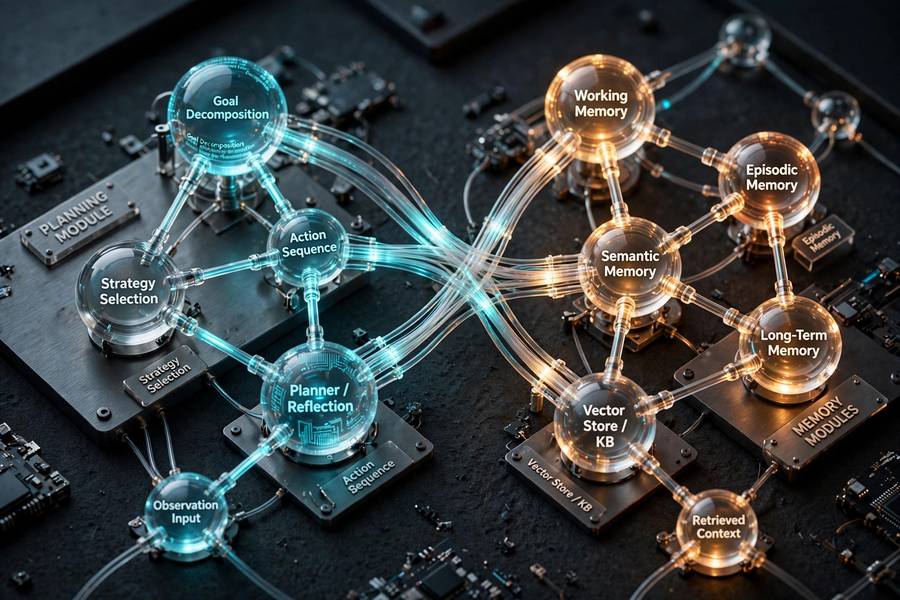
Memory is where agents get interesting — and where frameworks earn their keep. The model forgets everything between calls, so the framework manages several kinds of memory:
Working memory (context). The current conversation and recent steps, held in the model’s context window. Frameworks manage this carefully — summarizing when it gets long, prioritizing recent and relevant information, dropping what’s stale. Context management is an underappreciated art: too little context and the agent forgets its goal; too much and it gets confused (and expensive).
Episodic memory. Records of past interactions and task executions — “last time the user asked for X, I did Y and it worked.” Frameworks store these as retrievable records, letting the agent learn from experience within and across sessions.
Semantic memory. General knowledge the agent accumulates — facts about the user’s preferences, the domain, the tools. Often implemented with vector databases for retrieval: the agent stores what it learns and retrieves what’s relevant.
Component 4: Tools (Giving the Agent Hands)
Tools are how agents affect the world. A tool is a function the agent can call: search the web, query a database, send an email, run code, check the weather. The framework provides the tool interface — defining tools, describing them to the model, executing calls, and returning results.
What makes tool design critical:
The model can only use tools it understands. Each tool needs a clear name, description, and parameter schema. Vague tool descriptions produce vague tool use. I’ve seen agents fail simply because a tool was described ambiguously — the framework can’t fix bad tool design.
Tools need guardrails. Every tool is a capability, and capabilities need constraints: authentication, rate limits, confirmation for destructive actions, sandboxing for code execution. The framework should make it easy to wrap tools with safety checks — and hard to expose a dangerous tool by accident.

Component 5: Perception and Action Interfaces
Perception is how the agent takes in its environment; action interfaces are how it acts beyond discrete tool calls. In practice:
Perception includes the user input, tool outputs, retrieved documents, and — for multimodal agents — images, audio, sensor data. Frameworks handle the plumbing: formatting inputs for the model, managing multimodal content, keeping perception fresh as the environment changes.
Action interfaces include the obvious (tool calls, messages, file operations) and the less obvious: the agent’s ability to ask the user clarifying questions, to delegate to sub-agents, to schedule future actions. The richer the action space, the more capable the agent — and the harder it is to keep safe.
The design principle: perception complete enough that the agent isn’t flying blind, actions constrained enough that it can’t cause harm by accident.
The Framework Landscape: What’s Out There
The ecosystem moves fast, but the major options cluster into a few categories:
General-purpose agent frameworks. LangChain/LangGraph (the early leader, huge ecosystem), Microsoft’s AutoGen (multi-agent focused), CrewAI (opinionated, role-based agents, popular for business automation). These give you the full toolkit: loops, memory, tools, multi-agent orchestration.
Model-provider frameworks. OpenAI’s Agents SDK, Anthropic’s patterns and tooling, Google’s offerings. Tighter integration with the provider’s models, less portability, often simpler to start with.
Specialized frameworks. For coding agents, customer support, data analysis, robotics — domain-specific frameworks that trade generality for depth. Often the right choice when your use case fits.
ReAct, Plan-and-Execute, and Other Patterns
A few named patterns worth knowing, because framework documentation references them constantly:
ReAct (Reason + Act). The agent interleaves reasoning and action: think about what to do, do it, observe, think again. The default pattern for most practical agents. Simple, transparent, robust.
Plan-and-Execute. The agent plans the full task upfront, then executes step by step, replanning as needed. Better for structured tasks; the plan itself becomes an artifact you can inspect and approve.
Human-in-the-loop. Not a reasoning pattern but a control pattern: the agent pauses for human approval at defined checkpoints. Essential for consequential actions, and every production agent needs it somewhere.
These aren’t mutually exclusive — good frameworks let you combine them. The art is choosing the simplest pattern that handles your task reliably.
Multi-Agent Frameworks: Teams of Agents
The patterns:
Hierarchical. A manager agent delegates to worker agents, synthesizes results. Clear structure, single point of coordination.
Collaborative. Agents with different roles discuss and build on each other’s work — like a panel of experts. Richer, harder to control.
Sequential pipeline. Agents hand off in stages — research, then draft, then review, then finalize. Predictable, auditable.
For the different kinds of agents these frameworks can build, see my guide to the types of AI agents.
What Demos Hide: The Production Problems
Building a demo agent takes an afternoon. Building a production agent takes months, because of problems like:
Reliability. Demo agents succeed 80% of the time, which feels great until you need 99%. The last 19% is all edge cases, error handling, and graceful degradation — unglamorous work the framework helps with but doesn’t do for you.
Evaluation. How do you know your agent is good? Task success rates, human evaluation, regression suites for agent behavior — the evaluation infrastructure for agents is immature, and building it is half the job.
Safety. Agents take actions in the world. Prompt injection can hijack them. A confused agent with a powerful tool is a liability. Sandboxing, approval gates, audit logs, and least-privilege tool design aren’t optional.
Debugging. When an agent fails, the “stack trace” is a transcript of its reasoning across dozens of iterations. Frameworks with good observability are worth their weight in gold.
Choosing a Framework: Practical Advice
If you’re picking a framework today:
Start with your model. If you’re committed to a provider’s ecosystem, their framework is the path of least resistance. If you want model flexibility, choose a provider-agnostic framework.
Value debugging over features. You’ll spend more time debugging your agent than building it. Choose the framework with the best observability, tracing, and step-through debugging — not the one with the longest feature list.
Plan for evaluation from day one. Define what success looks like, build a test set of tasks, and measure. The teams that skip this end up with agents that “seem good” and nobody can prove it.
For the conceptual side — what agents are and how they reason — read my guide on how AI agents work.
Frequently Asked Questions
An AI agent framework is a software library or platform that provides the infrastructure for building AI agents: the perceive-plan-act loop, memory management, tool interfaces, planning patterns, and guardrails. The language model provides the intelligence; the framework provides everything else.
The core components are the reasoning engine (LLM), planning and task decomposition, memory (working, episodic, semantic, procedural), tools (functions the agent can call), and perception/action interfaces — all connected by the control loop with guardrails like iteration limits and human checkpoints.
ReAct (Reason + Act) is an agent pattern where the model interleaves reasoning and action: it thinks about what to do next, takes an action via a tool, observes the result, and reasons again. It’s the default pattern for most practical agents — simple, transparent, and robust.
Popular options include LangChain/LangGraph, Microsoft AutoGen, and CrewAI for general-purpose agents, plus model-provider frameworks like OpenAI’s Agents SDK. The best choice depends on your models, team skills, and deployment needs.
Single-agent frameworks run one agent through the perceive-plan-act loop. Multi-agent frameworks orchestrate teams of specialized agents — planners, researchers, critics, executors — working together hierarchically or collaboratively. Multi-agent systems are more powerful but much harder to debug; start with a single agent.
Since language models are stateless, frameworks manage memory externally: working memory (current context), episodic memory (records of past tasks), semantic memory (accumulated facts, often in vector databases), and procedural memory (reusable skills). The framework feeds relevant memories back into the model each iteration.