
People use “AI agent” and “LLM” almost interchangeably now, and the confusion is understandable — every agent you’ve met has an LLM inside it. But they are not the same thing, and the difference matters practically: it determines what the system can do, how it fails, what it costs to run, and whether you actually need an agent or just a chatbot.
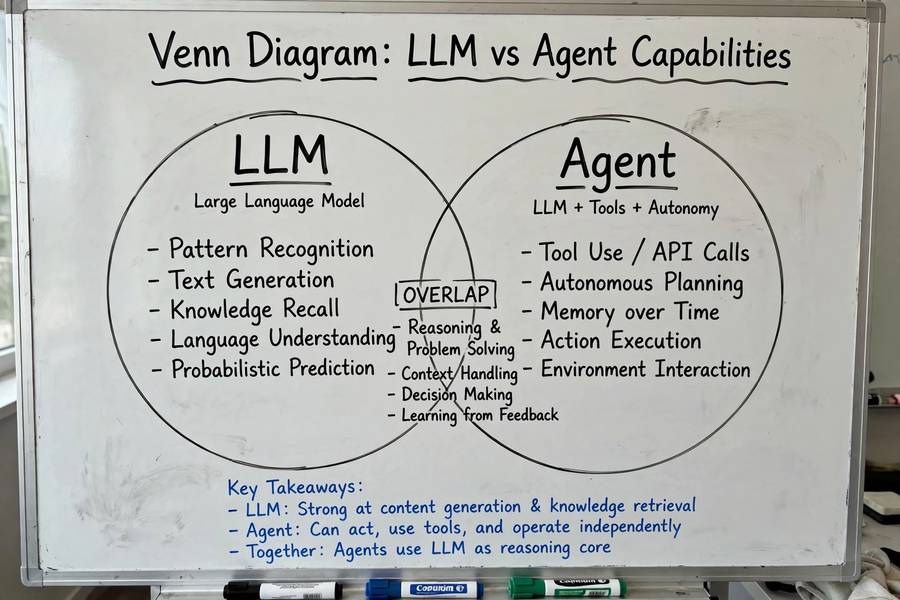
I like to put it this way: an LLM is a brain in a jar; an agent is that brain with hands, eyes, and a to-do list. The LLM generates text. The agent pursues goals. Everything interesting — and everything dangerous — about the current AI moment lives in the gap between those two descriptions. If you want the full picture, start with what is an AI agent.
Table of Contents
- What an LLM Actually Is
- What Turns an LLM Into an Agent
- The Five Differences That Matter
- When an LLM Is Enough
- When You Need an Agent
- The Cost and Reliability Tradeoff
- Common Misconceptions
- Frequently Asked Questions

What an LLM Actually Is
A large language model is, at its core, a next-token predictor — a system trained on vast text that, given some input text, produces the most plausible continuation. Ask it a question, it generates an answer. Give it a half-written email, it completes it. It is stateless between conversations (each session starts fresh), it cannot act on the world, and it has no goals of its own — it just responds.
This is not a diminishment. Next-token prediction at scale turned out to produce reasoning, knowledge, and language fluency that surprised even its creators. An LLM alone can write, explain, translate, summarize, and brainstorm at a level that would have seemed like science fiction a decade ago. Most of what people call “AI” in daily life is just an LLM with a chat interface.
But notice the limits: it cannot check whether its answer is true, cannot look anything up (without tools), cannot remember you next week, cannot send the email it just drafted, and cannot decide to do anything you did not ask for. It is brilliant and inert — a brain in a jar.
What Turns an LLM Into an Agent
An agent is an LLM plus four things:
1. Tools. The hands. Web search, code execution, file access, APIs, email, calendars — tools let the model affect the world beyond text. This is the single biggest difference. An LLM can describe booking a flight; an agent with a booking tool can book it.
2. Memory. The continuity. Conversation history, vector databases of past work, user preferences stored across sessions. Memory lets the agent build on previous interactions instead of starting over every time.
3. A planning loop. The initiative. Instead of responding once and stopping, the agent runs a cycle: assess the goal, plan steps, act, observe results, replan. This loop — sometimes called the agentic loop — is what makes behavior autonomous rather than reactive.
4. An objective. The direction. Agents are given goals (“research this topic and write a report”) rather than just prompts (“tell me about this topic”). The objective persists across the loop’s iterations, guiding decisions the LLM alone would never make.
Same brain, completely different creature. The LLM is the engine; the agent is the vehicle built around it. And like vehicles, agents come in different types with very different capabilities and risks.
The Five Differences That Matter
Initiative. An LLM waits for your prompt. An agent, given an objective, acts without being asked at each step — searching, reading, trying, adjusting. This is the difference between a consultant who answers questions and an employee who owns outcomes.
Action. LLMs produce text. Agents produce effects: files created, emails sent, bookings made, code deployed. Every capability an agent gains multiplies both its usefulness and its blast radius.
Persistence. An LLM’s work ends when its response ends. An agent’s work continues across dozens or hundreds of steps, maintaining context and adjusting plans. Multi-hour autonomous tasks are routine for agents; impossible for bare LLMs.
Tool use. This deserves emphasis because it is the practical dividing line. The moment a system can call a function — search the web, query a database, run code — it has crossed from LLM into agent territory, whatever the marketing calls it.
Failure modes. LLMs fail by generating wrong text (hallucination). Agents fail by doing wrong things — booking the wrong flight, deleting the wrong file, emailing the wrong person. Agent failures have consequences in the world, which is why how AI agents make decisions matters so much more than how LLMs generate text.

When an LLM Is Enough
Most tasks do not need an agent, and reaching for one is overengineering:
- Writing and editing — drafts, summaries, rewrites, translations. The LLM’s native territory.
- Q&A and explanation — “explain this concept,” “what does this error mean.” Single-turn brilliance.
- Brainstorming — ideas, names, angles, outlines. Generation without execution.
- Analysis of provided text — “summarize this document,” “extract the key points.” The input is given; no tools needed.
- Learning and tutoring — conversational explanation adapts to the student without needing to act.
The rule of thumb: if the task starts and ends with text you provide, an LLM suffices. Adding agentic machinery — tools, loops, memory — to a text task adds cost, latency, and failure modes for zero benefit.
When You Need an Agent
Agents earn their complexity when the task requires action, persistence, or adaptation:
- Research tasks — “find the best options and compare them” requires searching, reading, synthesizing across sources. An LLM can only answer from training data; an agent goes and looks.
- Multi-step workflows — booking travel, processing invoices, onboarding employees. Tasks with dependencies across steps and systems.
- Monitoring and reaction — watching for conditions and acting when they occur. LLMs cannot watch anything; agents can poll, check, and respond.
- Software development — writing code, running tests, fixing failures, iterating. The loop of write-test-fix is inherently agentic.
- Personal assistance — managing calendars, triaging email, coordinating schedules. Real assistance means acting on your behalf, not just advising.
The test: does the task require the system to do things in the world, adapt based on what it finds, or sustain effort across many steps? If yes, you need an agent. If the answer is “well, it would be nice if…” — you probably need a better prompt, not an agent.
The Cost and Reliability Tradeoff
This is the part vendors underplay. Agents cost 10–100x more per task than LLM calls — every loop iteration is another model call, plus tool costs, plus the infrastructure to manage state. A task that costs $0.02 as an LLM query can cost $2.00 as an agent run. At scale, that difference is the business model.
Reliability runs the other way too. An LLM answering a question is wrong maybe 5–15% of the time (domain-dependent). An agent running a 20-step task, where each step has a 95% success rate, succeeds end-to-end only about 36% of the time (0.95^20). Compounding error is the fundamental cost of agency — longer chains, lower reliability, unless each step is verified.
This is why the industry is converging on a pattern: LLMs for the many, agents for the few. Use cheap, reliable LLM calls for everything text-shaped. Reserve agents for the tasks where autonomous action justifies the cost and where you have built the verification to manage the reliability penalty.
Common Misconceptions
“Agents are smarter than LLMs.” No — they use the same models. The intelligence is identical; the capabilities differ because of tools and loops. A brilliant brain in a jar versus the same brain with hands: the hands do not make it smarter, they make it effective.
“Everything will be an agent soon.” Unlikely. The cost and reliability math favors LLMs for most tasks permanently. The future is probably LLM-first with agents for specific high-value workflows — not agents everywhere.
“Agent” means autonomous. Marketing has stretched “agent” to cover everything from chatbots with a search tool to genuinely autonomous systems. Ask what a so-called agent can actually do unsupervised — the answer reveals whether it is an agent or a chatbot with plugins.
“Bigger models make better agents.” Partially true, but agent performance depends as much on the scaffolding — tool design, prompt engineering, error handling, memory architecture — as on the underlying model. A well-built agent on a mid-tier model often outperforms a sloppy agent on the frontier model.
Frequently Asked Questions
An LLM is a text-generation model — it predicts the next token, producing answers without acting. An AI agent is an LLM plus tools, memory, a planning loop, and an objective, enabling it to pursue goals autonomously: searching, acting, observing results, and adjusting. Same brain; one has hands and initiative.
Standard ChatGPT is primarily an LLM with a chat interface, though newer versions with tool use (browsing, code execution, plugins) have agentic features. The distinction is about capabilities: text-only responses are LLM behavior; autonomous multi-step task completion with tools is agent behavior.
Use an agent when the task requires acting in the world, adapting based on findings, or sustaining effort across many steps — research, multi-step workflows, monitoring, software development. Use a plain LLM for text tasks: writing, Q&A, brainstorming, summarization. Agents cost 10–100x more per task, so reserve them for work that justifies it.
Yes, dramatically — 10–100x more per task. Every loop iteration is another model call plus tool and infrastructure costs. A $0.02 LLM query can become a $2.00 agent run. Agents also compound errors across steps, so they need real verification effort too. Use LLMs by default; agents where autonomous action justifies the cost.
Yes — that’s exactly how agents are built. Take an LLM, give it tools (APIs, code execution, web access), add memory across sessions, wrap it in a planning loop (assess, act, observe, replan), and assign it an objective. The LLM provides the intelligence; the scaffolding provides the agency.