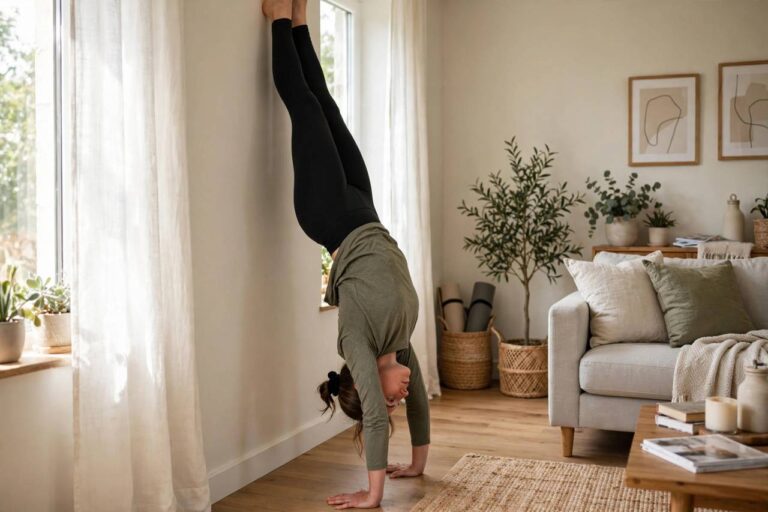
Back Workout at Home, No Equipment: 10 Moves for a Strong Back


The back is the hardest muscle to train at home without equipment, and I will not pretend otherwise. Every other muscle has an obvious bodyweight answer; the back needs creativity because its main movements are pulls, and your living room does not have much to pull. But hard does not mean impossible. These 10 movements, built around tables, doorways, towels, and floor work, train the lats, upper back, and spinal erectors thoroughly. Twice a week, 25 minutes, zero equipment. The gym-based programs are in my best back workouts guide.
The Challenge (and the Workarounds)
Back training is pulling, and pulling needs something to pull against. The workarounds: your bodyweight as resistance (rows under a table, using gravity), isometric and high-rep floor work for the spinal erectors (which respond well to endurance-style training), and doorways and towels for angles that mimic cable work. What you cannot fully replicate without equipment is heavy vertical pulling; that is the honest gap, and the fix is a doorway pull-up bar, covered at the end. Everything else in back training translates fine. The key mindset shift: back workouts at home are won with volume, tempo, and creativity rather than load. Ten perfect slow table rows beat five sloppy weighted rows for the muscles involved.
Upper Back and Lats: 5 Moves
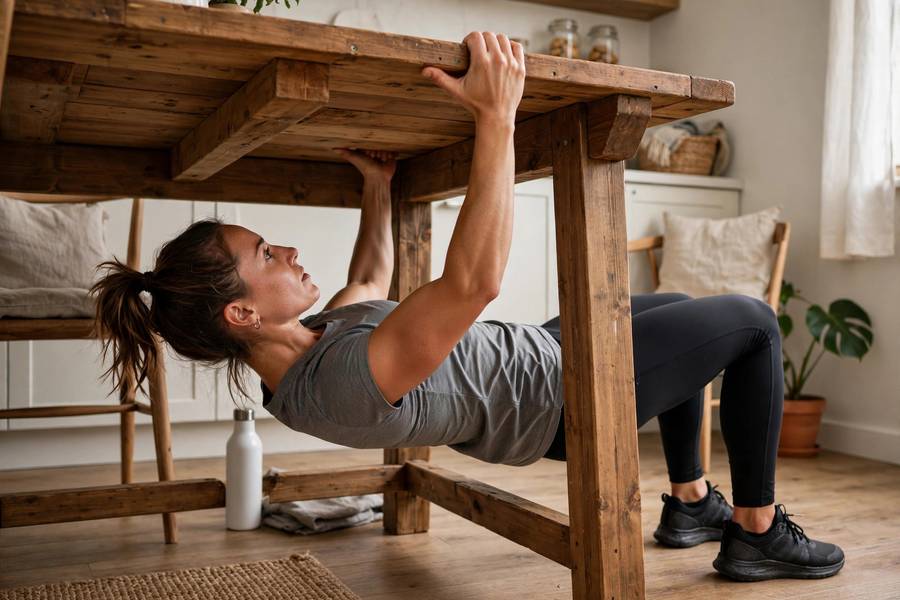
1. Table rows: 4×12. Under a sturdy table, body straight, pull your chest to the edge. The home equivalent of barbell rows; elevate feet when 15 reps get easy. Test the table’s stability first; it must hold your full weight without sliding.
2. Doorway rows: 3×12 per arm. Grip the doorframe, lean back, pull yourself in one arm at a time. Unilateral work that exposes imbalances; the weaker side always surprises.
3. Towel rows: 3×15. Loop a towel around a sturdy post or closed door (door anchor side), lean back, row. The unstable grip adds forearm work as a bonus.
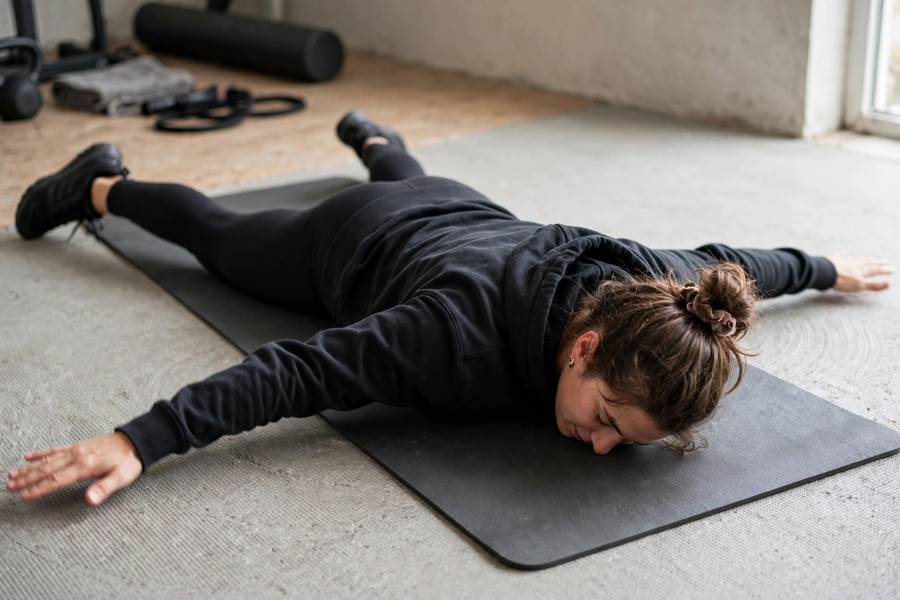
4. Prone Y-T-W raises: 3×10 each. Lying face down, arms in Y, T, and W positions, lift and squeeze. Light, precise, devastating for the upper back and rear delts; use 2-second holds at the top.
5. Reverse snow angels: 3×12. Face down, arms extended, sweep them from overhead to your sides while keeping them off the floor. Continuous tension across the entire upper back; harder than it looks by rep 8.

Lower Back and Spinal Erectors: 3 Moves
6. Supermans: 3×15. Face down, lift arms and legs simultaneously, hold 2 seconds. The foundational lower-back builder; squeeze the glutes hard at the top.
7. Reverse hyperextensions (table version): 3×12. Hips on the edge of a sturdy table or bed, legs hanging, lift them to body line. Pure glute and lower-back work; control the lowering.
8. Bird dogs: 3×10 per side. On all fours, extend opposite arm and leg, hold 3 seconds. Core stability plus lower-back endurance; the McGill-approved staple for spinal health.
Posture and Rear Delts: 2 Moves
9. Wall slides: 3×12. Back against a wall, arms in goalpost position, slide up and down keeping contact. Fixes the rounded-shoulder desk posture while training the mid-back; do these daily if you sit all day.
10. Prone press-ups: 3×10. Face down, press your chest up with straight arms like the top of a cobra stretch, hold 2 seconds. Lumbar extension endurance that counteracts sitting; physical therapists prescribe this one for a reason.
The 25-Minute No-Equipment Back Workout
Warm up 2 minutes: arm circles, cat-cow stretches. Then: table rows 4×12, doorway rows 3×10 per arm, supermans 3×15, prone Y-T-W 2×10 each, reverse snow angels 3×12, bird dogs 2×10 per side, wall slides 2×12. Rest 45 seconds between sets. That is about 24 minutes. Twice a week, at least two days apart. Pair with how to do pull-ups work once you get a bar, and finish with 2 sets of curls from my best arm exercises guide for the complete pull session. The workout looks easy on paper; the Y-T-W raises and snow angels will change your mind by round two.
The 8-Week Home Back Plan
Weeks 1-2: Run the 25-minute workout twice weekly, learning every movement with controlled tempo. Weeks 3-4: Add 3-second eccentrics to all rows and 2-second holds to all floor work. Add one set per movement. Weeks 5-6: Progress leverage: feet-elevated table rows, flatter doorway rows, 5-second superman holds. Weeks 7-8: Peak volume week, then a deload at half volume. Test: max strict table rows, max superman hold time. Typical result: row reps up 40-60 percent, visibly better posture, stronger everything. If you add a doorway pull-up bar at any point, slot pull-ups in as exercise one and watch progress accelerate; the vertical pulling was the missing piece and the back responds fast once it arrives.
Progressing Without Weights
Tempo first: slow every rep to 3 seconds down and add 2-second holds at peak contraction; this alone doubles the difficulty. Then leverage: elevate feet on table rows, lean further on doorway rows, extend hold times on supermans to 5 seconds. Then volume: add a set per movement every 2-3 weeks up to 5 sets. Then unilateral: single-arm table rows, single-leg reverse hypers. Track reps like any program; “felt harder” is not progression. Most people progress home back work for 6-12 months before the ceiling appears, and the ceiling is almost always vertical pulling strength, which is the doorway-bar conversation below. Until then, tempo and volume are legitimate progressive overload, and the back responds to them like any other muscle.
Honest Limits and the One Purchase
The honest limit: nothing here loads the lats like a pull-up. Table rows are horizontal pulling; the vertical pulling pattern needs a bar. If you buy one thing for home back training, make it a doorway pull-up bar; it unlocks pull-ups, chin-ups, and dead hangs, and it transforms the program from good to complete. Until then, maximize what you have: the 10 movements above build a genuinely strong, healthy back, just with a gap at heavy vertical pulling. I have trained clients for months on this exact program with excellent posture, strength, and muscle development; the pull-up bar simply accelerates what is already working. Do not let the missing bar stop you from starting; start now, add the bar when you can.
Back-Friendly Daily Habits
Training is two hours a week; posture is the other 166. Hourly: stand, roll the shoulders back, 5 wall slides. Takes 60 seconds, reverses desk slump. Daily: 2 minutes of dead hangs from a doorframe bar or 10 cat-cow stretches; spinal decompression and mobility. Walking: carry groceries in both hands evenly, suitcase-style; it is a farmer carry in disguise. Sleeping: side or back sleeping beats stomach sleeping for spinal health. Screens: raise the monitor to eye level; the forward-head posture from looking down undoes rowing progress faster than anything. These habits compound with the training: the workout builds the muscles, the habits stop daily life from tearing them down. Clients who fix the desk setup progress twice as fast as those who train hard and sit badly.
Frequently Asked Questions
Yes, up to a solid intermediate level. Table rows, doorway rows, and the floor work build real strength and muscle; the main gap is heavy vertical pulling. Add a doorway pull-up bar when possible and the program becomes complete. Most people underestimate what bodyweight back work can do.
A solid wooden dining table usually is; test it by hanging your full weight briefly before training. Avoid glass tables, folding tables, or anything that slides; wedge it against a wall for safety. When in doubt, use a closed door with a towel anchor instead.
Twice a week with at least two rest days between. The back recovers well from bodyweight volume, but the smaller stabilizers need the rest. Three times weekly works once you are conditioned, but twice is the sustainable standard.
Significantly, especially the wall slides, Y-T-W raises, and rows. Desk posture comes from weak mid-back muscles and tight front muscles; this program directly strengthens the weak half. Most people notice standing taller within 3-4 weeks, with continued improvement over months.
Start with standing doorway rows at a steep angle, nearly upright, and flatten the angle over weeks as you strengthen. Alternatively, do table rows with knees bent and feet on the floor to reduce the load. Everyone has an entry point; find yours and progress from there.
Track your table-row reps and superman hold times monthly; both should climb steadily. Posture photos every month show the visual change. And the real-world test: carrying groceries, lifting luggage, and sitting tall all get noticeably easier within two months.