

If I had to pick one maintenance job that best proves “understand your car instead of fearing it,” it’s the engine air filter. Ten minutes, usually zero tools, $15–25 in parts — and shops charge $40–70 to do it, often pushing it when it doesn’t need doing.
I’ve watched quick-lube techs hold up a slightly dusty filter like it’s a biohazard, pressuring customers into a replacement. Sometimes it’s legitimately filthy. Often it’s got another 10,000 miles in it. After this guide, you’ll know the difference — and you’ll do it yourself in the time it takes to drink a coffee.
Contents
- What the Engine Air Filter Does
- How Often to Replace It
- Signs Yours Is Dirty
- What You’ll Need
- Step-by-Step Replacement
- Engine Air Filter vs Cabin Air Filter (Don’t Confuse Them)
- Oiled vs Dry Filters: My Take
What the Engine Air Filter Does
Your engine is an air pump that happens to burn fuel. For every gallon of gas, it inhales roughly 10,000 gallons of air. All that air carries dust, pollen, insects, and road grit — and without a filter, that debris goes straight into the cylinders, sandblasting precision-machined surfaces.
The engine air filter sits in the intake path (in a plastic box — the “airbox” — connected to the engine by a large tube) and traps particles before they reach the engine. Clean filter = free-breathing engine. Clogged filter = the engine gasping through a straw.
On modern fuel-injected cars, a dirty filter mostly hurts performance and efficiency rather than causing damage (the computer compensates for restricted airflow up to a point). On old carbureted cars it was worse. Either way, it’s cheap maintenance with real benefits.
How Often to Replace It
The standard guidance: every 15,000–30,000 miles, or once a year. But the real answer depends on your environment:
- Dusty/rural areas, construction zones: check every 10,000 miles. These filters load up fast.
- Clean suburban/highway driving: 30,000 miles is often fine.
- Your manual has the official interval — start there.
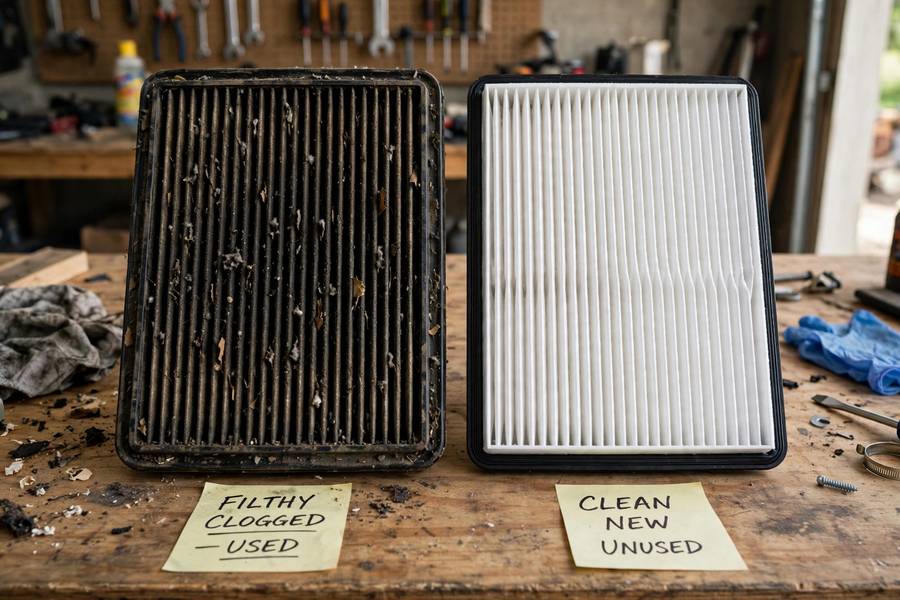
My shop-floor rule: inspect annually, replace when dirty — not on a rigid schedule. Hold it up to a bright light; if you can’t see light through the pleats, it’s done. This takes thirty seconds and beats any schedule.
Signs Yours Is Dirty
- Reduced fuel economy. The engine works harder to pull air through a clogged filter. A sudden 5–10% drop in MPG with no other explanation? Check the filter.
- Sluggish acceleration. Restricted airflow = less power, especially noticeable when merging or climbing.
- Dark exhaust smoke (on older cars) or a check engine light for lean/rich codes.
- Visible dirt. Pop the airbox and look — if the filter’s gray/black and packed with debris, it’s done.
- Engine misfires or rough idle in severe cases.
None of these are exclusive to the air filter, but the filter is the cheapest thing to check first. Always start with the cheap and easy.
What You’ll Need
- The correct replacement filter for your car (check the manual or parts store lookup — they vary by exact model)
- Usually no tools — most airboxes use clips or wing nuts
- Occasionally a screwdriver or socket for the few designs with screws
- 10 minutes
That’s it. This is genuinely the easiest maintenance job on most cars.

Step-by-Step Replacement
1. Find the airbox. Open the hood and look for a large black plastic box (roughly the size of a shoebox) with a big tube running to the engine. It’s usually on one side of the engine bay, obvious once you know what you’re looking for.
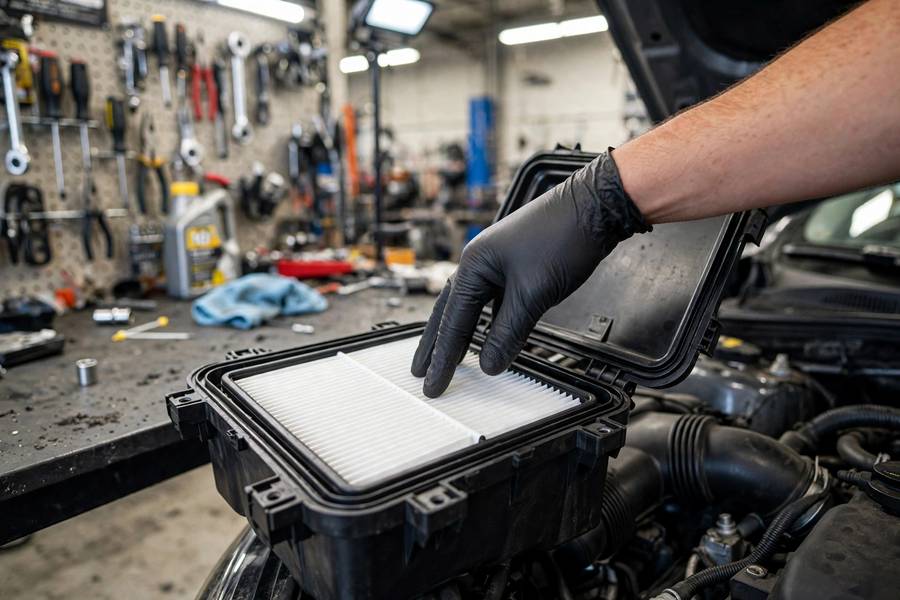
2. Open it. Most airboxes are held shut by 4–6 metal clips around the edges — flip them open with your fingers. Some use screws or wing nuts. Note how it opens; you’ll reverse this.
3. Lift out the old filter. Note its orientation — there’s usually only one way it fits, but note which side faced up. Take a look at it (see the light test above).
4. Clean the airbox. Wipe out any leaves, twigs, or mouse nests (yes, really — mice love airboxes) with a rag. Don’t let debris fall into the intake tube.
5. Drop in the new filter. It should seat flat with no forcing. If you’re muscling it, it’s the wrong filter or backwards.
6. Close the airbox and re-secure all clips/screws. Make sure it seals fully — an unsealed airbox lets unfiltered air bypass the filter, defeating the purpose.
7. Done. Seriously, that’s it. Go for a drive and enjoy the world’s most satisfying $20 maintenance.
Engine Air Filter vs Cabin Air Filter (Don’t Confuse Them)
Two different filters, two different jobs:
- Engine air filter: cleans air going into the engine. Affects performance and economy. Under the hood.
- Cabin air filter: cleans air going into the cabin (your lungs). Affects AC airflow and air quality. Usually behind the glove box.
Shops love to upsell both together. They’re independent — one can need replacement while the other’s fine. Now you know the difference, which puts you ahead of most customers I see.
Oiled vs Dry Filters: My Take
You’ll see “high-performance” oiled filters (K&N and similar) marketed with horsepower claims. My honest assessment from the shop:
The performance gains on a stock daily driver are negligible — single-digit horsepower at best, often zero measurable difference. The oiled design can flow slightly better, but over-oiling after cleaning coats the mass airflow sensor and causes running problems I’ve diagnosed more than once.
For a stock commuter: use a quality dry paper filter (OEM or equivalent) and change it on schedule. It’s cheaper, foolproof, and filters better. Save the oiled performance filters for actual performance builds where every fraction counts — and even then, maintain them exactly as instructed.
Would I spend my own money on a “performance” air filter for a daily driver? No. I’d spend it on the correct paper filter and a coffee with the change. The best maintenance is the boring kind, done on time.
Can You Clean and Reuse an Engine Air Filter?
Short answer: with paper filters, don’t bother. The temptation is real — pull it out, blast it with compressed air, put it back, save $20. Here’s why shops (including mine, back in the day) don’t recommend it.
Compressed air blows the big stuff out but drives fine particles deeper into the paper fibers. You end up with a filter that looks cleaner and filters worse — the worst combination. Tapping it on the ground is even less effective. Paper filter media degrades with each cleaning; the pores stretch and tear microscopically.
The math doesn’t work either. A quality paper filter costs $15–25 and lasts 15,000–30,000 miles. That’s roughly a tenth of a cent per mile. No cleaning method restores a paper filter to new condition, so you’re risking engine wear to save pennies.
The exception: oiled cotton/gauze performance filters (K&N style) are designed to be washed, dried, and re-oiled — that’s their whole selling point, and the recharge kit costs less than a couple of paper filters over time. But that’s a different product with different tradeoffs, as covered above. For standard paper filters: replace, don’t clean.
An air filter swap is one of the easiest wins in DIY car care. Two more that pay off just as well: learning how to jump start a car before you need it at 6 AM, and how to clean car headlights — cloudy lenses kill nighttime visibility the same way a clogged filter kills performance. And if your car has driver assists you’ve never touched, read up on what cruise control is while you’re at it.
Frequently Asked Questions
Open the hood, locate the black plastic airbox, flip open the clips, lift out the old filter, wipe the box clean, drop in the new filter (correct orientation), and re-secure the clips. It takes about 10 minutes and usually requires no tools.
Every 15,000–30,000 miles or once a year, depending on driving conditions. Dusty environments need more frequent changes. The best approach: inspect annually by holding the filter to a light — if light doesn’t pass through the pleats, replace it.
A clogged filter restricts airflow, reducing fuel economy, acceleration, and performance. In severe cases it can trigger a check engine light or cause misfires. It’s cheap preventive maintenance — neglecting it costs more in fuel than the filter costs.
The engine air filter cleans air entering the engine (under the hood; affects performance). The cabin air filter cleans air entering the passenger compartment (usually behind the glove box; affects AC airflow and air quality). They’re independent parts with independent replacement schedules.
For stock daily drivers, no — gains are negligible and oiled filters can foul the mass airflow sensor if over-oiled. A quality dry paper filter changed on schedule filters better and costs less. Performance filters only make sense on actual performance builds.