Basic Squash Rules for Beginners: The Complete First-Timer’s Guide


My first squash game lasted about eleven minutes, and I spent most of it standing in the wrong place while a much better player apologized for nearly hitting me. Nobody had explained the basic squash rules to me — I just walked onto a court with a racket and hoped for the best. Don’t be me.
Squash looks chaotic from the glass back wall, but the rules are genuinely simple once someone lays them out plainly. This guide covers everything a beginner needs: how rallies work, serving, the tin, lets, and scoring — so your first game feels like a game instead of a guessing contest. For the full official-style rundown, our complete squash rules guide goes deeper once you’re comfortable with the basics here.
In this guide:
- The Point of Squash in 60 Seconds
- How a Rally Actually Works
- Serving: The Basics
- The Tin and the Lines That Matter
- Interference, Lets and Strokes
- How You Win a Match
- Your First Game: A Minute-by-Minute Walkthrough
- Beginner Mistakes to Avoid
The Point of Squash in 60 Seconds
Two players share one court and take turns hitting a small rubber ball against the front wall. The ball must hit the front wall above a low metal strip called the tin and below the top line, and it can bounce only once on the floor before you hit it. You win the rally when your opponent can’t return the ball legally. Rallies are scored point-a-rally: every rally produces a point for someone, and games go to 11.
How a Rally Actually Works
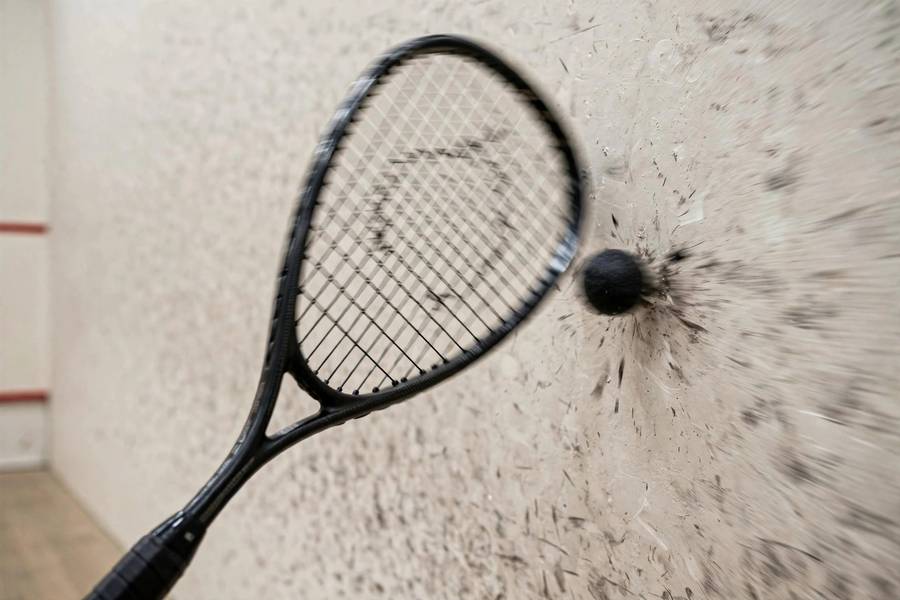
After the serve, players alternate hitting the ball. Each shot must strike the front wall directly or via the side/back walls, landing above the tin. The ball may bounce once on the floor — after the second bounce, the rally’s over. You can also volley (hit it before it bounces), which is how aggressive players take time away from their opponent.
The rally ends when: the ball bounces twice, a shot hits below the tin (called “down”) or above the out line, a player hits the ball into the floor before the front wall, or someone obstructs their opponent badly enough to be penalized. That’s genuinely it — the rest is detail.
Serving: The Basics
The server stands with at least one foot inside the service box and hits the ball directly onto the front wall so it lands in the opposite quarter court, above the service line. Unlike tennis, there’s only one serve attempt — if you fault, you lose the rally (and the point). Serve from the box on the side matching the score: right box when your score is even, left box when it’s odd.
The Tin and the Lines That Matter
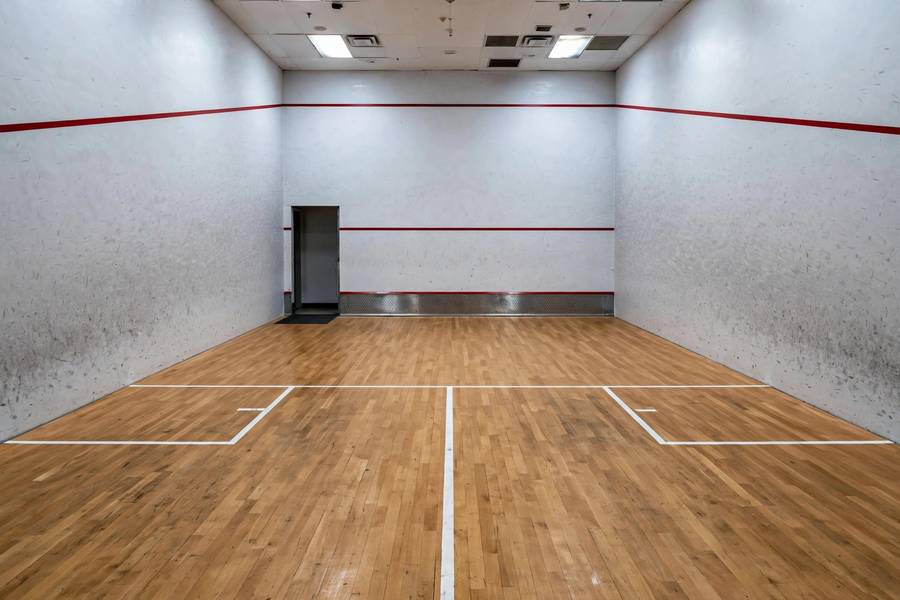
The front wall has three important markings. The tin is the metal strip along the bottom (19 inches high in the pro game) — anything hitting it or below it is “down” and loses the rally. The service line sits above it; serves must land above this line. The out line (board line) runs around the top of the walls — anything above it is out. If you’re fuzzy on dimensions, our guide to squash court dimensions maps the whole court out.
Interference, Lets and Strokes
Because both players share the same space, squash has detailed rules about getting in each other’s way. If your opponent blocks your swing or your path to the ball, you can ask for a “let” (the rally is replayed). If the interference was serious and you were in position to win the rally, you may be awarded a “stroke” — you win the point outright. Deliberate or dangerous obstruction can be a conduct penalty.
The golden rule for beginners: after you hit the ball, clear out of the way. Give your opponent a fair path to the ball and room to swing. Most beginner disputes come from someone camping in the middle of the court.
How You Win a Match
Games are played to 11 points, and you must win by 2 (so a game can go to 12–10, 13–11, and beyond — there’s no cap in most play). A match is the best of five games: first to three games wins. At the club level, some leagues play best-of-three or use different formats to fit court booking times.
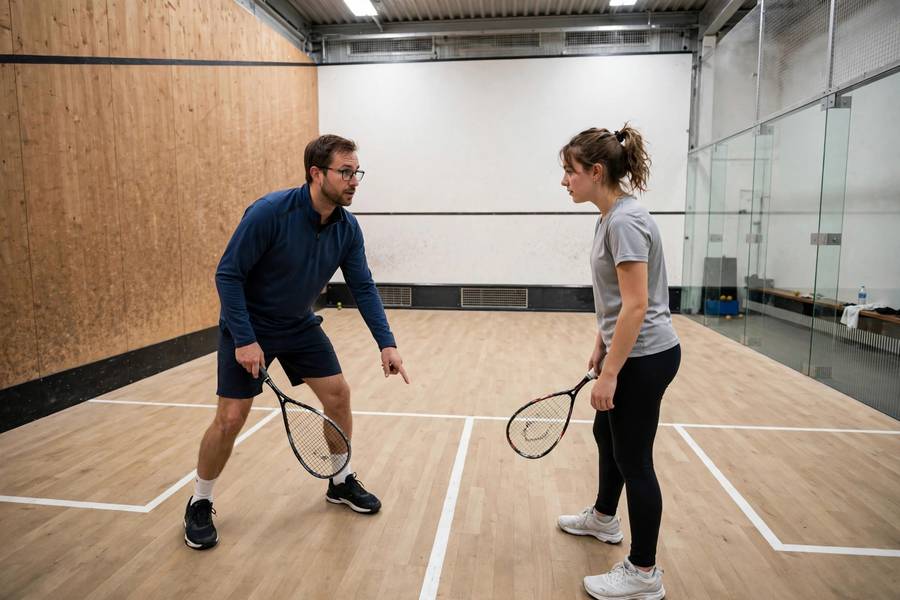
Your First Game: A Minute-by-Minute Walkthrough
Theory is nice; here’s what actually happens when you walk on court for the first time.
- Minutes 0–5: the knock-up. You and your opponent take turns hitting the ball to warm it up (a cold squash ball barely bounces) and find your range. Hit straight drives down the walls, then some cross-courts. Nobody’s keeping score yet — this is practice.
- Minute 5: spin for serve. One player spins the racket; the other calls which side the logo lands on. Winner serves first.
- The first rally. Serve from the correct box (right box if your score is even — it’s 0–0, so right box), aim for a high, deep serve to the back corner, then sprint back to the T. Your opponent returns, and you’re in your first rally. It’ll probably last four shots. That’s fine.
- Calling the score. The server announces the score before each serve, server’s score first: “3–1.” It feels formal at first and becomes second nature by game two.
- Between games: 90 seconds rest, towel off, switch sides of the court. The loser of the last game doesn’t get any head start — it’s 0–0 again.
- After the match: shake hands, and here’s the tradition I love — the loser buys the drinks. Or at club level, you at least pretend to argue about who was worse.
A few etiquette notes that the rulebook assumes you know: wear non-marking shoes (most clubs enforce this strictly), bring your own ball or agree on one — beginners should use a blue-dot or red-dot ball, which bounces more and makes rallies actually possible — and never walk onto someone else’s court mid-rally. Wait for a break between points.
And one safety rule that matters more than all the others: if your opponent is between you and the front wall and you can’t swing safely, STOP. Don’t play the shot. Ask for the let. Eye injuries in squash are rare but real, and every club player has a story about someone who swung through. Protective eyewear is cheap and, for beginners, genuinely smart.
Beginner Mistakes to Avoid
- Standing in the middle after your shot. Hit, then move back toward the T (the center of the court). Always.
- Trying to kill every ball. Beginners smash and miss. Focus on hitting the front wall consistently; power comes later.
- Ignoring the let rule. Don’t play through someone blocking you — stop and ask for the let. And don’t block others.
- Serving too aggressively. A reliable, deep serve beats a fancy one that faults half the time.
- Forgetting you only get one bounce. If in doubt, hit it early rather than letting it die on the second bounce.
Squash is brutally physical — the constant lunging and sprinting demand real leg power, so some off-court conditioning like our guide to strength training for runners pays for itself within weeks.
That’s the whole foundation. Get on court, keep the ball above the tin, clear after your shots, and you’ll have genuinely fun games within a week or two.One last tip from someone who learned it the slow way: play your first dozen games with someone patient, not someone good. A patient partner gives you rallies; a much better player gives you 11–0 beatdowns and a sore ego. Find the right partner and squash becomes the most addictive hour of your week — I say that as someone who now plans holidays around court availability.
Hit the ball against the front wall above the tin and below the out line, alternating shots with your opponent. The ball can bounce once before you hit it. You score a point every rally your opponent fails to return legally; games go to 11 (win by 2), and matches are best of five.
Squash uses point-a-rally scoring (PAR): every rally awards a point to someone, regardless of who served. Games are played to 11 points and must be won by 2. The first player to win 3 games takes the match.
The tin is the metal strip along the bottom of the front wall, 19 inches (48 cm) high. Any shot that hits the tin or below it is ‘down’ — the rally is lost. It exists to keep rallies alive by forcing shots upward.
A let is a replayed rally. If a player is blocked by their opponent from reaching the ball or swinging freely, they can appeal and the referee (or players, in casual games) may call a let, meaning the point is replayed with no one penalized.
No. After the serve, the ball may bounce once on the floor before being hit. If it bounces a second time, the rally is over and the point goes to the player who hit the shot.