Cable Arm Exercises: 9 Constant-Tension Moves

Cables are the most underrated arm-training tool in the gym. Everyone walks past the cable station to the dumbbell rack, and I understand why: dumbbells feel like real training. But cables do something dumbbells cannot: they keep tension on the muscle through the entire rep, including the top where free weights go slack. That constant tension is why cable work produces some of the best pumps and some of the most joint-friendly volume in arm training. These 9 exercises are the complete cable arm menu, with the setup details that make each one work. The full arm library is in my best arm exercises guide.
Why Cables Work So Well for Arms
Free weights load muscles according to gravity; at the top of a curl or pushdown, when your forearm is vertical, the torque drops near zero and the muscle gets a rest every rep. Cables pull from the pulley direction regardless of gravity, so the muscle works through the full range. The practical result: more time under tension per set, better pumps, and less joint stress at the turnaround points, because there is no momentum to catch. This makes cables ideal for three roles: finishers after heavy free-weight work, high-volume phases when joints need a break, and anyone with cranky elbows who still wants to train arms hard. They are a complement to free weights, not a replacement; the heavy compounds still build the base, and cables refine it.
5 Cable Tricep Exercises
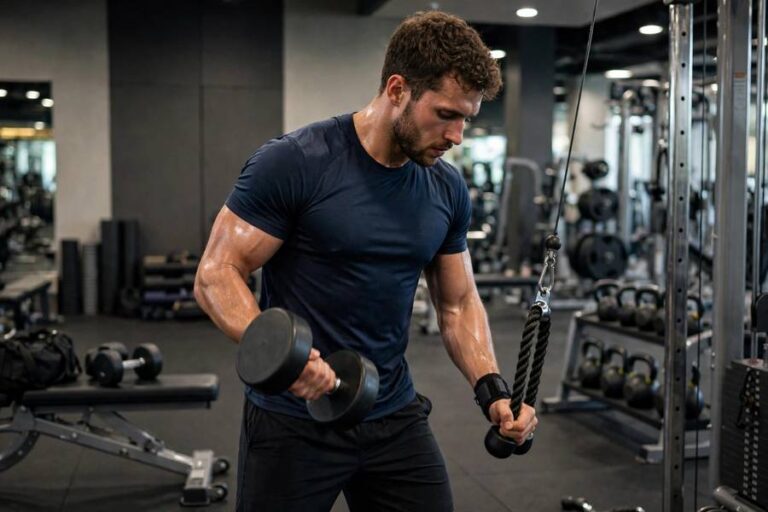
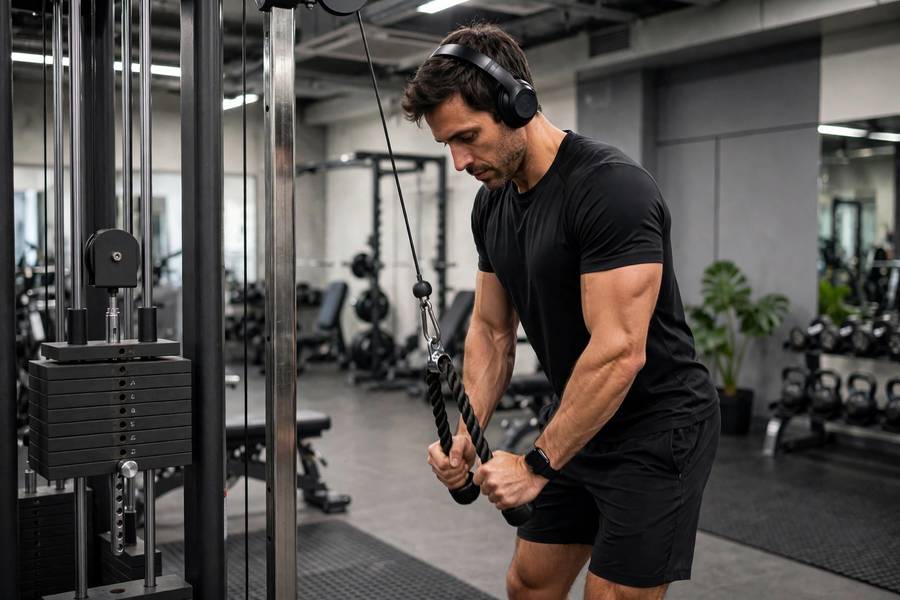
1. Rope pushdown: 3×12-15. The classic. Elbows pinned, press down and split the rope at the bottom for a hard contraction. The rope allows a natural wrist path that is kinder to elbows than the straight bar.
2. Straight-bar pushdown: 3×12. Heavier than the rope version, slightly less comfortable. Use an underhand grip for variety; it shifts emphasis and gives the wrists a break.
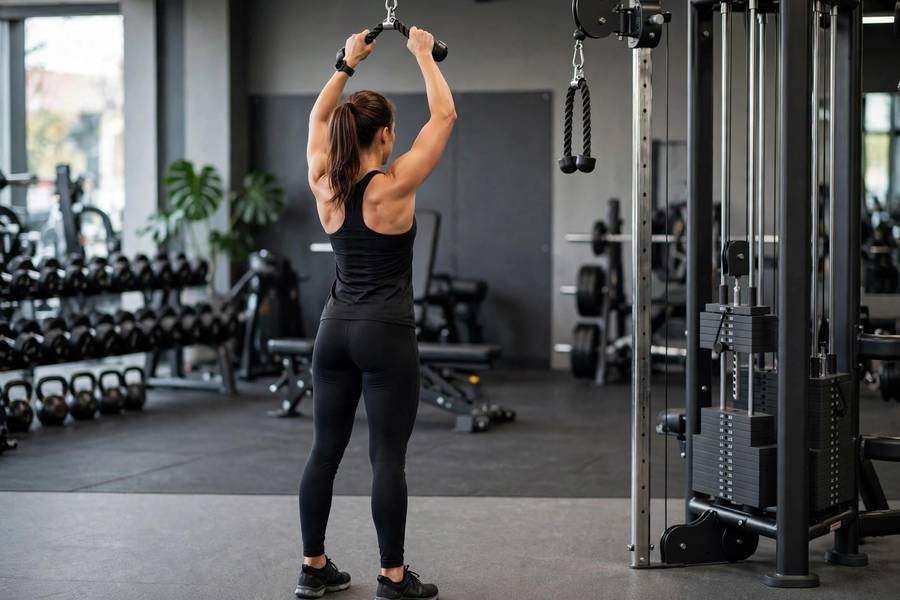
3. Overhead cable extension: 3×12. Facing away from the machine, cable behind your head, extend overhead. The long-head stretch under constant tension is unmatched; this is the best cable tricep builder.
4. Single-arm reverse pushdown: 3×12 per arm. Underhand grip, one arm at a time. Fixes imbalances and lets you focus completely on the contraction. The weaker arm always surprises people.
5. Cable kickback: 3×12 per arm. Bent over, cable behind you, extend the elbow fully. The cable keeps tension at the contracted position where dumbbell kickbacks go slack; strictly better than the dumbbell version.
4 Cable Bicep Exercises
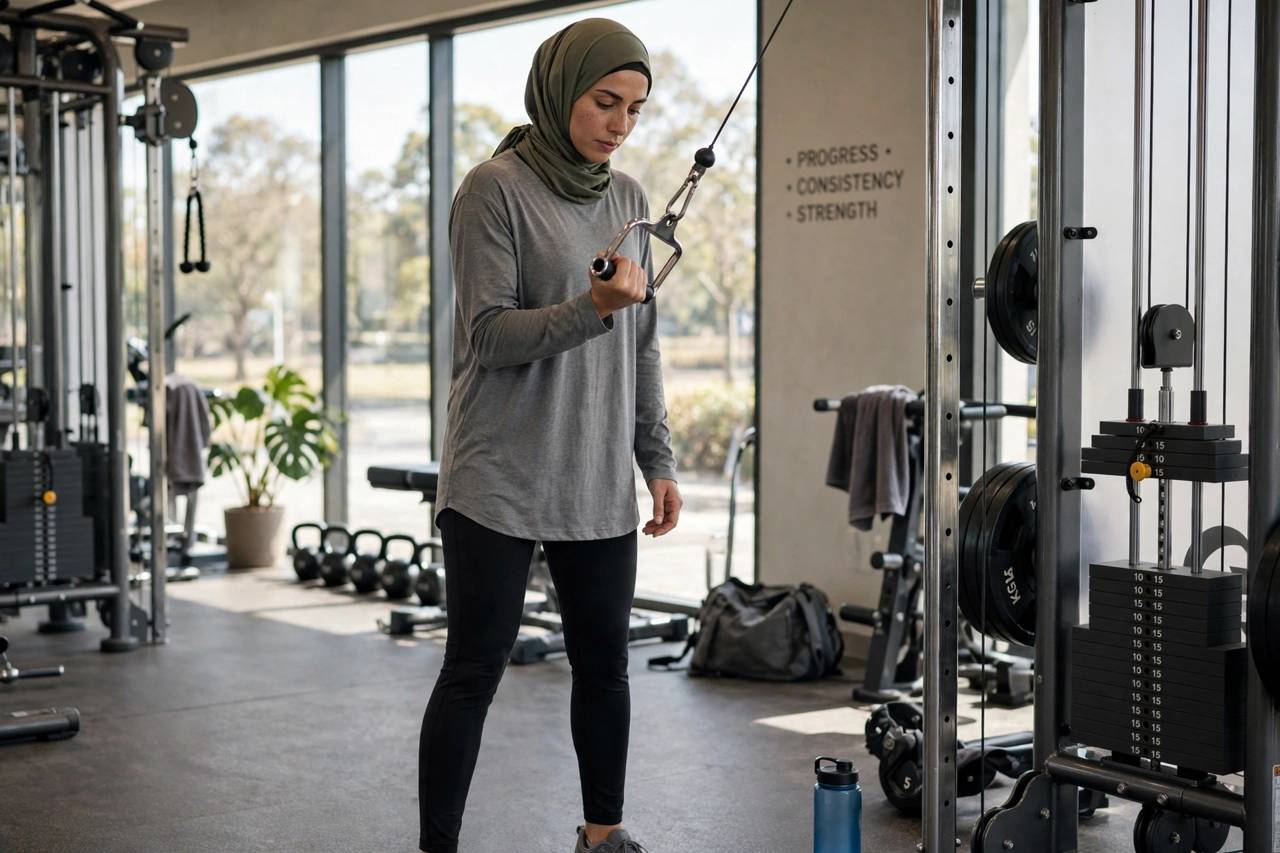
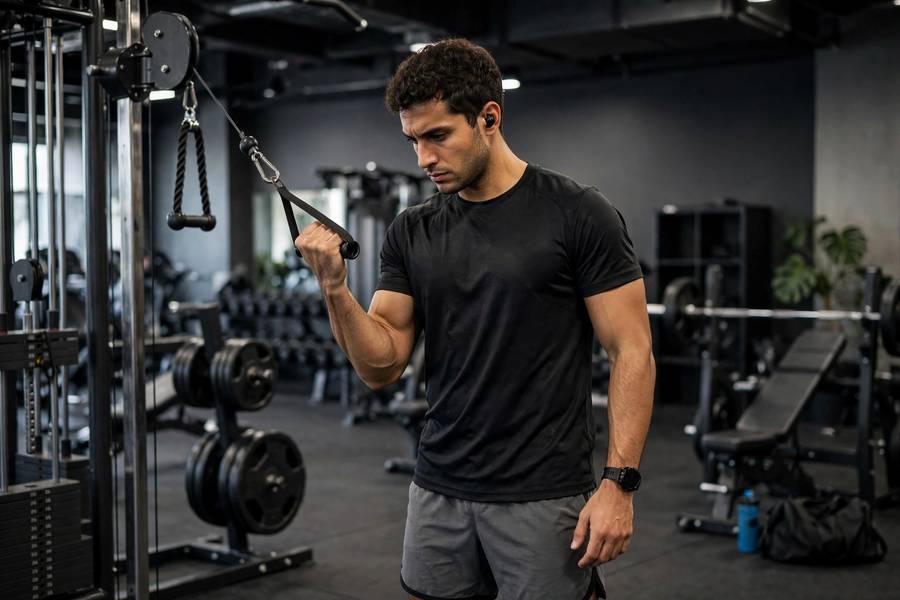
6. Standing cable curl: 3×12. Straight bar, low pulley, curl with elbows pinned. The tension at the top, where dumbbell curls rest, is the entire point; squeeze hard for one second.
7. Rope hammer curl: 3×12. Rope attachment, neutral grip. Brachialis and forearms with constant tension. My favorite cable bicep movement for complete arm development.
8. Single-arm cable curl: 3×12 per arm. Stand sideways to the pulley, curl across your body. The angle lets you finish with a peak contraction that straight-bar curls cannot match.
9. Overhead cable curl: 3×12. Facing the machine, arms overhead, curl the handles toward your head. Stretches the long head under load through the full range; the bicep equivalent of the overhead tricep extension, and criminally underused.
Attachments: What to Use When
Rope: the default for pushdowns and hammer curls; natural wrist path, split-apart finish. Straight bar: heaviest pushdowns and curls; maximum load, watch the wrists. EZ/cambered bar: the compromise; angled grips reduce wrist strain while allowing heavy loads. Single D-handle: all unilateral work; essential for fixing imbalances. Ankle strap on the wrist: for cable kickbacks and overhead extensions when you want zero grip involvement. You need exactly two attachments to do everything here: a rope and a straight bar. Everything else is optimization. Do not let attachment choice become procrastination; the muscle does not know what is in your hands.
The Cable-Only 8-Week Plan
Weeks 1-2: Run the 30-minute workout twice weekly, learning cable positioning for each movement. Keep weights moderate; the constant tension is more fatiguing than it feels. Weeks 3-4: Add a fourth set to pushdowns and curls. Introduce the overhead variations if you skipped them. Weeks 5-6: Increase stack weight when you complete all reps with a 1-second pause at contraction. Add single-arm work for the weaker side. Weeks 7-8: Peak week, then deload: test max reps on rope pushdowns and cable curls with your working weight, then halve volume for week 8. Typical result: working weights up 20-30 percent, visibly fuller arms, happier elbows. Repeat or rotate back to free weights for a strength block. Cable blocks pair perfectly with heavy free-weight blocks in alternating 8-week cycles; the joints get variety and the muscles get complete stimulus.
The 30-Minute Cable Arm Workout
Warm up: 2 minutes of arm circles and 15 light pushdowns. Then: rope pushdowns 3×15, standing cable curls 3×12, overhead cable extensions 3×12, rope hammer curls 3×12, single-arm reverse pushdowns 2×12 per arm, single-arm cable curls 2×12 per arm. Rest 45-60 seconds between sets; cables let you move faster because setup is instant. Total: 16 sets, about 28 minutes. Twice a week, or use it as the second weekly arm session alongside a free-weight day. The cable day works beautifully as the “joint-friendly” session in a two-day split: heavy dumbbells Monday, cables Thursday, and the elbows stay happy indefinitely. Pair with best back workouts pulling for balanced programming, and keep best shoulder exercises in the rotation for joint health.
Cable Mistakes That Waste the Advantage
Standing too close or too far. Position yourself so the cable pulls along the intended line through the full range; wrong distance turns constant tension into no tension at parts of the rep. Adjust until you feel work from stretch to contraction.
Using momentum. Cables punish cheating less visibly than free weights, which makes it more tempting. Lean-back pushdowns and swinging curls waste the constant-tension advantage entirely; the whole point is strict tension.
Too much weight. Cable stacks go heavy, and ego goes heavier. If you cannot pause one second at the contraction, reduce the weight; the pause is where cables earn their keep.
Skipping the stretch. Letting the stack touch down between reps removes tension at the stretched position. Keep the plates floating; continuous tension means continuous.
Only doing pushdowns and curls. The overhead variations (exercises 3 and 9) are the highest-value cable movements because they load the long heads through full range. Most cable users never try them; be the exception.
Progressing on Cables
Cable stacks jump in fixed increments that are often too big for arm isolation; bridge the gap with reps first (12 to 15 to 18), then take the weight jump and drop back to 10 reps. Micro-loading with magnetic plate mates works if your gym has them. Tempo is the other progression lever: 3-second eccentrics make any stack weight harder without changing plates. And do not neglect the single-arm versions for progression; when the bilateral stack gets too heavy to progress smoothly, unilateral work with half the weight progresses in smaller effective steps. Track the stack setting plus reps; “pin 7 for 12” is your progressive overload, same as any barbell number. Cables progress a little slower than free weights on paper but produce equal growth in practice, because every rep is quality tension.
Frequently Asked Questions
Neither is better; they are complementary. Dumbbells allow heavier loading and natural stabilizer work; cables provide constant tension and joint-friendly volume. The best arm programs use both: heavy free weights for the base, cables for finishers and high-rep work.
Yes, especially for intermediates. Nine exercises with progressive overload on the stack build complete arms. Advanced lifters benefit from adding heavy free-weight compounds, but cable-only training works far better than most people assume.
The rope, for most people: it allows a natural wrist path and the split-apart finish maximizes the contraction. The straight bar allows heavier loads. Own both movements; use the rope for higher reps and the bar for heavier sets.
Do not let the weight stack touch down between reps, control the eccentric over 2 seconds, and pause briefly at both the stretch and contraction. Position your body so you feel resistance through the entire range; if part of the rep feels empty, adjust your distance from the machine.
Generally yes. The smooth resistance curve and lack of momentum make cables kinder to elbows than free weights, especially for extensions. Many lifters with cranky elbows can do high-volume cable work pain-free while free-weight extensions irritate them. Start light and progress gradually.
No. Resistance bands with a door anchor replicate most cable arm exercises well enough for home training. The tension curve is similar, the cost is minimal, and the setup takes seconds. A cable machine is a gym luxury, not a requirement.