World Cup Tiebreaker Rules: What Decides Level Teams

Nothing ends a watch party debate faster than someone confidently stating the wrong tiebreaker. I have heard fans argue head-to-head, then alphabetical order, then a coin toss, all in the same breath. So let me settle it, coach-style: here are the actual tiebreaker rules, in order, with real examples of how they play out.
This guide covers group-stage tiebreakers step by step, the fair play rule everyone forgets, what happens in the knockouts, and how third-placed teams are ranked. For the broader format, our complete guide to how the World Cup works sets the stage.

Why Tiebreakers Matter More Than You Think
In a three-game group stage, ties on points are not rare; they are normal. With only three matches to separate four teams, identical point totals happen in almost every tournament. The tiebreakers are not obscure fine print. They are the rules that decide who goes home roughly once per group stage.
I make my players learn these before the tournament starts, because tiebreakers change behavior. When you know goal difference might decide your fate, you do not ease off at 3-0. When you know fair play points count, you think twice about a reckless tackle. The rules shape the football.
Tiebreaker 1: Goal Difference
The first tiebreaker is goal difference: goals scored minus goals conceded across all three group matches. Score four and concede one, and your difference is plus three. It is simple, and it is why attacking football gets rewarded beyond the three points for a win.
Goal difference creates the famous final-matchday scenarios: a team needing to win by two clear goals, or knowing a 1-0 loss still sees them through. I love this tiebreaker because it keeps games honest. There is no parking the bus when your goal difference is under threat; you have to keep playing.
Tiebreaker 2: Goals Scored
If goal difference is also level, the next tiebreaker is total goals scored in the group. A team that won 3-2 and lost 1-0 beats a team that won 1-0 and lost 1-0, even though both have three points and a zero goal difference.
This is the tiebreaker that rewards brave football. Two teams can have identical records, but the one that attacked more goes through. I point this out to defensive-minded players: the rules literally favor the team that tries to score. Caution is not just boring; under these rules it can be fatal.
Tiebreaker 3: Fair Play Points
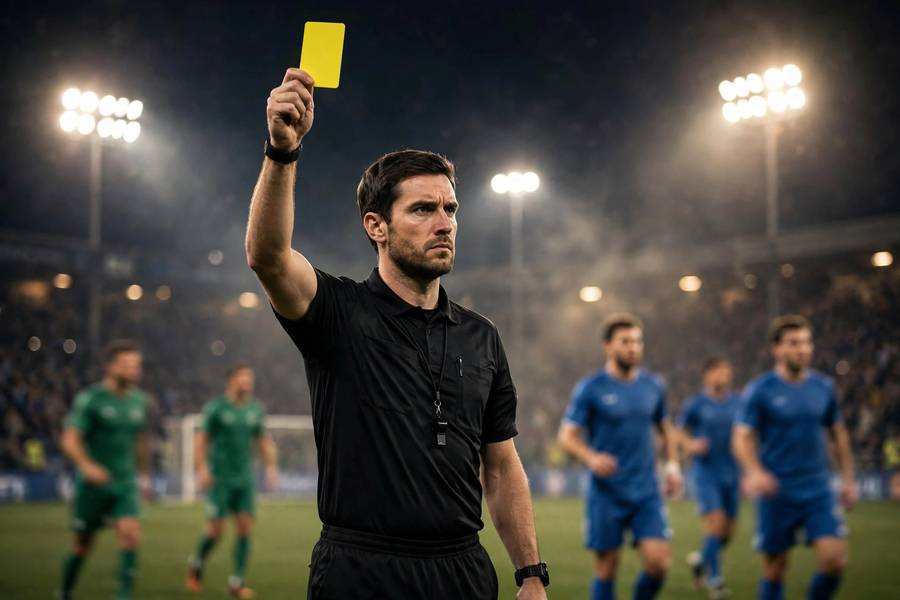
Here is the one that surprises everyone. If teams are still level, FIFA uses fair play points from cards: a yellow card costs minus one, an indirect red (two yellows) costs minus three, a direct red costs minus four, and a yellow plus a direct red costs minus five. The team with the better (less negative) disciplinary record advances.
Yes, a team has genuinely advanced on fair play at a World Cup, and I use it as my ultimate discipline lesson. Every cynical foul, every dissent yellow, every reckless challenge goes on a ledger that might decide your tournament. I tell my players: discipline is not just character, it is arithmetic.
Tiebreaker 4: Drawing of Lots
If everything is still level after fair play, FIFA draws lots. A literal random draw decides which team advances. It has never actually decided a World Cup group in the modern era, but the rule exists as the final backstop.
Coaches joke about it, but nobody wants to be there. Imagine two years of qualification decided by balls in a bowl. The existence of this rule is exactly why teams fight for every goal and avoid every card: nobody wants their tournament decided by luck when effort could have settled it.
What About Head-to-Head?
This is the most common misconception I hear. In many leagues and in the Euros, head-to-head is an early tiebreaker. At the World Cup group stage, it is not used. FIFA goes straight to overall goal difference and goals scored across all group matches.
Why does this matter? Because it changes final-day tactics. Under head-to-head rules, beating your direct rival settles things. Under FIFA’s rules, hammering the weakest team in the group can matter more than edging your rival 1-0. Different tiebreakers, different football. Know which tournament you are in.
Knockout Tiebreakers: Extra Time and Penalties
The knockout stage has no use for tables: tied matches go to 30 minutes of extra time, played as two full 15-minute periods, and then to penalties if still level. Five kicks each, then sudden death. There is no golden goal; both periods are always completed.
Teams also get a sixth substitution in extra time, which is a real tactical factor. Fresh legs at 105 minutes against exhausted defenders decide matches. Tournament fitness is built over months, and this is where strength and conditioning programs and core stability training pay off visibly.
Third-Placed Teams: A Tiebreaker of Their Own
The eight best third-placed teams are ranked by their own mini-table: points first, then goal difference, then goals scored, then fair play points. It is the same logic applied across groups instead of within one.
This creates delicious complexity on the final matchday. A third-placed team is not just watching its own game; it is scoreboard-watching eleven other groups. I have seen dressing rooms erupt at a goal in a match 3,000 kilometers away. The tiebreakers turn the whole tournament into one connected drama. Understand the system that creates it in our guide to how the World Cup works.
The Fair Play Tiebreaker in Action
The fair play tiebreaker stopped being theoretical in 2018, when Japan and Senegal finished level on points, goal difference, and goals scored in their group. Japan advanced because they had fewer yellow cards. It was the first time the rule decided a World Cup group, and it changed how seriously teams take discipline.
Think about what that means in practice. A single unnecessary yellow card in the opening game, a moment of dissent, a tactical foul that was not needed: any of these can be the card that sends you home three games later. I show my players the Japan-Senegal table before every tournament. It makes the abstract concrete in a way no lecture can.
Coaches now manage cards like a resource. A player on a yellow might be substituted to protect him, not just from suspension but from the fair play count. It adds a layer of chess to squad management that fans rarely see. Discipline has always mattered; now it is literally tabulated.
Tiebreaker Scenarios: A Worked Example
Let me walk you through a realistic scenario, because this is how you learn it. Group X after two games: Team A has 4 points with +2 goal difference, Team B has 4 points with +1, Team C has 3 points with 0, Team D has 0. Final day: A plays D, B plays C. Suppose A draws and B draws: A finishes on 5, B on 5, and goal difference decides between them.
Now suppose B wins 3-0 and A draws 1-1. B goes to 7 points and wins the group. A stays on 5. Meanwhile C, losing to B, stays on 3 and is out. But if C had beaten B 1-0 instead, C would reach 6 points and take first place, with B second on 4 ahead of A on goal difference. Three results, three different tables.
This is why the final matchday is glorious chaos and why I keep a calculator in my pocket. Every goal in every simultaneous game ripples through the tables. When you watch with the tiebreakers in mind, even a meaningless-looking goal in the 89th minute can flip a group. The math is the drama.
Goal difference across all group matches: goals scored minus goals conceded. If that is level, total goals scored is next.
No. Unlike some other tournaments, the World Cup group stage does not use head-to-head. FIFA applies goal difference, then goals scored, then fair play points, then drawing of lots.
Yellow cards cost -1 point, two-yellow reds -3, direct reds -4, and yellow plus direct red -5. The team with the better disciplinary record advances if all football tiebreakers are level.
Not in the modern era. It exists as the final backstop after goal difference, goals scored, and fair play points, but it has never actually been needed.
By points, then goal difference, then goals scored, then fair play points, across all twelve groups. The top eight advance to the round of 32.
30 minutes of extra time (two 15-minute periods, always played in full), then a penalty shootout: five kicks each, then sudden death.