Assisted Pull-Up Alternatives: 9 Moves That Build Real Pulling Strength

Here’s a truth nobody in the fitness industry wants to admit: most “assisted pull-up” advice is garbage. Jump pull-ups that turn into a cardio bounce. Band-assisted reps where the band does half the work at the bottom and nothing at the top. Machine-assisted stations that groove a movement pattern you’ll never use on a real bar. I’ve coached dozens of people to their first real pull-up, and almost none of them got there by doing sloppy assisted reps. They got there with alternatives that built the actual strength a pull-up demands.
So this isn’t a list of random back exercises. These are nine movements I actually program, in the order I program them, each one targeting a specific weak link in the pull-up chain: grip, scapular control, the bottom hang, the top lockout, or the pulling muscles themselves. Pick the ones that match your weak point, run them for six to eight weeks, and retest. That’s the whole system.
Why Most Assisted Pull-Ups Don’t Work
A pull-up has three distinct phases, and most assisted methods only train one of them badly. The bottom — the dead hang — demands grip and scapular depression. The middle demands lat and bicep strength through the sticking point. The top demands you pull your chin over the bar and hold it. A thick band tied to the bar gives you maximum help at the bottom (where the band is stretched) and minimum help at the top (where the band is slack) — the exact opposite of what most beginners need, since the top is where they fail.
The assisted pull-up machine is worse. It stabilizes your body for you, so your core learns nothing, and the fixed movement path teaches a groove that doesn’t transfer to a free bar. I’m not saying these tools are useless — a band has its place, used correctly — but if assisted reps are your only strategy, you’ll stall. The alternatives below each attack a specific phase with honest loading. That’s why they work.
One more thing before the list: you should still be doing your pull-up practice on the bar itself — dead hangs and scapular pulls cost nothing and build the bottom position better than any alternative. These nine movements are the support crew, not the replacement.
The 9 Assisted Pull-Up Alternatives (In Order)
I program these roughly in this sequence, from most foundational to most specific. You don’t need all nine — most people need three or four, chosen for their weak link.
1. Dead Hangs
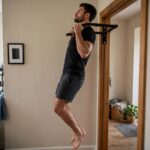
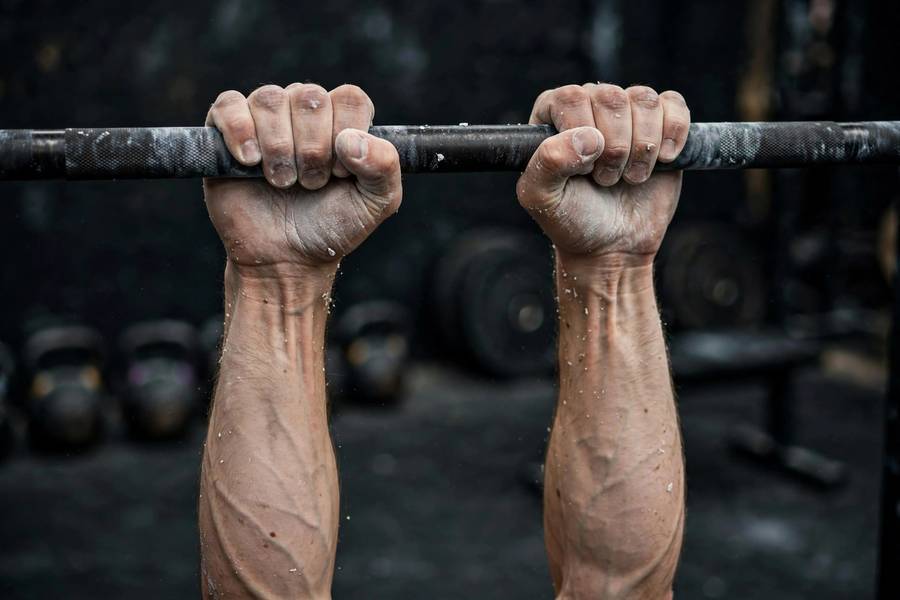
The foundation everything else sits on. Hang from the bar with straight arms, shoulders pulled down away from your ears, for time. If you can’t hang for 30 seconds, your grip is the bottleneck and no amount of lat work will fix it — the bar will leave your hands before your back gets tired. Build to 3 sets of 45 to 60 seconds. Boring? Yes. Non-negotiable? Also yes.
2. Scapular Pull-Ups
Hang from the bar and, without bending your elbows, pull your shoulder blades down and together so your body rises two to three inches. That’s one rep. This teaches the initiation of every pull-up — the part where most beginners yank with their arms and shrug their shoulders to their ears. Do 3 sets of 8 to 10. When these feel crisp, your pull-ups will start with your back instead of your biceps, which changes everything.
3. Inverted Rows (Australian Pull-Ups)
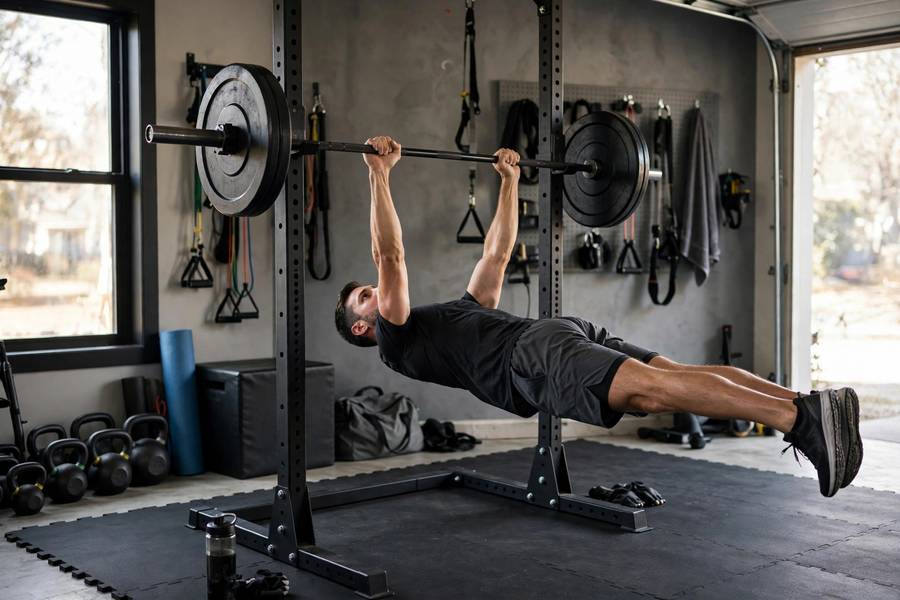
Set a barbell in a rack at hip height, hang underneath it with your body straight as a board, and pull your chest to the bar. This is the number-one pull-up builder I program, because you can adjust difficulty precisely by changing body angle — walk your feet forward to make it harder, back to make it easier. Keep your body rigid; the moment your hips sag, the rep doesn’t count. Work up to 3 sets of 12 with your body nearly horizontal before you worry about anything fancier.
4. Band-Assisted Pull-Ups (Done Right)
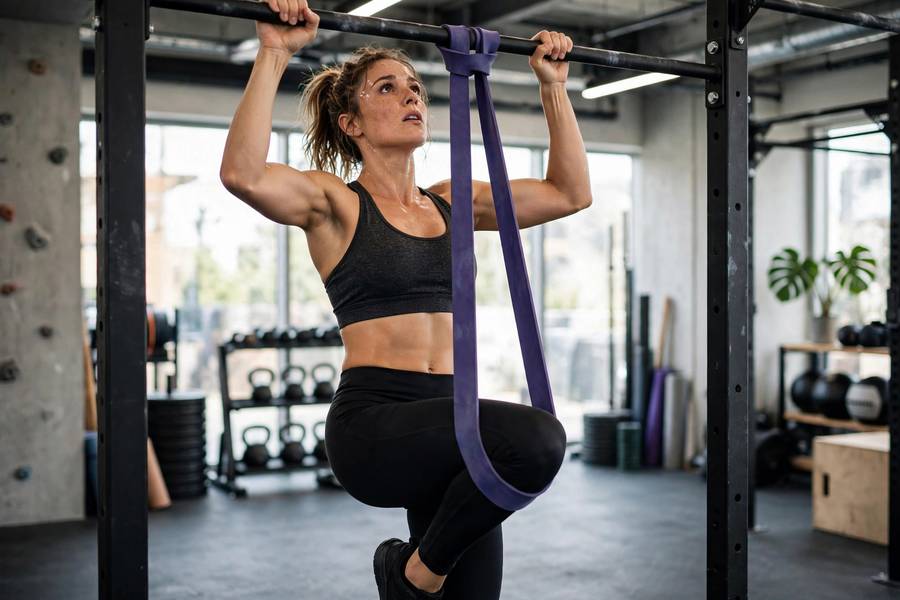
Bands aren’t the enemy — bad band programming is. Use the thinnest band that lets you do 5 clean reps, loop it over the bar, and put one knee (not both feet) in it. The key rules: full dead hang at the bottom of every rep, chin clearly over the bar at the top, and a controlled two-second lower. When you can do 3 sets of 8, drop to a thinner band. The goal is to need the band less, not to do more reps with the same band forever.
5. Eccentric-Only Pull-Ups (Negatives)
Jump or step up to the top position — chin over the bar — and lower yourself as slowly as possible, aiming for 5 full seconds down. This is brutally effective because you’re stronger eccentrically than concentrically; you can overload the exact muscles the pull-up needs even if you can’t do one rep yet. Do 5 sets of 3 reps with full rest between sets. Stop the set when you can’t control the lowering anymore — grinding out fast, sloppy negatives teaches nothing.
6. Lat Pulldowns
Yes, the machine has a place — for loading the lats heavy when your bodyweight is the limiter. The trick is programming it like a strength movement, not a pump movement: 4 sets of 6 to 8 reps with a weight that makes the last two reps hard, pulling the bar to your upper chest with your chest up and a slight lean back. If your gym’s pulldown stack is too light to challenge you for 6 reps, you’re probably ready for real pull-ups already.
7. Resistance Band Straight-Arm Pulldowns
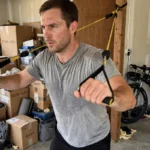
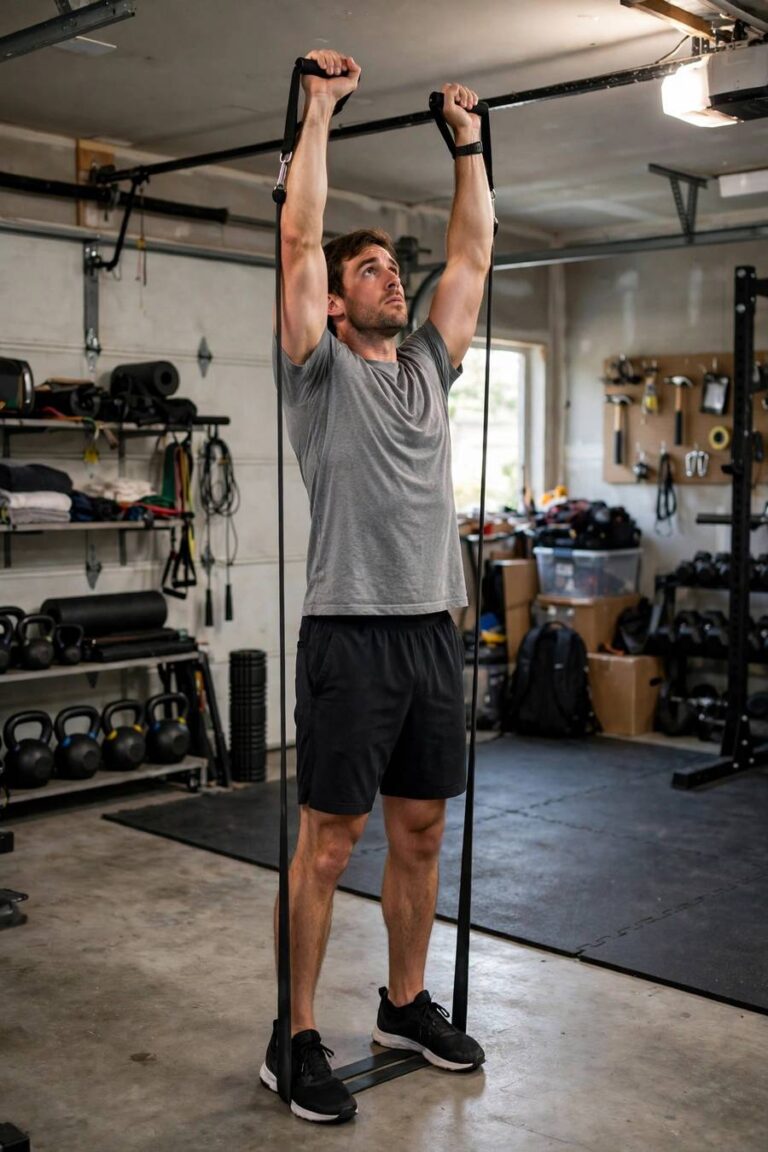
Anchor a band overhead, keep your arms straight, and pull the band down to your thighs by driving your lats. This isolates the lat’s job in the pull-up — shoulder extension — without the biceps taking over, which is exactly what happens when beginners try to “arm” their pull-ups. I use these as activation work: 2 to 3 sets of 12 to 15 before bar work. For more on this tool, see my guide to the benefits of resistance band training.
8. Dumbbell and Barbell Rows
Heavy rows build the thick upper-back strength that supports everything about a pull-up — the lats, rhomboids, and rear delts that keep your shoulders healthy under volume. One-arm dumbbell rows are my pick: brace your off-hand on a bench, keep your back flat, and row the bell to your hip for 3 sets of 8 to 10 per arm. My bent-over row guide covers the barbell version if you want to load it heavier.
9. Flexed-Arm Hangs
Hold the top position of a pull-up — chin over the bar — for time. This builds the lockout strength and the mental comfort of being at the top of the bar, which is where beginners panic and drop. Build to 3 sets of 20 to 30 seconds. Combine these with dead hangs (bottom position) and eccentrics (the middle), and you’ve trained every inch of the pull-up without doing a single full rep.
How to Program Them: The 8-Week Bridge
Here’s the exact template I give clients who can’t do a pull-up yet. Three days per week, about 30 minutes:
Day A — Horizontal pulling + bottom position: Inverted rows 4×8–12, dead hangs 3×max time, scapular pull-ups 3×8. Rest 90 seconds between sets.
Day B — Vertical pulling + top position: Band-assisted pull-ups 5×5 (thin band, perfect form), flexed-arm hangs 3×max time, straight-arm band pulldowns 3×12. Rest 2 minutes on the band work.
Day C — Heavy back + eccentrics: One-arm dumbbell rows 4×8 per arm, eccentric pull-ups 5×3 (5-second lowers), dead hangs 2×max time.
Every week, try to add one rep or five seconds somewhere. At the end of week 4 and week 8, test a real pull-up attempt — jump to the top and see if you can pull from a dead hang. Most of my clients get their first rep between weeks 6 and 10 on this template. Bodyweight matters here too: if you’re carrying extra weight, every pound lost is a pound you don’t have to pull. Bodyweight training rewards leanness like nothing else.

What to Avoid
Kipping before you’re strong. The kip is an advanced CrossFit skill, not a beginner shortcut. Kipping your way to “pull-ups” before you can do strict reps is how shoulders get wrecked. Earn strict first.
Half reps as a steady diet. Chin barely reaching the bar, no dead hang at the bottom — these build strength in a partial range and leave you weak where it counts. Full range or it doesn’t count. I don’t care what your rep counter says.
Only training the pull-up. The alternatives above work because they build the system — grip, scaps, lats, core. Doing nothing but failed pull-up attempts builds frustration. Train the components, and the whole movement shows up.
Ignoring body composition. I say this with zero judgment: a pull-up is a strength-to-weight ratio exercise. At 250 pounds you need dramatically more pulling strength than at 170. If fat loss is part of your goal, it directly accelerates your pull-up timeline.
Frequently Asked Questions
Inverted rows under a sturdy table or low bar are the best no-bar alternative — they train the same horizontal pulling pattern and you can adjust difficulty by changing your body angle. Pair them with resistance band pull-aparts and straight-arm pulldowns anchored in a door. You’ll build real pulling strength, though you’ll still want bar access eventually for the specific skill.
Yes, if programmed correctly. Use the thinnest band that allows 5 clean reps, do full dead hangs at the bottom and chin-over-bar at the top, and move to a thinner band once you hit 3 sets of 8. Bands fail when people use a band so thick it does half the work and never progress off it. The band is a bridge, not a destination.
Most beginners get their first strict pull-up in 6 to 12 weeks of consistent training, 3 days per week, using a structured progression of rows, eccentrics, and assisted work. Your starting point matters — if you can already do 10 inverted rows and hang for 45 seconds, you’re closer than you think. Bodyweight is a major factor; lighter trainees get there faster.
They’re a good strength builder but an incomplete substitute. Pulldowns load the lats well, but they don’t train grip, core stability, or the specific coordination of moving your body through space. Use them as one tool — programmed heavy for 6 to 8 reps — alongside hangs, rows, and eccentrics. Nobody ever got their first pull-up from pulldowns alone.
No. Eccentrics create significant muscle damage — that’s why they work — and they need 48 hours of recovery like any hard training. Doing slow negatives daily will fry your elbows and lats and stall your progress. Two to three sessions per week with full recovery between them will get you there faster than daily grinding.
Stop collecting assisted reps and start building the components. Pick three movements from this list that target your weakest link, run them hard for eight weeks, and test. The bar isn’t going anywhere — but with the right alternatives, you won’t need the help much longer.