
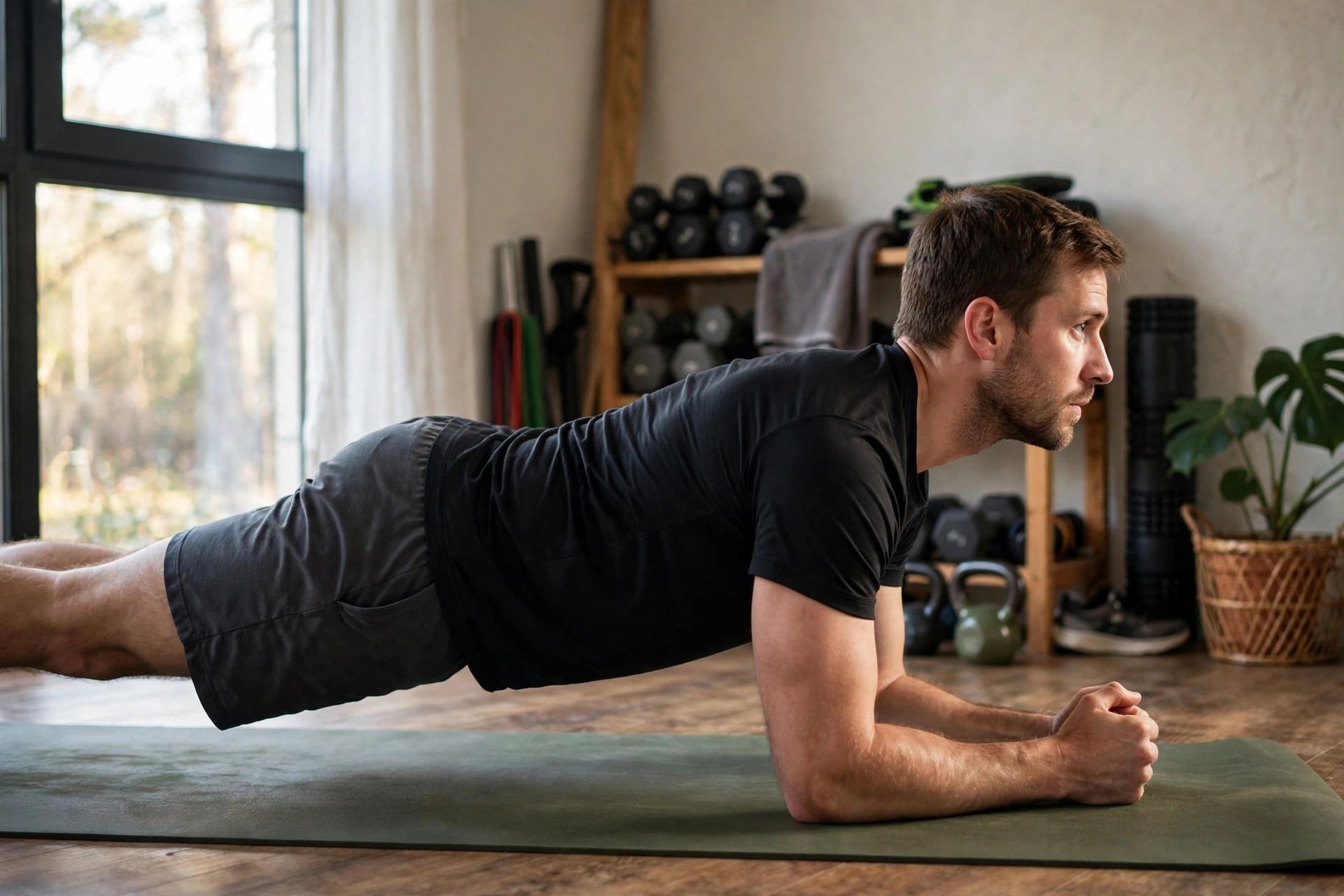
The plank is the most lied-about exercise in fitness. Not because people lie on purpose — because almost everyone does it wrong and doesn’t know it. I’ve watched hundreds of planks in my coaching career, and I’d estimate fewer than one in ten beginners holds a real one. Hips sagging. Back arched. Breath held. Two minutes of that isn’t a workout — it’s a nap in a bad position.
Here’s the truth: a 30-second plank done correctly will humble you more than a 3-minute plank done badly. So let’s build yours from the ground up. This is the exact form checklist I run through with every new client.
Why the Plank Is Worth Your Time
Your core is everything between your shoulders and your hips — abs, obliques, lower back muscles, glutes, all working as a team. The plank trains that whole team at once, in the position it actually works during real life: bracing to keep your body stable.
Unlike crunches, which bend your spine repeatedly under load, the plank is an isometric hold — your muscles work hard without moving. That makes it joint-friendly, equipment-free, and brutally honest. You can’t fake a plank. Either your body holds the line or it doesn’t.
One more thing: the plank transfers to everything else. A stronger brace means a stronger squat, a stronger push-up, a stronger deadlift. It’s not the sexiest exercise. It’s the most useful one nobody does properly.
The Setup: Forearm Plank, Step by Step
Do this exactly as written the first time. Details matter.
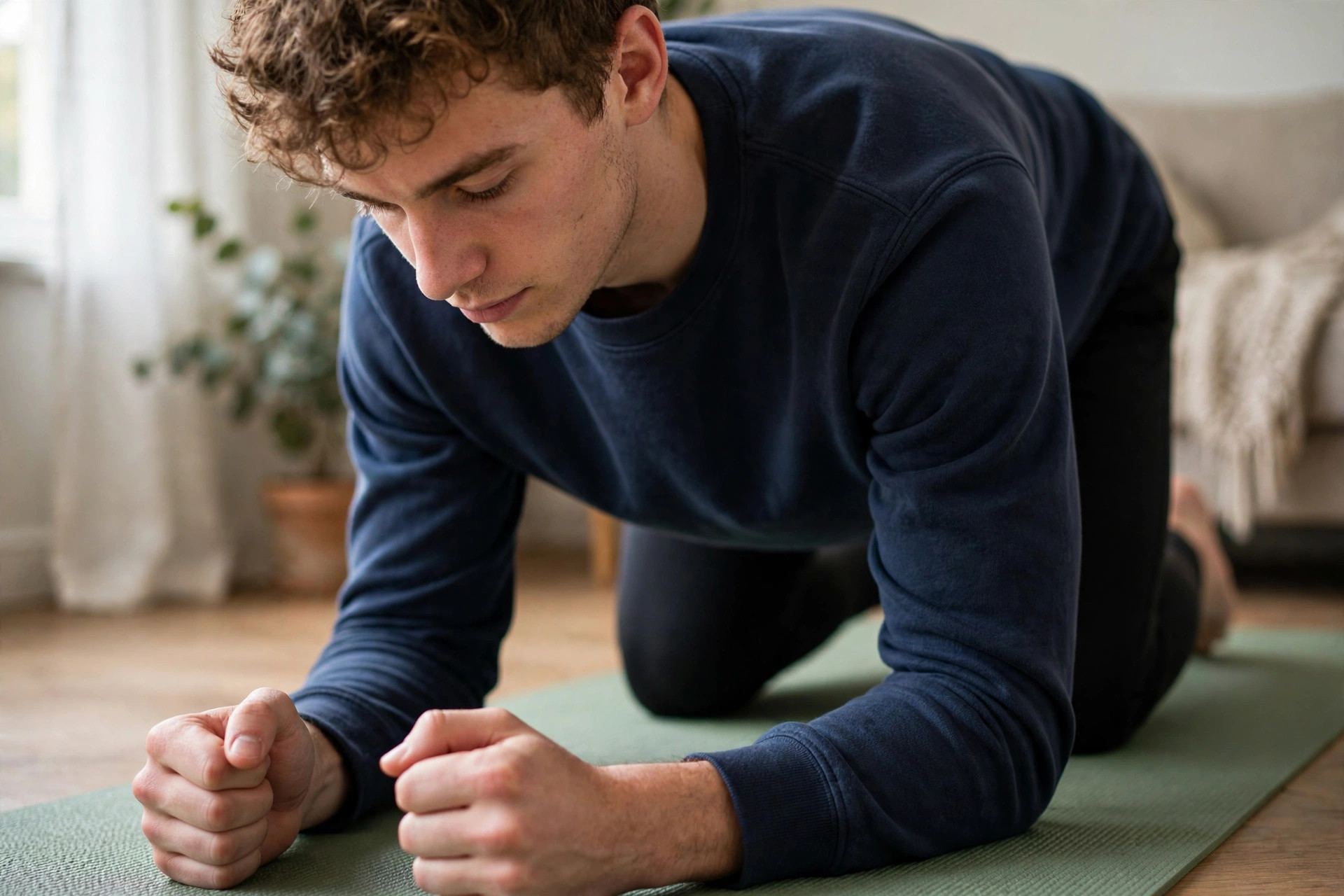
- Get on the floor. Kneel on a mat or carpet. Place your forearms on the ground, elbows directly under your shoulders, palms flat or fists closed — whichever feels stable.
- Step back. Extend one leg behind you, then the other, coming up onto your toes. Feet can be together or slightly apart — slightly apart is more stable for beginners.
- Squeeze your glutes. Hard. Like you’re holding a coin between them. This is the step everyone skips, and it’s the one that locks your hips in place.
- Brace your core. Imagine someone’s about to punch you lightly in the stomach. Tighten everything around your midsection.
- Tuck your pelvis slightly. Think about pulling your belt buckle toward your chin — just a small tilt, not a big movement.
- Set your head. Look at the floor between your hands. Your neck stays in line with your spine. Don’t crane up, don’t let your head droop.
- Breathe. Slow, steady breaths in and out. Holding your breath is cheating and it’ll spike your blood pressure — breathe through the hold.
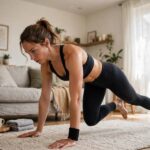
You’re now in a plank. Your body should form one straight line from head to heels. If you had a broomstick laid along your back, it would touch your head, upper back, and glutes at the same time.
The 5 Form Checkpoints (Scan Head to Heels)
Once you’re up, run this scan every 10 seconds. I call it the checkpoint system, and it fixes most form breakdowns before they become habits.
Checkpoint 1 — Head: Eyes on the floor. If you’re staring at yourself in the mirror, your neck is cranked. Fix it.
Checkpoint 2 — Shoulders: Push the floor away from you. Your shoulder blades should be flat on your back, not pinched together or hunched toward your ears. Think “long neck.”
Checkpoint 3 — Hips: This is where planks die. Your hips should be in line with your shoulders and heels — not sagging toward the floor, not piked up toward the ceiling. The most common fault is the sag. When your hips drop, your lower back takes the load instead of your core. That’s your signal: reset or drop to your knees.
Checkpoint 4 — Glutes: Still squeezed? They loosen first when you get tired. Re-squeeze. Every time.
Checkpoint 5 — Breathing: Still breathing? Good. The moment you catch yourself holding your breath, exhale deliberately and re-establish the rhythm.
Run the scan. Fix what drifted. That’s the whole game.
The 4 Mistakes Everyone Makes
Mistake 1: The sag. Hips drop, lower back arches, and suddenly it’s a back exercise instead of a core exercise. Fix: squeeze glutes harder, tuck the pelvis, and if you can’t hold the line, shorten the hold. A 20-second perfect plank beats a 60-second saggy one.
Mistake 2: The pike. Hips shoot up like a tent. Usually means your core gave up and your shoulders are doing everything. Fix: lower your hips back into line. If they won’t stay, you’re too tired — rest and go again.
Mistake 3: Holding your breath. Beginners brace by locking everything, including their lungs. You’ll feel dizzy and your face will turn red. Fix: practice bracing while breathing before you plank. Take a breath in, brace 70%, breathe shallow behind the brace.
Mistake 4: Looking up. Craning your neck to watch the timer or the mirror. Fix: put the timer where you can hear it, not see it. Eyes on the floor. Always.
Easier Versions: Start Where You Are
No shame in scaling. The only bad plank is the one with terrible form. Pick the version you can hold with a straight line, and progress from there.
Knee plank. Same setup, but knees on the floor instead of toes. This cuts the load roughly in half. Master 60 seconds here before moving up.
Incline plank. Hands or forearms on a bench, couch, or sturdy table. The higher the surface, the easier it is. A great bridge between knee planks and full planks.
High plank. Hands instead of forearms — the top of a push-up position. Slightly different muscle emphasis, same rules. Some people find this easier on the shoulders; others find it harder. Try both.
The progression path: knee plank → incline plank → full forearm plank → full high plank. Own each stage for 45–60 seconds with clean form before advancing.
Harder Versions: When the Basic Plank Gets Easy
Once you can hold a perfect forearm plank for 90 seconds, the basic version stops challenging you. Time to level up:
Shoulder taps. From a high plank, lift one hand and tap the opposite shoulder. Alternate. Your hips will want to rock side to side — fight it. Keep them dead still.
Plank up-downs. From a forearm plank, press up to a high plank one arm at a time, then lower back down. Brutal on the shoulders and core. Keep hips level throughout.
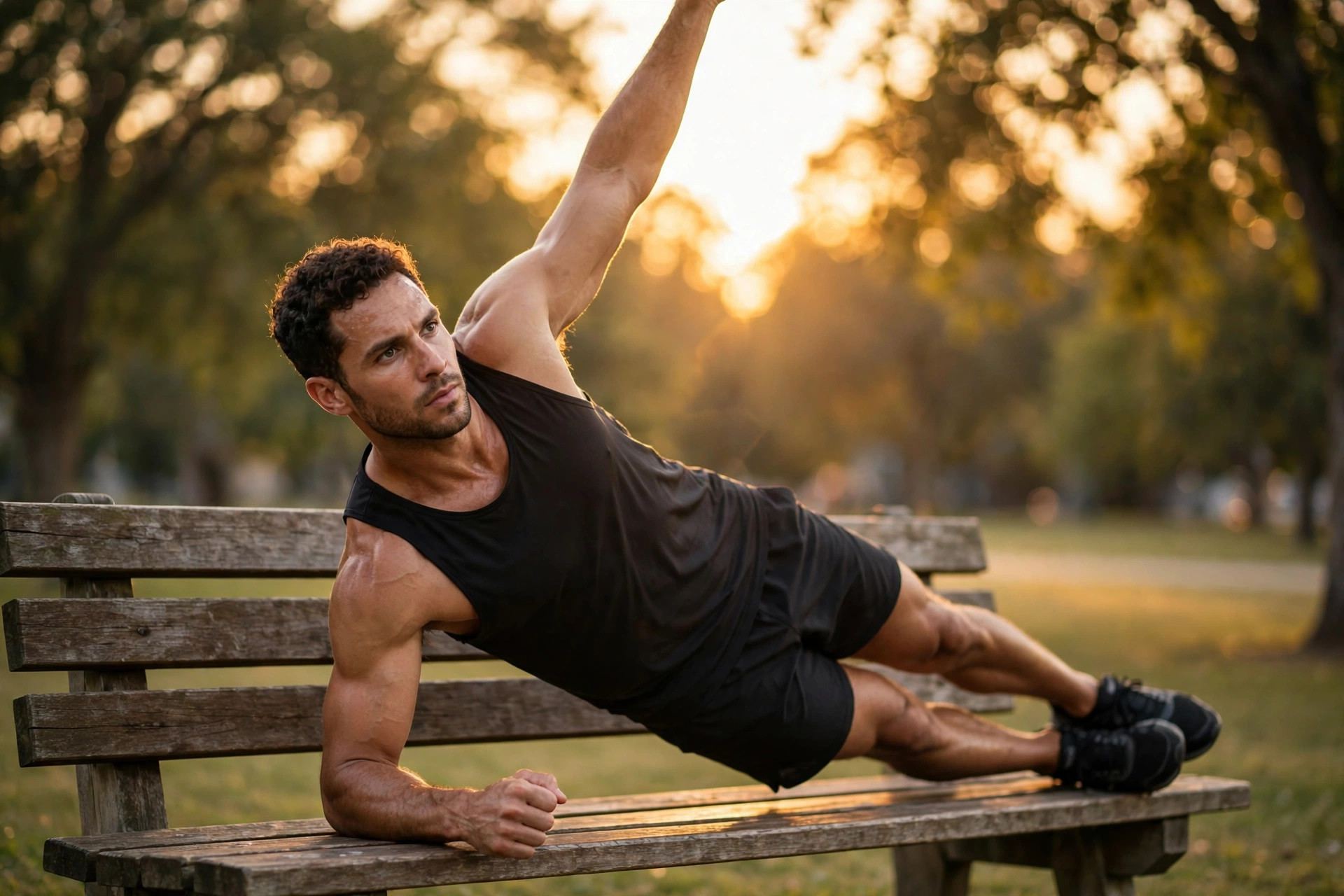
Side plank. Lie on your side, forearm under shoulder, stack your feet, and lift your hips. This hammers the obliques. Do both sides — everyone has a weaker one.
Single-leg plank. From a forearm plank, lift one foot a few inches off the floor. Hold 15 seconds, switch. Your glutes and core have to work overtime to keep you stable.
How Long Should You Hold It?
Stop chasing the 5-minute plank. Past about 90 seconds of a true, braced plank, you’re training endurance, not getting stronger. For most people, the sweet spot is 3 sets of 30–60 seconds with full tension and 30–60 seconds of rest between sets.
Here’s my programming rule: when you can hold 60 seconds with perfect form across all 3 sets, move to a harder variation instead of a longer hold. Quality and progression beat duration. The guy holding a saggy 4-minute plank is getting less out of it than the woman holding a perfect 45-second plank. Every time.
For a bigger-picture plan that uses planks alongside the other fundamental moves, here’s my guide to building muscle at home — the plank slots into it perfectly as your core work.
The 5-Minute Plank Finisher
Add this to the end of any workout. No rest between moves — 40 seconds of work, 20 seconds of transition:
- Forearm plank — 40 seconds
- High plank — 40 seconds
- Side plank, right — 40 seconds
- Side plank, left — 40 seconds
- Shoulder taps — 40 seconds
- Forearm plank — hold whatever you have left, minimum 20 seconds
Five minutes. Your entire core, torched. If you can’t finish it cleanly the first time, that’s normal — shorten each round to 30 seconds and build up. And do it when you’ll actually do it consistently; timing matters less than showing up, though there’s a good breakdown of the best time to exercise if you’re curious.

Frequently Asked Questions
Start with 20-30 second holds for 3 sets. Focus entirely on form — straight line from head to heels, glutes squeezed, breathing steady. Add 5-10 seconds per week. When you can hold 60 seconds with clean form, move to a harder variation rather than holding longer.
A 1-minute plank with genuine form — no sagging, glutes engaged, steady breathing — is solid. Most people who claim long plank times are holding with broken form. Judge your plank by quality, not the clock: 45 perfect seconds beats 3 sloppy minutes.
Elbows under shoulders, body in a straight line from head to heels, glutes squeezed, core braced, pelvis slightly tucked, eyes on the floor, and steady breathing. Run a head-to-heels checkpoint scan every 10 seconds: head neutral, shoulders pushed away from the floor, hips in line, glutes tight, still breathing.
For most people, yes. Planks train your entire core as a stabilizing unit — the way it works in real life — while crunches isolate the abs through repeated spinal bending. Planks are also easier on the neck and require no equipment. That said, variety is fine; planks just deserve to be the foundation.
Almost always a form fault: your hips are sagging, which shifts the load from your core to your lower back. Fix it by squeezing your glutes harder, tucking your pelvis slightly, and shortening the hold. If you can’t keep your hips in line, drop to your knees and rebuild from there — that’s the correct move, not a failure.
You don’t need daily planks. Three sets of 30-60 seconds, 3 times per week as part of a full-body routine, is plenty for most people. Muscles strengthen during recovery, so rest days between sessions matter. Once planks get easy, progress to harder variations instead of adding more sets.
The Bottom Line
The plank is simple. That doesn’t mean it’s easy — it means there’s nowhere to hide. Set up right, run your checkpoints, fix your mistakes, and progress when the basics get easy. Thirty perfect seconds. That’s the standard. Everything else is just details.
Now get on the floor.
For more no-excuses training guides, they’re all in the fitness section.