
I’ve trained everyone from total beginners to athletes, and here’s what I know: the most expensive gym membership is the one you never use. Your body is equipment you always have with you. No commute. No monthly fee. No waiting for the squat rack.
Bodyweight exercises work. Not “sort of work” — they genuinely build strength, and I’ve watched beginners transform on nothing but floor space and consistency. The catch? Form matters more when there’s no machine guiding you. So let’s do this right.
Why Bodyweight Training Actually Works
Muscles don’t know what a dumbbell is. They know tension. When you lower yourself into a push-up, your chest, shoulders, and triceps are under load — real load, your full bodyweight minus whatever your knees or the floor helps with. That’s the principle of progressive overload: challenge the muscle with a little more than it’s used to, and it adapts by getting stronger.
Bodyweight training applies that principle with leverage instead of plates. Move your hands closer together on a push-up and your triceps work harder. Elevate your feet and your shoulders take more of the load. Slow the lowering phase to four seconds and every rep gets dramatically harder. The resistance is always there — you just learn to dial it up.
And here’s the practical advantage: frequency. Because you can train anywhere, you actually do it. The best workout is the one you’ll actually do, and a 20-minute session in your living room beats a skipped gym trip every time. Consistency is the whole game.
The Ground Rules (Read This First)
Three rules. Non-negotiable. I make every client learn these before the first real session.
Warm up. Five minutes. March in place, arm circles, leg swings, a few easy squats. Cold muscles are stiff muscles, and stiff muscles move badly. This isn’t optional — it’s the first five minutes of every workout, forever.
Form before reps. Ten perfect squats beat thirty sloppy ones. If your form breaks down, stop the set. Rest. Then continue. Ego is the enemy of progress.
Train the whole body. Everyone wants to do push-ups and skip legs. Don’t be everyone. The Big 5 below hit pushing, legs, and core — everything you need.
The Big 5, #1: The Push-Up
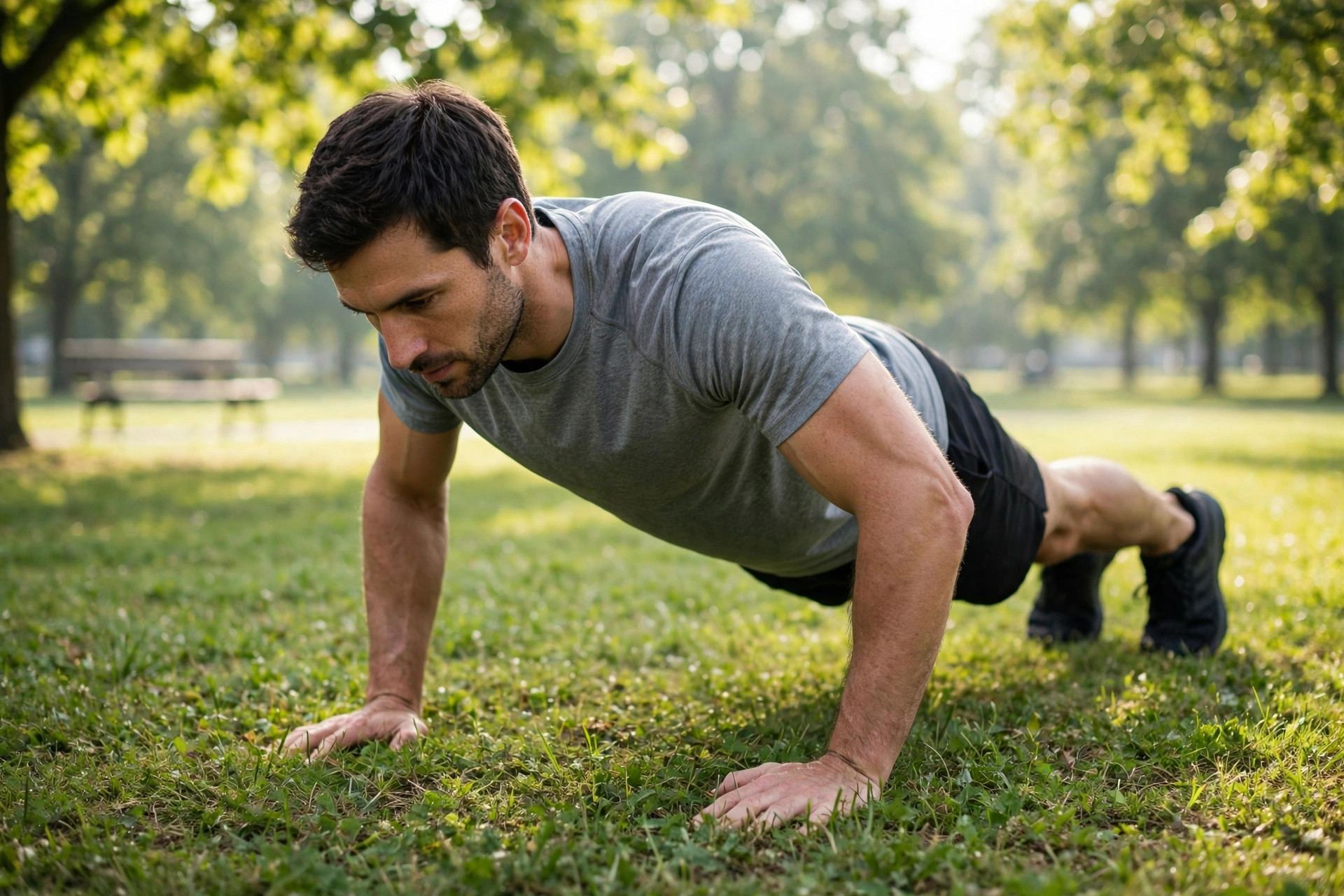
The king of bodyweight exercises. It hits your chest, shoulders, triceps, and core all at once — if you do it right.
How to do it:
1. Start in a high plank: hands under shoulders, fingers spread, body in a straight line from head to heels.
2. Squeeze your glutes and brace your core like someone’s about to poke your stomach.
3. Lower your chest toward the floor by bending your elbows to about 45 degrees — not flared out wide.
4. Go down until your chest nearly touches the floor (or as far as you can with control).
5. Push the floor away and return to the start. That’s one.
Form cues that fix 90% of bad push-ups:
– Hips don’t sag. If your lower back is arching like a hammock, you’re done — drop to your knees and finish the set properly.
– Head stays neutral. Look at the floor, not at the mirror.
– Full range beats half reps. A half push-up is half an exercise.
Too hard? Do them from your knees, or with hands on a sturdy elevated surface like a couch. Too easy? Slow the lowering to 4 seconds, or try diamond push-ups with hands close together.
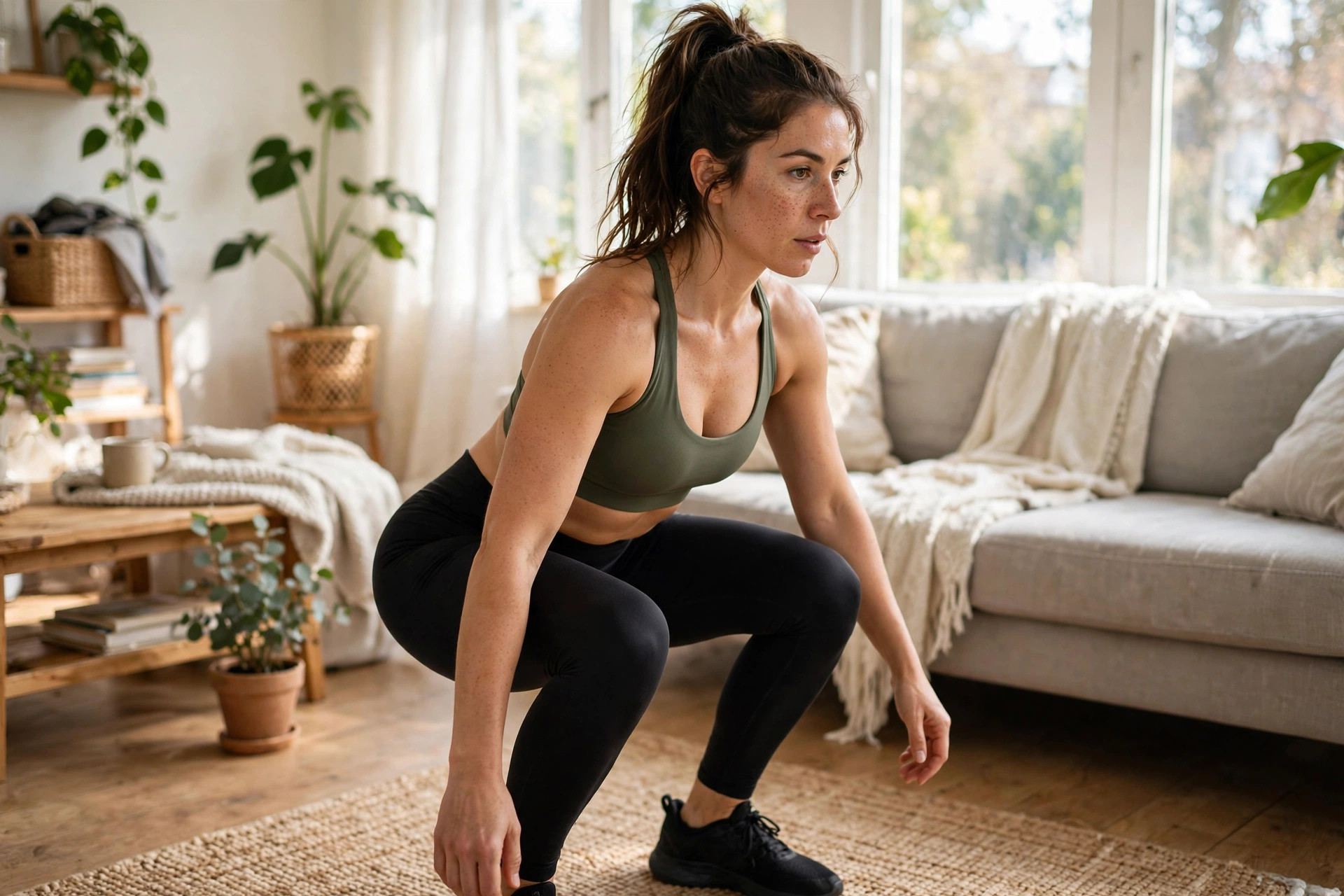
The Big 5, #2: The Squat
The foundation of lower-body strength. Your legs are your biggest, strongest muscles — training them pays off everywhere.
How to do it:
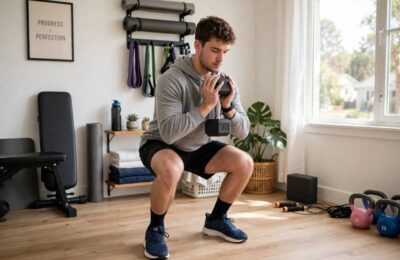
1. Stand with feet about shoulder-width apart, toes slightly out.
2. Push your hips back like you’re sitting into a chair.
3. Keep your chest up and your weight through your whole foot — not just your toes.
4. Lower until your thighs are at least parallel to the floor (deeper if your mobility allows).
5. Drive through your heels and stand tall. Squeeze your glutes at the top.
Form cues:
– Knees track over your toes. They shouldn’t cave inward — think “knees out.”
– Your back stays flat, not rounded. Chest proud.
– If your heels lift off the floor, narrow your stance slightly or work on ankle mobility over time.
Too hard? Do box squats — squat down to touch a chair, then stand. Too easy? Try jump squats (land soft, knees bent) or single-leg assisted squats holding a doorframe.
The Big 5, #3: The Lunge
Single-leg work exposes imbalances that two-legged moves hide. Everyone has a stronger side. Lunges find it.
How to do it:
1. Stand tall, feet hip-width apart.
2. Step forward with one leg and lower your body until both knees are bent at roughly 90 degrees.
3. Your front knee stays over your ankle — don’t let it shoot past your toes.
4. Keep your torso upright. No leaning forward.
5. Push through your front heel to return to standing. Alternate legs.
Form cues:
– Long enough step. A short step crams the front knee; take a real stride.
– Back knee hovers just above the floor. Tap it lightly if you want a depth target.
– Slow down. Lunges done fast are lunges done badly.
Too hard? Hold a wall or chair for balance, or do split squats with feet stationary. Too easy? Try reverse lunges (step backward — easier on the knees) or walking lunges across the room.
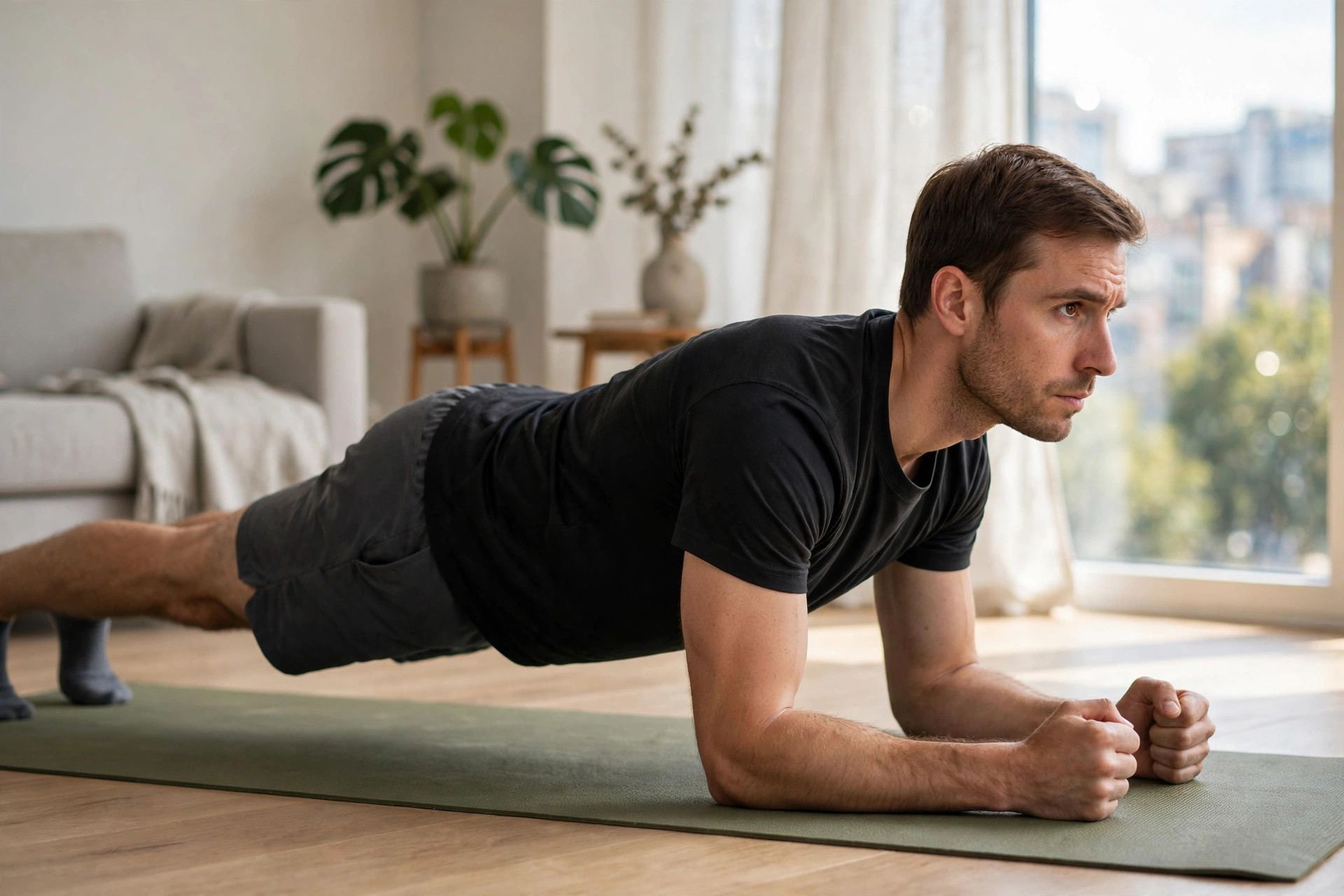
The Big 5, #4: The Plank
The simplest core exercise ever invented — and the most butchered. A plank isn’t about hanging out on your elbows. It’s about creating total-body tension.
How to do it:
1. Forearms on the floor, elbows under shoulders.
2. Extend your legs behind you, up on your toes.
3. Squeeze your glutes hard. Brace your core. Tuck your pelvis slightly.
4. Your body should form one straight line from head to heels.
5. Breathe normally. Hold.
Form cues:
– Hips in line. Too high and you’re cheating; sagging and you’re loading your lower back instead of your core.
– Don’t hold your breath. Breathing while bracing is a skill — practice it.
– Quality over duration. A 30-second plank with real tension beats a 2-minute saggy plank.
Too hard? Drop to your knees. Too easy? Try shoulder taps from a high plank, or lift one foot slightly off the floor.
The Big 5, #5: The Glute Bridge
Your glutes are the engine of your lower body — and most people sitting at desks all day have glutes that forgot how to work. This wakes them up.
How to do it:
1. Lie on your back, knees bent, feet flat on the floor about hip-width apart.
2. Arms at your sides, palms down.
3. Drive through your heels and lift your hips until your body forms a straight line from shoulders to knees.
4. Squeeze your glutes hard at the top — one full second.
5. Lower slowly. That’s one.
Form cues:
– The squeeze matters more than the height. Don’t overarch your back to get higher.
– Feet stay flat. If your heels lift, move your feet slightly closer to your glutes.
– 15–20 slow reps with a real squeeze will humble you.
Too easy? Try single-leg glute bridges — one foot on the floor, the other leg extended.
The 20-Minute Routine: Put It All Together
Here’s a full workout using only the Big 5. Three levels — pick yours honestly.
Warm-up (5 min): march in place 1 min, arm circles 30 sec each direction, leg swings 30 sec each leg, 10 easy bodyweight squats, 10 arm swings across chest.
Starter (repeat circuit 2x):
– 8 knee push-ups
– 10 box squats
– 8 reverse lunges (4 each leg)
– 20-second plank
– 10 glute bridges
– Rest 90 seconds between rounds
Standard (repeat circuit 3x):
– 12 push-ups
– 15 squats
– 10 lunges each leg
– 40-second plank
– 15 glute bridges
– Rest 60 seconds between rounds
Savage (repeat circuit 4x):
– 15 push-ups (4-second lowering)
– 20 jump squats
– 12 walking lunges each leg
– 60-second plank
– 20 single-leg glute bridges (10 each)
– Rest 45 seconds between rounds
Total time: about 20 minutes including the warm-up. No equipment, no excuses. For a structured muscle-building plan that pairs with this routine, here’s how to build muscle at home.
How to Make It Harder: The Progression Ladder
Bodyweight training only stops working when you stop making it harder. Here’s how to keep progressing, in order:
- More reps. Master the movement pattern first, then add volume.
- More sets. Go from 2 rounds to 3 to 4.
- Slower tempo. A 4-second lowering phase doubles the difficulty of any move.
- Harder variations. Knee push-ups → full push-ups → diamond push-ups → archer push-ups. There’s always a next step.
- Less rest. Shorter breaks between rounds raise the challenge.
- Unilateral work. One-leg and one-arm versions multiply the load.
The rule: only progress one variable at a time. Add reps OR slow the tempo — not both in the same week. Your progress will be steadier and your joints will thank you.
Mistakes I See Every Week
After years of coaching, the same errors show up on repeat. Fix these and you’re ahead of 80% of people training at home:
- Racing through reps. Fast reps use momentum. Momentum is cheating. Control every inch.
- Skipping the warm-up. Cold muscles move badly. Five minutes, every time.
- Half range of motion. Chest to floor. Thighs to parallel. Full reps, every time.
- Training chest daily, legs never. Balance. The Big 5 exist for a reason.
- No plan. Use the routine above. Write down your numbers. Beat them next week.
How Often Should You Train?
For most people: 3 days a week, full body. Monday, Wednesday, Friday. Train, rest, train, rest — muscles adapt during recovery, not during the workout.
Beginners can start with 2 days a week. Advanced trainees can push to 4. More than that without a real plan is usually counterproductive — you’re just accumulating fatigue.
When to train? Whenever you’ll actually do it consistently. There’s a solid breakdown of the best time to exercise — but honestly, consistency beats timing every time.

Frequently Asked Questions
Yes. Muscles respond to tension and progressive overload, not to the brand of equipment. Push-ups, squats, lunges, and their harder variations provide real resistance. The key is progression — harder variations, more reps, slower tempo — so the challenge keeps increasing as you get stronger.
Twenty to thirty minutes is plenty for most people, including a five-minute warm-up. A focused 20-minute full-body session done consistently three times a week will outperform occasional hour-long marathon workouts. Quality and consistency matter far more than duration.
Start with the fundamentals: knee or incline push-ups, bodyweight squats (or box squats), reverse lunges, short planks from the knees, and glute bridges. Master good form on these five before adding complexity — they cover pushing, legs, and core, which is everything a beginner needs.
Three full-body sessions per week is the sweet spot for most people — for example, Monday, Wednesday, and Friday. Beginners can start with two days. Muscles adapt during rest, so take at least one rest day between sessions rather than training the same muscles daily.
Yes. Five minutes of easy movement — marching in place, arm circles, leg swings, easy squats — prepares your muscles and joints for harder work. Cold muscles move stiffly and form breaks down faster. Treat the warm-up as part of the workout, not an optional extra.
They train the same muscles through the same movement patterns, and for most fitness goals — strength, muscle tone, general fitness — they’re highly effective. Weights make progression simpler (just add plates), but bodyweight training offers progression through leverage, tempo, and unilateral variations. Many people get excellent results with bodyweight alone.
The Bottom Line
You don’t need a gym. You need five movements, twenty minutes, and the discipline to show up three times a week. Master the push-up, squat, lunge, plank, and glute bridge with real form, progress them systematically, and your body will change. That’s not a sales pitch — it’s just how training works.
Start today. Not Monday. Do the warm-up, run the starter circuit once, and see how you feel. Then do it again in two days. The people who get results aren’t the ones with the best equipment. They’re the ones who kept showing up.
For more of my no-excuses training guides, they’re all in the fitness section.