Everyone blames winter for dead batteries. Winter gets the reputation because that’s when weak batteries finally give up — but heat is what killed them. I spent years working in a hot climate before moving to the snow belt, and the pattern was unmistakable: batteries in extreme heat lasted 2 to 3 years, sometimes less, while the same batteries in mild climates went 5. Heat is the silent assassin of car batteries, doing its damage all summer and collecting the body in January. Here’s exactly how heat destroys batteries, what lifespan to expect, and how to fight back. The general lifespan picture is in my guide on how long car batteries last.
Table of Contents
- The Short Answer: 2-3 Years in Extreme Heat
- Why Heat Kills Batteries (the Chemistry)
- Why Batteries Die in Winter But Heat Did It
- How Hot Is Too Hot? The Numbers
- Signs of Heat Damage to Watch For
- How to Make Your Battery Survive the Heat
- Choosing a Battery for Hot Climates
- The Under-Hood Heat Problem
- Frequently Asked Questions
The Short Answer: 2-3 Years in Extreme Heat
In consistently hot climates — think Phoenix, Las Vegas, southern Texas, the Gulf states, the Middle East — expect 2 to 3 years from a conventional car battery. In moderately warm climates, 3 to 4 years. In mild climates, 4 to 5+ years. The same battery, the same car, wildly different lifespans — determined almost entirely by ambient temperature.
The industry rule of thumb I trust: for every 15°F (about 8°C) above 77°F (25°C), battery life roughly halves. A battery rated for 5 years at 77°F becomes a 2.5-year battery at 92°F average, and worse where summer under-hood temperatures regularly exceed 140°F. These are approximations, not physics equations — but they match what I’ve seen across thousands of battery replacements. Heat doesn’t just shorten battery life; it dominates it.
Why Heat Kills Batteries (the Chemistry)
A car battery is a chemical machine: lead plates, lead dioxide plates, sulfuric acid electrolyte. Heat accelerates every chemical reaction inside it — including the ones you don’t want. The killer reaction is grid corrosion: the lead alloy grids that support the active plate material slowly oxidize and corrode, and heat dramatically speeds this up. Corroded grids mean less conductive path, higher internal resistance, and eventually plates that crumble.
Heat also accelerates water loss. The electrolyte is part water, and heat evaporates it — faster in non-sealed batteries, but even “maintenance-free” sealed batteries lose water through their vents over time. Low electrolyte exposes the tops of the plates to air, and exposed plate material sulfates rapidly and permanently. A battery that’s lost significant water is a battery that’s lost significant capacity, and no amount of topping up restores plates that have already sulfated.
There’s a cruel irony: heat actually improves battery performance in the short term. Chemical reactions run faster when hot, so a hot battery cranks strongly and tests well. The damage is cumulative and invisible — until the weakened battery meets its first cold morning and can’t deliver. Heat makes the battery feel healthy while killing it. Winter just reads the will.
Why Batteries Die in Winter But Heat Did It
This is the pattern every mechanic in a four-season climate knows: the tow trucks run hardest on the first cold snap of the year, and the batteries they replace are heat-damaged. Here’s the mechanism. All summer, heat corrodes the grids and evaporates the water. The battery’s capacity quietly drops from 100 percent to 70, 60, 50 percent — but warm weather masks it, because warm batteries deliver current easily.
Then the temperature drops. Cold thickens engine oil (harder to crank), slows the battery’s chemical reactions (less current available), and increases the starter’s current demand. A battery at 60 percent capacity that started the car fine at 90°F can’t start it at 20°F. The cold didn’t damage the battery — it exposed the damage heat had already done. The failure gets blamed on winter; the autopsy says summer.
This is why I tell customers in hot climates to test batteries in late summer, not after the first winter failure. A load test in September catches the heat-weakened battery before the January morning it was destined to fail on. Preventive replacement in fall is the cheapest tow you’ll never need.
How Hot Is Too Hot? The Numbers
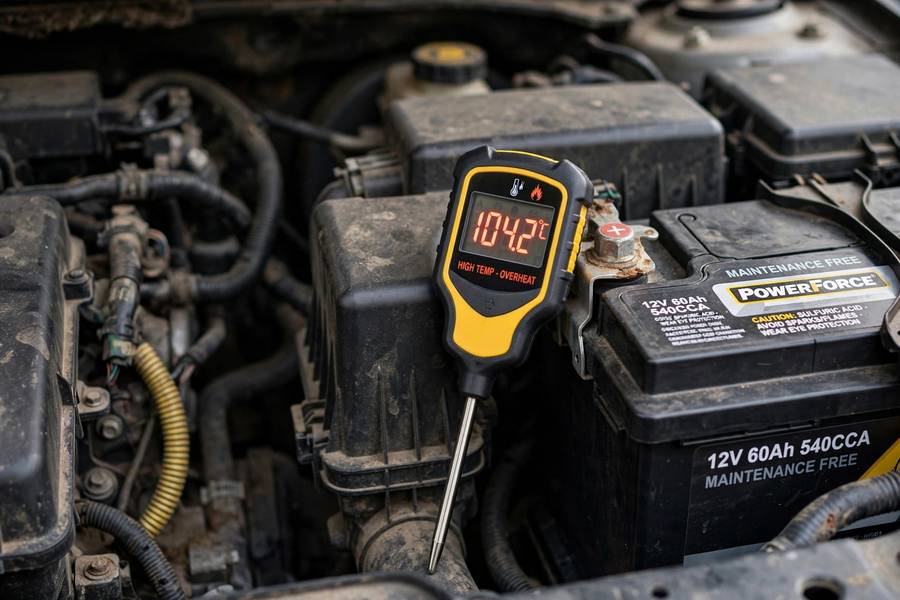
Ambient temperature is only half the story — under-hood temperature is what the battery actually experiences. On a 100°F day, under-hood temperatures after a drive can reach 160-200°F near the exhaust side, with the battery typically seeing 130-160°F depending on its location. Batteries mounted near the firewall or away from the exhaust run cooler; batteries jammed against hot components cook.
The damage curve steepens fast. At 77°F, grid corrosion proceeds at its baseline rate. At 95°F, roughly double. At 113°F, roughly quadruple. Parked in direct sun, a car’s interior can hit 170°F — the under-hood isn’t far behind after heat soak. Every summer day above 100°F is a bad day for your battery, and in places like Phoenix, that’s 100+ days a year.
Short trips compound the problem: the battery never fully recharges (the alternator needs 20-30 minutes of driving for a full charge), and partial charge states sulfate faster in heat. The worst combination I see: a hot-climate car driven only on short trips. Those batteries sometimes last barely two years. Long highway drives are actually kinder — full recharge, airflow cooling the bay.
Signs of Heat Damage to Watch For
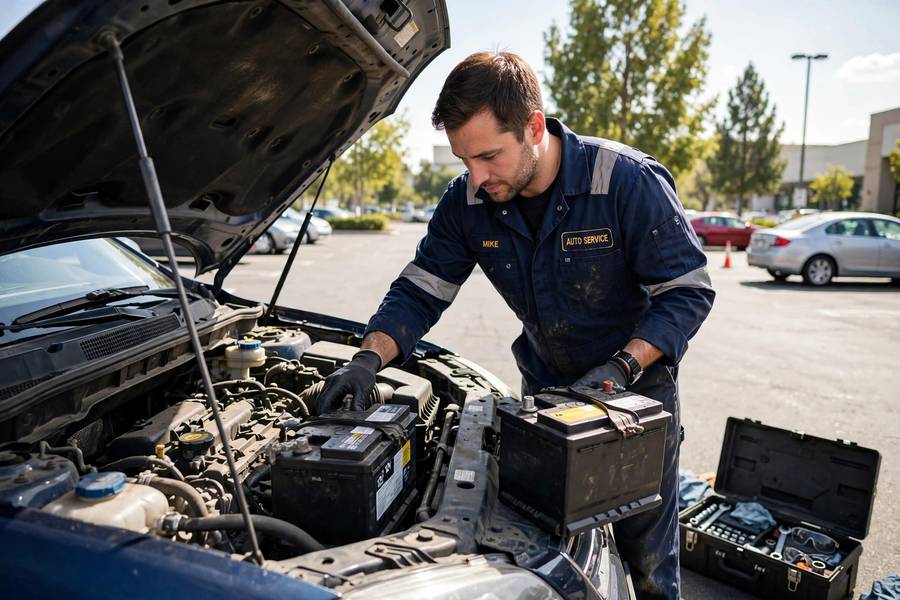
Heat damage has signatures. Excessive terminal corrosion — white/blue crusty buildup returning quickly after cleaning — means the battery is venting more than normal, a sign of internal stress. Low electrolyte in serviceable batteries (check annually in hot climates): if you’re adding distilled water frequently, heat is evaporating it, and the plates may already be damaged.
A swollen or bulging case indicates internal gas pressure from overheating or overcharging — replace promptly. The “works fine but tests weak” pattern: strong cranking in summer heat but a load test showing 60 percent capacity — that’s heat damage hiding behind warm-weather performance. And the calendar: any battery past 2.5 years in extreme heat is suspect regardless of symptoms.
The test I recommend for hot climates: annual load testing starting at year 2. Not voltage checks — load tests. Voltage lies in heat (warm batteries read well); capacity under load tells the truth. Most parts stores test free. Two minutes, once a year, starting early — that’s the whole program.
When a heat-damaged battery finally quits — usually on the first cold morning — you’ll need a jump to get moving. Review how to jump start a car before you need it at 6 a.m. in a dark driveway.
How to Make Your Battery Survive the Heat
You can’t change the climate, but you can change the battery’s experience of it. Park in shade or a garage whenever possible — it measurably reduces under-hood heat soak. It sounds trivial; the temperature difference between sun and shade parking can be 30-40°F under the hood, which meaningfully slows the damage reactions.
Keep the battery clean and the terminals tight: corrosion increases resistance, resistance generates heat under load, and heat is the enemy — it’s a feedback loop worth breaking. Check electrolyte levels annually on serviceable batteries and top with distilled water only. Ensure the battery hold-down is secure — vibration damages plates, and heat-weakened plates are more vulnerable.
Drive long enough to fully recharge: regular 30+ minute drives keep the battery at full charge, and fully charged batteries resist heat damage better than partially charged ones (sulfation accelerates in discharged states). For vehicles that sit, use a maintainer — a battery sitting discharged in heat sulfates fast and permanently.
And test proactively: annual load tests from year 2 in hot climates. Replace at the first sign of real decline, not the third. A $150 battery replaced six months “early” is infinitely cheaper than a tow, a missed meeting, and a battery bought at emergency prices.
Choosing a Battery for Hot Climates
Not all batteries handle heat equally. AGM (absorbent glass mat) batteries generally tolerate heat better than conventional flooded batteries — their sealed design loses less water, and their construction resists vibration damage. They cost 40-60 percent more, but in extreme heat the lifespan advantage often justifies it. Many start-stop vehicles require AGM anyway.
Look for batteries with high heat tolerance in the specs — some manufacturers specifically rate for hot climates. Freshness matters enormously in heat: check the date code and buy the freshest battery on the shelf. A battery that’s sat in a hot warehouse for eight months has already aged before you bought it. I always check date codes for customers; you should too.
Warranty structure matters more in hot climates: favor batteries with longer free-replacement periods. A 3-year free replacement warranty in Phoenix is worth real money — you may well use it. And size correctly: meet or exceed the original CCA, ensure the group size fits properly (a loose battery vibrates; vibration plus heat is a plate-killer), and verify terminal orientation matches your cables.
The Under-Hood Heat Problem
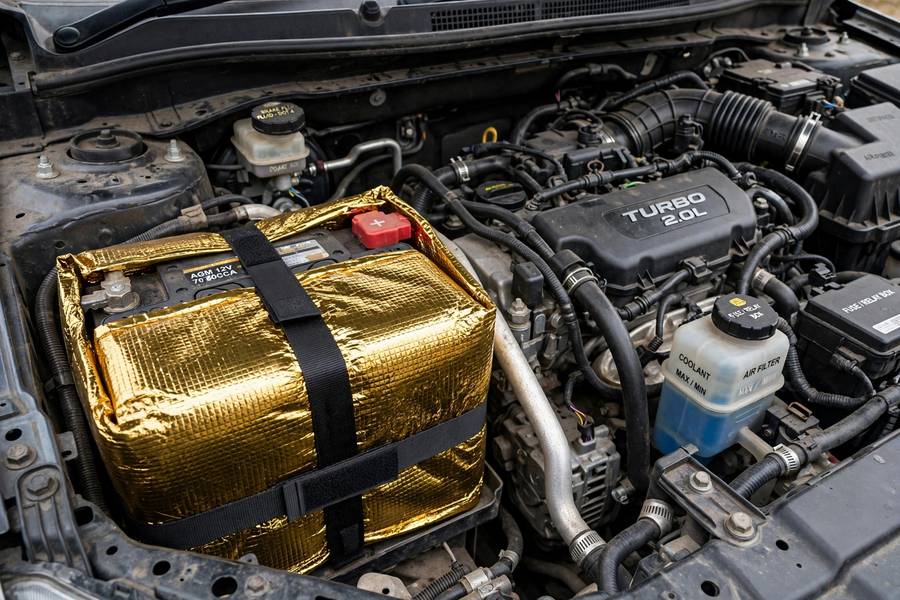
Some of the heat problem is the car’s design, not the climate. Modern engine bays are packed tight for aerodynamics and pedestrian safety — less airflow, more heat soak. Turbocharged engines run especially hot. Batteries mounted low near the exhaust or tucked against the firewall live in the worst spots.
What you can do: some vehicles come with battery heat shields or insulating blankets — if yours has one, keep it; if it’s missing or deteriorated, replace it ($15-$30, worthwhile). Don’t remove under-hood insulation thinking it “lets heat out” — it’s designed to manage heat flow, and removing it usually makes things worse. Keep the cooling system healthy: an engine running hot makes the whole bay hot, and a weak cooling system in summer punishes everything under the hood, battery included.
Aftermarket relocation kits exist (moving the battery to the trunk), popular with enthusiasts in extreme heat. It’s effective — trunk temperatures are far lower — but it’s a real project involving heavy-gauge cable, proper venting, and secure mounting. For most drivers, shade parking and proactive replacement are the practical answers.
Frequently Asked Questions
In extreme heat (Phoenix, Las Vegas, Gulf states), expect 2-3 years. In moderately warm climates, 3-4 years. In mild climates, 4-5+ years. As a rule of thumb, every 15°F above 77°F roughly halves battery life, because heat accelerates internal grid corrosion and water loss.
Heat kills faster — it causes the actual damage (grid corrosion, water evaporation, plate sulfation). Cold just exposes the damage: a heat-weakened battery that cranked fine at 90°F can’t deliver enough current at 20°F. Winter gets blamed for failures that summer caused.
Park in shade or a garage, keep terminals clean and tight, check electrolyte annually (distilled water only), drive long enough for full recharges (30+ minutes), use a maintainer for stored vehicles, keep the battery heat shield in place, and load-test annually starting at year 2.
Generally yes. AGM batteries lose less water (sealed design), resist vibration damage better, and typically outlast conventional flooded batteries in extreme heat. They cost 40-60% more, but the lifespan advantage in hot climates often justifies the premium.
Test annually starting at year 2, and consider proactive replacement around year 2.5-3 in extreme heat — ideally in fall, before winter exposes the heat damage. A load test showing declining capacity is your signal; don’t wait for the first cold-morning failure.