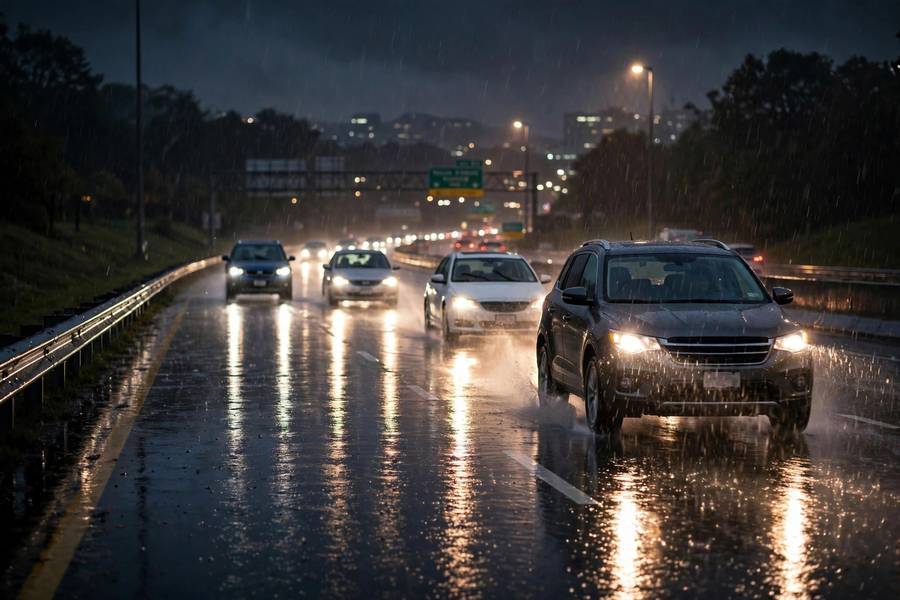
Rain is the most common slippery condition almost every driver faces — more common than snow, mud, or sand combined. And it’s the condition where the AWD-versus-4WD answer is the clearest, because one of the two systems shouldn’t even be engaged. I’ve seen the aftermath of that mistake in my shop: a transfer case damaged not on a trail, but on a rainy commute, by an owner who thought 4WD was a rain mode. Here’s how each system actually behaves on wet roads, what really keeps you safe in a downpour, and the rain-driving truths nobody advertises. The full system comparison is in my AWD vs 4WD guide.
Table of Contents
- The Short Answer
- Why 4WD Stays Off in the Rain
- How AWD Helps on Wet Roads
- Hydroplaning: What It Is and What Stops It
- Tires: The Real Rain Safety System
- Stability Control: The Unsung Hero
- Standing Water and Flooding: Special Rules
- Rain-Driving Technique That Actually Works
- Frequently Asked Questions
The Short Answer
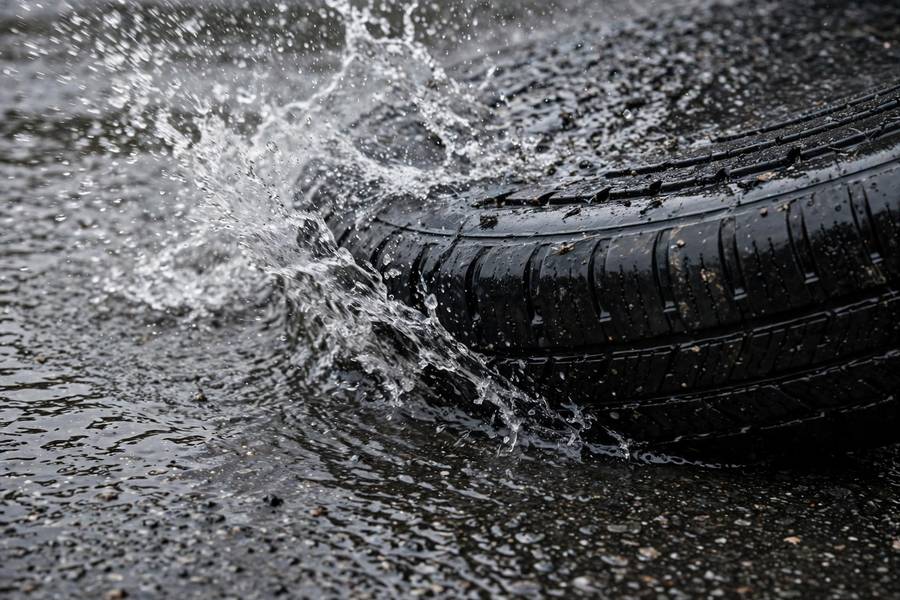
AWD is better for rain — decisively. It’s automatic, it’s designed for high-traction surfaces, and it’s already working before the first raindrop hits. Part-time 4WD should stay disengaged in rain: wet pavement still offers too much traction for a locked drivetrain, risking binding damage for zero benefit. If you drive a 4WD truck, your rain mode is 2WD (or 4WD Auto if equipped), good tires, and sensible speed.
The deeper truth: in rain, the drivetrain is a supporting actor. Tires, speed, and stability control are the leads. AWD gives you a genuine edge in traction and stability during downpours — but it’s an edge measured in confidence and composure, not in permission to drive faster.
Why 4WD Stays Off in the Rain
This surprises people, so let me be blunt: do not engage part-time 4WD because it’s raining. Wet asphalt still provides high traction — a good tire on wet pavement grips at maybe 70 to 80 percent of its dry capability. That’s nowhere near slippery enough for a locked transfer case. The axles need to rotate at different speeds in turns; the tires grip too well to slip and release the difference; the result is the same driveline binding that dry pavement causes, just developing somewhat slower.
I know the temptation. It’s pouring, the roads are slick, the 4WD dial is right there promising security. But locked 4WD adds nothing on wet pavement that your tires and stability control aren’t already handling, and it subtracts drivetrain longevity with every turn. The owners who damage transfer cases in rain are always surprised — “but the road was wet!” Wet isn’t slippery enough. Snow, mud, gravel, sand — those are 4WD surfaces. Rain is a 2WD (or AWD) surface.
The exception: 4WD Auto mode, which engages the front axle via clutch pack only when slip is detected. That’s safe in rain — it’s effectively an on-demand AWD system. If your truck has 4WD Auto, it’s the right choice for downpours. If it only has 2H/4H/4L, stay in 2H.
How AWD Helps on Wet Roads
AWD’s rain advantage is real and multifaceted. First, launch traction: pulling away from lights and intersections on slick pavement, AWD distributes power to all four contact patches, reducing wheelspin and getting you moving cleanly. Anyone who’s spun the front tires of a FWD car pulling into traffic in the rain knows the value of this.
Second, stability in standing water and heavy rain: when one axle encounters deeper water or a slick patch, AWD’s torque redistribution keeps the vehicle composed — power flows to the axle with grip before the situation develops into a slide. The system reacts in about a tenth of a second, faster than any driver’s correction.
Third, cornering composure: torque-vectoring AWD systems actively manage power side-to-side, resisting the understeer that wet corners provoke. The car feels planted and predictable rather than vague and floaty.
But the honest caveat: AWD helps you maintain control, not exceed physics. It cannot prevent hydroplaning (that’s tires and speed), it cannot shorten braking distances (that’s tires), and it cannot compensate for bald tires or reckless speed. AWD in rain is a safety net, not a superpower. The net is real — just don’t test it.
The hardware behind that wet-road confidence is explained step by step in what all-wheel drive is.
Hydroplaning: What It Is and What Stops It
Hydroplaning deserves its own section because it’s rain’s signature danger and the most misunderstood. It happens when water builds up under the tire faster than the tread can channel it away, and the tire rides up onto a wedge of water — losing contact with the road entirely. At that moment, you have zero steering, zero braking, zero traction. No drivetrain on earth helps, because the problem isn’t power distribution — it’s contact.
The physics: hydroplaning risk rises with speed and water depth, and falls with tread depth and tire pressure. The rough rule: with decent tires, partial hydroplaning can begin around 45-55 mph in heavy standing water; with worn tires (under 4/32″ tread), it can begin as low as 35-40 mph. Proper inflation matters because an under-inflated tire’s contact patch deforms and channels water poorly.
What stops it: slowing down (the single most effective action), tires with deep tread and good water-channeling design, and avoiding the outside lanes where water pools deepest. If you hydroplane: ease off the gas, do NOT brake hard, do NOT jerk the wheel — hold straight and wait for the tires to reconnect. It feels like an eternity. It’s usually two seconds.
Tires: The Real Rain Safety System
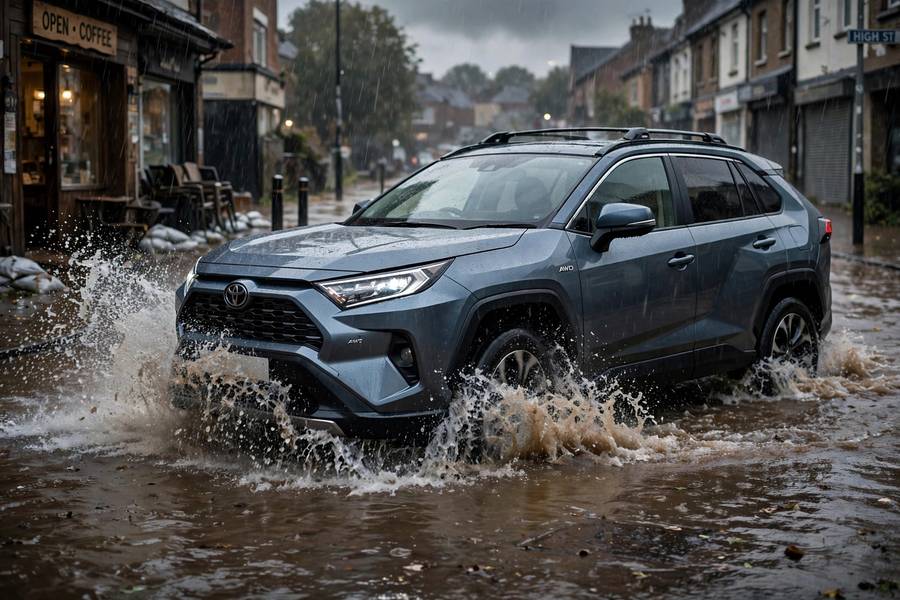
In rain, tires are everything. The tread’s circumferential grooves are water pumps: at 60 mph, each tire must evacuate roughly a gallon of water per second from the contact patch in heavy rain. Worn tires can’t do it — below 4/32″ of tread, wet-weather performance falls off a cliff, and below 2/32″ (the legal minimum in most places) the tire is essentially a racing slick in the rain.
Tire design matters too. Dedicated rain performance varies enormously between tire models — the UTQG ratings don’t capture it well, but independent tests consistently show 20-30 percent differences in wet braking distance between good and mediocre tires in the same size. When buying tires in a rainy climate, wet braking performance is the spec to research, not treadwear warranties.
And age matters: rubber hardens over time, and hardened rubber grips wet pavement poorly regardless of tread depth. Tires older than six years deserve scrutiny even if they look fine. I’ve measured wet braking differences that shocked owners who thought their “plenty of tread” tires were fine. Tread is necessary but not sufficient — the compound has to be alive.
Stability Control: The Unsung Hero
If I had to credit one technology for rain safety, it wouldn’t be AWD — it would be electronic stability control (ESC), mandatory on all new vehicles since 2012. ESC watches steering input versus actual vehicle rotation, and when they disagree — the beginnings of a skid — it brakes individual wheels to pull the car back in line. In rain, it’s working constantly in the background, catching slides you’d never even feel.
The data backs this up dramatically: ESC reduces single-vehicle crash risk by roughly a third, with even bigger reductions in wet conditions. It’s more valuable in rain than any drivetrain choice. And it works with whatever you drive — FWD, RWD, AWD, 4WD. The best rain safety investment isn’t a drivetrain at all; it’s making sure your ESC is functional (no warning lights, no disabled system) and your tires are good.
Traction control — ESC’s sibling — deserves mention too: it prevents wheelspin on launch by braking spinning wheels and reducing engine power. In rain, it’s the system that stops your wheels spinning at every green light. Combined with AWD, the two systems make wet launches almost foolproof.
Standing Water and Flooding: Special Rules
Heavy rain brings standing water, and standing water brings the flood rules. The big one: never drive through water of unknown depth. Six inches of moving water can knock an adult off their feet; twelve inches can float a car; twenty-four inches can carry away an SUV. The “it’s just a puddle” instinct has killed more drivers than any drivetrain deficiency.
If you must cross shallow standing water: go slow (walking pace) to avoid creating a bow wave that floods the engine bay, maintain steady throttle, and test your brakes afterward — wet brakes need a few light applications to dry. Know your vehicle’s wading depth (usually 18-24 inches for trucks, less for cars) and respect it. Water in the engine intake means hydrolock — a destroyed engine, instantly, with repair bills from $3,000 to $8,000.
After any water exposure above the hubs: check differential and transmission breathers, and consider fluid changes — water intrusion through breathers is a real thing, and milky differential fluid is the telltale. This maintenance note applies to AWD and 4WD alike.
Rain-Driving Technique That Actually Works
The technique list is short and unglamorous, which is why people ignore it. Slow down: wet roads need 10-20 percent speed reduction in light rain, more in downpours — your stopping distance grows substantially. Increase following distance: double it at minimum, triple in heavy rain. Avoid cruise control in heavy rain: you want your foot aware of traction, and cruise can delay your reaction to hydroplaning.
Watch for the first ten minutes: rain on dry roads mixes with oil and dust to create the slickest surface of the whole storm — the beginning of rain is more dangerous than the middle. Avoid sudden inputs: gentle steering, gentle braking, gentle throttle. And keep your lights on — visibility is safety, and daytime running lights often don’t illuminate your taillights, so switch the headlights on manually in rain.
None of this requires AWD or 4WD. All of it matters more than either. The safest rain driver I know drives a front-wheel-drive sedan with excellent tires and a healthy respect for water. The drivetrain debate is interesting; the technique is what gets you home.
Frequently Asked Questions
AWD, decisively. It’s automatic, pavement-safe, and already working in downpours. Part-time 4WD should stay disengaged in rain — wet pavement has too much traction for a locked drivetrain, risking binding damage. In a 4WD truck, use 2WD (or 4WD Auto) in rain.
No. Wet asphalt retains 70-80% of dry traction — nowhere near slippery enough for locked 4WD. Engaging 4H in rain causes driveline binding in turns with zero traction benefit. Save 4WD for snow, mud, gravel, and sand. Your rain tools are good tires, reduced speed, and stability control.
No. Hydroplaning happens when tires lose contact with the road entirely by riding up on water — no drivetrain can help because there’s no contact to distribute power to. Prevent it by slowing down, maintaining deep tire tread (above 4/32″), keeping tires properly inflated, and avoiding lanes where water pools.
Good tires, by a wide margin — tread depth and wet-braking performance decide grip. Second is electronic stability control, which catches skids automatically. AWD is a genuine third, adding launch traction and composure. Speed reduction underpins all of them.
As a rule, avoid water of unknown depth entirely — 12 inches of moving water can float a car. Most cars handle only a few inches safely; trucks typically wade 18-24 inches maximum. Cross slowly at walking pace, test brakes after, and check drivetrain fluids for water intrusion if water reached the hubs.