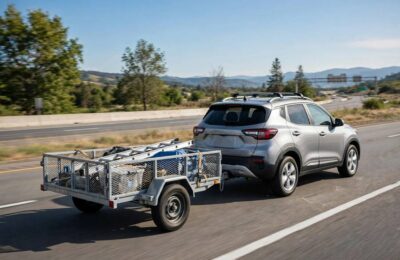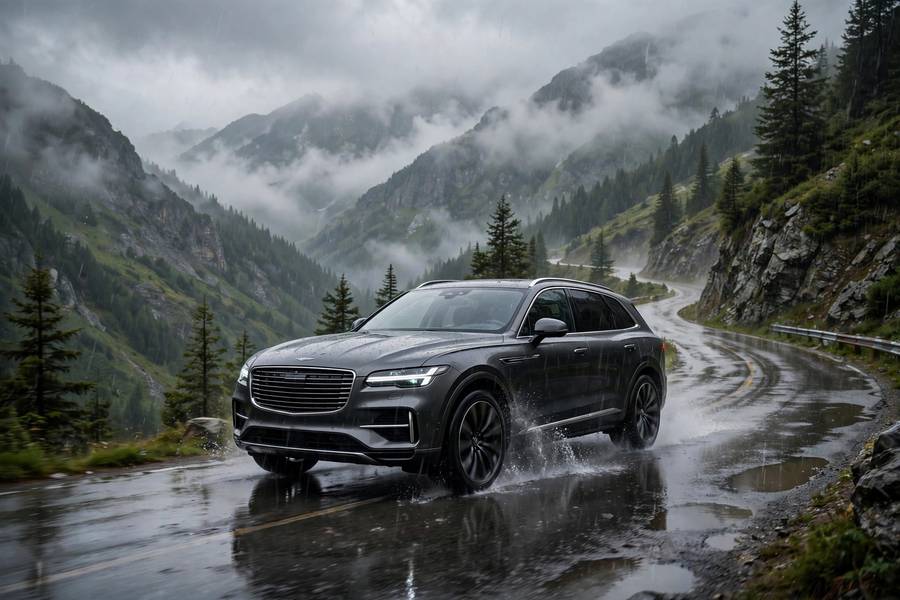
Full-time 4WD is the drivetrain for people who want 4WD capability without ever thinking about it — the system that’s always working, never needs a mode decision, and still gives you a low range and a locking differential when things get serious. It’s the bridge between AWD convenience and 4WD toughness, and it’s rarer than it should be. Most buyers have never driven one, which is a shame, because for the right driver it’s the best of both worlds. Here’s how it works, how it differs from its cousins, and whether you’re the right driver. The family tree is mapped in my AWD vs 4WD guide.
Table of Contents
- The Simple Definition
- The Center Differential: How It Works
- Normal Driving: What the System Does All Day
- Locked Mode: When Things Get Serious
- Low Range: The 4WD Heritage
- Full-Time 4WD vs Part-Time 4WD
- Full-Time 4WD vs AWD
- Who Should Buy Full-Time 4WD?
- Frequently Asked Questions
The Simple Definition
Full-time 4WD is a four-wheel-drive system that powers all four wheels continuously — on every surface, in every condition — using a center differential to allow the front and rear axles to rotate at different speeds. Unlike part-time 4WD, there’s no 2WD mode and no requirement for slippery surfaces. Unlike typical AWD, it includes a lockable center differential and usually a low-range gear for serious off-road work.
The easiest way to think about it: full-time 4WD is what you get when you take part-time 4WD’s toughness and add AWD’s brains. You get the always-on traction and pavement safety of an all-wheel-drive system, plus the low range and locking capability that define real four-wheel drive. It’s the system that never asks you to choose — until the extremes, when it hands you the lock and the low range and says “your call.”
The Center Differential: How It Works
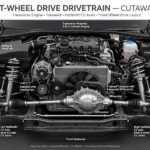
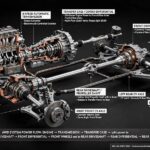
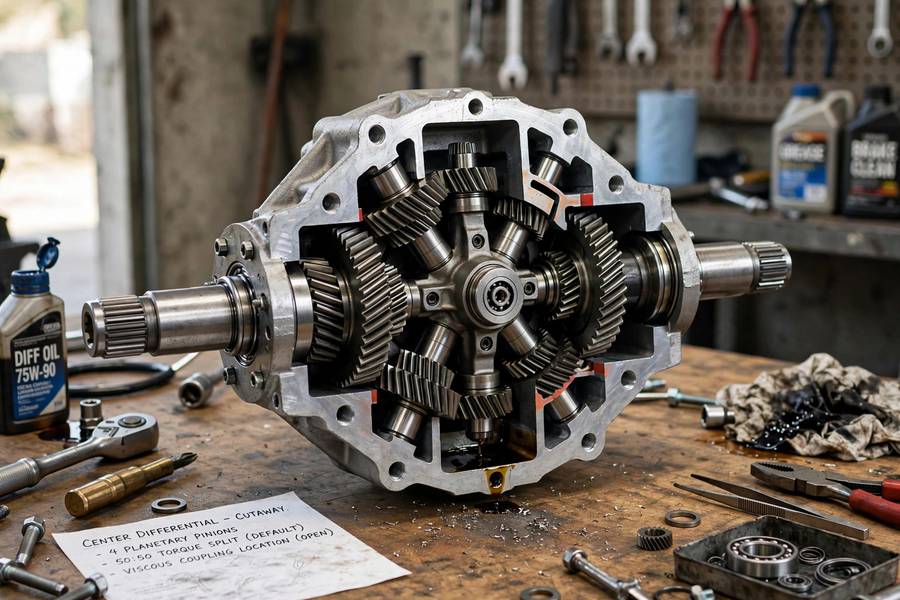
The center differential is the component that makes full-time operation possible. It sits in the transfer case (or in a dedicated housing) between the front and rear outputs, and it does exactly what an axle differential does for left and right wheels: it allows speed differences while transmitting torque. When you corner, the front axle needs to rotate faster than the rear — the center diff permits this smoothly, with no binding, no stress, no driver intervention.
Most full-time systems use one of three center-diff designs. The Torsen (torque-sensing) mechanical differential uses worm gears to bias torque toward the axle with more grip — elegant, purely mechanical, no electronics required. Planetary gearset diffs split torque at a fixed ratio (commonly 40/60 front/rear) and rely on traction control to manage slip. Electronically controlled clutch-pack center diffs vary the split actively based on sensor input, like an oversized version of on-demand AWD.
Each has a personality. Torsen units feel mechanical and predictable — a favorite of enthusiasts. Clutch-pack centers feel smarter but add electronic complexity. All of them do the same fundamental job: keep all four wheels driven, all the time, without fighting the pavement.
Normal Driving: What the System Does All Day
In daily driving, full-time 4WD is beautifully boring — which is the point. You start the car, you drive. The center differential distributes torque continuously: typically with a rear bias (40/60 or 30/70) for balanced handling, shifting power forward or backward as traction demands. Rain starts? The system is already working. Gravel driveway? Already working. Surprise ice patch? Already working — no dial to turn, no lever to pull, no moment of “should I engage something?”
This always-on readiness is the system’s killer feature for winter climates and mixed-surface commutes. The traction is simply there, the way power steering is there — you notice it only in its absence. And because the center diff allows axle speed differences, dry pavement, parking lots, and tight turns are all completely safe. There’s no binding, no hopping, none of part-time 4WD’s pavement anxiety.
The cost of this serenity is constant drivetrain operation: you’re always spinning the full system, which means the 1-3 mpg penalty of AWD-class efficiency and continuous wear on front drivetrain components. Serenity isn’t free, but for many drivers it’s cheap at the price.
Locked Mode: When Things Get Serious
When the center differential is unlocked, it’s a compromise device — it allows speed differences, which means it can also allow a spinning axle to waste power (just like an open axle differential). On a truly slippery surface with one axle on ice, an unlocked center diff will send power to the spinning axle. That’s when you lock it.
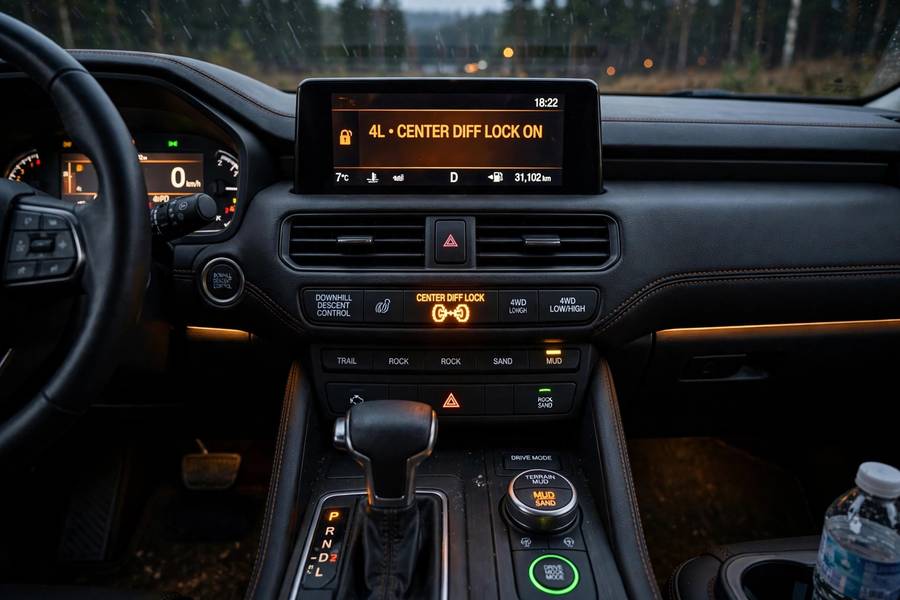
Engaging the center diff lock (button, dial, or lever depending on the vehicle) mechanically couples the front and rear outputs together — and now the system behaves exactly like part-time 4WD: locked 50/50 split, both axles turning at the same speed, maximum traction. Use it for deep snow, mud, sand, serious off-road — the same situations where you’d engage part-time 4H. And observe the same restriction: disengage the lock on dry pavement, because a locked center diff binds just like a part-time transfer case.
The lock is the system’s honest moment: it admits that sometimes the clever differential needs to get out of the way and let brute mechanical lock do the job. I respect a system that knows its own limits.
Locked full-time 4WD acts a lot like old-school AWD when things get rough — what all-wheel drive is covers that system’s take on the same idea.
Low Range: The 4WD Heritage
What separates full-time 4WD from AWD — and what justifies the “4WD” in the name — is the low range. Most full-time 4WD transfer cases include reduction gearing (typically 2.5:1 to 3:1) selectable via the same control that manages the center diff lock. Engage low range and you get the same torque multiplication and crawling capability as part-time 4L: walking-pace speeds with enormous pulling force, ferocious engine braking on descents.
This is the capability that AWD systems simply don’t offer, and it’s what makes full-time 4WD a genuine off-road tool rather than just a weather system. Rock crawling, steep grades, deep mud, pulling a stuck vehicle — the full repertoire is available. Combined with the center diff lock, a full-time 4WD vehicle in low range with the center locked is mechanically equivalent to a part-time truck in 4L. Same lock, same gearing, same capability.
The engagement procedure mirrors part-time systems: stopped, transmission in neutral, foot on brake, then select low range. And the same prohibition applies: never low range on dry pavement. Multiplied torque plus locked axles plus grippy surface is the recipe for broken hardware regardless of which 4WD flavor you bought.
Full-Time 4WD vs Part-Time 4WD
The practical differences come down to convenience versus simplicity. Full-time 4WD: always on, no mode decisions, pavement-safe, slightly more complex, slightly thirstier, slightly costlier to maintain. Part-time 4WD: driver-managed, must remember to engage/disengage, mechanically simpler, more efficient in 2WD, cheaper to maintain.
Off-road capability at the extremes is essentially equal — both give you locked axles and low range when it counts. The difference is everything before the extremes: the full-time driver just drives, while the part-time driver manages. On a mixed-surface day — pavement to gravel to mud to pavement — the full-time system is pure convenience. On a dedicated off-road trip, the part-time system’s simplicity is its own virtue: fewer components, fewer failure modes, easier field repairs.
Reliability-wise, both are excellent when maintained. The full-time system’s center differential is one more component to service, and its constant operation means steadier wear. The part-time system’s weakness is human: the disuse that seizes actuators and the forgetfulness that binds drivetrains. Pick your failure mode.
Full-Time 4WD vs AWD
This is the subtler comparison, because the two feel similar in daily driving — both always on, both automatic, both pavement-safe. The differences are in the extremes and the hardware. Full-time 4WD brings low range and a mechanically lockable center differential: genuine crawling capability and a true locked mode. AWD brings lighter weight, better fuel economy, and usually more sophisticated on-road torque vectoring.
Think of it as a spectrum of intent. AWD is optimized for the road with off-pavement ability as a bonus. Full-time 4WD is optimized for everywhere with on-road manners as a requirement. The Land Cruiser runs full-time 4WD because it’s expected to cross continents; the typical crossover runs AWD because it’s expected to cross town in the rain.
Maintenance overlaps heavily — both need center-diff fluid changes and matched tires — but full-time 4WD’s low range and lockable center add service items AWD doesn’t have. And purchase price reflects the hardware: full-time 4WD lives in more expensive, more capable vehicles. You’re paying for the extremes whether you use them or not.
Who Should Buy Full-Time 4WD?
You’re the right buyer if: you face real winter or mixed surfaces daily and want traction without thought; you tow or haul in variable conditions; you go genuinely off-road but also daily-drive the same vehicle; you want one vehicle that does everything without compromise. The classic full-time 4WD owner lives somewhere with actual seasons, drives a mix of pavement and unpavement, and uses the capability regularly enough to justify it.
You’re the wrong buyer if: you never leave pavement (AWD gives you the same daily experience for less money); you’re chasing maximum fuel economy; you’re on a tight maintenance budget; your off-roading is serious enough to want the simplest possible hardware (part-time 4WD). And be honest about the price premium: full-time 4WD vehicles cost more upfront, and the capability you’re buying is only worth it if the extremes are in your life.
My shop verdict: full-time 4WD is the most complete drivetrain you can buy — the one I’d recommend to the driver who wants to stop thinking about drivetrains entirely. Just maintain the center diff, keep the tires matched, and exercise the lock and low range occasionally. It’ll take care of the rest.
Frequently Asked Questions
Full-time 4WD powers all four wheels continuously through a center differential that allows front and rear axles to rotate at different speeds — so it’s safe on dry pavement. It adds a lockable center differential and usually a low-range gear for serious off-road traction when conditions demand it.
Part-time 4WD locks the axles together with no center differential, so it can only be used on slippery surfaces and requires driver mode selection. Full-time 4WD is always on and pavement-safe thanks to its center differential; you only engage the lock and low range for extreme conditions.
They’re similar in daily driving — both always-on and automatic. The difference: full-time 4WD includes a low-range gear and mechanically lockable center differential for genuine off-road crawling, while AWD is lighter, more efficient, and optimized for on-road behavior without low range.
Yes — that’s its defining advantage over part-time 4WD. The center differential absorbs the axle speed differences created in turns, so there’s no binding. Only the locked center-diff mode and low range are restricted to slippery surfaces.
Yes. Change the center differential fluid every 30,000-60,000 miles per your owner’s manual, keep all four tires matched in size and wear, and exercise the diff lock and low range periodically on loose surfaces so the actuators don’t seize from disuse.