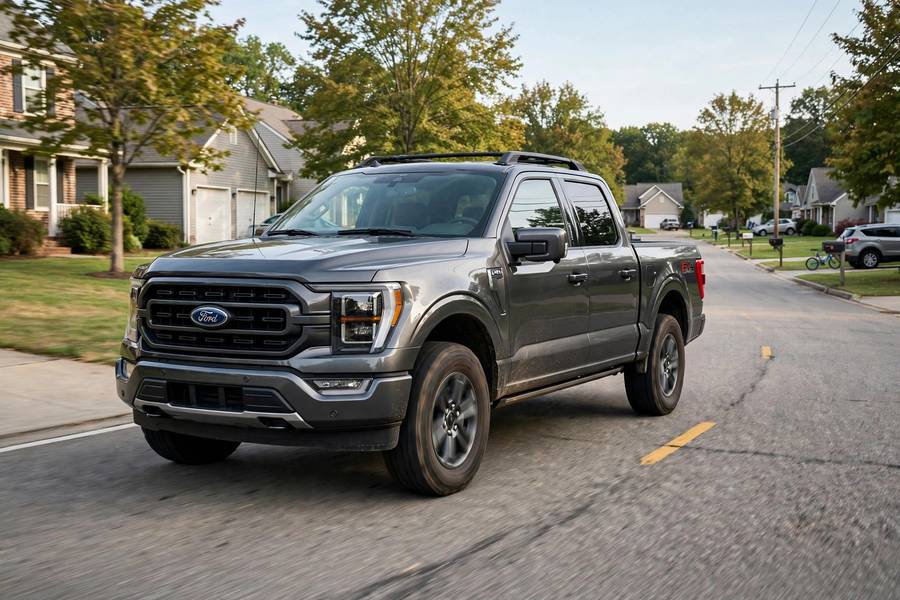
Short version for the impatient: no. If your truck has part-time 4WD, driving it on dry pavement in 4WD is slowly — or sometimes quickly — destroying your drivetrain. I have rebuilt the transfer cases to prove it, and the repair bills have made grown men quiet. But “no” deserves an explanation, because understanding why will save you thousands, and because there are legitimate exceptions. Here’s the full story, including what binding actually is, what breaks, and what to do if you’ve already done it. The broader context lives in my AWD vs 4WD guide.
Table of Contents
- The Short Answer
- What Is Drivetrain Binding?
- Why Part-Time 4WD Binds on Pavement
- What Actually Breaks (and What It Costs)
- The Exceptions: Full-Time 4WD and AWD
- Warning Signs You’re in 4WD on Dry Roads
- How to Unwind a Bound-Up Drivetrain
- Myths That Refuse to Die
- Frequently Asked Questions
The Short Answer
No — do not use part-time 4WD on dry pavement. The locked transfer case forces your front and rear axles to rotate at the same speed, but in turns the front wheels need to travel farther than the rears. On slippery surfaces the tires slip a little and absorb the difference harmlessly. On dry pavement they grip, the difference has nowhere to go, and the resulting stress — called driveline bind or wind-up — loads up your U-joints, axle shafts, and transfer case until something breaks.
How fast does damage happen? It varies. A straight highway run in 4WD on dry pavement might do no immediate harm, because straight-line driving creates almost no speed difference between axles. But the first tight turn — a parking lot, an intersection — loads everything up at once. I’ve seen a single dry-pavement parking maneuver crack a transfer case housing. Distance matters less than turning.
What Is Drivetrain Binding?
Picture this: you’re making a U-turn. Your front wheels trace a wider arc than your rear wheels — they literally travel more distance. They also need to rotate faster to cover that distance in the same time. In a normal 2WD car, no problem: the undriven wheels just roll at whatever speed the road demands, and the differential allows left-right differences.
Now lock the front and rear driveshafts together, as part-time 4WD does. The transfer case insists both axles rotate at identical speeds. But the road insists the front axle rotate faster in the turn. Something has to give. On mud, snow, or gravel, the tires give — they slip microscopically against the loose surface, releasing the tension continuously. Engineers call the surface “forgiving.”
Dry asphalt is unforgiving. The tires grip, the tension can’t release, and it accumulates in the steel between the tires and the transfer case. The driveshafts twist slightly, the U-joints load up, the transfer case chain stretches against its sprockets. That stored energy is driveline wind-up, and it’s the reason your truck starts hopping and bucking in tight dry turns — the tires are being forced to skip across the pavement to release tension they can’t release by slipping.
Why Part-Time 4WD Binds on Pavement
The binding is a direct consequence of the system’s greatest strength: the mechanical lock. Part-time 4WD has no center differential — no device that allows the front and rear outputs to rotate at different speeds. That absence is what makes the system so brutally effective in mud (power can’t escape to a spinning axle), and it’s what makes it destructive on pavement (speed differences can’t be absorbed).
Every turn creates the conflict. Even gentle highway curves create small speed differences; they’re just small enough that tire flex and minor slip absorb them. Tight turns at low speed — parking lots, driveways, intersections — create large differences, and that’s where the damage happens. This is why the classic sign is a truck that drives fine on the highway in 4WD but bucks and hops the moment you turn into a parking space.
Note that 4WD Low makes everything worse: the torque multiplication that makes low range so capable off-road also multiplies the binding forces. Engaging 4WD Low on pavement isn’t just wrong, it’s the fastest way I know to break a transfer case without hitting anything.
What Actually Breaks (and What It Costs)
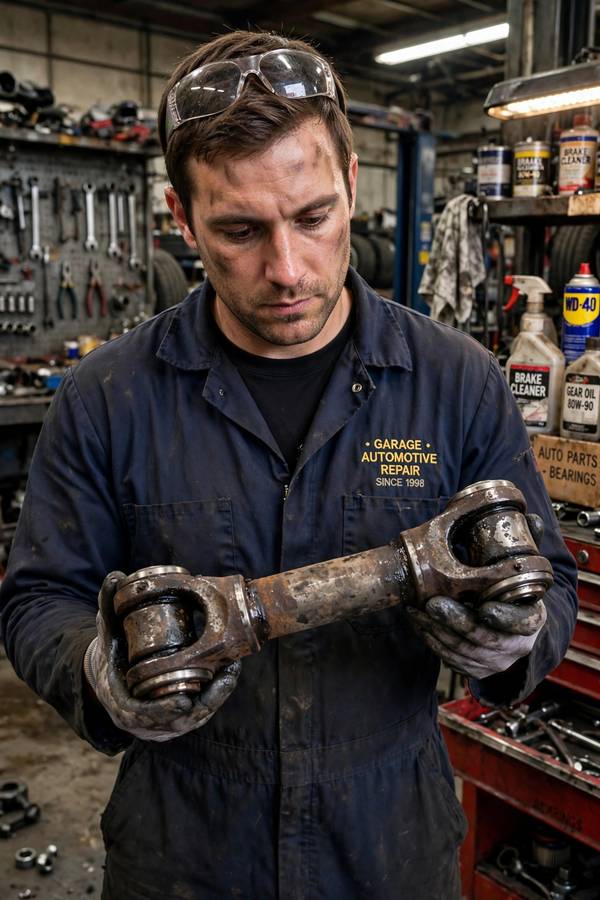
Let me walk the failure chain in the order I usually see it. First to complain are the U-joints — the flex couplings at each end of the driveshafts. They take the twisting load directly, and a worn U-joint under binding stress will fail with a bang. Replacement: $200 to $400 per joint, and most trucks have four to six of them.
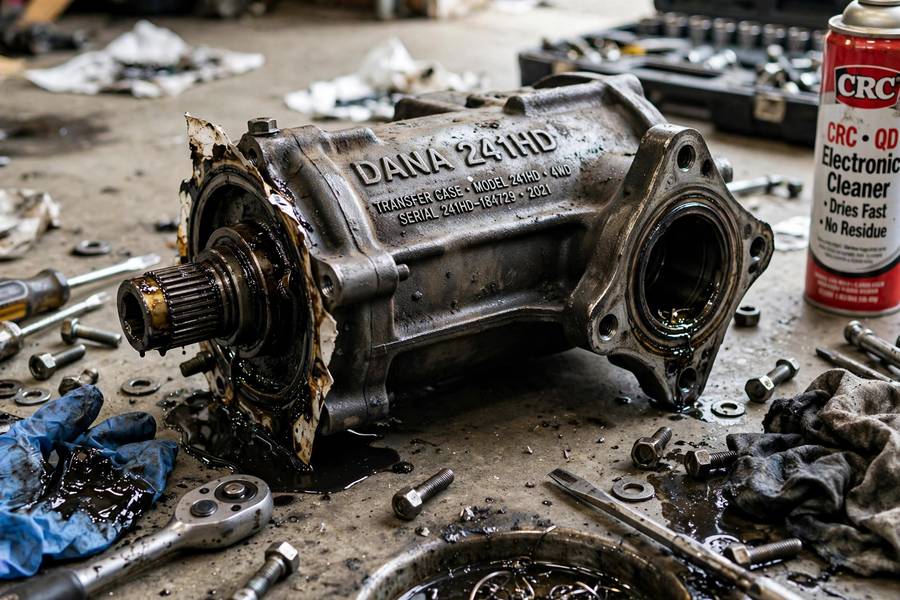
Next is the transfer case itself. The chain (in chain-drive cases) stretches and starts skipping teeth on the sprockets — you’ll hear a loud popping or banging under load. The fix is a rebuild: $1,500 to $2,500 at most shops, more for heavy-duty cases. In severe cases the case housing cracks from the internal forces, and then you’re buying a remanufactured unit at $2,500 to $4,000 plus labor.
Axle shafts and CV joints can snap under extreme bind, especially if the driver keeps forcing the truck through the resistance instead of stopping. Front CV axles run $300 to $600 each replaced. And the tires themselves suffer — forced skipping across dry asphalt scrubs rubber fast and can flat-spot a tire in one bad session.
The punchline I give every customer: the most expensive part of forgetting to disengage 4WD is never the part. It’s the tow, the rental car, and the week without your truck.
The Exceptions: Full-Time 4WD and AWD
Not every “4WD” system has this problem. Full-time 4WD systems include a center differential that allows front and rear axles to rotate at different speeds on pavement — they only lock the center diff when you ask for maximum traction. Vehicles like the Land Cruiser run this setup, and you can drive them on dry pavement in their normal full-time mode indefinitely. The lock is a separate selection you engage only for slippery going.
AWD systems are also exempt by design. Whether full-time or on-demand, every AWD system allows axle speed differences — that’s the fundamental mechanical distinction from part-time 4WD. You can drive an AWD vehicle on dry pavement forever; it’s literally what the system was built for.
The tricky middle ground is automatic 4WD (often labeled 4WD Auto). These systems run in 2WD until slip is detected, then engage the front axle via clutch pack — similar to on-demand AWD. They’re generally safe on pavement because the engagement is slip-triggered and the clutch pack allows some speed difference. But they’re still not designed for continuous locked operation on dry roads; if your truck has both 4WD Auto and 4WD High, use Auto for mixed conditions and save High for consistently slippery surfaces.
Full-time systems behave more like car-based AWD on pavement — what all-wheel drive is explains why they don’t bind.
Warning Signs You’re in 4WD on Dry Roads
Maybe you engaged 4WD in this morning’s snow and the roads are dry now. Here’s how to tell before damage happens. The classic sign: resistance and hopping in tight turns. The truck feels like it’s fighting you in parking lots, the steering feels heavy, and you might hear tires chirping or feel a bucking sensation. That’s binding, happening right now.
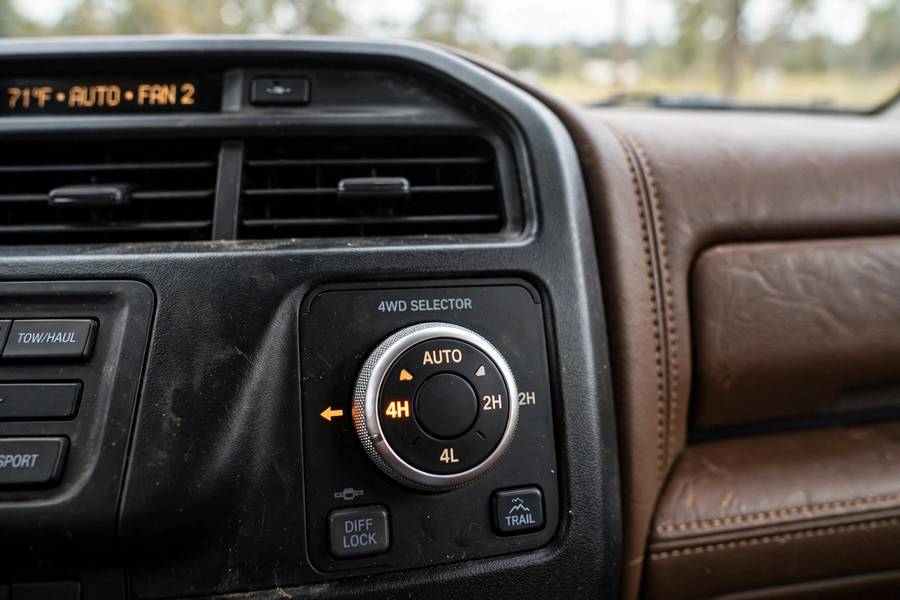
Other signs: a whining or humming from underneath that wasn’t there before, difficulty shifting the transfer case lever or dial (bound-up gears resist disengagement), and the 4WD indicator light still on — check it every time you drive. I tell owners to make the dash light part of their scan: if that light’s on and the road is dry, disengage immediately.
If the truck won’t come out of 4WD — the lever won’t budge or the dial just blinks — don’t force it. Forcing a bound transfer case out of gear can break the shift fork. Stop somewhere safe and follow the unwind procedure below.
How to Unwind a Bound-Up Drivetrain
If you’ve been driving in 4WD on dry pavement and the drivetrain is bound up, here’s the fix. Find a straight, flat stretch — a parking lot lane or quiet street. Shift the transfer case to 2WD (or 4WD Auto). Then drive straight, or reverse straight, for 20 to 30 feet. Driving straight removes the speed difference between axles, letting the stored tension release through the tires harmlessly. You’ll sometimes feel a soft clunk as it unwinds — that’s normal, that’s the bind releasing.
If the transfer case won’t shift out of 4WD while bound, try this: stop, shift the transmission to neutral, then try the transfer case shift again. Still stuck? Drive slowly in a straight line for a bit in 4WD, then try shifting to 2WD while rolling straight at low speed — some electronic systems engage the shift motor more willingly when rolling. As a last resort before forcing anything, reverse in a straight line for 30 feet or so; reversing often unloads the gears enough to allow the shift.
Once it’s out, drive in 2WD and listen. Any new clunking, popping, or vibration that wasn’t there before deserves a shop visit. Binding stresses components even when nothing visibly breaks, and a U-joint weakened today can fail on the highway next month. A quick inspection is cheap protection.
Myths That Refuse to Die
“It’s fine on the highway because you’re going straight.” Mostly true for gentle curves, but highway exits, lane changes, and any real turning still create speed differences. And the bigger risk is forgetting — highway miles in 4WD lull you into leaving it engaged, and then the parking lot at your destination does the damage. Just disengage.
“4WD Low gives you more control on icy roads.” No — 4WD Low is for crawling, not cruising. The torque multiplication makes wheelspin more likely on ice, not less, and the speed limit is around 25 mph. On icy roads you want 4WD High, gentle inputs, and good tires.
“Modern trucks are smart enough to prevent damage.” Modern trucks are smart enough to warn you, not to save you from yourself. Some will flash warnings or refuse certain shifts, but no system can repeal the physics of a locked drivetrain on grippy pavement. The computer can suggest; only you can disengage.
“A little binding won’t hurt anything.” A little binding once probably won’t. But binding is cumulative stress on components with finite fatigue lives, and “a little” has a way of becoming “every winter for five years.” The transfer cases I rebuild didn’t fail from one incident — they failed from habits.
Frequently Asked Questions
No. Part-time 4WD locks the front and rear axles together, and on dry pavement the tires can’t slip to absorb the speed differences created in turns. This causes driveline binding that stresses and can break U-joints, axle shafts, and the transfer case — repairs run $200 to $4,000.
You’ll feel binding: resistance, hopping, or tire chirping in turns. Stop somewhere safe, shift to 2WD, and drive or reverse straight for 20-30 feet to let the drivetrain unwind. Then listen for new clunks or vibrations — binding stresses components even when nothing visibly breaks.
Wet pavement still offers high traction, so part-time 4WD can bind there too — just less severely than on dry asphalt. For rainy roads, full-time AWD or 4WD Auto mode is the right choice. Save locked 4WD High for consistently slippery surfaces like snow, mud, or gravel.
Yes. Full-time 4WD systems have a center differential that allows the front and rear axles to turn at different speeds, so there’s no binding on pavement. Only engage the center diff lock on slippery surfaces. AWD vehicles are likewise safe on dry pavement by design.
Check the 4WD indicator light on your dash — make it part of your regular scan. Physical signs include heavy steering, hopping or bucking in tight turns, tire chirping in parking lots, and unusual humming from underneath. If you feel binding, disengage 4WD immediately.